
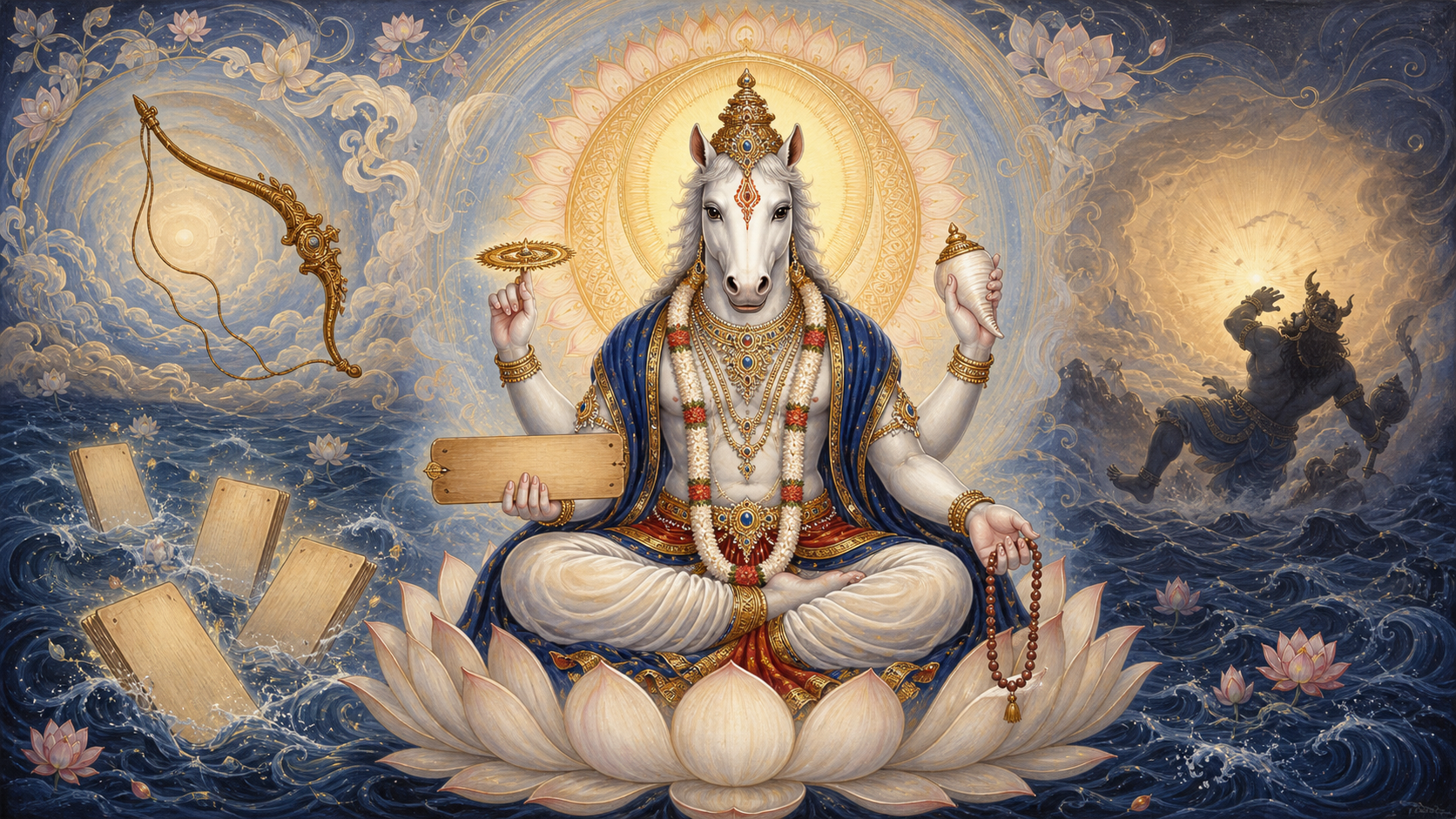
If you have heard that Vishnu became Hayagriva after losing his head, only to encounter another telling in which Hayagriva retrieves the Vedas or defeats an asura, you may wonder which version is authentic. You do not have to discard one account to make room for the other.
The useful move is to separate three questions: How does the horse-headed form appear? What does Hayagriva do once manifested? What does that form mean for a devotee? Different Purāṇic strands answer different questions, and confusion begins when we force them into a single modern plot.
Why Hayagriva appears to have more than one origin
The word origin can conceal several distinct concerns. You may be asking about Hayagriva’s physical appearance, his identity as a form of Vishnu, his connection with the Vedas, or the asura who bears a similar name. Each concern belongs to a different layer of the tradition.
- Narrative origin: Vishnu is decapitated when a bowstring snaps, and a horse’s head is attached to restore him.
- Divine identity: Hayagriva is the horse-headed form of Vishnu, not merely a new being assembled after an accident.
- Cosmic function: Hayagriva protects or retrieves the Vedas, overcomes forces of ignorance, and restores dharma.
- Devotional meaning: The form represents knowledge, disciplined speech, mantra, vigilance, and the recovery of sacred order.
The first layer explains the transformation. The second identifies the deity. The third explains the mission. The fourth tells you why the narrative continues to matter in practice. A version devoted to the recovery of the Vedas does not have to repeat the decapitation scene before it can speak meaningfully about Hayagriva.
Related motifs are associated with the Padma Purāṇa and Skanda Purāṇa traditions, but a general Purāṇic attribution is not the same thing as a precise passage citation. When a speaker names a Purāṇa without a book, chapter, verse, or identifiable episode, treat the name as a direction for further reading rather than proof that every detail comes from one continuous passage.
The decapitation story is a chain of duty and consequence
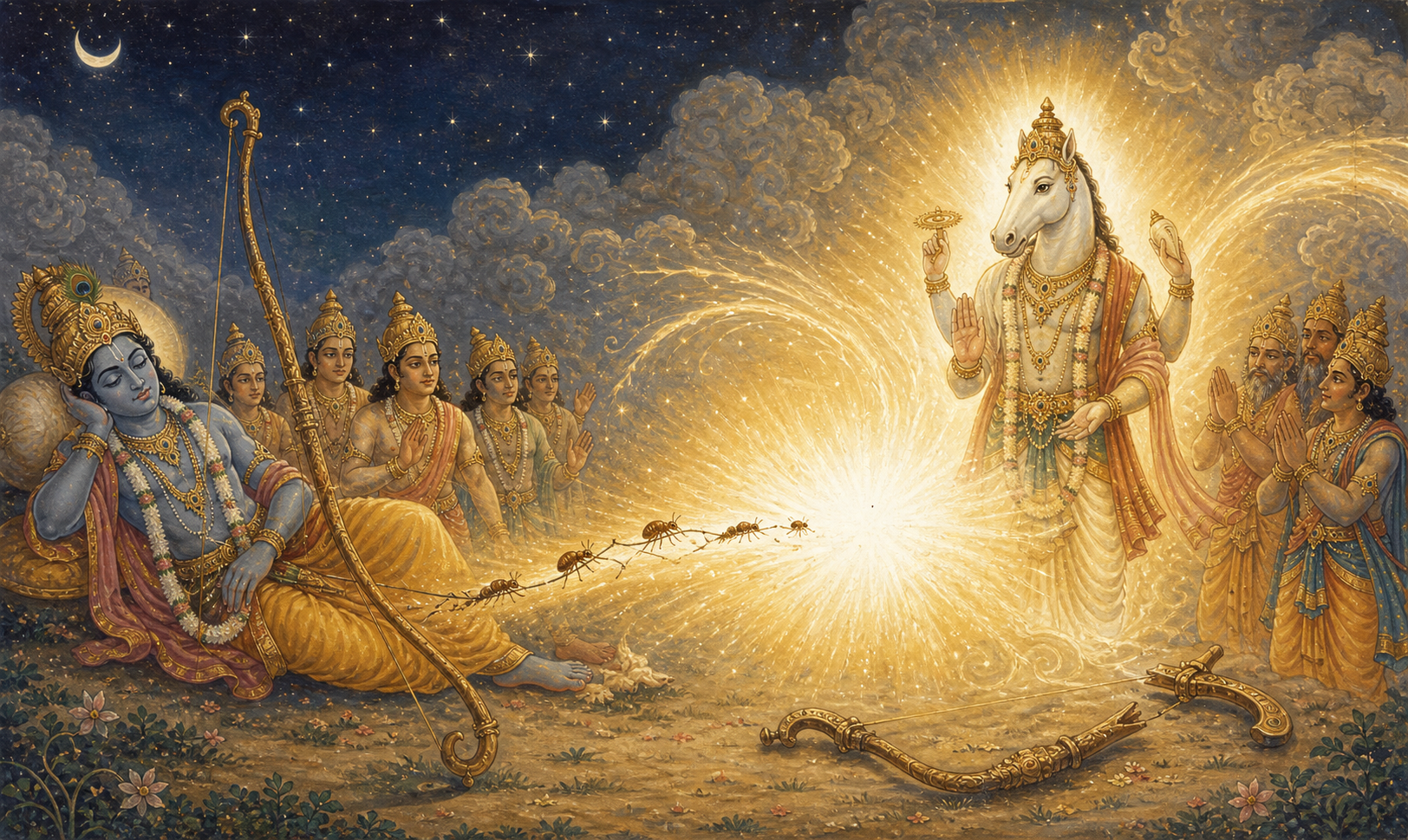
The familiar decapitation sequence is easiest to understand when you preserve its order. Every step changes the meaning of the next one.
- Brahma’s sacrificial rite requires Vishnu’s active presence. The yajna cannot proceed as intended while the preserver remains unavailable.
- Vishnu rests in a condition often described as cosmic sleep, with his head supported by a taut bow.
- The devas need to awaken him, but they seek a means that will not create a violent disturbance.
- Brahma brings forth termites, or white ants, whose small and silent action appears suited to the task.
- The termites gnaw through the bowstring. Its release produces enough force to sever Vishnu’s head.
- A sacred restoration follows. A horse’s head is affixed to Vishnu, and the horse-headed Hayagriva form emerges.
- Vishnu’s restored presence allows the sacrificial current and cosmic duty to continue.
This sequence is not simply an explanation for an unusual icon. Cosmic duty creates the need to act; a subtle intervention produces an unforeseen rupture; sacrifice then transforms that rupture into a renewed order. Hayagriva stands at the point where loss becomes restoration.
That structure also prevents two shallow readings. The termites are not villains whose wickedness defeats Vishnu, and the decapitation is not a final divine failure. Within the narrative, the termites are minute instruments in a much larger causal movement, while the severed head marks a transition from one condition to another. The crisis makes the horse-headed manifestation possible.
Notice, too, that the devas’ intention and the result of their intervention are not identical. They want to awaken Vishnu; their chosen means produces a catastrophe. That gap gives the episode its ethical force. A necessary aim does not make every consequence predictable, and a small action does not remain small merely because its agent is small.
What actually changes across the Purāṇic strands
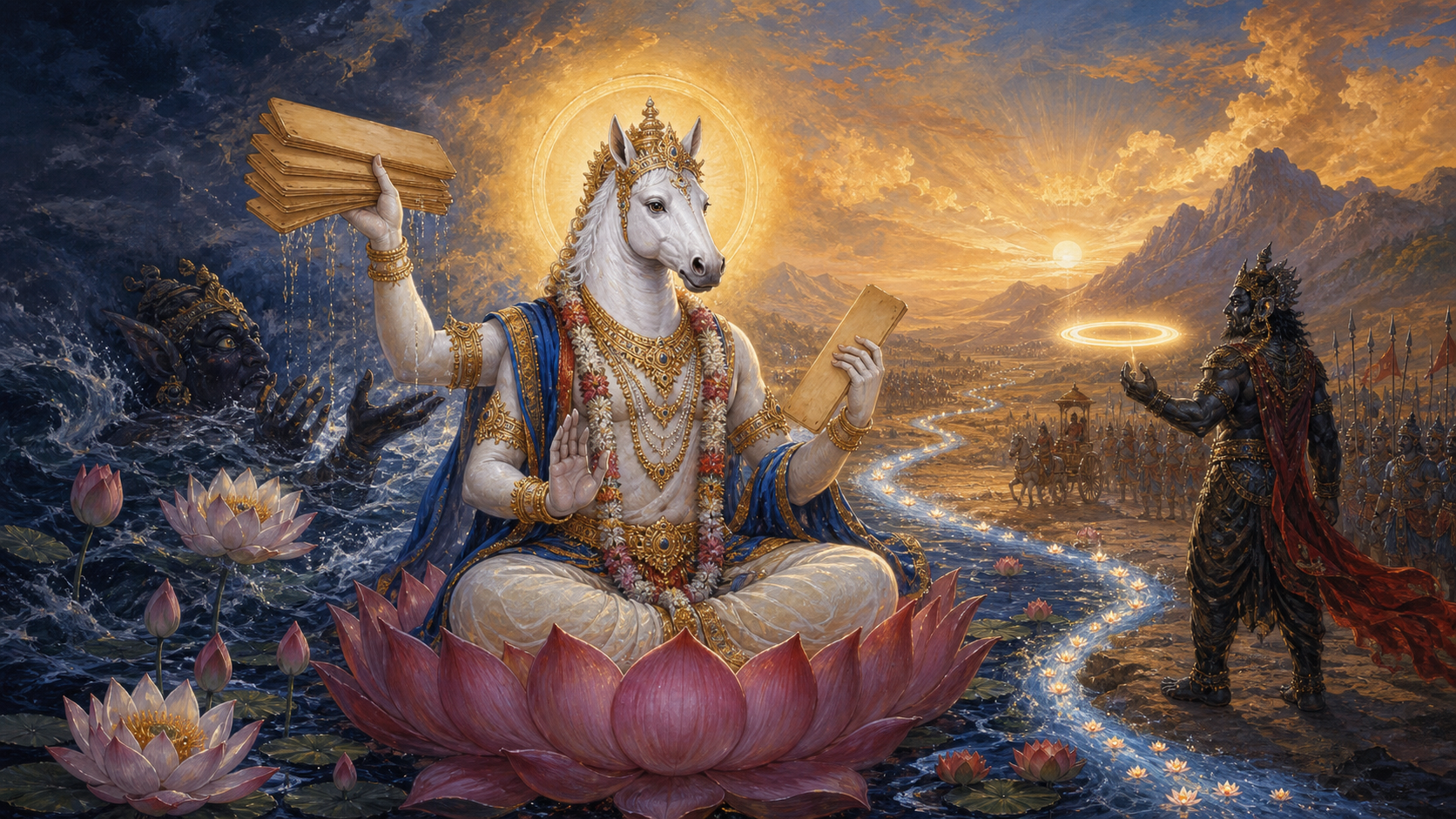
Do not compare retellings only by checking whether they contain the same scenes. Compare the question each one is trying to answer. The following map keeps the main emphases distinct without pretending that every telling fits neatly into one column.
| Question | Decapitation and restoration strand | Veda and knowledge strand | What you should notice |
|---|---|---|---|
| How does the horse-headed form appear? | Vishnu is beheaded by the snapping bow and restored with a horse’s head. | Hayagriva may enter the narrative primarily as an already manifest form of luminous wisdom. | One strand narrates the transformation; another begins with the completed divine identity. |
| What threatens cosmic order? | Vishnu’s absence interrupts the sacrificial work that requires his presence. | The Vedas or sacred knowledge must be protected or retrieved from forces of ignorance. | The danger shifts from interrupted yajna to obscured knowledge. |
| Who or what is called Hayagriva? | The name identifies Vishnu in his horse-headed form. | A divine Hayagriva may confront an asura bearing the same or a similar name. | Check the referent before assuming that every Hayagriva is the same character. |
| What is restored? | The sacrifice, cosmic balance, and Vishnu’s active participation. | The Vedas, wisdom, and dharma. | Restoration is more stable across the tradition than the exact mechanism of the crisis. |
| What is the dominant teaching? | Small causes, unintended consequences, sacrificial transformation, and renewal. | Vigilance, sacred learning, and victory over ignorance. | The emphases differ, but both make Hayagriva an agent of recovered order. |
The name is the most important practical checkpoint. If Hayagriva is acting as Vishnu, the horse-headed figure protects knowledge and restores dharma. If an asura of similar name is being subdued, the name marks the antagonist. Failing to identify which one is present can turn a meaningful variation into an apparent contradiction.
You should also resist assembling every available motif into one supposedly complete chronology. The bow, the termites, Brahma’s yajna, the horse-headed restoration, the recovery of the Vedas, and the defeat of an asura can illuminate one another without belonging to one uninterrupted narrative in every Purāṇic setting. Preserve the seams when the tradition preserves them.
The symbols explain why this form belongs to knowledge
Termites make the subtle visible
The termites represent the potency of the subtle, or sūkṣma. Their action is nearly invisible, but the tension stored in the bow magnifies its result. The decisive force is not the size of the termites; it is the relationship among a weakened string, a taut bow, and the position of Vishnu’s head.
For your own practice, the lesson is more exact than a generic warning that small things matter. Look for small actions connected to accumulated tension: the recitation repeatedly postponed, the careless phrase that becomes habitual, the neglected doubt in your understanding, or the daily discipline quietly maintained. Repetition joins the small act to the large outcome.
The horse’s head joins breath, speech, and mantra
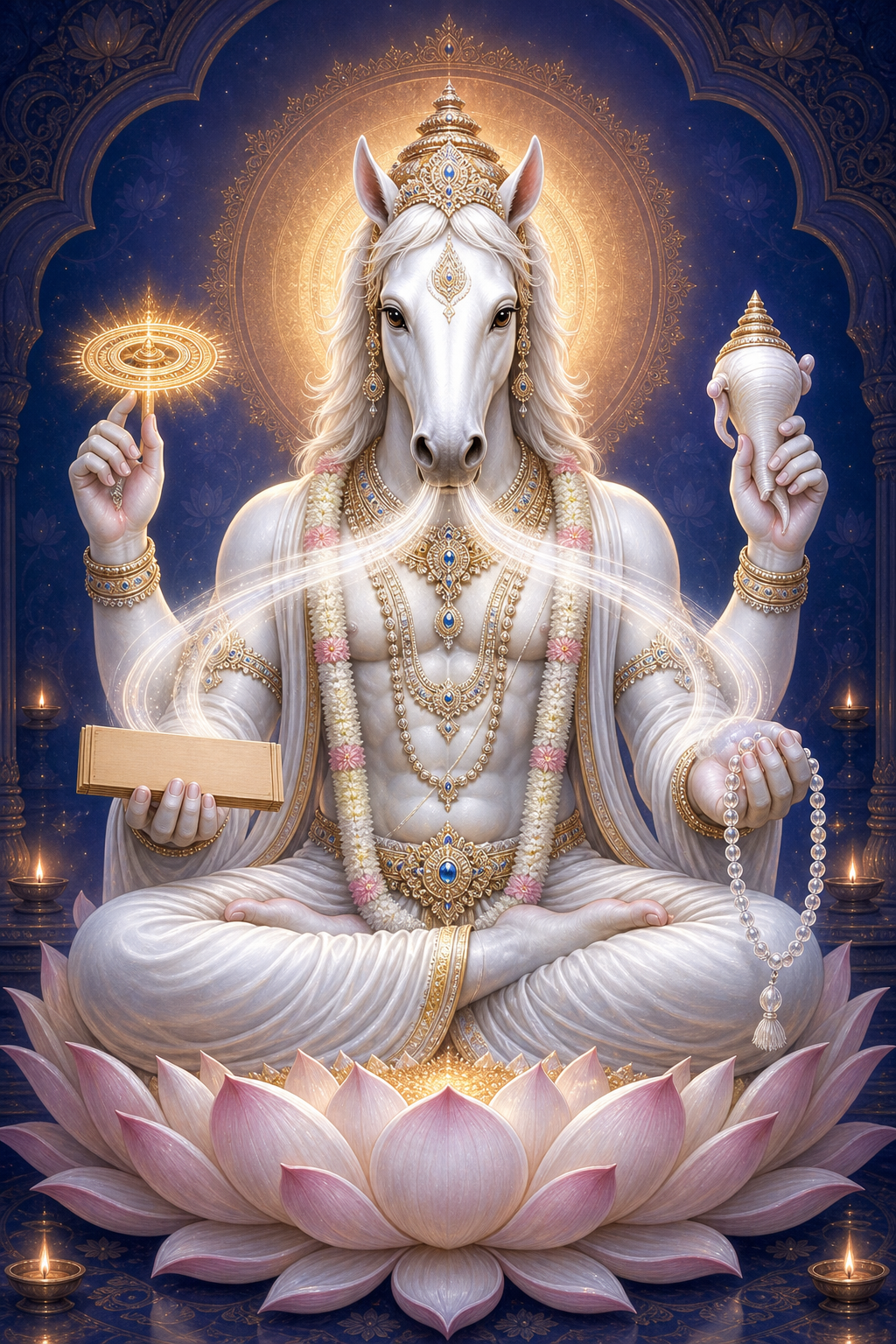
The horse-headed form evokes prāṇa, articulated speech, and the measured cadence of mantra. This makes Hayagriva’s association with the Vedas more than an assignment to guard a collection of sacred knowledge. Vedic wisdom is voiced, remembered, transmitted, and embodied through disciplined sound.
If you approach Hayagriva as a deity of learning, do not reduce vidyā to the accumulation of information. Attend to how knowledge is spoken and carried. Clear pronunciation, truthful speech, sustained study, careful memory, and restraint in argument all belong to the ethical protection of knowledge.
Yajna turns rupture into restored alignment
The sacrifice is not incidental scenery. It creates the original need for Vishnu’s presence and supplies the ritual setting in which restoration becomes possible. Yajna therefore connects the apparent catastrophe to a larger order: loss is not celebrated for its own sake but transmuted into renewed alignment with ṛta and dharma.
This distinction matters when you teach the episode. A thin moral would say that a mistake caused punishment. A more faithful reading follows the complete movement: duty required action, limited action produced rupture, and sacrificial intelligence restored order in a transformed form. The result is not a return to the exact condition that existed before. Vishnu returns as Hayagriva, carrying a sharpened association with wisdom and sacred speech.
Other Dharmic traditions can recognize resonances here without being made into copies of the same Purāṇic narrative. Buddhist mindful attention addresses subtle tendencies before they mature into harmful action. Jain ahiṃsā heightens awareness of even minute forms of life. Sikh simran and seva discipline remembrance, speech, and action toward truth. These are ethical parallels, not claims that all four traditions share an identical Hayagriva account.
Key takeaways for reading any Hayagriva account
- Ask what kind of origin is being explained: the appearance of the horse’s head, Hayagriva’s identity as Vishnu, his mission, or his devotional significance.
- Keep the decapitation sequence intact: yajna, cosmic sleep, bow, termites, severing, horse-headed restoration, and the resumption of divine duty.
- Treat the Veda-protecting and demon-subduing material as a functional strand centered on knowledge, vigilance, and the restoration of dharma.
- Check whether the name Hayagriva refers to Vishnu’s divine form or to an asura of the same or a similar name.
- Distinguish a precise textual citation from a general Purāṇic attribution. Devotional value does not require pretending that every retelling is a verbatim passage.
- Look for the invariant beneath the variation: endangered order is recovered through wisdom, vigilance, and transformation.
The next time you hear a Hayagriva narrative, write down four things: the cause of the crisis, the means of transformation, the task Hayagriva performs, and the form of order that is restored. That small discipline will usually reveal whether you are facing a contradiction or two complementary layers of meaning.
Then carry the reading into one concrete act. Protect knowledge by studying carefully, speaking truthfully, preserving a teaching, or correcting a neglected discipline before it reaches the breaking point. Hayagriva’s origin becomes most intelligible when vigilance over wisdom becomes part of your own dharma.
References
