
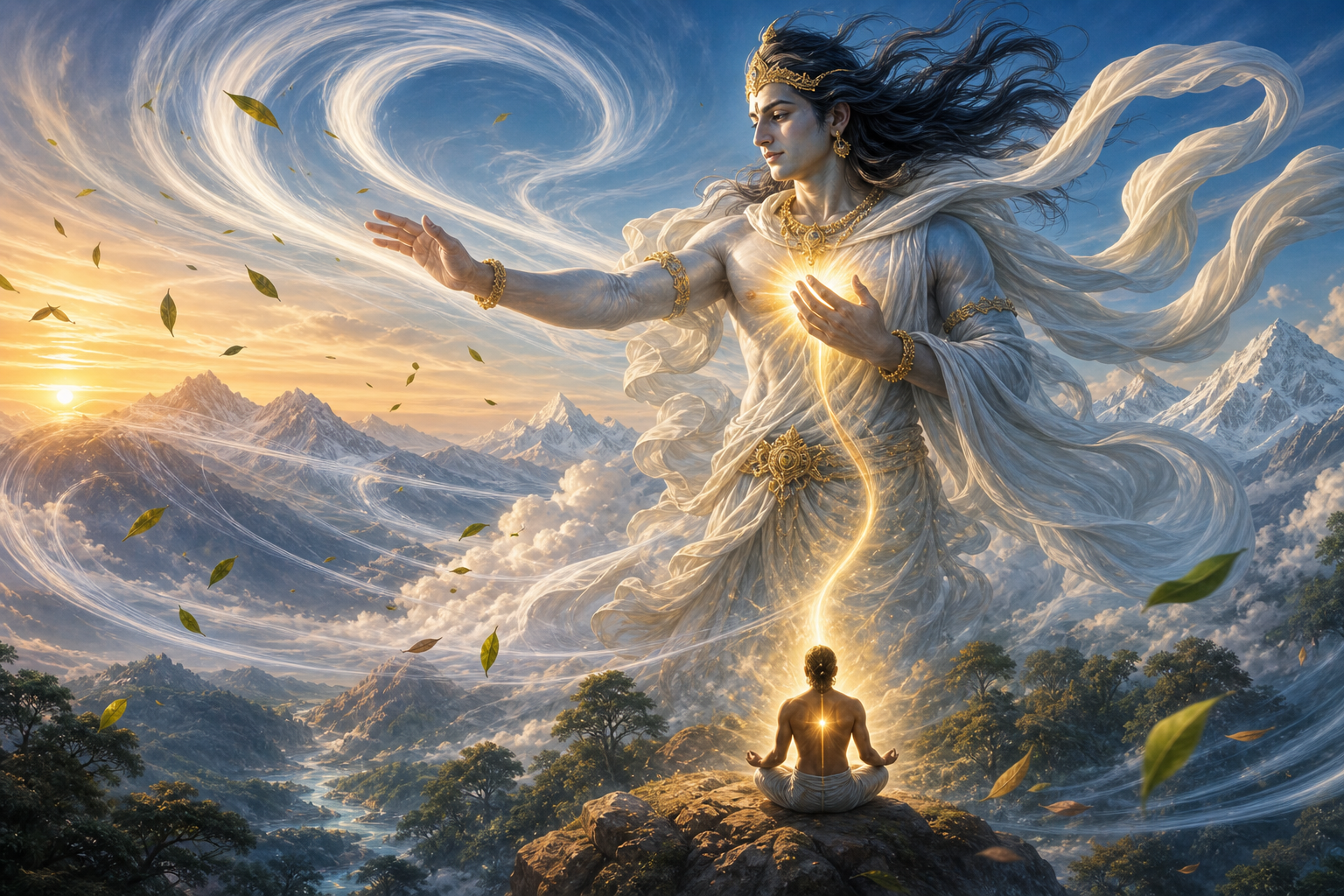
If Vayu Bhagavan seems like a distant god of the weather, the missing link is prana. The wind outside and the living current within are not interchangeable, but they reveal the same truth: life depends on movement, and movement needs direction.
This matters when your mind is scattered, your courage is failing, or your energy has become restless. Vayu’s legacy gives you a practical question for such moments: will the power moving through you serve Dharma, or will it merely serve impulse?
Why Vayu cannot be reduced to the wind

Calling Vayu the wind god is a useful beginning, but it is not a complete understanding. Wind cannot be held in the hand, yet its presence becomes obvious through what it moves. Vayu likewise signifies movement, vitality, freedom, and the power that sets life into action. His domain reaches from the atmosphere to the subtle life-force associated with body, mind, and consciousness.
Prana should not be treated as a decorative synonym for oxygen or ordinary breathing. Breath is one of the clearest ways you experience dependence on a force you do not manufacture. You can influence breathing, but you do not create the principle of life that makes breathing meaningful. Prana names that enlivening current; Vayu gives it divine personality, cosmic scale, and devotional significance.
This protects you from two opposite mistakes. If you reduce Vayu to meteorology, you lose the inward and spiritual dimension. If you reduce him to a psychological metaphor, you lose the reality of the Deva and the possibility of devotion. Hindu thought can hold both dimensions together: Vayu is worshipped as a divine being, and his presence also helps you recognize how sacred power operates within embodied life.
His place in sacred genealogy reinforces that theological status. Vayu is presented as a son of Rishi Kashyapa and Aditi, placing him within the lineage of the Devas rather than leaving him as an impersonal natural phenomenon.
You can apply this distinction immediately. When you feel energetic, do not ask only how much energy you possess. Notice its direction. Is it scattered among impulses, trapped by fear, or ordered toward a worthy duty? Vayu represents movement, but Dharma determines where that movement should go.
Hanuman and Bhima reveal the moral tests of strength

Vayu’s legacy becomes easier to understand through Hanuman and Bhima. Both possess extraordinary strength, but neither teaches that strength is self-justifying. Their power becomes meaningful because it is disciplined by relationship, duty, and devotion.
- Hanuman, revered as Vayuputra, joins courage to humility and unwavering service to Lord Rama. His strength does not demand attention for itself; it becomes an instrument of devotion.
- Bhima, born after Kunti invokes Vayu, joins physical power to discipline and righteous valor. Under Lord Krishna’s guidance, his force is placed within the demands of Dharma.
These two lives disclose complementary expressions of Vayu’s potency. Hanuman corrects the belief that humility means weakness. Bhima corrects the belief that spirituality requires passivity. One shows strength kneeling in devotion; the other shows strength standing firm in a righteous struggle.
That distinction is useful when you face a difficult decision. Ask which failure is more likely in the present moment. Are you hesitating because fear has disguised itself as gentleness? Bhima’s disciplined resolve may be the needed corrective. Are you pushing because pride has disguised itself as courage? Hanuman’s humility and service may be the needed corrective.
The standard is not whether you feel forceful or calm. The standard is whether your capacity has become answerable to something higher than preference. Strength aligned with Dharma protects, serves, persists, and accepts discipline. Strength severed from Dharma becomes appetite with greater reach.
A shared reverence for breath does not erase distinct paths

The legacy of prana also opens a meaningful conversation among Dharmic traditions. Hindu, Buddhist, Jain, and Sikh paths do not need to use identical doctrines for breath to matter within each of them. Their points of contact are strongest when we acknowledge both kinship and difference.
- In Hindu Yoga, pranayama works with breath and prana as part of a disciplined movement toward greater steadiness and integration.
- In Buddhist meditation, breathing can become an immediate field of attention through which agitation, distraction, and awareness are observed.
- Within Jain practice, regard for life-breath belongs within a demanding framework of ethical discipline rather than a search for power.
- In Sikh simran, remembrance of the Divine brings attention back from mental dispersion and places life within devotion.
The common ground is a recognition that life-breath, attention, ethical formation, and spiritual practice are deeply connected. The differences still matter. Pranayama, Buddhist meditation, Jain discipline, and Sikh simran should not be collapsed into one generic wellness routine.
If you belong to one of these traditions, let its own teachings determine your method, vocabulary, and spiritual aim. The shared significance of breath can help you understand a Dharmic relative; it should not become an excuse to strip every path of its theology and discipline. Unity is stronger when it can accommodate distinction.
This also corrects a common modern misreading. Breath is not valuable merely because it can make you feel better. It exposes your condition with unusual immediacy. A hurried breath may alert you to agitation; an unforced, steadier breath may create room for clearer attention. But breathing does not make an ethical choice on your behalf. You still have to direct the resulting clarity toward compassion, truth, restraint, courage, or service.
Turn remembrance of Vayu into a daily discipline

You do not need to invent an elaborate ritual to begin honoring Vayu’s legacy. Start with a small sequence that connects breath to remembrance and remembrance to conduct.
- Let the breath remain natural. Sit or stand without deliberately forcing, lengthening, or holding it. Your first task is attention, not control.
- Name the movement of the mind. Notice whether you are hurried, dull, afraid, angry, or clear. Treat the breath as a signal of your present condition, not as a verdict on your spiritual worth.
- Remember the form of strength you need. Bring Hanuman to mind when ego, distraction, or reluctance to serve is dominant. Bring Bhima to mind when fear, passivity, or lack of resolve is preventing rightful action.
- Identify the next duty. Do not leave the reflection at the level of mood. Name the honest reply, difficult task, act of restraint, courageous conversation, or service that the situation actually requires.
- Act while the intention is clear. Vayu is movement. Complete one concrete Dharmic action before attention disperses again.
Reflective reading can deepen this discipline. When you read the Ramayana, watch how Hanuman’s fearlessness remains inseparable from devotion to Lord Rama. When you read the Mahabharata, watch how Bhima’s force operates amid duty, conflict, discipline, and Lord Krishna’s guidance. Do not read only to admire their abilities. Ask what governs those abilities.
Recitation associated with Hanuman, mindful attention to breathing, and remembrance of Vayu can all support this practice. Keep the order clear: attention, remembrance, discernment, action. Otherwise, spiritual energy can become another form of self-absorption.
This simple contemplation is not a substitute for instruction in intensive pranayama. Forceful breathing and prolonged breath retention should not be improvised from a general devotional reflection. If any breathing practice produces dizziness, pain, panic, or unusual shortness of breath, stop. Persistent or unexplained breathing difficulty needs appropriate medical attention, not a spiritual explanation that dismisses the body.
Key takeaways
- Vayu Bhagavan is not merely a personification of weather. He is a Deva whose domain reveals the sacred power of movement, vitality, and prana.
- Prana is not identical to ordinary air. Breath gives you an immediate way to attend to the enlivening current that sustains embodied life.
- Hanuman shows strength governed by humility, devotion, and service. Bhima shows strength governed by discipline, courage, and righteous duty.
- Hindu, Buddhist, Jain, and Sikh traditions can share a reverence for life-breath without being reduced to one interchangeable doctrine.
- A grounded Vayu practice links an unforced breath to honest self-observation, divine remembrance, a Dharmic choice, and concrete action.
The next time you feel scattered or powerless, do not begin by demanding a stronger feeling. Let one natural breath show you your present state. Then choose Hanuman’s devoted service or Bhima’s disciplined courage and place that virtue into your next duty. In that movement from breath to Dharma, Vayu’s legacy remains alive.
References
