
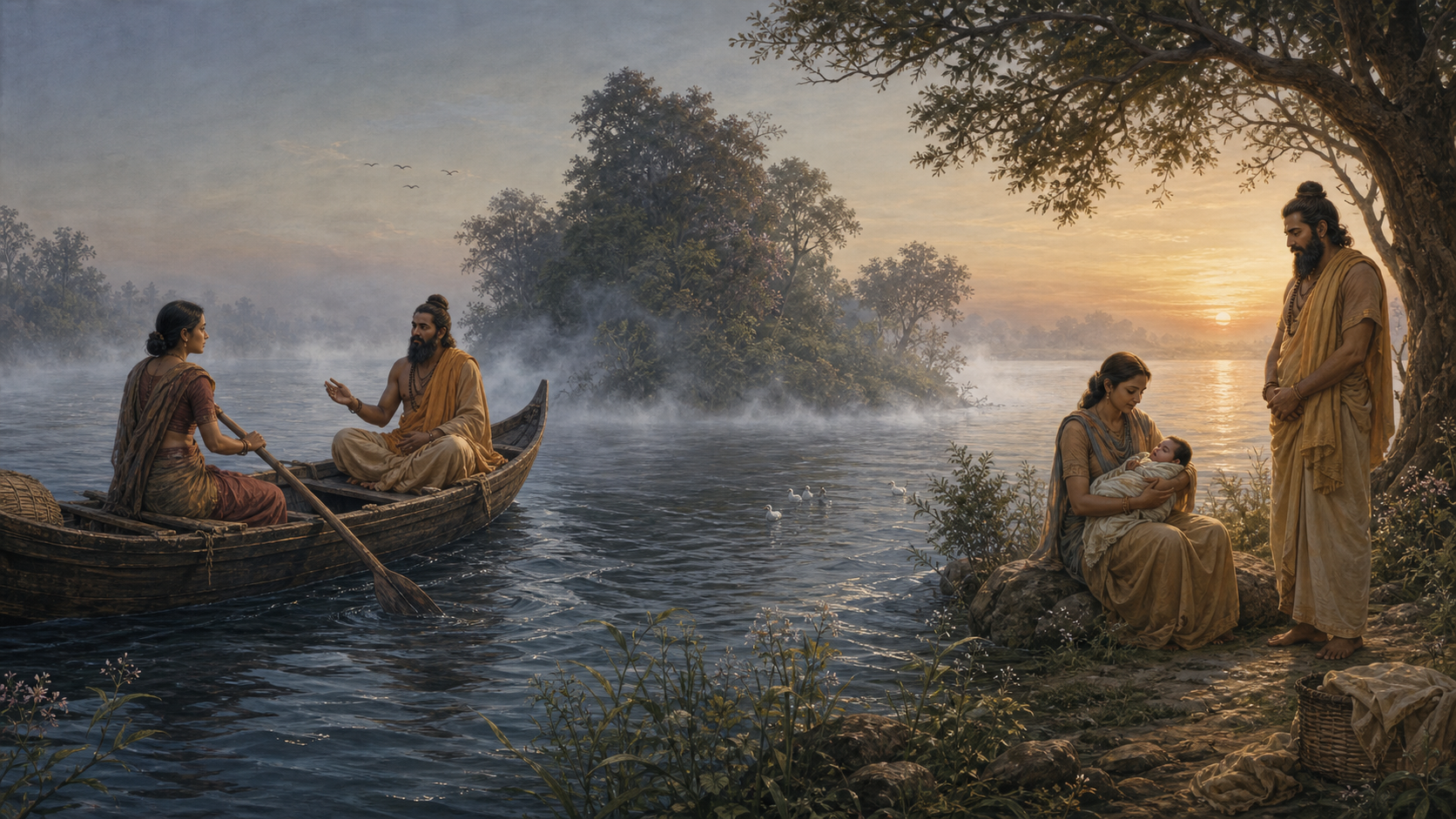
If you came to this episode wondering whether it is merely a troubling story about a sage overcome by desire, don’t stop at the encounter itself. Its moral structure lies in Matsyagandhi’s objections, the conditions established before the union, and the extraordinary responsibility associated with the child who is born.
You can read the narrative seriously without either sanitizing its tensions or forcing it into a single modern category. Keep three layers visible at once: what happens, what Matsyagandhi requires, and why Vyasa’s birth matters. Remove any one of them, and the story becomes flatter than the dharmic reflection it invites.
Begin with the sequence, not an isolated moment
The order of events matters because Matsyagandhi does not silently disappear into Parashara’s intention. She speaks before the union, identifies its possible consequences, and receives answers directed toward those consequences.
- Matsyagandhi is the daughter of a ferryman and conducts boats across the Yamuna.
- Rishi Parashara meets her while travelling. Their meeting is placed within a larger destiny connected to dharma and the welfare of the world.
- When desire enters the encounter, Matsyagandhi raises concerns about her honor, reputation, and future social standing.
- Parashara envelops the river setting in mist, creating privacy and protecting the encounter from public observation and rumor.
- He grants boons that answer her concerns: fragrance in place of the stigma associated with Matsyagandhi, restoration of maidenhood, and the preservation of a dignified future.
- Their child is born on an island in the river. His dark complexion gives him the name Krishna, while his island birth gives him the name Dvaipayana.
- Matsyagandhi later becomes known as Satyavati, marries King Shantanu, and becomes deeply involved in the future of the Kuru lineage.
Traditional accounts vary in some details while retaining this central structure: Parashara’s discernment, Matsyagandhi’s expressed concerns, the protected union, and Vyasa’s consequential birth. When you encounter a retelling, establish that stable sequence before drawing conclusions from an ornamental detail that may belong to only one version.
This also corrects a common reading error. The mist and boons are not miscellaneous miracles placed around the main event. They are responses to matters Matsyagandhi has raised. Her speech changes what follows, which makes it part of the ethical action rather than a pause before it.
Matsyagandhi’s conditions are the moral hinge
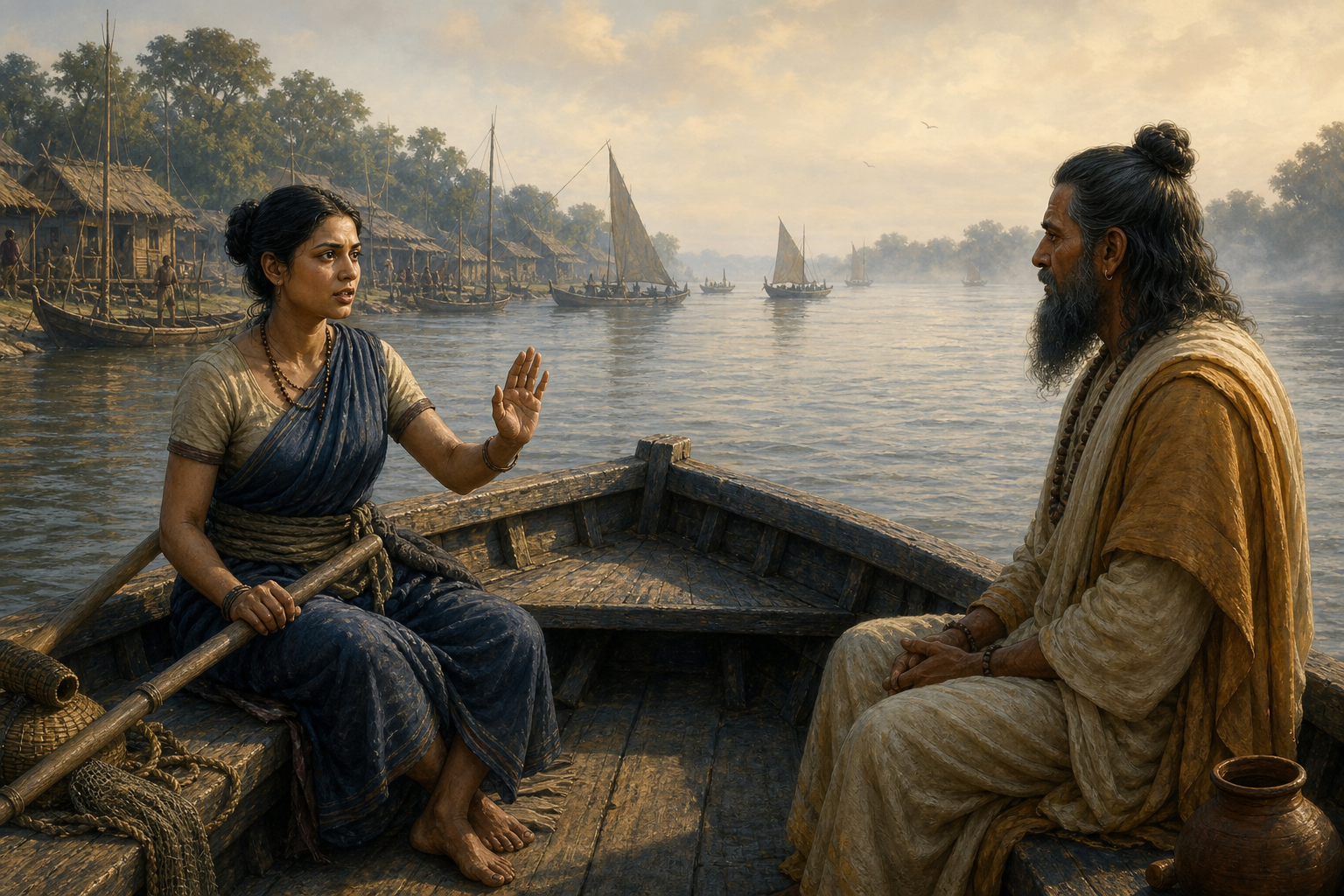
Matsyagandhi understands that the consequences of the encounter will not fall evenly. Parashara possesses the standing of a sage; she anticipates the damage that exposure could bring to her own name and future. The narrative does not require you to pretend that this difference is absent. It asks you to notice how she responds to it.
Her agency is real, but it should be described precisely. Agency does not mean that every available choice is free of pressure, social expectation, or unequal consequences. It means that she voices the risks as she understands them, places conditions on what may occur, and receives specific assurances. That is more faithful than depicting her as either a voiceless instrument of destiny or a completely unconstrained modern individual.
- The mist addresses immediate exposure. Privacy protects her from observers and the rumor that could follow them.
- The fragrance addresses an existing stigma. The identity signified by Matsyagandhi is transformed into an enduring mark of dignity.
- The restoration of maidenhood addresses her future. Within the logic of the sacred narrative, the union is not permitted to close the social possibilities that still lie before her.
The boons therefore have an ethical function as well as a miraculous form. Each corresponds to a cost she fears she may have to bear. Whatever view you take of the story’s metaphysics, the narrative purpose is clear: Parashara cannot treat his desire as sufficient reason to disregard her future.
You can use four questions to test any interpretation of this episode:
- Does the interpretation allow Matsyagandhi’s own concerns to remain audible?
- Does it explain why privacy and the boons appear before the union?
- Does it recognize that the anticipated social costs fall especially upon her?
- Does it preserve her continuing life as Satyavati, rather than reducing her to the mother of a famous son?
If a retelling cannot answer those questions, it has probably kept the sensational surface and discarded the story’s ethical architecture.
Kama is acknowledged, then placed under dharma
The purusharthas give this episode its most useful philosophical setting. Hindu thought recognizes four broad human aims: dharma, the order of right responsibility; artha, material security and flourishing; kama, desire and enjoyment; and moksha, liberation. Kama belongs within human life, but it is not entitled to govern the other aims.
Parashara’s sagehood does not make him incapable of desire. Nor does spiritual stature turn every desire into a command that others must obey. The encounter becomes dharmically intelligible through the restraints placed around it: Matsyagandhi voices her conditions, her dignity is protected, consequences are considered, and the union is connected to a purpose beyond immediate gratification.
This distinction guards against two opposite mistakes. One is to treat desire itself as proof of spiritual failure. The other is to assume that a great outcome automatically sanctifies whatever produced it. Vyasa’s future greatness is important, but it is not a blank cheque. The moral weight of the episode also comes from assent, responsibility, protection, and the refusal to leave Matsyagandhi alone with the aftermath.
If you want to apply this dharmic lens to your own choices, don’t begin by asking whether a desire is strong or whether its imagined result sounds noble. Ask instead:
- Have you named the desire honestly, without disguising personal appetite as duty?
- Has the other affected person been able to state conditions before action occurs?
- Are the promised protections concrete, or do they merely ask the more vulnerable person to trust the more powerful one?
- Have you considered who will carry the social, emotional, and practical consequences afterward?
- Can the choice coexist with your existing responsibilities, or does it require someone else to absorb the cost?
That is a demanding view of kama. It neither condemns human feeling nor crowns feeling as sovereign. Desire must become answerable to dharma before it can participate in a larger good.
The discipline has recognizable echoes across the wider Dharmic family. Buddhist teaching directs longing through the Middle Way; Jain ethics emphasizes intention and self-mastery; Sikh wisdom dignifies the grihastha, or householder, path as an arena of spiritual duty. These traditions are not interchangeable, and the Parashara-Matsyagandhi narrative belongs to the Hindu sacred world. The shared insight is narrower and more useful: human emotion gains ethical direction through discernment, restraint, and responsibility.
Vyasa’s names reveal why this birth changes history
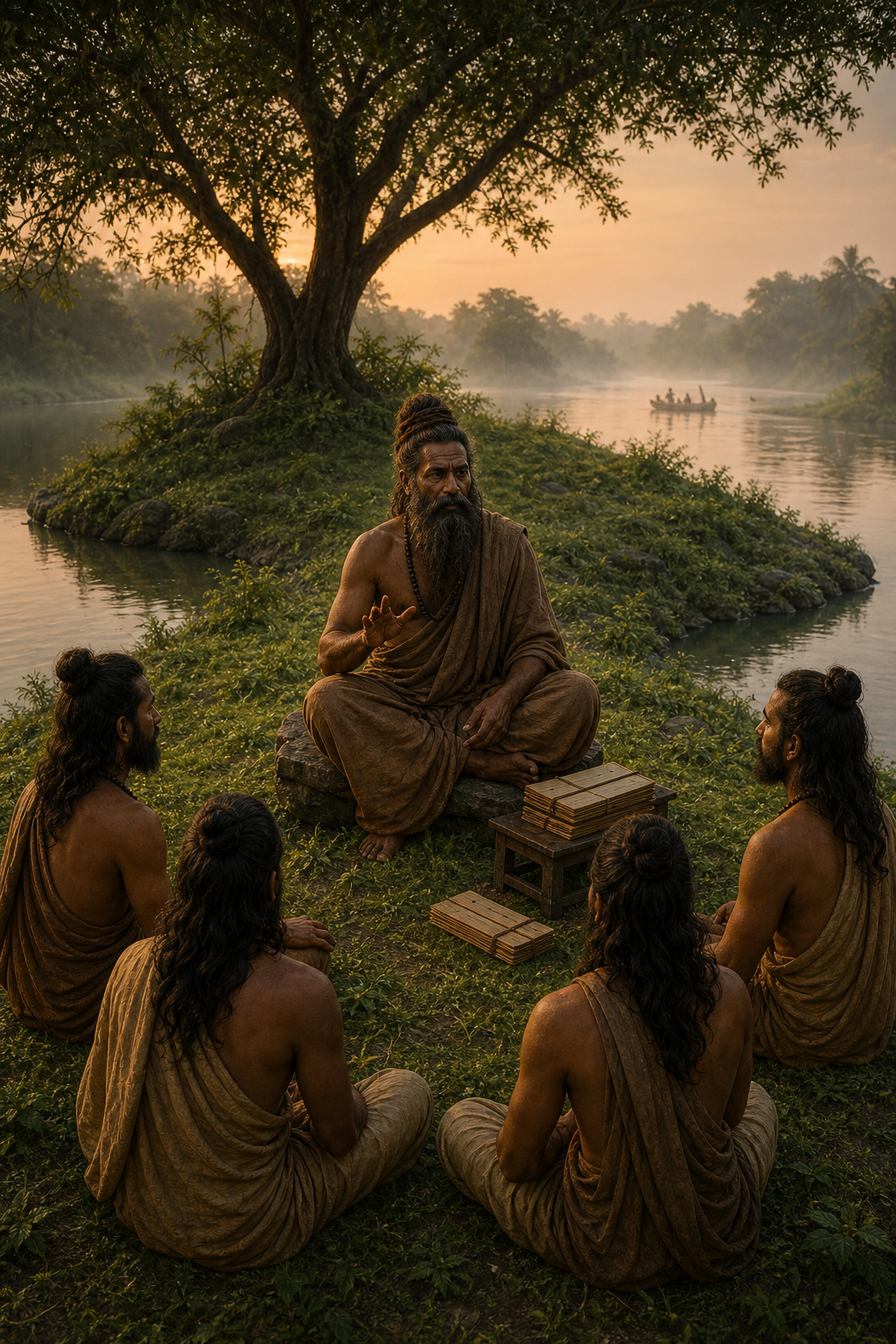
The child’s names prevent his birthplace from becoming incidental. He is Krishna because he is dark-hued and Dvaipayana because he is born on a river island. He becomes renowned as Vyasa through a life associated with the arrangement and transmission of sacred knowledge.
Hindu tradition credits Krishna Dvaipayana Vyasa with compiling and classifying the Vedas, authoring the Mahabharata, and inspiring the Purana tradition. These are not minor accomplishments added to make an unusual birth seem important. They explain why the episode stands near the foundations of the tradition’s remembered intellectual and spiritual history.
His birth also joins social worlds that might otherwise appear separate: the itinerant sage, the ferryman’s family, the river landscape, and eventually the Kuru court. Sacred knowledge does not arrive in this story through a neat genealogy isolated from ordinary society. It appears at a crossing point, both literally and socially.
Matsyagandhi’s later life makes that crossing even more significant. As Satyavati, she marries Shantanu and becomes a mother within the Kuru lineage. Her decision on the river is therefore not the end of her relevance; it precedes a continuing role in the human history from which the Mahabharata unfolds. The woman who negotiates for her dignity in a private encounter later stands within the public destiny of a royal house.
This is why you should not read Vyasa’s birth as a detachable tale of miraculous conception. It is simultaneously a story about the origin of a transmitter of sacred knowledge, the agency of his mother, the humanity of a sage, and the convergence of lives from different social settings. Its scale expands from a boat crossing to the memory of an entire civilization.
Key takeaways for reading the episode well
- Keep the sequence intact. Matsyagandhi raises her concerns before the union, and Parashara’s protections respond to them.
- Treat her agency precisely. She is neither silent nor free from social constraint; her conditions matter because the consequences are unequal.
- Read the boons by their function. Privacy, fragrance, and restored status protect her present dignity and future possibilities.
- Place kama within the purusharthas. Desire is recognized, but dharma requires assent, restraint, foresight, and responsibility.
- Do not use Vyasa’s greatness to erase ethical questions. The outcome matters alongside the manner in which Matsyagandhi’s concerns are answered.
- Follow Matsyagandhi into her later life as Satyavati. Her role in the Kuru lineage shows that she remains a shaper of the epic’s history, not merely the setting for Vyasa’s birth.
The next time you meet an abbreviated version of this story, notice what has been omitted. If Matsyagandhi’s questions, Parashara’s obligations, or Satyavati’s later importance have vanished, return to the full sequence. That is where the episode’s dharmic depth becomes visible – in desire brought under responsibility, dignity protected before action, and a human encounter opened toward the preservation of sacred knowledge.
References
