

You may know what needs to change in your work, family, health, or surroundings, yet some conditions will not move on demand. If peace depends on winning every argument, removing every uncertainty, or securing every desired result, your inner life remains governed by forces you cannot fully control.
The Dharmic answer is not to pretend that circumstances are harmless. It is to separate two questions: What must I change through wise action? and What in me is never reduced to this condition? That distinction gives you room to act firmly without making the outcome the master of your mind.
Freedom does not have to wait for life to cooperate
We commonly use the word freedom for three different things. Keeping them distinct prevents both spiritual confusion and practical neglect.
- External freedom concerns the choices available to you: where you may go, what you may say, what work you may do, and whether another person or institution is constraining you.
- Psychological freedom is the space between an impulse and your response. Anger, fear, praise, or disappointment may arise without automatically dictating your next action.
- Spiritual freedom is recognition that your deepest identity is not exhausted by the body, senses, roles, thoughts, or passing states of mind.
The third does not cancel the first two. If you face harm, exploitation, or injustice, dharma may require boundaries, protection, resistance, or help from others. The teaching of the ever-free Self is not an order to remain in a damaging situation. It prevents the situation from acquiring a second power: the power to define what you are.
The Upanishads and the Bhagavad Gita describe the atman as uncreated, undying, and intrinsically whole. Moksha, from this standpoint, is not a spiritual possession added to an incomplete person. It is the removal of ignorance about what has always been present. The personality may feel calm one day and unsettled the next; the freedom of the Self is not another fluctuating mood.
When you find yourself saying, I need to be free, complete the thought in three ways. What external condition needs action? What reaction needs discipline? What belief about yourself needs examination? The first question calls for practical effort, the second for self-mastery, and the third for spiritual inquiry. You may need all three, but they are not the same task.
Notice where a difficult experience becomes bondage

Painful circumstances are not imaginary, but bondage usually grows when an experience hardens into an identity. A plan fails, and the mind moves from this attempt failed to I am a failure. Fear appears, and fear is present contracts into I am nothing but this fear. Someone rejects an opinion, and the mind treats the disagreement as an attack on its very existence.
To catch that contraction, write four lines whenever a recurring situation disturbs you:
- Fact: State only what happened, without predicting motives or consequences.
- Movement in body and mind: Name the sensations, emotions, images, and urges that followed.
- Identification: Complete the sentence, Because this happened, I am… This line often reveals the imagined bondage.
- Dharma: Name the next truthful, proportionate, and non-harming action available to you.
Suppose someone criticizes your work. The fact is the criticism itself. The movement may be heat in the face, defensive thoughts, or the urge to retaliate. The identification may be, If this criticism stands, my worth is diminished. Dharma may require correcting an error, asking for evidence, setting a boundary, or simply listening. Once the identity claim is visible, you can respond to the actual event instead of defending an imagined self.
Advaita Vedanta and Samkhya-Yoga provide different analyses of this freedom. Advaita directs inquiry toward knowledge of the non-dual Self. Samkhya-Yoga distinguishes purusha, the seer, from prakriti, the changing field of body and mind. Their conclusions should not be carelessly collapsed, but both give you a practical opening: distinguish what is observed from the awareness to which it appears.
A thought can be noticed. A mood can be noticed. Even the statement I am trapped can be noticed. Anything noticed is an object within awareness and cannot, by itself, exhaust the identity of the knower. This is not a reason to suppress emotion. Let the sensation be felt and the thought be heard. Your task is to stop granting either one absolute authority.
Choose the yoga that meets your actual obstacle

The Bhagavad Gita brings action, devotion, knowledge, and contemplative discipline into one spiritual life. You do not need to collect techniques indiscriminately. Identify the form your bondage usually takes, then choose a lead practice that addresses it directly.
Karma Yoga when you are trapped by results
Use Karma Yoga when your mind bargains constantly with outcomes: I will act only if I can control the result, or I will be at peace only if I receive recognition. Before beginning a duty, identify what is yours to do and whom the action should serve. While acting, give the work your full attention. Afterward, examine the quality of your conduct and release the demand that the result prove your worth.
Non-attachment does not mean that outcomes are irrelevant. A physician, parent, teacher, public servant, or student must still care about consequences. The change is subtler: the outcome guides learning and further action, but it does not become the final verdict on the Self.
Bhakti when emotion needs a sacred direction
Use Bhakti when intellectual understanding leaves the emotional current untouched. Bring fear, longing, grief, gratitude, and hope into a relationship with the Divine instead of allowing them to circle endlessly around the ego. Remember a chosen Divine name or form before a demanding activity, offer the action inwardly, and return the result in the same spirit.
Devotion changes the center of ownership. The question shifts from How do I make everything confirm me? to How can this moment become an offering? That shift can free family responsibilities and ordinary work from the burden of continually constructing a personal identity.
Jnana when the binding thought concerns who you are
Use Jnana when a recurring story makes a temporary condition sound absolute. Ask: What exactly is changing? How do I know it is changing? Is the awareness of change itself identical to the changing object? Do not rush to recite a philosophical answer. Stay with the distinction until the thought loses its claim to be the whole of you.
Jnana is not the replacement of one slogan with another. Saying I am the Self while remaining wholly governed by praise, blame, attraction, and fear merely gives the old identification spiritual vocabulary. Inquiry becomes useful when it exposes the identification operating in a real moment.
Raja Yoga when attention will not remain steady
Use Raja Yoga when you understand the distinction but cannot hold it because attention is scattered. Sit without unnecessary movement, let the breath settle naturally, and place attention on a stable support such as the breath or a mantra. Each time the mind wanders, notice the movement and return without self-condemnation.
This return is abhyasa, steady practice. The refusal to chase every passing object is vairagya, dispassion. If you use pranayama, keep it gentle and unforced unless you have competent instruction in a more demanding method. The aim is clarity and steadiness, not an impressive breathing performance.
Choose one lead practice for daily use. Let the other yogas support it: action keeps insight honest, devotion softens the heart, inquiry corrects identification, and meditation steadies attention. Household duties, study, service, and public responsibility then become fields of practice rather than interruptions to spiritual life.
Use a daily practice that survives a difficult day
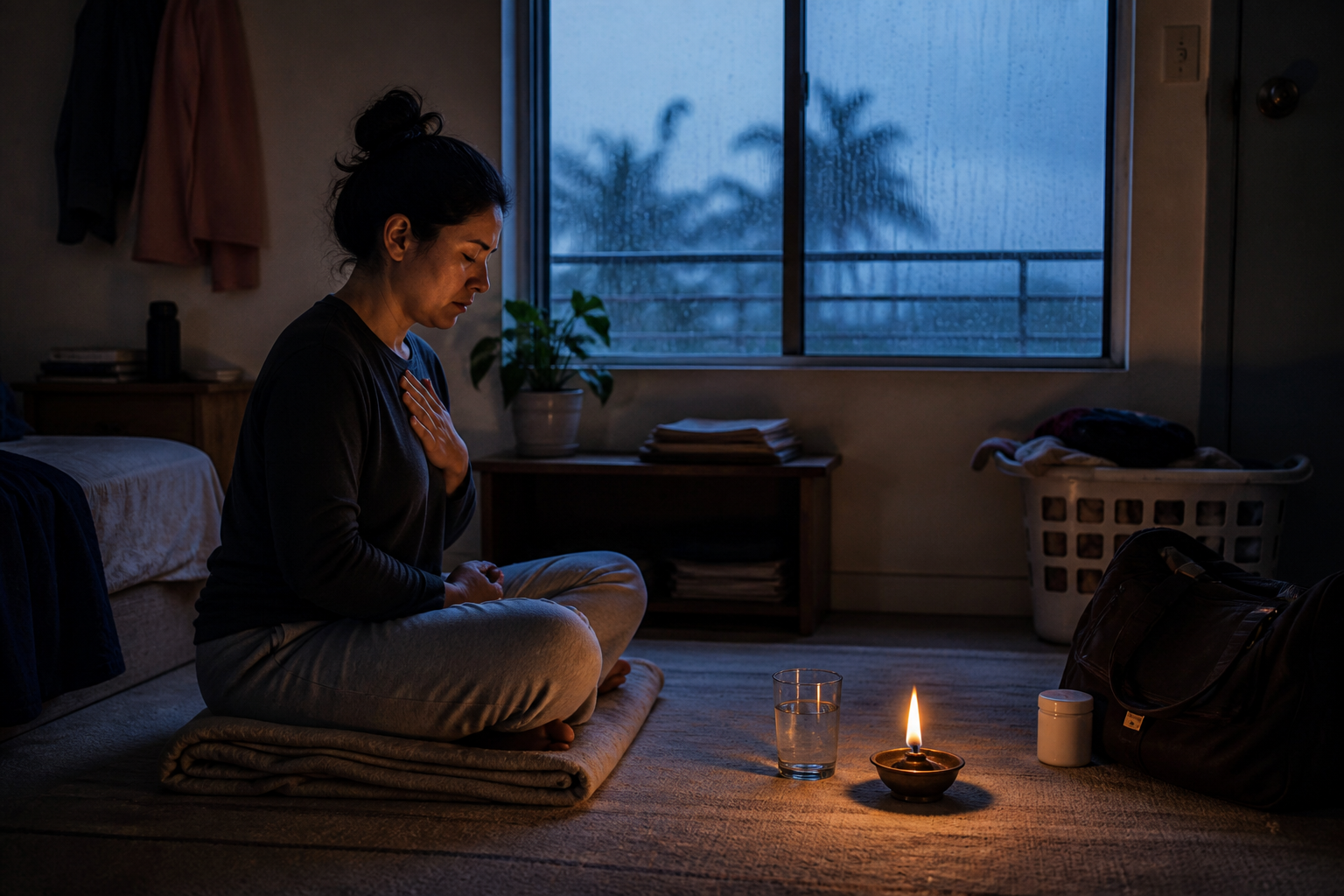
A practice that works only when the house is quiet and the schedule is empty will not reveal much about freedom. Build the discipline around transitions and recurring friction instead.
- Orient yourself on waking. Recall that the body, mind, and circumstances will change during the day, while awareness is not reduced to any single change.
- Name one duty. Choose the action that most clearly expresses dharma today. Make it concrete enough to perform, not a vague intention to be better.
- Pause at the first trigger. Separate fact, bodily and mental movement, identification, and dharmic response. If you cannot write them down, name them inwardly.
- Act without adding a second struggle. Address the circumstance itself. Do not also demand that it validate your identity, guarantee your future, or remove every uncomfortable feeling.
- Review one moment before sleep. Ask where identification took over, when you noticed it, and what a freer response would look like next time. The purpose is recognition, not self-accusation.
The strength of this routine lies in repetition. Brief, regular meditation, reflective study, and mindful action are more usable in ordinary life than waiting for rare periods of ideal concentration. Study a manageable passage from the Bhagavad Gita or an Upanishad, then carry one question from it into the next duty or disagreement.
When the reaction is already strong
Do not try to win a metaphysical debate with yourself while anger or fear is surging. If it is safe, delay speech and irreversible action. Notice the strongest bodily sensation, name the urge without obeying it, and identify the smallest non-harming action available. Return to inquiry after the immediate force has softened.
If the situation involves danger or continuing injustice, move toward safety, support, and appropriate external action. Witnessing fear does not require you to ignore the warning it may carry. Inner freedom removes blind compulsion; it does not remove practical intelligence.
Measure freedom by conduct, not spiritual vocabulary

Uninterrupted calm is a poor test. Favorable conditions can make anyone appear detached. Watch what happens when a plan fails, praise goes elsewhere, a familiar fear returns, or another person refuses to cooperate.
- Recovery becomes quicker: You notice contraction sooner and return to deliberate action without feeding the reaction for as long.
- Compulsion weakens: A thought or urge can remain present without forcing immediate speech, withdrawal, retaliation, or grasping.
- Duty becomes clearer: You spend less energy defending an identity and more energy doing what the situation actually requires.
- Results carry less existential weight: Success and failure still matter, but neither becomes a complete definition of you.
- Ethics become more visible: Ahimsa, seva, humility, and responsibility appear more consistently in your choices.
The ethical test matters. A claim of inner freedom that produces indifference to suffering, contempt for others, or avoidance of responsibility has gone astray. Freedom is not permission for the ego to do whatever it wants. It is freedom from the ego’s demand to make every person, opinion, and event serve its insecurity.
The wider Dharmic family preserves distinct accounts of liberation. Buddhism speaks of nirvana, Jainism of kevala jnana, and Sikhism of mukti through remembrance of the Divine Name, or Naam. These teachings are not interchangeable with Advaita or with one another. Their shared practical direction is more careful: inner transformation, disciplined practice, clarity, and compassionate conduct matter more than the conquest of circumstances.
Key takeaways
- The ever-free Self is not a permanently pleasant mood; it is the awareness in which changing moods are known.
- External problems may require decisive action, while spiritual inquiry prevents those problems from defining your deepest identity.
- Bondage becomes visible when a fact turns into an absolute conclusion about who you are.
- Karma, Bhakti, Jnana, and Raja Yoga address different forms of attachment and can support one another in daily life.
- Growing freedom should make you less compulsive, more responsible, and more capable of ahimsa and seva.
Choose one predictable trigger today. At its next appearance, separate the fact, the movement of body and mind, the identity claim, and the action required by dharma. You do not need to manufacture the Self in that moment. You need to stop mistaking the passing movement for the whole of what you are, then take the next right action from that clearer ground.
References
