
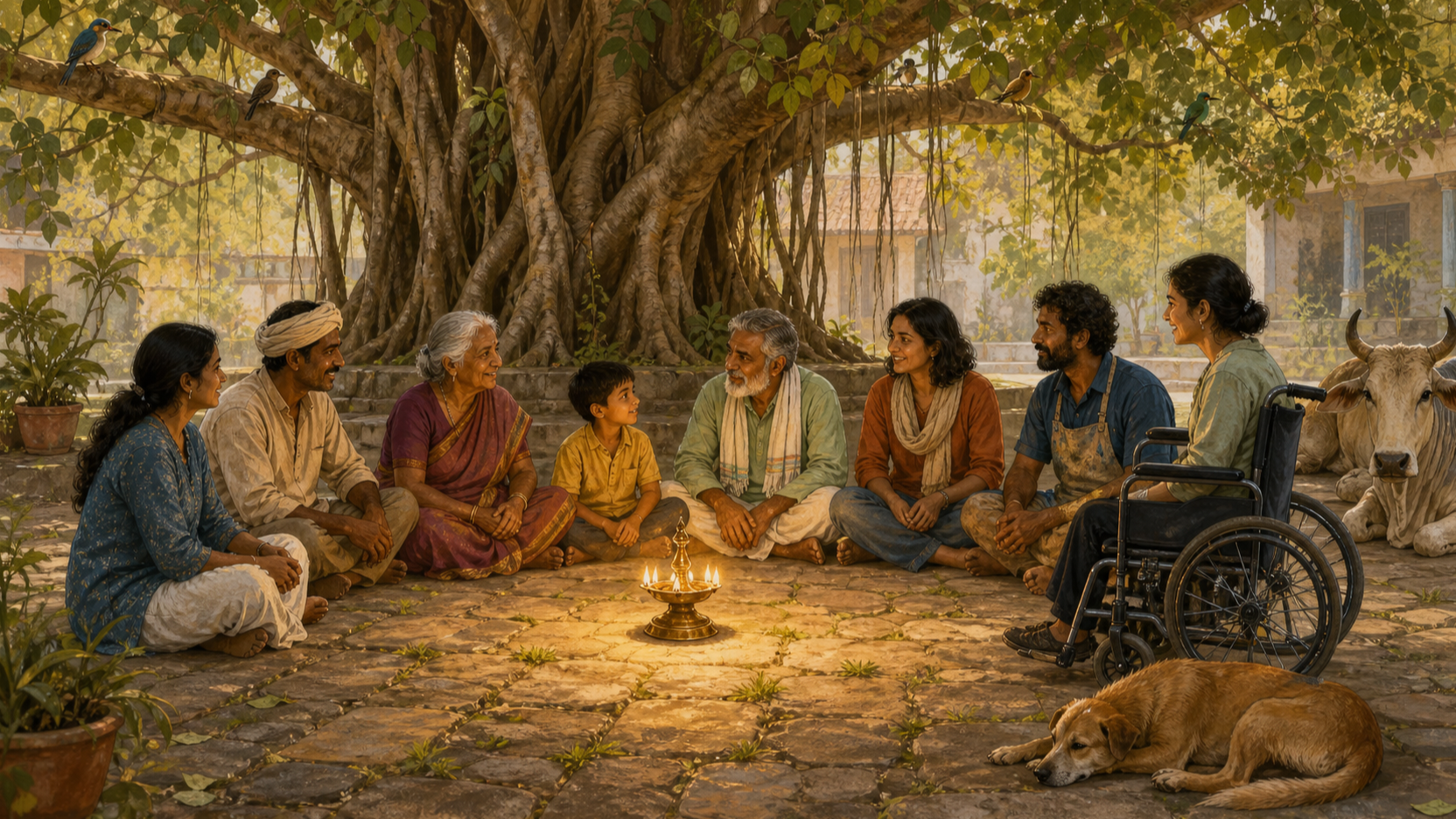
You may accept that the Divine is present in every being and still face a harder question: what should that change when someone is difficult, an animal is inconvenient, or a social convention assigns people different ranks? A belief in oneness becomes useful at the moment comparison threatens to become contempt.
You do not have to deny real differences in order to answer. Hindu sacred equality asks you to distinguish ungraded spiritual worth from differences in capacity, circumstance, responsibility and conduct. That distinction lets you honor life without abandoning discernment, accountability or dharma.
Sacred equality begins with how you see

The Upanishadic expression isavasyam idam sarvam presents existence as permeated by the Divine. Advaita Vedanta articulates the insight through non-duality: the apparent separateness of beings does not constitute an ultimate division in reality. Atman is not a badge awarded for learning, status, usefulness or good behavior. The deepest reality of a being is grounded in Brahman.
This makes equality ontological before it becomes social. In plain language, it concerns what a being is at the deepest level, not merely how generously society has decided to treat that being. Social recognition can be granted, restricted or withdrawn. Sacred worth cannot be manufactured by approval or erased by disapproval.
The Bhagavad Gita turns this metaphysical insight into a discipline of perception called sama-darshana, or equal vision:
vidya-vinaya-sampanne brahmane gavi hastini suni caiva sva-pake ca panditah sama-darsinah
Bhagavad Gita
The sequence places a learned and humble brahmin beside a cow, an elephant, a dog and a person located at the social edge. The differences remain plainly visible. Equal vision is therefore not an inability to notice form, knowledge, role or condition. It is the wisdom that refuses to turn outward difference into a hierarchy of inner being.
That gives you a practical test. When you encounter someone unlike you, ask two separate questions: What differences must I understand in order to act responsibly? Which of my labels are being used to make this life seem less worthy of care? The first question supports discernment. The second exposes contempt disguised as judgment.
Equal worth does not mean identical conduct or responsibility
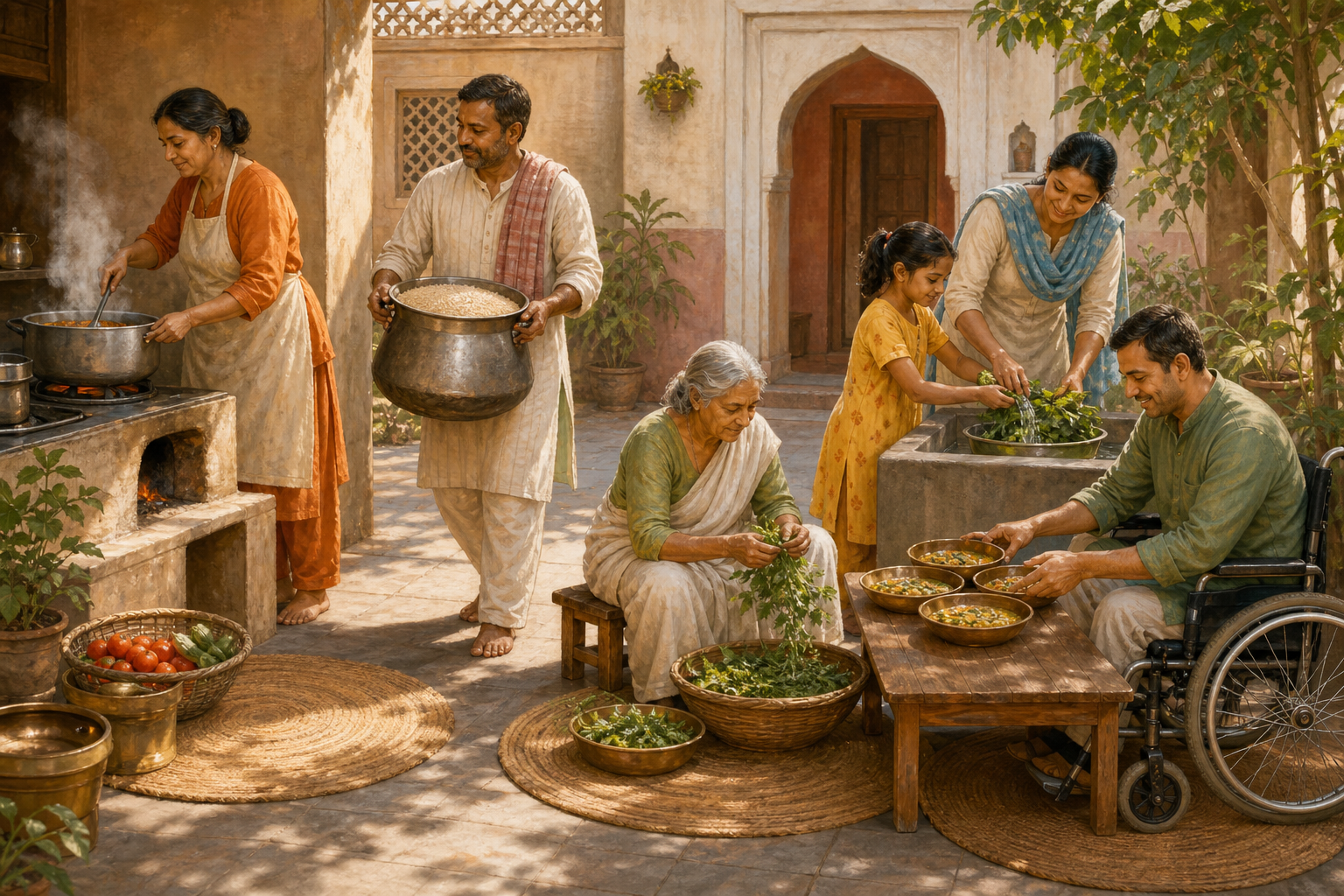
Sacred equality is often weakened in one of two directions. One mistake turns human differences into ranks of spiritual value. The other assumes that equal value requires you to treat every action, need and responsibility as interchangeable. Hindu thought gives you room to reject both errors.
Keep three levels separate
- Essence: Sacred worth is not graded. Wealth, birth, education, occupation, ritual status and social approval do not create a superior Atman.
- Circumstance: Beings have different bodies, capacities, needs and roles. Responsible care responds to those differences instead of pretending they are absent.
- Conduct: Actions can be wise or harmful, dharmic or adharmic. Equal spiritual worth does not make every choice equally acceptable.
This distinction matters most in conflict. You can stop harmful behavior, protect the person being harmed and impose a necessary boundary without declaring the wrongdoer subhuman or spiritually disposable. Condemn the act precisely. Do not enlarge that judgment into hatred of the being.
A useful boundary has four parts: name the conduct, state the harm, require it to stop and preserve the person’s basic dignity. For example: this conduct is wrong, it is harming another person, and it cannot continue. Nothing in that judgment requires humiliation, cruelty or pleasure in punishment.
The same clarity applies to social inequality. Repeating that everyone carries sacred worth while accepting routine degradation leaves the teaching safely trapped in abstraction. The real test is whether status changes how patiently you listen, how respectfully you speak, whose suffering you notice and whose vulnerability you are willing to exploit.
Metaphysical equality does not write a complete legal code or settle every institutional decision. Those tasks still require facts, proportion and careful judgment. It does, however, remove one possible justification for injustice: the claim that some lives possess a naturally inferior spiritual value. When a custom depends on that claim, sama-darshana gives you reason to question it, including when the custom carries a Hindu label.
Ahimsa makes equal vision visible in ordinary choices

If all life participates in sacred reality, ahimsa cannot be reduced to refraining from dramatic violence. It becomes a positive commitment to protect, nurture and honor life. Your omissions matter alongside your overt actions: neglect, carelessness and habitual indifference can reveal where your circle of concern quietly ends.
Before a choice that affects another being, run a four-question ahimsa check:
- Which living beings will bear the cost of this choice?
- Is the harm connected to a genuine responsibility, or merely to my convenience, anger or inattention?
- Is there a workable path that causes less harm?
- If some harm cannot be avoided, how can I limit it and respond with care rather than indifference?
This check belongs in small moments. Watch where you step when an insect crosses your path. Water a plant before neglect turns into damage. Pause before answering a difficult person with a humiliating remark. Examine whether a pattern of consumption imposes avoidable harm merely because its consequences remain out of sight.
These acts are not spiritually trivial. Each one trains perception. When you repeatedly notice a life that habit taught you to ignore, sama-darshana begins to move from an admired idea into character.
You will not make every choice free of impact, and ahimsa should not become a performance of personal purity. The useful question is whether reverence changes your decision when a less harmful option is actually available. If your conduct never changes, your belief in sacred equality has not yet become a discipline.
Dharmic kinship does not require identical doctrines

Hinduism is not alone in directing attention beyond the isolated ego. Jainism, Buddhism and Sikhism express related ethical commitments through their own vocabularies. Recognizing that kinship can strengthen Dharmic cooperation, but only if you resist flattening distinct traditions into one theology.
- Jain ahimsa intensifies reverence for life, while anekantavada cultivates humility about the partial character of any single perspective.
- Buddhist karuna, or compassion, works alongside pratityasamutpada, the insight of interdependence, to challenge the fiction of a completely separate self.
- Sikh sarbat da bhala directs goodwill toward the welfare of all rather than the advantage of one group alone.
These concepts do not prove that the traditions make identical claims about Atman, Brahman or ultimate reality. They show a practical convergence: spiritual discipline should loosen selfishness, widen care and restrain the urge to degrade unfamiliar lives.
When you enter an inter-Dharmic conversation, begin with the practice that follows from a principle. Ask how a community protects life, handles disagreement, serves the vulnerable or restrains hostility. That approach creates unity around ethical work while allowing philosophical differences to remain honest.
The same standard can guide public choices. In community life, ask whether disagreement is being handled without humiliation. In environmental decisions, count nonhuman life as more than an invisible cost. In social policy, examine whether people with little power are treated as bearers of dignity or merely as problems to be managed. Sacred equality will not supply every technical answer, but it changes whose interests are allowed to count.
Key takeaways for practicing sacred equality
- See essence and difference together. Sama-darshana recognizes one sacred ground without pretending bodies, needs, roles and actions are identical.
- Judge conduct without degrading the being. Accountability can be firm while remaining free of dehumanization.
- Test belief through behavior. Notice whether rank changes the patience, protection and respect you extend to someone.
- Use ahimsa before ordinary decisions. Identify who bears the cost, look for avoidable harm and reduce what you can.
- Build Dharmic unity without erasing plurality. Cooperate around compassion, restraint and universal welfare while naming doctrinal differences honestly.
- Choose one recurring point of practice. A conversation, purchase, meal, journey or encounter with nonhuman life can become a daily exercise in equal vision.
For the next seven days, choose one recurring encounter in which you usually act from impatience, status or convenience. Pause there and apply the three-part distinction: equal essence, different circumstance, accountable conduct. Then make one observable change. Sacred equality becomes credible when another life can feel the difference in how you act.
References
