

You finish an important task, buy something you wanted, or reach a long-awaited goal. The relief is real, but it barely settles before the mind produces its next demand. If that cycle feels familiar, the useful question is not whether you should stop wanting things. It is whether wanting has begun to control your attention, conduct, and sense of worth.
Dharmic contentment offers a way out without asking you to lower your standards. Across Hindu, Buddhist, Jain, and Sikh paths, contentment is cultivated as an inner sufficiency that supports ethical action. You still plan, work, protect, build, and serve. You simply stop making peace conditional on possessing the next object or securing the next result.
Contentment is not surrendering your responsibilities
Contentment begins by accepting the reality of the present moment. That does not mean declaring every present condition good, just, or permanent. It means seeing what is actually here without adding envy, panic, or resentment to the facts.
Complacency says, “Nothing needs to be done.” Contentment says, “My peace does not have to wait, so I can see clearly what needs to be done.” The distinction matters whenever you are deciding whether to persist, change direction, confront a wrong, or let go of an outcome you cannot command.
You can test the difference with three questions:
- What is my dharma in this situation: the next honest responsibility that is actually mine?
- Can I perform it without allowing fear, envy, anger, or praise to choose my conduct?
- If the outcome is delayed or denied, can I remain ethical and continue doing what is right?
If you can answer those questions clearly and still act, contentment is strengthening you. If “being content” becomes a reason to neglect family, tolerate adharma, avoid necessary effort, or leave a wrong unchallenged, the word is being used to disguise withdrawal.
The Bhagavad-Gita’s ideal of the sthita-prajna is helpful here. Steadiness does not remove a person from action. It removes the fever that makes personal reward, recognition, and emotional impulse more important than right action. The aim is not a life without goals. It is a life in which a goal does not become your master.
Four traditions train the same capacity in distinct ways
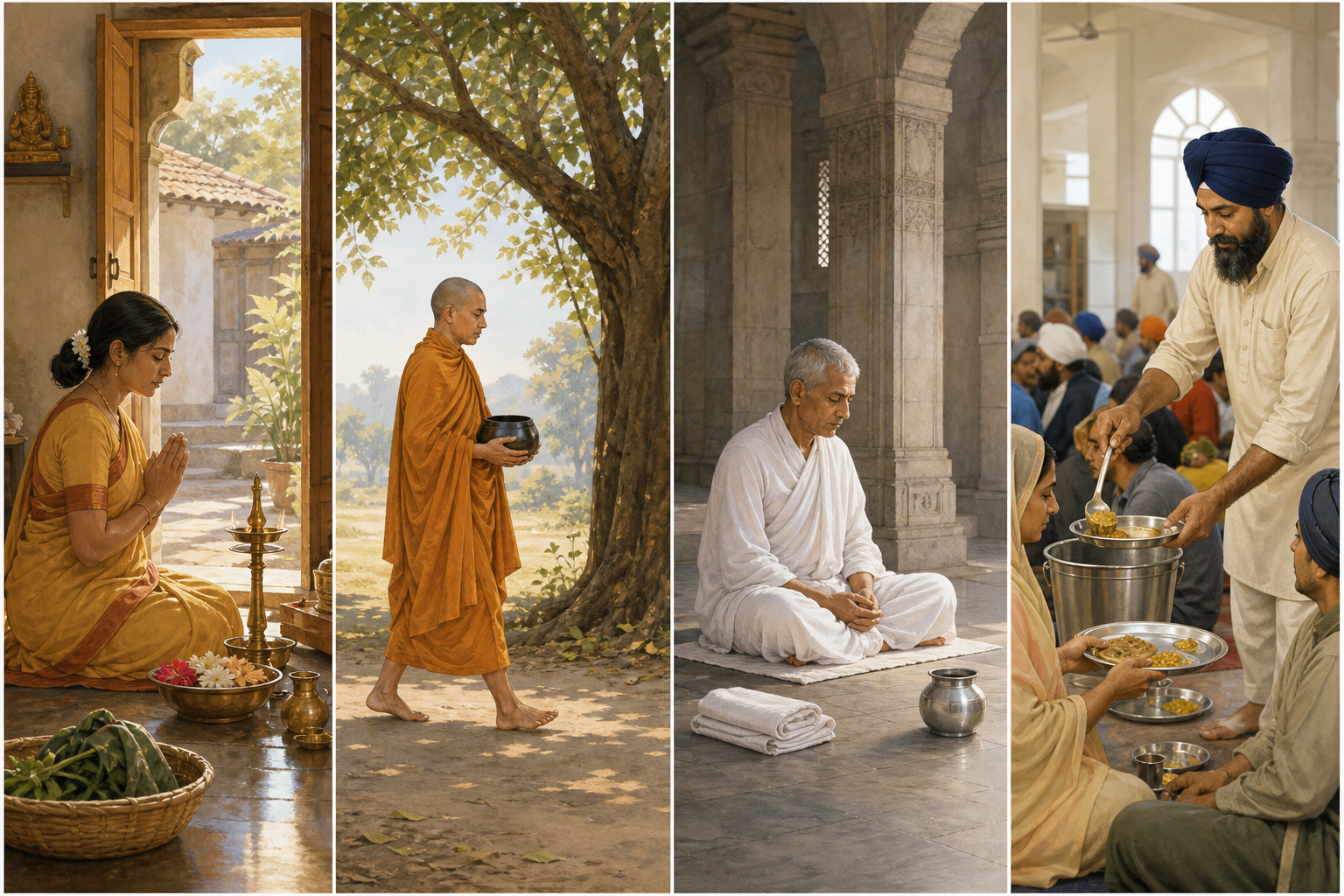
The Dharmic traditions do not share identical philosophies, and their sacred vocabularies should not be collapsed into a generic wellness formula. Their approaches to contentment nevertheless reveal a clear practical convergence: restrain craving, steady attention, simplify desire, and turn inner sufficiency toward ethical conduct.
| Tradition | Working principle | What it trains | A practical starting point |
|---|---|---|---|
| Hindu traditions | Santosha and equanimity | Ease with what is present while continuing to perform dharma | Begin the day with gratitude, japa, or quiet breath awareness before taking in external demands |
| Buddhist traditions | Santutthi, simplicity, and moderation | Freedom from the assumption that every desire must be fed | Notice wanting as it arises and pause before turning it into consumption |
| Jain traditions | Aparigraha and santosh | A lighter relationship with possession, accumulation, and craving | Adopt a clear, modest vow that limits an area of unnecessary acquisition |
| Sikh tradition | Santokh through Simran and Seva | Sufficiency rooted in remembrance of the Divine and service | Join regular remembrance to a concrete act that benefits someone beyond yourself |
In the Yoga Sutra, santosha appears among the niyamas: it is a discipline to be practised, not a fortunate mood possessed by naturally placid people. In the Gita, equanimity makes action clearer because the mind is less captive to gain and loss. Buddhist santutthi redirects life toward simplicity and moderation. Jain aparigraha weakens the bond between accumulation and identity. Sikh santokh joins inward remembrance with outward Seva, preventing contentment from becoming self-absorbed tranquillity.
The shared lesson is precise. A peaceful mind and a responsible life are not competing goals. When craving becomes quieter, you can respond to duty with less distortion. When duty is connected to remembrance and service, contentment becomes more than private comfort.
Choose practices rooted in the tradition you actually follow. Om, Ram, Waheguru, metta, breath awareness, and reflective study should not be treated as interchangeable items on a spiritual menu. The common principle can unite Dharmic paths without erasing the integrity of each path.
Find the machinery of discontent before fighting every desire

Modern dissatisfaction does not arise only from material deprivation. It is repeatedly provoked by algorithmic persuasion, constant comparison, fragmented attention, and over-choice. A mind exposed to an endless stream of alternatives can interpret every unchosen option as a loss. It then mistakes stimulation for fulfilment and novelty for need.
Do not respond by declaring all desire bad. Diagnose the mechanism operating in the moment. During an ordinary day, pay attention to the following triggers:
- Comparison: You were satisfied until another person’s possession, success, appearance, or opinion entered your attention. Reduce unnecessary exposure to the trigger before trying to argue with the envy it creates.
- Stimulation: You reach for a screen whenever a pause appears, even though you are not seeking anything in particular. Protect transitions, meals, prayer, and the beginning of the morning from automatic input.
- Over-choice: You keep reopening a settled decision because another option might be marginally better. Define what is sufficient before browsing; stop when an option meets the real need and your ethical boundaries.
- Accumulation: Acquisition promises relief, but ownership adds storage, maintenance, expense, and mental attention. Ask whether the object will serve dharma or merely prolong the search for novelty.
- Outcome fever: You can no longer perform the right action calmly because your identity depends on winning, praise, or immediate success. Separate the conduct you control from the result you can influence but never completely command.
This diagnosis changes the remedy. Comparison may require a boundary around media. Accumulation may require an aparigraha vow. Over-choice may require a definition of “enough.” Outcome fever may require returning to the Gita’s discipline of action and equanimity. A generic promise to “be more grateful” will not do all of those jobs by itself.
Kali Yuga can be recognised not only in public quarrel but in this intimate confusion about sufficiency. Attention is pulled outward, craving multiplies, and the mind becomes less able to distinguish a genuine duty from a manufactured urgency. Protecting attention is therefore not merely a productivity technique. It is part of protecting discernment.
Build a small rule of life around sufficiency

Contentment becomes dependable through abhyasa, repeated practice. Waiting to feel content before changing your habits reverses the order. Establish a simple rhythm first; let the feeling mature from the discipline.
Begin before the world names your desires
Keep the opening of the morning free from feeds, shopping, headlines, and comparison. Sit in silence and use a practice grounded in your path: japa with Om or Ram, Simran with Waheguru, metta, natural breath awareness, or quiet contemplation of a teaching. The immediate purpose is not to manufacture an extraordinary state. It is to let attention become your own before external demands begin competing for it.
Follow the practice with two prompts: “What is already sufficient for this day?” and “What is mine to do?” The first interrupts scarcity. The second prevents gratitude from sliding into passivity.
Put a gate between desire and consumption
Before an optional purchase, subscription, upgrade, or fresh commitment, ask:
- Did this desire exist before I saw someone else’s choice or an advertisement?
- Does it meet a real need, support a responsibility, or contribute to worthwhile enjoyment?
- What attention, maintenance, money, and storage will ownership continue to demand?
- What does “enough” look like in this category?
A small vow works better when its boundary is observable. You might stop replacing useful possessions merely for novelty, decline new commitments that displace existing duties, or remove an especially agitating stream of digital input. The vow should reduce excess without depriving dependants or obstructing legitimate responsibilities. Aparigraha is not austerity performed for display.
Use the breath at the moment of friction
The difficult moment is not usually meditation itself. It is the instant when criticism, delay, envy, or uncertainty arrives. Before replying or deciding, allow the breath to become gentle and unforced. Name the pressure accurately: “I want recognition,” “I am afraid of losing,” or “I am comparing.” You do not have to condemn the feeling. You do have to prevent it from issuing commands before discernment returns.
Convert sufficiency into Seva
Private calm can quietly become another possession: something guarded, displayed, and centred on the self. Seva corrects that tendency. Choose a regular act that answers a real need in your household, sangat, temple, community, or neighbourhood. The act need not be visible. Its value lies in redirecting time and energy away from endless self-concern.
Service also reveals whether contentment is genuine. If you have enough inwardly, some attention becomes available for another person. If your spiritual routine only makes interruptions feel intolerable, it may be producing control rather than santokh.
Close the day with a truthful review
Recall something concrete that was already given: nourishment, shelter, a relationship, a teaching, honest work, or an opportunity to serve. Then examine the point at which agitation governed you. Do not turn the review into self-accusation. Identify the trigger and choose the boundary or practice that would help when it returns.
Begin with the morning anchor and the desire boundary. When they have become ordinary, establish a regular form of Seva and an evening review. A complicated routine that collapses under work and family pressure teaches less than a modest discipline you can actually keep.
Measure progress by freedom, not by a permanent mood

The goal is not uninterrupted serenity. Making that your standard simply gives craving a spiritual object: now you must acquire the perfect inner state. Look instead for changes in your relationship with provocation, possession, solitude, and service.
- Reactivity loosens: A difficult remark or delay no longer determines your response immediately.
- Gratitude appears earlier: You notice what is present before comparison announces what is missing.
- Possessions feel lighter: Keeping, replacing, lending, or releasing an object becomes a practical decision rather than a verdict on identity.
- Solitude becomes easier: An unfilled pause does not always have to be covered with noise or consumption.
- Service becomes more natural: You notice useful work that can be done without first asking whether it will bring recognition.
Contentment can coexist with serious ambition. Before pursuing a goal, name the duty or benefit it serves, the ethical boundary you will not cross, and the condition that will count as enough. After the result arrives, assess your conduct as carefully as the outcome. Success does not make adharmic means clean, and disappointment does not make right action worthless.
This also protects contentment from misuse. Santosh is an inward discipline, not an instruction for silencing another person’s legitimate need. A leader, relative, employer, or spiritual authority cannot avoid responsibility by telling the person bearing the cost to be satisfied. Contentment should clarify courageous action against adharma, not demand submission to it.
Key takeaways
- Contentment means acting from inner sufficiency; complacency means using peace as an excuse not to act.
- Hindu santosha, Buddhist santutthi, Jain aparigraha and santosh, and Sikh santokh share a practical movement from craving toward ethical steadiness without becoming identical doctrines.
- Comparison, algorithmic stimulation, over-choice, accumulation, and fixation on results require different boundaries.
- A workable discipline joins remembrance, restrained consumption, steady attention, gratitude, and Seva.
- Progress appears as reduced reactivity, greater ease with possessions and solitude, spontaneous gratitude, and a stronger readiness to serve.
At the next opening of your day, pause before the first stream of external input. Remember the sacred in the form your tradition gives you. Ask what is already enough, identify what dharma requires, and carry both answers into your first decision. Contentment grows when that sequence becomes a way of living rather than an idea reserved for peaceful moments.
References
