
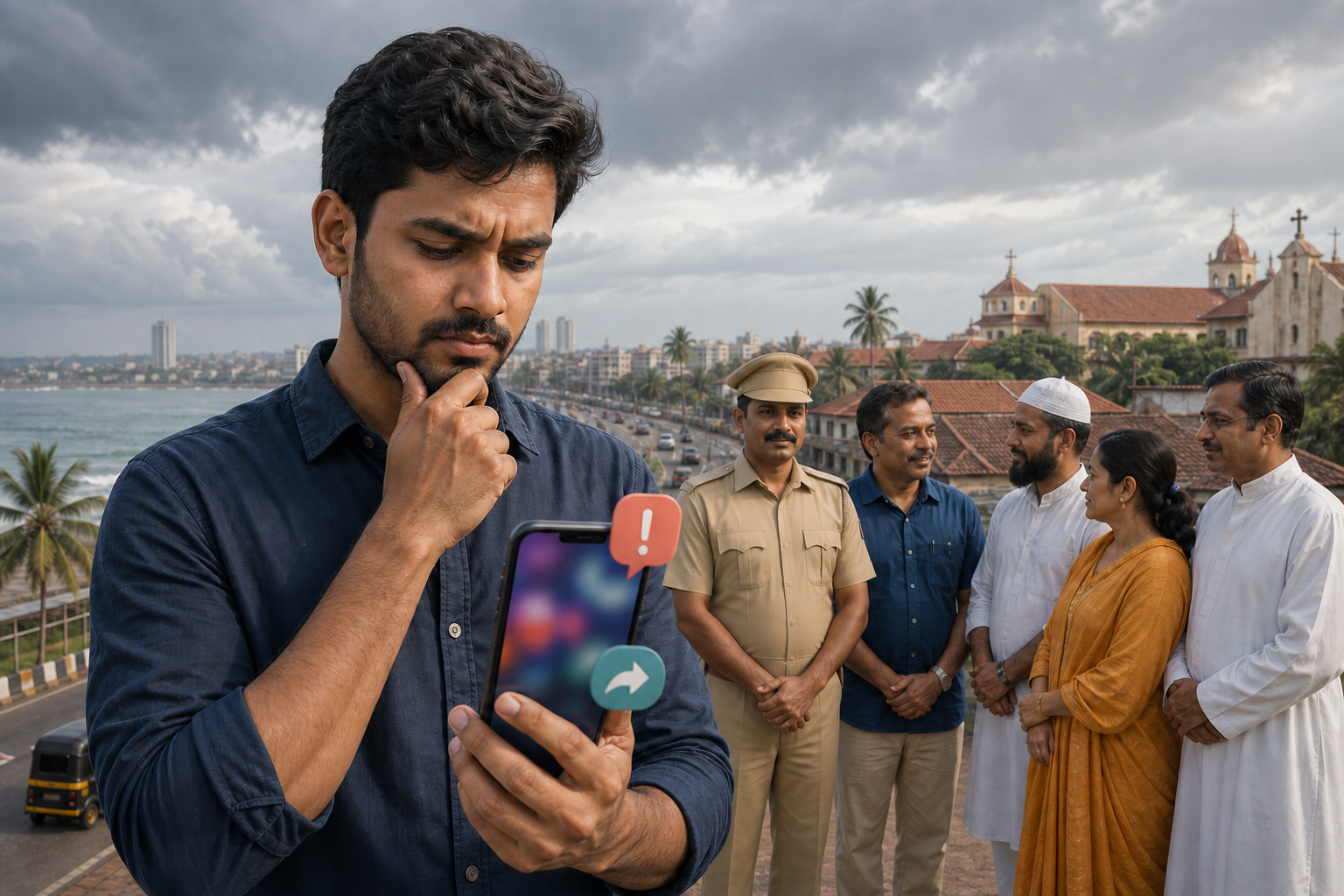
If an incendiary social-media post about Hindus or another religious community reaches your phone in Mangaluru, should you expose it, report it, or ignore it? The instinct to quote it publicly can feel like vigilance. It can also deliver the provocation to thousands of people who would never otherwise have seen it.
Your most useful role is narrower and more disciplined: preserve the original evidence, stop its unnecessary circulation, report the risk through the proper channels, and wait for verified information. That approach protects Hindu interests, neighborhood peace, and lawful accountability at the same time.
What the Mangaluru police action does and does not establish
On December 19, 2025, Mangaluru City Police had intensified action against provocative online material alleged to threaten public order, inflame religious feelings, or encourage violence. One individual was detained after returning from abroad as part of that wider enforcement effort. At that stage, investigative procedures were still ongoing.
That last point matters. Detention is not conviction. A viral accusation does not prove what was published, who controlled an account, what the author intended, or whether the legal elements of an offence are present. Police action does not by itself settle those questions either. They require preserved evidence, investigation, and due process.
The action nevertheless shows why authorities cannot always treat online provocation as harmless screen activity. A small amount of incendiary material can be copied across groups, stripped of context, embellished with rumor, and turned into fear or retaliation on the street. By the time a claim has gone viral, correcting it may be much harder than preventing its initial amplification.
Cases of this kind can engage legal provisions concerning promotion of enmity, incitement, deliberate attempts to outrage religious feelings, and applicable parts of the Information Technology Act. That general description is not a statement about the final charges or guilt of any particular person. Do not attach statutory sections to a name merely because another account has done so. If you are the complainant, the accused, or someone who has received an official notice, preserve the material and obtain advice from a qualified lawyer rather than relying on social-media interpretations.
The same discipline applies to collective blame. An alleged offence belongs to the person or people responsible for it. It does not justify a verdict against a religion, neighborhood, language group, or country of residence. Turning a case-specific investigation into a communal indictment reproduces the very mechanism that responsible policing is supposed to interrupt.
How to report a dangerous post without helping it spread

Before taking action, distinguish personal offence from a possible public-safety risk. This is not a legal test, but it is a useful triage. Look at the exact words and surrounding context. Does the material call for violence, retaliation, or hostile mobilization? Does it identify a person or place in a way that could create immediate danger? Is an old or edited image being presented as a current local event? Is the claim being repeated across local groups without any verifiable origin?
A harsh criticism, an insult, a fabricated allegation, and an operational threat are not interchangeable problems. They may all deserve a response, but not necessarily the same response. Describe what is actually present rather than upgrading an offensive remark into a threat or downgrading a direct call for violence into mere opinion.
- Stop public amplification. Do not quote-post the material, add it to a status update, or forward it through multiple groups to ask whether it is genuine. If others need a warning, describe the risk without reproducing the slur, image, or call to action.
- Preserve the original context before reporting it. Capture the account name, visible date and time, complete text, surrounding replies or caption, and the original URL. Keep an unedited copy. A tightly cropped screenshot may omit the information needed to distinguish an authentic post from an impersonation, edit, or recycled image.
- Record observation separately from inference. Note when and where you encountered the material and what it explicitly says. Put suspicions about identity, motive, or group affiliation in a separate sentence and label them as unverified. This keeps a complaint useful and reduces the chance of accusing the wrong person.
- Report through both relevant routes. Use the platform’s reporting function and submit the preserved information to the local cybercrime cell or police when the content may provoke disorder. Reporting only to the platform may address visibility without addressing a credible local threat; reporting only to police may leave the material circulating online.
- Escalate immediate danger directly. If the content identifies a threatened person, place, gathering, or time, contact local police promptly and provide those details first. Do not summon a crowd, confront the suspected account holder, or travel to the named location to investigate for yourself.
- Keep the evidence intact after reporting. Retain the original files, URLs, and any acknowledgement or complaint reference you receive. Do not alter the material to make it more dramatic, and do not publish private addresses, phone numbers, or family details in the name of exposure.
The order of these steps matters. Preserve first, because a platform report may make the content unavailable. Report next, because evidence sitting privately on your phone does not reduce the risk. Discuss publicly only when there is verified information and a legitimate civic reason to do so. Forwarding evidence privately to an authorized recipient is not the same as broadcasting it to an audience.
What fair and effective policing should look like

Swift intervention and careful intervention are not opposites. Police can move quickly to preserve digital evidence, assess an immediate threat, and prevent escalation while remaining precise about what is alleged and what has been established. Speed is useful when it contains danger; it becomes damaging when it produces public claims that the evidence cannot support.
Those concerned about anti-Hindu provocation should insist on conduct-based, even-handed enforcement. Protecting Hindu society does not require treating every theological disagreement, satire, insult, rumor, and call for violence as one category. It requires authorities to examine the words, context, apparent intent, likely consequences, account history, and available digital evidence. A weak case built around outrage can collapse and give a provocateur a grievance narrative. A careful case makes accountability harder to evade.
Due process is therefore not a concession to communal incitement. It is what separates public protection from factional punishment. The same standard should apply regardless of which community is targeted or which identity is attributed to the accused.
Residents and local journalists can improve accountability by asking precise questions:
- What conduct has been confirmed, and what remains an allegation?
- Was the material preserved in its full context rather than as a cropped or forwarded image?
- Does the case concern criticism, deliberate religious provocation, promotion of enmity, a call for violence, or another alleged act?
- Which official reporting channel should residents use for related material?
- Will police issue a prompt correction if a viral claim about the case proves false?
- Is the same evidentiary and enforcement standard being applied across communities?
These questions do not obstruct enforcement. They help prevent rumor from filling gaps in official communication. A short, factual police update that clearly separates allegation, action, and confirmed risk is more useful than an ambiguous warning that different factions can reinterpret for themselves.
Build a civic firewall before the next rumor arrives

Police generally enter the process after harmful material has been created. Families, schools, businesses, neighborhood associations, and religious institutions shape what happens in the crucial interval between publication and police attention. That is where a city either limits a provocation or becomes its distribution network.
Temples, viharas, derasars, and gurdwaras can adopt a simple common protocol without blurring their distinct beliefs or overlooking genuine threats. Each institution can designate a trusted liaison, preserve suspect material privately, verify local claims before issuing a statement, and direct members toward an established reporting channel. Group administrators can enforce one clear rule: no inflammatory forward is permitted merely for awareness once the necessary evidence has been preserved.
Corrections also need discipline. Lead with the verified fact, not a large reproduction of the falsehood. Avoid repeating a communal slur in the headline. If an image comes from another event or period, explain the mismatch plainly. A correction that sensationalizes the original allegation may extend its life even while declaring it false.
Schools and civic groups can make digital literacy practical by working through realistic decisions: how to retain a URL, how to identify a cropped screenshot, how to separate a witness statement from hearsay, and when a platform report is insufficient because physical safety may be at risk. Small businesses should establish the same discipline for staff groups, since a rumor-driven closure, crowd, or confrontation can disrupt people who had nothing to do with the original content.
A Dharmic response is firm without becoming retaliatory. Ahimsa does not require passivity in the face of incitement, and the protection of social order does not require collective vengeance. Restraint prevents an anonymous provocateur from dictating your conduct; truthful reporting places responsibility where it belongs.
Cooperation across communities need not demand false equivalence or silence about anti-Hindu hostility. Its immediate purpose is narrower: keep neighbors from treating an unverified account as permission to distrust or attack one another. Local relationships provide a channel for checking claims before an online actor succeeds in manufacturing an offline confrontation.
Key takeaways
- A detention is not a finding of guilt; keep allegations, confirmed facts, and legal conclusions separate.
- Preserve the full post, account details, context, time, and original URL before a platform report can make the material disappear.
- Do not quote-post incendiary material merely to condemn it. Public condemnation can still provide distribution.
- Report credible communal incitement to the platform and the appropriate local cybercrime or police channel; contact police directly when physical danger appears immediate.
- Demand fast, evidence-led, case-specific, and even-handed policing rather than collective blame.
- Give temples, schools, associations, and group administrators a reporting protocol before the next viral rumor tests them.
The next inflammatory post should meet a prepared citizen, not an impulsive audience. Save the evidence, deny it free circulation, send it to people authorized to act, and judge the resulting case by verified facts. That is how you turn digital restraint into practical protection for Mangaluru.
References
