
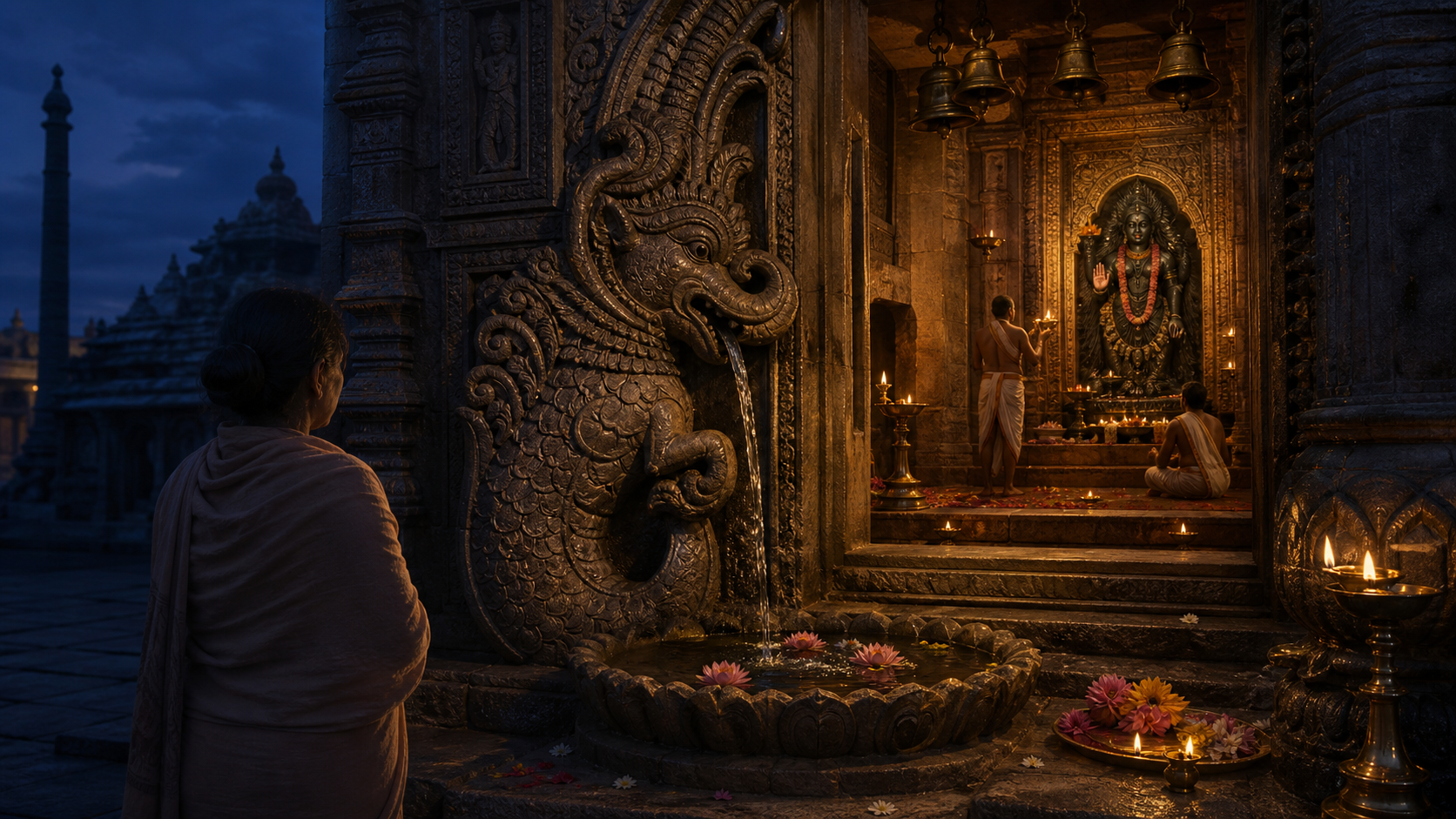
You may recognize Kali, a skull garland, or the curved body of a Makara and still have no idea what the image is asking you to notice. A label gives you a name. It rarely tells you why that being appears in that place, carries that object, or assumes that form.
Dharmic iconography becomes clearer when you read it as a relationship rather than a collection of exotic objects. Location, association, number, posture, and ritual setting work together. Once you learn to inspect those elements in order, a fearsome image can become a teaching about courage, while a composite creature can reveal the spiritual meaning of a doorway, river, or ocean.
Read the image as a sentence, not as a specimen
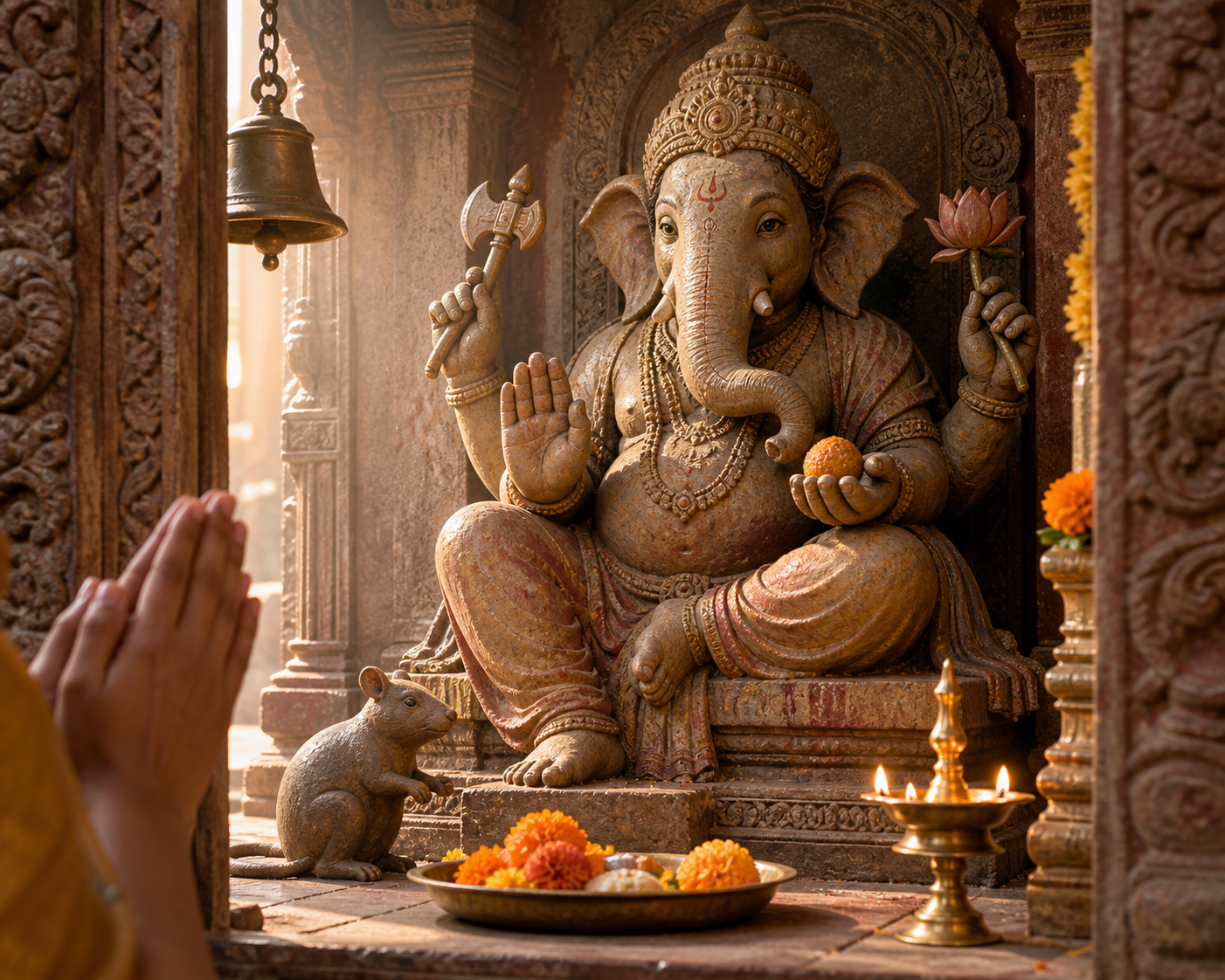
The first question should not be: Which animal or object is this? Ask instead: What role does it have here? A vahana, a banner emblem, a garland, and a threshold guardian do not make the same statement, even when the same form appears in each role.
The Makara shows why this distinction matters. It can be the vahana of Ganga or Varuna, an emblem on Kamadeva’s banner, or a guardian on a temple balustrade, torana, architrave, throne, or doorway. Identifying it as Makara is therefore only the first step. Its relationship to the surrounding figure or structure tells you which aspect of its meaning is active.
Use this five-question sequence whenever you meet an unfamiliar sacred image:
- Which tradition and setting produced it? Record whether you are in a Hindu temple, Buddhist complex, Jain sacred space, museum, manuscript, or domestic shrine. Then narrow the context by region and lineage when that information is available. A resemblance across traditions is useful evidence, but it is not permission to assume an identical meaning.
- Where has the image been placed? A figure at an entrance may govern protection, transition, or preparation. One beneath or beside a deity may indicate a vahana or associated power. An image worn on the body speaks differently from one carved around a doorway.
- What is the relationship? Distinguish bearer, vehicle, companion, adversary, ornament, attribute, and guardian. Do not isolate a skull, animal head, weapon, lotus, or gesture from the being who possesses it.
- Which features repeat? Notice count, sequence, direction, posture, and symmetry. Repetition may carry doctrinal meaning. It may also vary across regional or script traditions, so treat a visible count as a clue rather than an automatic verdict.
- What spiritual work does the whole arrangement perform? Ask whether it confronts fear, marks a passage, expresses protection, cuts attachment, honors water, or places human life within a larger cosmic order. Your answer should follow from the preceding four observations, not from your first emotional reaction.
This method corrects three common errors. Literalism reduces a skull garland to violence or a composite creature to zoology. Decorativism assumes that an elaborate carving has no work beyond beautifying a surface. Universalism notices a similar form in several traditions and declares that all of them mean the same thing. Each shortcut discards part of the image’s grammar.
It also helps to separate levels of confidence. Placement and visible association are direct observations. A lineage’s established explanation gives you a traditional interpretation. A proposed connection to natural history or cultural memory may be plausible without being certain. Keeping those levels distinct allows you to appreciate an image deeply without making it prove more than it can.
Kali’s garland joins sacred sound, time, and fearlessness
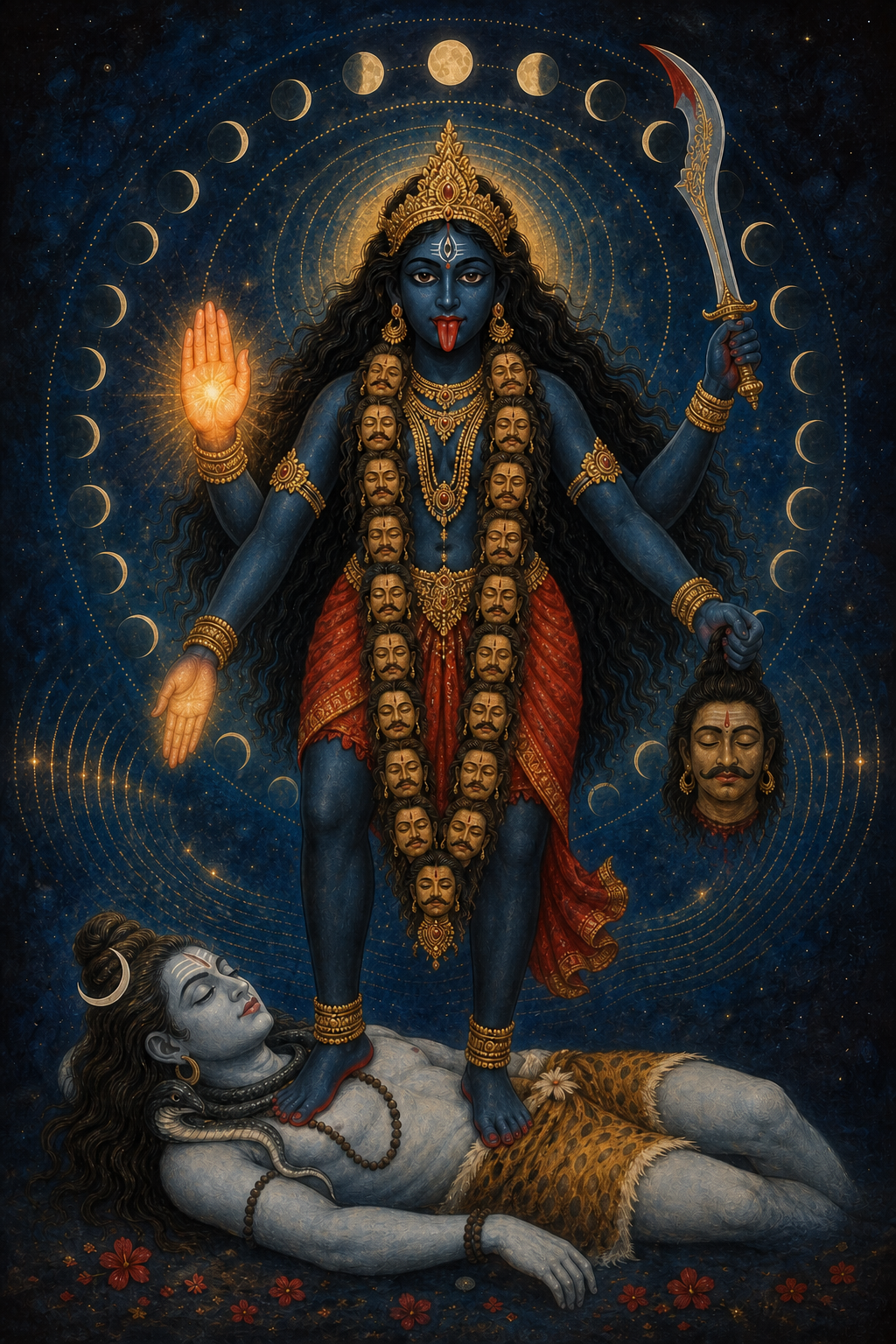
Kali’s mundamala is an especially useful test of this reading method because its surface appearance can overwhelm its structure. If you stop at severed heads or skulls, the image seems to speak only of death. If you examine number, wearer, and philosophical setting, it presents a much larger account of creation, dissolution, and liberation from false identity.
Why the number of skulls matters
The garland commonly contains fifty skulls, although traditions also depict fifty-one or fifty-two. These variations correspond to different enumerations of the Sanskrit varnamala rather than to one universally fixed visual template. In Tantric interpretation, the skulls correspond to phonemes associated with the Matrikas, linking each letter with shabda, Vak, and the creative potency of Shakti.
That correspondence changes the reading completely. The garland is not merely a collection of dead forms. It represents the field of sound through which names and articulated forms become possible. Kali wears that field rather than being confined by it. Creation belongs to her power, and so does the dissolution of every created identity.
This is why you should not reject a depiction merely because it does not show exactly fifty recognizable skulls. First determine whether the local tradition uses fifty, fifty-one, or fifty-two. Then allow for the difference between skulls and severed heads, both of which occur in regional and lineage-based depictions. Count carefully, but do not turn iconographic attention into a mechanical authenticity test.
Time destroys the identity to which ego clings
Kali’s sovereignty also extends over kala, time. Every name, face, role, achievement, and possession changes within time. The mundamala exposes the error of treating any transient identity as the whole self. Its severity is directed toward avidya and attachment, not toward a nihilistic rejection of life.
Creation and destruction therefore do not cancel each other. Sound gives rise to articulated form; time transforms and dissolves that form; life continues through renewal. Kali holds the entire movement together. Her fearsome appearance is compassionate in function because it removes the illusion that security can be obtained by clinging to what must change.
Turn recognition into a disciplined reflection
If you use the mundamala as a contemplative aid, keep the exercise concrete. This is a way to examine the symbol ethically, not a claim to reproduce a lineage ritual.
- Name one identity you are trying to defend at any cost: reputation, position, possession, group status, or a preferred picture of yourself.
- Separate the role from the duty. The role may change; truthfulness, compassion, courage, and responsibility can still guide your conduct.
- Identify the fear beneath the attachment. Do not argue that loss is pleasant. Notice instead whether fear is pushing you toward dishonesty, cruelty, paralysis, or neglect of dharma.
- Choose one action that would remain right even if the threatened identity disappeared. Take that action while it is still available to you.
This is the practical force of abhaya in Kali’s iconography. Fearlessness does not mean pretending that death, loss, or uncertainty is unreal. It means refusing to let fear govern your ethical judgment. The garland becomes useful when it helps you release a false necessity and perform a real duty.
The Makara teaches you to read thresholds and living waters
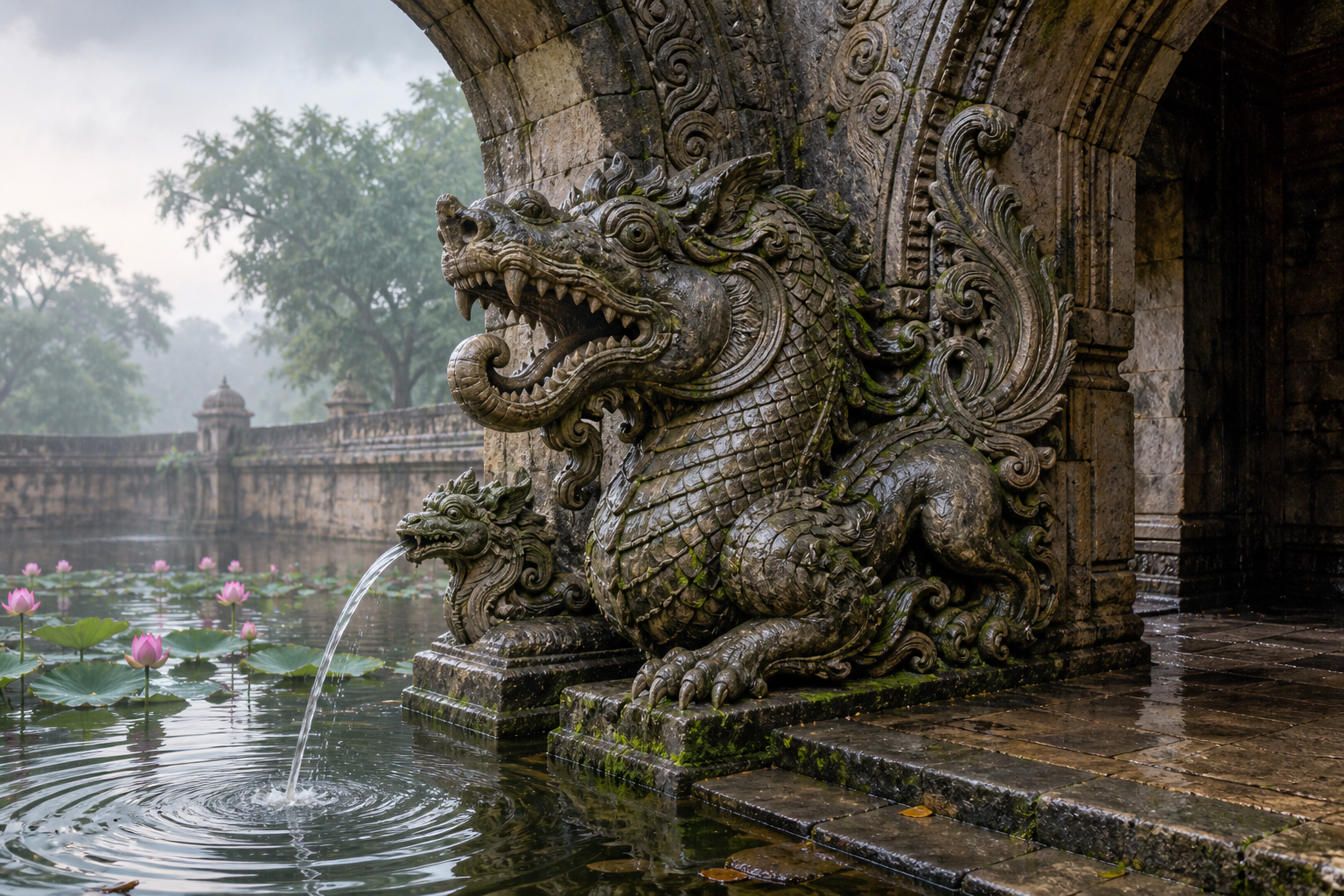
The Makara presents the opposite visual problem. Instead of reducing it to horror, viewers often try to solve it as if it were an unidentified animal. Its composite body may recall observable aquatic creatures, but its primary function is symbolic rather than taxonomic.
Begin with placement. When a Makara curves around a doorway, balustrade, gateway, or sacred throne, it marks a boundary between ordinary space and a charged interior. The creature brings the depth, danger, abundance, and mystery of water to that boundary. You are not simply entering a building. You are crossing into an ordered sacred space, and the guardian asks for awareness appropriate to the passage.
When the Makara accompanies Ganga or Varuna as a vahana, the aquatic association becomes more direct. When it appears on Kamadeva’s banner, the relationship is emblematic rather than architectural. The form remains recognizable, but its surrounding grammar determines the emphasis.
Use these checks at a temple or museum:
- If the creature frames an entrance or appears in a mirrored pair, investigate protection and passage before searching for a zoological identity.
- If a divine figure rides, stands upon, or is consistently accompanied by it, investigate the vahana relationship.
- If it appears on a banner or another attribute, treat it as an emblem connected to the bearer.
- If its anatomy combines several aquatic features, preserve the composite character. Do not discard the parts that prevent a one-species identification.
- If the carving is damaged or highly stylized, record what you can actually see before supplying missing details from memory.
A natural-history reading can still contribute, provided you state it at the right level of certainty. Makara forms may preserve observations of crocodiles, gharials, Gangetic dolphins, sharks, rays, and formidable creatures known through river life or Indian Ocean voyaging. That possibility helps explain why the form communicates aquatic scale and power. It does not turn the Makara into a scientific record of one species, nor does it prove that every anatomical feature came from direct observation.
The symbol also carries a present obligation. A sacred river or ocean cannot be honored only as scenery while being treated carelessly in practice. When you visit a water-associated sacred place, make reverence visible: carry away what you brought, do not leave packaging with offerings, and observe local rules intended to protect the site. The Makara’s guardianship is most intelligible when human conduct also protects the threshold between culture and the living world.
Compare Dharmic traditions without erasing their differences
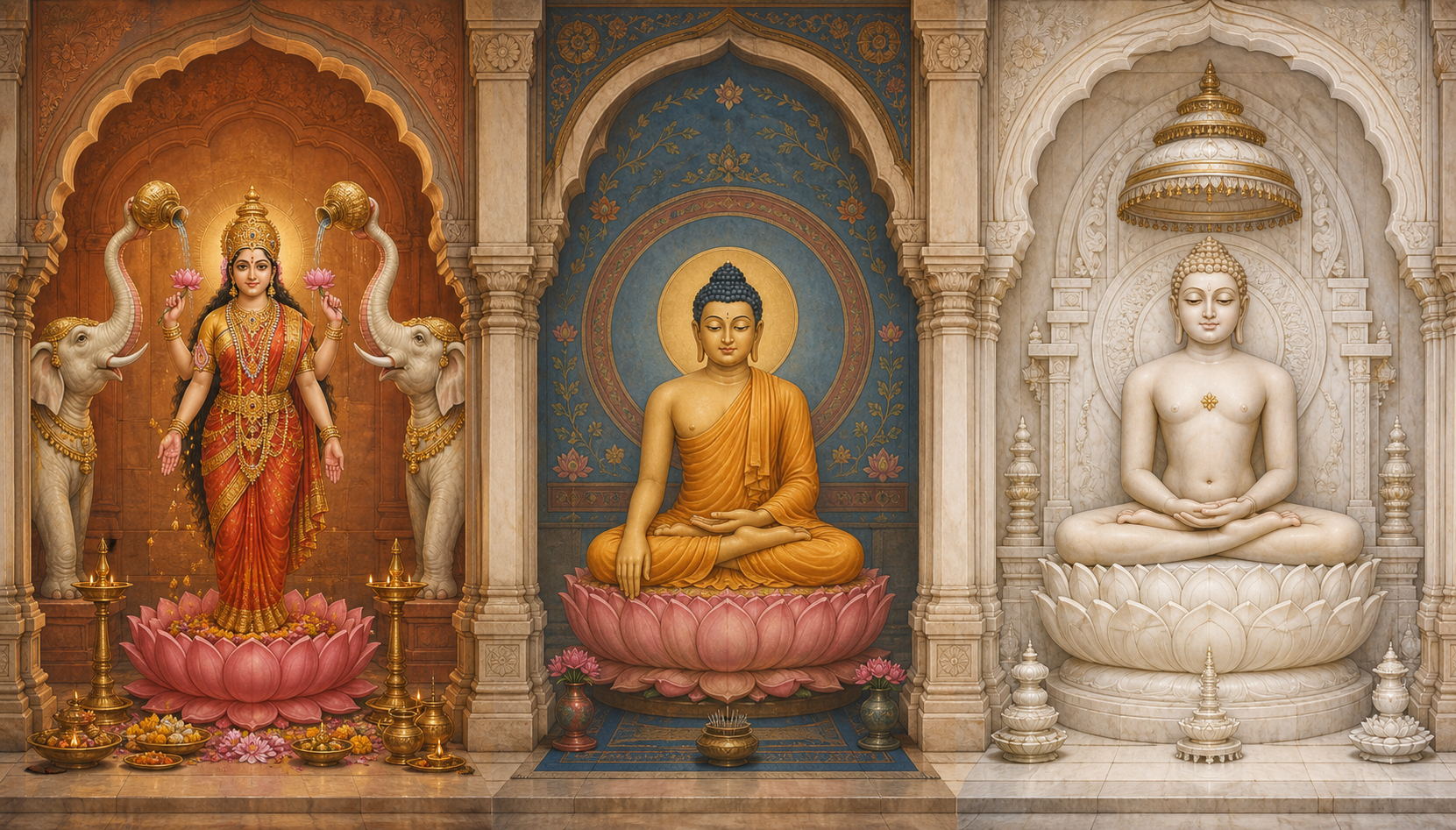
Shared motifs can reveal a civilizational conversation, but resemblance is the beginning of comparison rather than its conclusion. Buddhist wrathful imagery can use skull garlands to confront ignorance and impermanence. Makara forms also appear on Buddhist stupas and gateways. Jain contexts employ aquatic motifs as auspicious protectors at liminal spaces, while Jain teaching gives non-attachment and the shedding of karmic accretions its own philosophical frame. Sikh thought has a distinct relationship to sacred imagery, yet fearlessness, harmony with hukam, and reverence for water and earth provide genuine ethical points of resonance.
The responsible comparison is precise about both connection and boundary:
| Tradition | What you can responsibly notice | What you should not assume |
|---|---|---|
| Hinduism | Kali’s garland can unite Shakti, sacred sound, time, the end of ignorance, and fearlessness. The Makara’s meaning changes with its role beside Ganga, Varuna, Kamadeva, or a temple threshold. | Every Hindu lineage fixes the same count, renders the form identically, or gives every occurrence one meaning. |
| Buddhism | Wrathful skull imagery can cut through ignorance and emphasize impermanence; Makara motifs can protect or frame sacred passage. | A shared visual form automatically imports Hindu deity relationships or Tantric explanations unchanged. |
| Jainism | Non-attachment, karmic shedding, purity, protection, and liminal aquatic motifs provide meaningful points of comparison. | Jain teachings can be translated directly into the language of Shakti or treated as a branch of Hindu Tantra. |
| Sikhism | Nirbhau, alignment with hukam, and reverence for wind, water, and earth can illuminate a shared ethical concern with courage and sacred ecology. | Ethical resonance proves that Sikh practice uses the same iconographic system. |
A reliable cross-tradition statement has three parts: name the visible resemblance, explain the local function, and then identify the shared concern. If you cannot supply the middle part, you are not yet ready to make the comparison. Saying that two images look alike is observation. Saying that they teach identical theology requires evidence that appearance alone cannot provide.
This distinction protects both unity and plurality. The traditions can share an ethical arc of courage, non-attachment, compassion, truthful living, and respect for the natural world without becoming interchangeable. Their differences are not obstacles to Dharmic kinship; they are part of the inheritance that careful interpretation must preserve.
Key takeaways for your next encounter
- Start with location and relationship. Identification by itself rarely completes the meaning.
- Treat numbers as doctrinal clues, but check regional, script, and lineage variations before declaring a depiction incorrect.
- Read Kali’s mundamala through sacred sound, time, avidya, impermanence, and abhaya rather than reducing it to a spectacle of death.
- Read the Makara’s composite body through its role as vahana, emblem, or threshold guardian before proposing an animal identification.
- Keep traditional interpretation, direct observation, and historical speculation at separate levels of confidence.
- Use parallels among Hindu, Buddhist, Jain, and Sikh thought to clarify shared concerns, not to erase distinct theologies and practices.
At your next temple, stupa, Jain sacred space, museum, or shrine, make four notes before reaching for an explanation: exact location, associated being, repeated feature, and apparent role. Then consult a lineage-aware account or a knowledgeable custodian of that tradition. That small discipline turns a strange image into a legible teaching while leaving room for the plurality through which Dharma has remained alive.
References
- DharmaRenaissance Blog — Hindu Goddess Kali’s Fifty-Skull Garland: Fearless Wisdom on Creation, Death, and Renewal
- DharmaRenaissance Blog — Makara and the Deep: Ancient India’s Powerful Memory of Gigantic Ocean Beings
