
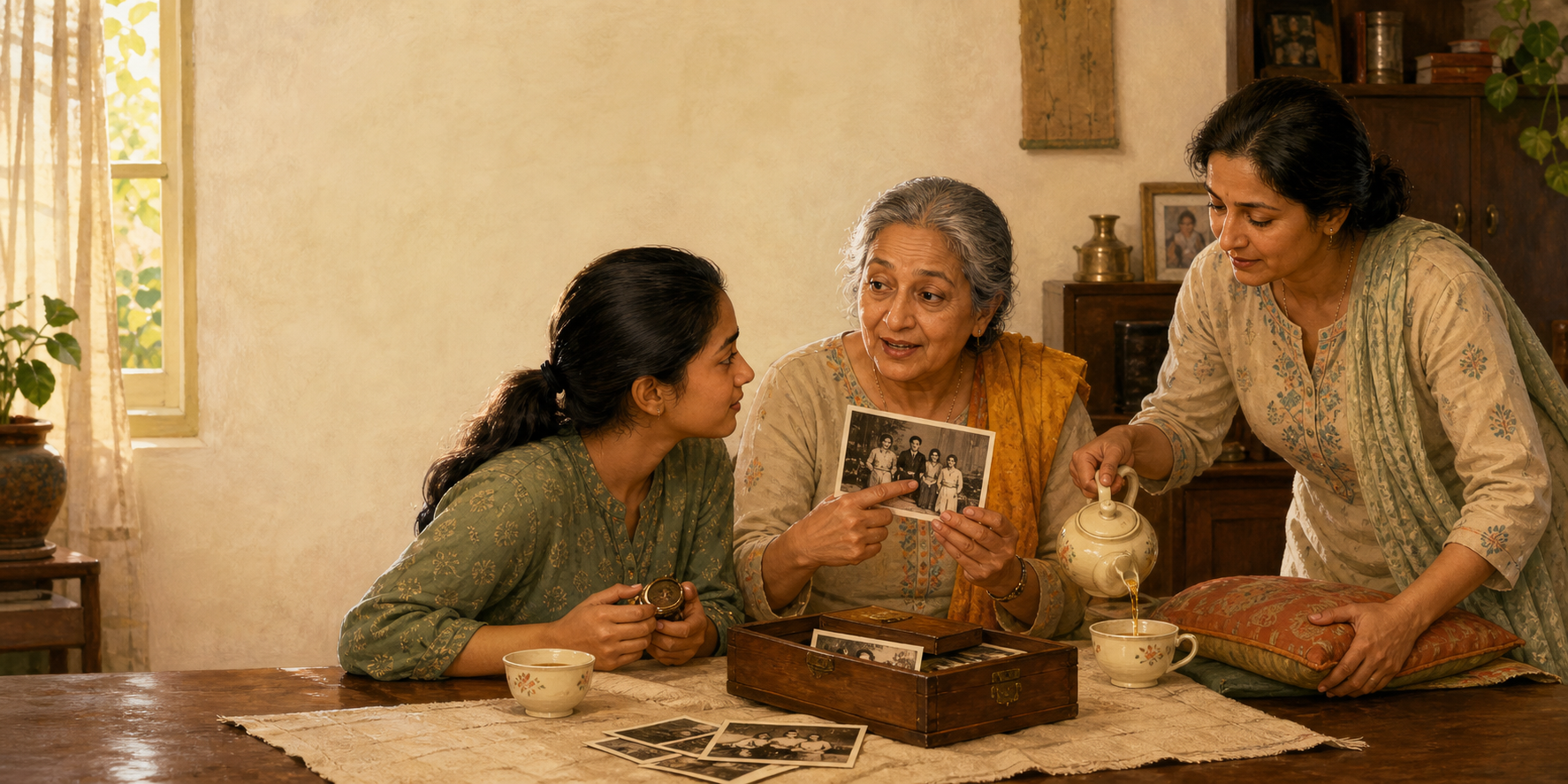
You may have been meaning to ask your mother about the family stories that live only in her memory. You may also be helping her through a difficult season, or trying to support a child without making that child feel helpless. These are not separate responsibilities. They are different moments in the same relationship: guidance, care, and remembrance.
The practical question is how to honor a mother’s role without turning her into a symbol, taking over the life of the person she supports, or waiting until her memories are difficult to recover. The answer begins with attention: notice what she enables, protect her dignity when roles change, and give her stories a form that can outlast the moment.
A mother’s work has three movements
Maternal care is often praised as sacrifice. That description is incomplete. It notices what a mother gives up but can miss the intelligence with which she prepares another person to act. Three kinds of work deserve to be seen clearly:
- Guidance: She establishes a moral horizon, encourages effort, and supplies enough confidence for another person to take the next step.
- Caregiving: She responds to practical needs while trying to preserve comfort, participation, and self-respect.
- Memory keeping: She carries names, relationships, customs, decisions, songs, hardships, and family meanings that may never have entered a written record.
A widely shared scene makes the distinction between guidance and substitution unusually clear. In it, a mother steadies her disabled son as he crosses a stage dressed as Chhatrapati Shivaji Maharaj. Her hand matters, but the movement remains his. She does not take his part, conceal his support needs, or make his achievement her own.
That is a useful standard whenever you help a child, an older parent, or anyone whose circumstances require assistance. Begin with the person’s intended action. Ask what help is wanted. Provide enough support to make participation possible, then keep the credit where it belongs. If you record or share the moment, seek permission rather than assuming that affection overrides privacy.
The image also evokes the cultural memory of Jijabai’s guidance of Chhatrapati Shivaji Maharaj, remembered alongside devotion, discipline, protection of society, and the blessings of Goddess Bhavani. Interpretations of particular historical episodes can vary, but the enduring lesson does not depend on making every episode uncontested: maternal mentorship can help form ethical courage. Guidance at its best does not manufacture obedience. It prepares someone to exercise judgment when the guiding hand is no longer beside them.
When care reverses, protect dignity as carefully as safety

A mother who once waited for a child’s words may eventually need others to wait for hers. That reversal can happen gradually. Meals, appointments, mobility, and medication begin to dominate family attention, while conversation is treated as optional. Practical care is necessary, but it is not the whole of care.
An aging person may pause while searching for a name or the next part of a memory. The silence can tempt you to finish the sentence, correct the sequence, or move on to the next task. Yet waiting through that pause protects both the story and the speaker’s right to retrieve it. The memory may arrive slowly, but slowness is not permission to take possession of another person’s voice.
You can make ordinary caregiving more dignified with a few precise changes:
- Address your mother directly, even when another relative or professional is present.
- Ask, “Would you like help with this?” before stepping in when the situation permits a choice.
- Let a full pause pass before supplying a word. If she wants a prompt, offer one gently rather than turning the conversation into a test.
- Do not correct a harmless detail merely to prove that your recall is sharper. Clarify only when the distinction genuinely matters.
- Notice what restores engagement: a familiar song, a photograph, a name, a place, or a household object may open a path into a story.
- Preserve small choices about food, clothing, visitors, routines, and conversation whenever those choices remain available.
This kind of listening complements medical, mobility, and accessibility support; it does not replace them. If changes in memory or functioning concern you, seek an appropriate professional assessment rather than treating family conversation as a diagnosis or remedy. The relational task remains important alongside that support: make sure the person receiving care is still seen as a person, not reduced to a schedule of needs.
Role reversal can also bring anticipatory grief. You may be caring for someone who is physically present while sensing that parts of a familiar world are narrowing. Do not demand that every conversation become profound. Sitting through an unfinished memory, enjoying a song, or hearing a familiar account again can be an adequate act of love.
Build a memory practice small enough to continue
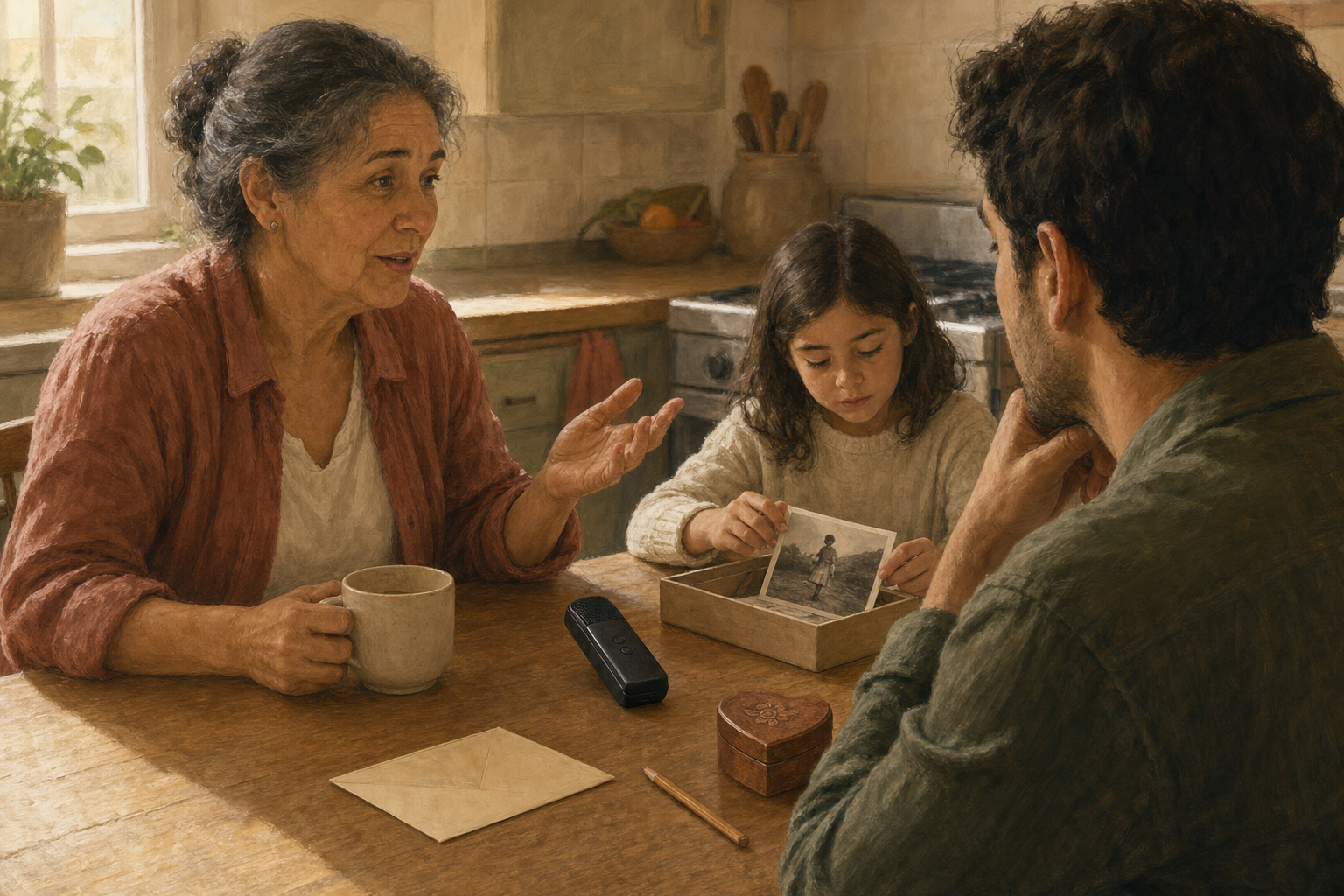
Families often postpone oral history because they imagine a formal interview, a complete genealogy, or a perfectly organized archive. The scale becomes an excuse. A repeatable conversation is more valuable than an ambitious project that never begins.
- Choose a recurring opportunity. A weekly conversation can work, but the useful interval is the one your family can actually sustain without making your mother feel summoned for an interview.
- Ask one narrow question. “Tell us about your childhood” is too broad. Ask about a room, a person, a festival, a journey, a meal, or a decision.
- Leave room after the question. Do not replace a searching silence with several new questions. Memory often needs time to assemble a scene.
- Follow the detail that carries energy. If her expression changes at the mention of a song, teacher, sibling, temple, or family custom, ask about that detail instead of forcing your prepared sequence.
- Request consent before preserving anything. Ask whether you may write, record, photograph, or share the story. Permission to tell you something privately is not automatic permission to publish it.
- Label the memory while context is available. Add the speaker’s name, the recording date, relevant people and places, and an approximate period when known. A simple filename such as
date-person-topicis easier to find than a folder full of unnamed recordings. - Return the story to the family. Let your mother review it if she can and wishes to. Invite children or grandchildren to hear it, ask a respectful follow-up question, and learn that family history comes through living voices as well as books.
Questions that open a specific door
The best prompt contains a place to begin. Try one of these rather than presenting a long questionnaire:
- Which festival preparation were you first trusted to do by yourself?
- Who taught you the first prayer, song, recipe, craft, or household skill you remember?
- What did your home sound and smell like in the morning when you were a child?
- Which family decision was especially difficult, and what principle guided it?
- What changed after marriage, migration, hardship, or the arrival of a new technology in the home?
- Which custom should the next generation understand rather than merely imitate?
A handwritten notebook is enough. So is an audio folder or a simple digital document. Use the format your family can maintain and recover. Keep a backup where appropriate, but do not let technical perfection delay the first conversation.
Treat the result as remembered experience, not courtroom testimony. Two relatives may remember an event differently. Do not silently merge their accounts into a falsely tidy version. Identify each speaker and preserve both recollections when the disagreement matters. Memory keeping should protect voices, not erase complexity.
Dharmic values turn reverence into a practical test
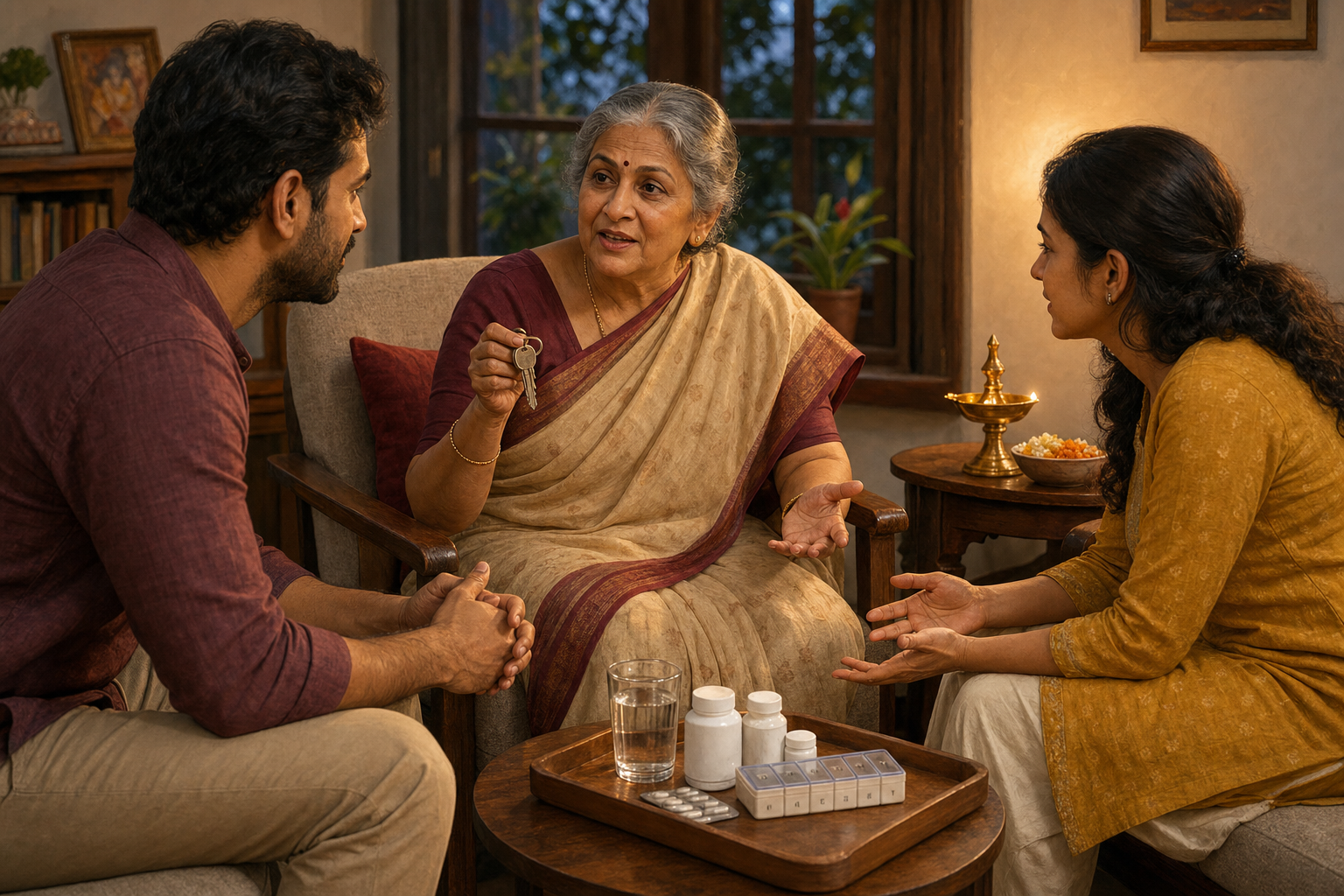
The dharmic traditions do not use one interchangeable vocabulary, and their theological differences should not be blurred. They do, however, offer related ways to examine the quality of family care. Hindu reverence for Shakti, Buddhist emphasis on karuna, Jain commitment to ahimsa, and Sikh esteem for seva and the wise counsel of mata all direct attention toward strength that enables, compassion that remains present, non-harming conduct, and service grounded in dignity.
You can turn those values into questions about conduct:
- Shakti: Does your support release another person’s capacity, or make that person more dependent on your control?
- Karuna and maitri: Can you remain present when speech is slow, a story is repeated, or the encounter does not reward your impatience?
- Ahimsa and daya: Does your manner avoid humiliation, unnecessary correction, infantilization, and public exposure?
- Seva: Are you willing to do the ordinary work of care without converting it into a claim of ownership over the recipient?
- Shraddha: Do you listen as though the speaker’s experience deserves preservation, even when it cannot be made efficient?
Calling motherhood sacred must not become a way to demand endless, invisible labor from women. If a family honors maternal care, the family should also share care. Men and younger relatives can learn the rituals, recipes, relationships, and practical duties a mother has been expected to remember alone. They can ask about her aspirations as well as her sacrifices. Reverence becomes credible when it relieves a burden and preserves agency.
This is also why memory keeping should not begin only when a mother is very old. Her account of raising children, making decisions, sustaining worship, navigating hardship, and maintaining kinship belongs to the family’s understanding of itself. Record the reasoning behind a custom, not just the steps. Preserve what changed and why, not only an idealized version of what was supposedly always done.
Key takeaways for your next family conversation
- Ask your mother one precise question about a person, place, custom, or decision rather than requesting her entire life story.
- Wait when she pauses. Do not treat silence as a failure that you must immediately repair.
- When giving physical or practical help, ask what support is wanted and preserve as much participation as circumstances allow.
- Record or share a personal moment only with permission, especially when disability, illness, grief, or family conflict is involved.
- Give each saved memory enough context to be understood later: speaker, people, place, approximate period, and subject.
- Invite a younger relative to listen so transmission becomes a relationship, not merely a file.
At your next unhurried visit, choose one question and stay through the silence that follows it. You do not need to rescue an entire family history in a day. Help one voice remain audible, and let that act become a habit.
References
- Hindu Human Rights — Viral Video: Mother Guides Disabled Son as Shivaji, a Moving Tribute to Shakti and Courage
- Tiny Buddha — Listening Deeply to an Aging Mother: Preserving Elders’ Wisdom and Dignity in Fast Times
