
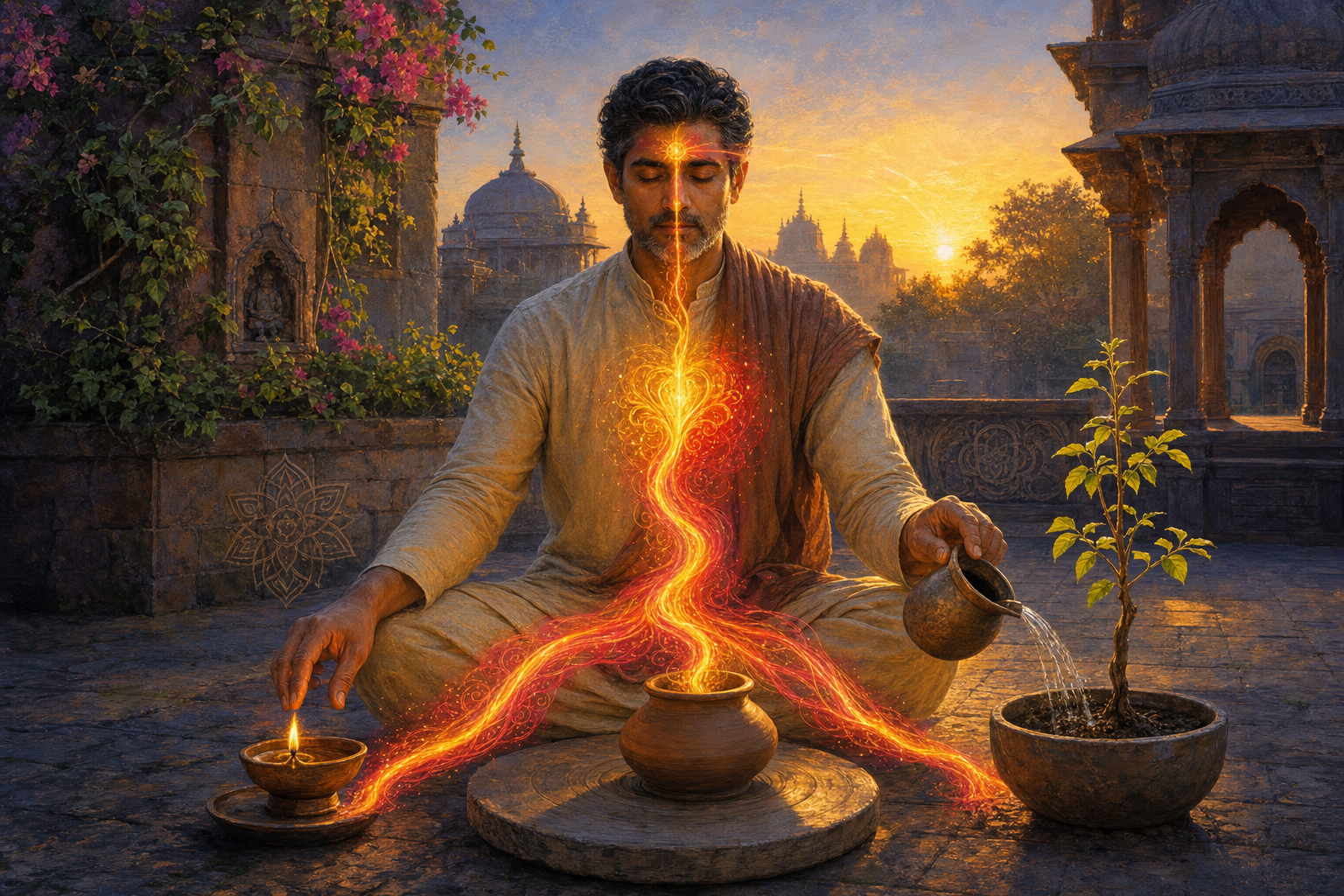
You may recognize the moment when attraction, ambition, devotion, or creative urgency becomes too strong to ignore. The question is not whether you should suppress that energy or surrender to it. The useful question is sharper: what would this passion become if it had to pass through dharma before becoming action?
Madanakala offers a way to answer. In a Tantric-Shakta understanding, it names passion as a current of Shakti that can animate creation. It is not a religious excuse for appetite. It is energy awaiting direction, discipline, and a form worthy of its force.
Sacred energy is not sacred permission

The most dangerous misunderstanding of sacred passion is simple: if a feeling is powerful, unusual, or spiritually charged, it must be right. Intensity proves only that energy is present. It does not prove that your interpretation is true, that another person owes you anything, or that the action you want is dharmic.
Madanakala therefore has to be distinguished from kama that has taken command of the mind. The distinction is not between having desire and having none. It is between holding desire consciously and allowing it to write its own rules.
Before you call a passion sacred, look for four signs of distortion:
- It demands an ethical exception. You begin treating honesty, consent, non-harm, or an existing responsibility as an obstacle to your supposed spiritual purpose.
- It turns a person into an instrument. Their freedom, boundaries, or dignity matter less than the experience you want from them.
- It survives through concealment. You need deception, manipulation, or a double life to keep the passion alive.
- It produces heat without integration. You become more agitated, scattered, possessive, or self-important, while no patient work, service, or compassionate action emerges.
No Tantric vocabulary can convert coercion into communion or self-deception into sadhana. Yama and niyama supply the ethical frame; tapas gives energy endurance; svadhyaya exposes the motives hiding beneath noble language. These disciplines do not extinguish the fire. They stop it from burning whatever happens to be nearby.
Use iccha, jnana, and kriya as a three-part test

Madanakala becomes constructive when passion is coordinated with three powers: iccha-shakti, the power of will; jnana-shakti, the power of understanding; and kriya-shakti, the power that brings intention into form. You can use this triad as a practical test whenever a desire feels urgent.
- Iccha: What is the deeper movement of will? Look beneath the immediate object. You may want recognition beneath ambition, communion beneath attraction, meaningful form beneath creative restlessness, or surrender beneath devotional emotion. Naming the deeper movement loosens your fixation on one outcome.
- Jnana: What must be understood before you act? Include facts that excitement would prefer to ignore: another person’s wishes, your duties, foreseeable harm, the difference between aspiration and capacity, and the possibility that you have misread the situation.
- Kriya: What action can carry this energy without violating dharma? Choose something concrete and accountable. Have an honest conversation, accept a boundary, complete a piece of work, keep a neglected vow, begin a regular practice, or serve a need that exists outside your own emotional drama.
Each power corrects the others. Will without understanding becomes impulse. Understanding without action becomes elaborate self-observation. Action without clear will or knowledge becomes restless activity. Sacred passion needs all three: a worthy intention, an honest view, and a responsible embodiment.
When you are unsure what to do, write three sentences: “My energy is reaching for…”; “Dharma requires me to see…”; and “The next responsible action is…” If you cannot complete the second sentence without evasion, do not rush into the third.
A six-step discipline for refining strong desire

Transformation begins before the outer decision. The aim is to preserve the energy while removing the compulsion, fantasy, and self-justification attached to it.
- Pause the outward reaction. Do not send the message, make the promise, abandon the responsibility, or claim spiritual certainty while you are overwhelmed. A pause is not repression. It separates energy from reflex.
- Name the energy without glorifying it. Use ordinary words: longing, attraction, fear of loss, creative drive, ambition, devotion, hunger for recognition. A precise name is more useful than declaring that destiny or the Goddess has endorsed your preferred outcome.
- Apply the dharmic gates. Ask whether the intended action harms, deceives, grasps, coerces, or abandons a legitimate duty. Ahimsa and aparigraha are especially revealing here: can the passion remain alive without injuring someone or trying to possess what is not yours to possess?
- Give the energy a stable container. Tantric disciplines may use mantra, yantra, mudra, pranayama, concentration, meditation, and absorption. Use a practice you have genuinely learned rather than improvising an esoteric performance. Technique contains energy; it does not replace ethics.
- Convert feeling into one bounded act. Finish a defined creative task, repair a neglected relationship, keep a daily discipline, perform seva, or take one responsible step in your vocation. Kriya becomes real through completion, not through increasingly dramatic intention.
- Review the residue. After acting, notice what remains. A well-directed current tends toward greater clarity, steadiness, compassion, and capacity for meaningful work. If the action leaves you more secretive, entitled, fragmented, or dependent on repeated stimulation, return to the ethical gates.
This process is neither repression nor indulgence. Repression says the energy must not exist. Indulgence says the energy must be obeyed. Transformation accepts that the energy is real while insisting that its expression remain answerable to dharma.
Measure the subtle ascent by visible conduct

In a kundalini-oriented interpretation, Madanakala is associated with a disciplined movement of awareness through swadishtana, manipura, and anahata. The practical movement is from emotionally charged desire, through purposeful capacity, toward creative intelligence and empathic strength. Treat this as a contemplative map, not as a claim that every sensation is evidence of spiritual attainment.
The safest measure of integration is conduct. An extraordinary inner experience matters less than whether you become more truthful, dependable, creative, and capable of respecting another person’s freedom.
| Where passion appears | What misdirection looks like | What dharmic conversion looks like |
|---|---|---|
| Relationships | Possession, secrecy, entitlement, or treating intensity as consent | Honesty, mutual freedom, care, clear boundaries, and the capacity to accept no |
| Vocation | Status fixation, frantic activity, or abandoning responsibility for excitement | A clearly chosen responsibility carried through with competence and awareness of consequences |
| Creativity | Chasing inspiration while leaving every form unfinished | Giving energy a bounded form and completing work that can be offered to others |
| Devotion and community | Emotional display, spiritual self-importance, or identity without discipline | Regular practice, remembrance, seva, and concern for lokasangraha, the welfare of all |
Let your own path provide the discipline
Several Dharmic traditions share the practical insight that desire can be refined, but they do not express it through one interchangeable theology. Vajrayana-oriented practice speaks of transforming desire through upaya into wisdom and compassion. Jain discipline subjects impulse to ahimsa and aparigraha. Sikh practice redirects kama through simran, kirtan, and alignment with hukam. Tantric Shaktism works through Shakti-tattva and its own structures of sadhana.
The shared lesson is useful; careless mixing is not. If you are rooted in a tradition, allow its ethical commitments, tested disciplines, and community of practice to shape the method. You do not need to assemble a hybrid ritual to begin. You need to stop treating emotion as authority and start giving energy a dharmic form.
Key takeaways
- Madanakala is a way of understanding passion as creative Shakti, not a license to satisfy every desire.
- The intensity of an experience does not prove that its interpretation or intended action is dharmic.
- Iccha, jnana, and kriya provide a usable sequence: clarify the deeper will, understand the full situation, and choose an ethical action.
- Mantra, meditation, pranayama, and related disciplines are containers for energy; yama, niyama, ahimsa, tapas, and self-examination determine its direction.
- Judge spiritual integration by visible effects: honesty, steadiness, compassion, completed work, responsible relationships, and service beyond the self.
The next time passion surges, do not immediately suppress it, sanctify it, or obey it. Write the three sentences of iccha, jnana, and kriya. Then choose one action that preserves the energy while making it answerable to truth, non-harm, responsibility, and the welfare of more than yourself. That is where sacred fire begins to illuminate rather than consume.
References
