
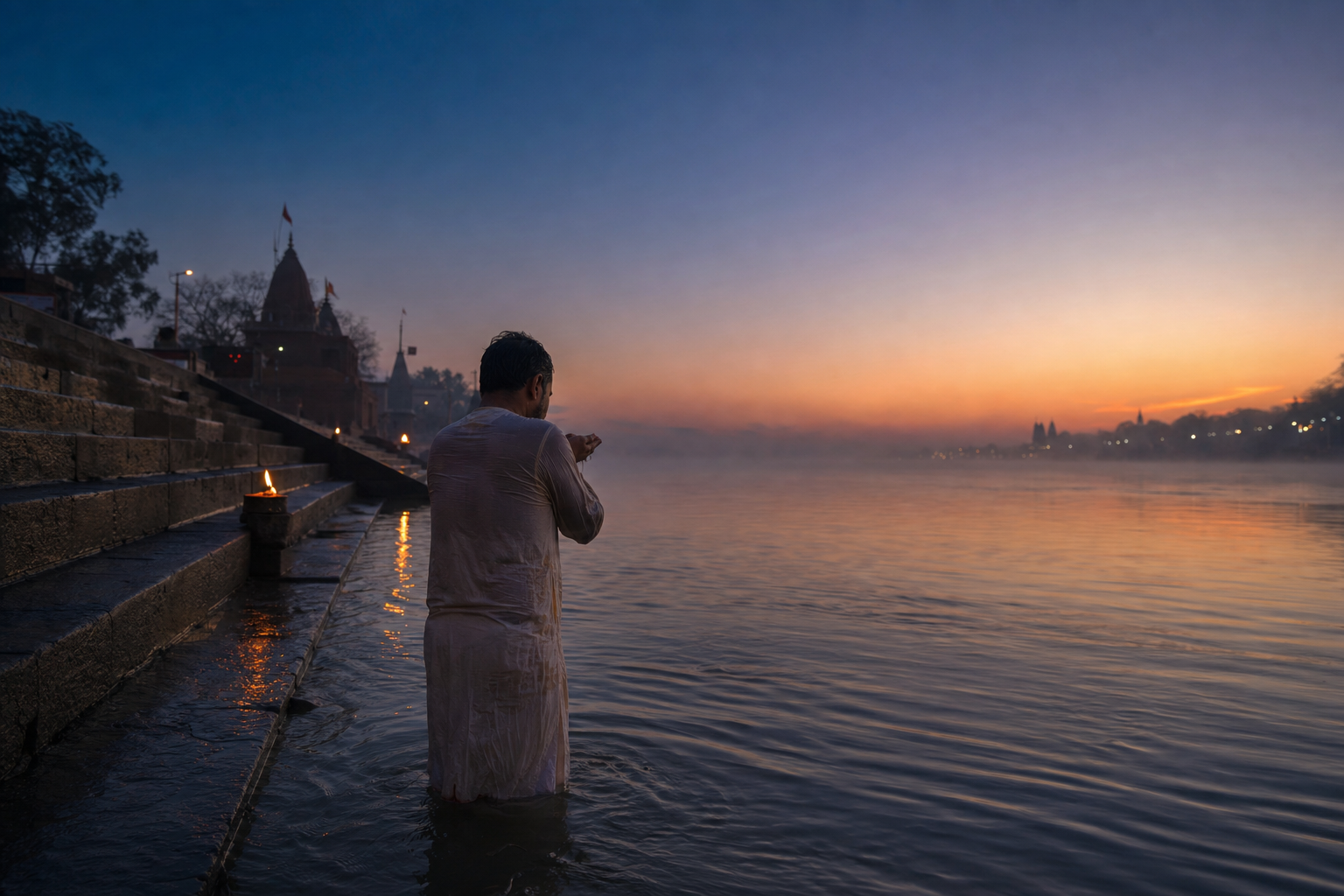
You want to observe Magh Snan, but a practical question is getting in the way: must you reach a sacred river, immerse yourself in cold water, know a particular Sanskrit formula, or bathe at an exact minute for the observance to count?
The workable answer is demanding but simple. Keep the pre-dawn bath as the anchor, enter it with a clear intention, and make your conduct after it part of the vrata. A sincere and safe bath at home can carry the discipline when pilgrimage is not possible. An elaborate dip cannot compensate for carelessness, anger, waste, or indifference.
Pre-dawn is an inner boundary, not a test of endurance
The traditional pattern centers on snana before sunrise, often joined to japa, vrata, daana, and sunrise arghya. Brahma Muhurta is especially honored because the world is comparatively quiet: ordinary demands have not yet occupied the mind, and prayer does not have to fight through the momentum of the day.
You do not need to turn that principle into false precision. Work backward from your local sunrise and complete the bath before it. If your sampradaya, temple, teacher, or family tradition gives a more exact discipline, follow that received practice. Otherwise, the important distinction is between a hurried bath after the day has begun and a deliberately chosen pre-dawn observance.
Cold water is not a certificate of sincerity. Magh Snan is sometimes described as a holy dip, but the spiritual work is not measured by how much discomfort you can display. Use water and conditions that are safe for you. Do not enter dark, fast-moving, contaminated, prohibited, or unsupervised water. At a crowded pilgrimage site, respect barriers and local instructions. If outdoor immersion is unsafe, bathe at home rather than converting devotion into avoidable danger.
Water marks a threshold. You enter carrying restlessness, attachment, resentment, or regret; you leave with a decision about how you will meet them. Without that decision, the bath remains bodily cleanliness. With it, the same act becomes a form of abhyasa – repeated training of attention and character.
Choose the setting without losing the purpose
Magh Snan has a powerful geography. Ganga, Yamuna, Brahmaputra, Narmada, and Godavari carry sacred memory across Bharat, while confluences such as Prayagraj give the observance a collective form. A tirtha joins personal discipline to pilgrimage, inherited memory, and the presence of other worshippers.
- At a tirtha: arrive with enough time to avoid rushing, carry only what you need, obey the site’s safety arrangements, and keep your attention on sankalpa and prayer rather than spectacle. Crowds do not lessen the sacredness, but they do increase your responsibility to move carefully and avoid obstructing others.
- At a local river or lake: use only a permitted and safely accessible place. Pre-dawn darkness changes familiar terrain, so do not assume that a bank, current, or path is safe merely because you have seen it during daylight. If the conditions are uncertain, do not enter.
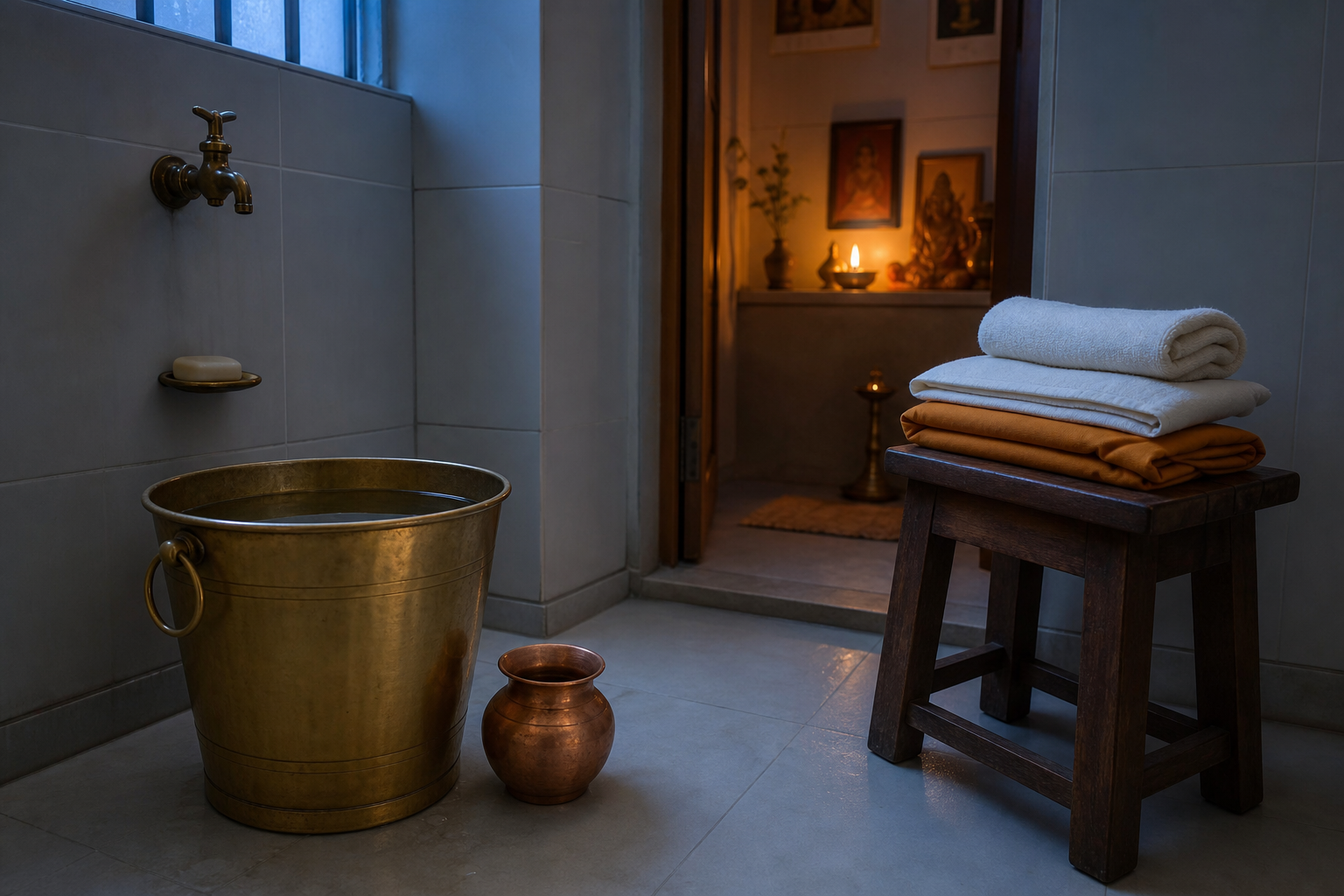
- At home: bathe fully and attentively before sunrise. Prepare the space beforehand, put the phone aside, make your sankalpa, and give prayer the time that travel would otherwise have occupied. Home snana is an accessible observance, not a reason to perform it casually.
Do not treat river water as an authenticity token. Sacred place matters, and pilgrimage cannot be reduced to bathroom ritual. Yet distance, weather, disability, caregiving, work, or safety may prevent travel. In those circumstances, the dharmic response is not to abandon the observance or imitate a dangerous immersion. It is to preserve the elements available to you: pre-dawn discipline, mindful bathing, remembrance, prayer, daana, and ethical restraint.
A simple Magh Snan sequence you can actually keep
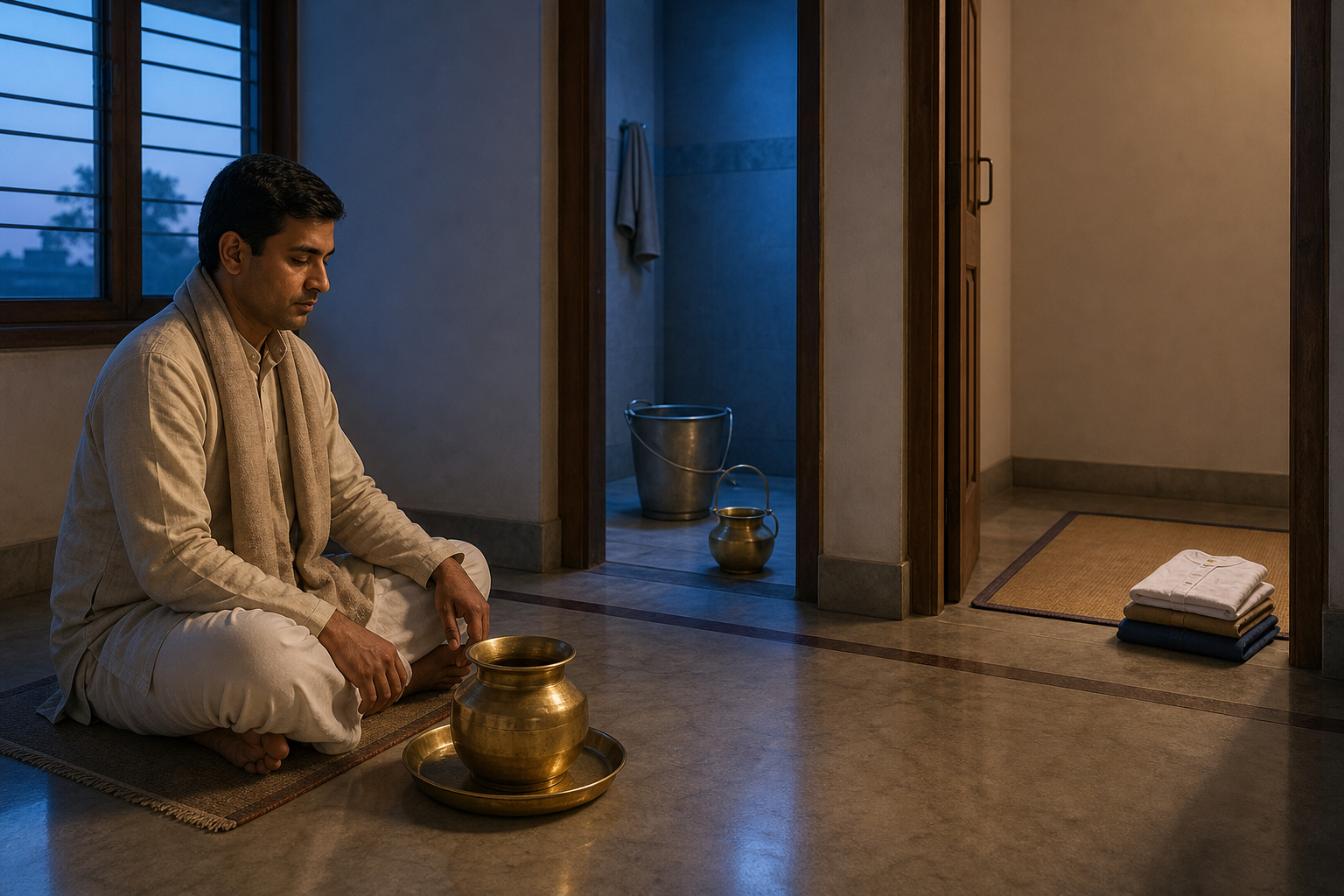
The exact order varies among regions, households, and lineages. A received family or sampradaya practice should take precedence. If you do not have one, the following sequence is complete enough to be meaningful and simple enough to repeat.
Prepare the night before
- Find the local sunrise time. Work backward so that bathing, dressing, and a few undisturbed minutes of prayer fit before sunrise. Do not rely on a memorized time from another season or location.
- Set out what you need. Prepare a towel, clean clothes, a safe light if necessary, your prayer text or mala, and anything required for arghya. Removing small decisions protects the quiet of the morning.
- Choose one recitation. You might use your established mantra, a Ganga stotra, Vishnu Sahasranama, or another prayer received in your tradition. Choose what you can recite attentively; a shorter prayer kept with presence is more useful than an ambitious programme abandoned midway.
- Decide your daana or service in advance. Make it concrete enough to complete that day. Preparing the gift, amount, item, or act beforehand prevents charity from becoming the part of the observance that is always postponed.
Move from waking to sunrise deliberately
- Begin without immediately filling the mind. If circumstances allow, leave messages, news, and ordinary conversation until after the practice. The quiet you protect is part of the preparation.
- Make a brief sankalpa. State what you are undertaking, why you are undertaking it, and whom its benefit should include. A plain form is enough: During Magh, I undertake this snana for clarity, self-restraint, and the welfare of all beings.
- Bathe before sunrise. Bring attention back whenever the mind wanders. Let the water mark the release of one specific fault or burden rather than vaguely wishing to become a better person.
- Pray or perform japa. Use the mantra, stotra, or meditation you selected. Do not measure the practice by volume or speed. The purpose of choosing beforehand was to make room for recollection, not mere completion.
- Offer arghya to Surya at sunrise if this belongs to your practice. Make the water offering in the customary manner, where it is safe and permitted. Keep the act reverent and simple; do not leave vessels, packaging, or other waste behind.
- Complete the daana or service. Do it the same day if possible. This carries the clarity of the morning into another person’s welfare and prevents the observance from closing around the self.
Do not overload the sequence merely because the month is sacred. Complexity often fails at the most predictable point: after the first enthusiastic morning. If your vrata extends across several mornings, use a form that can survive workdays, family obligations, and imperfect energy. Steadiness is part of the discipline.
The bath has not finished when your skin is dry
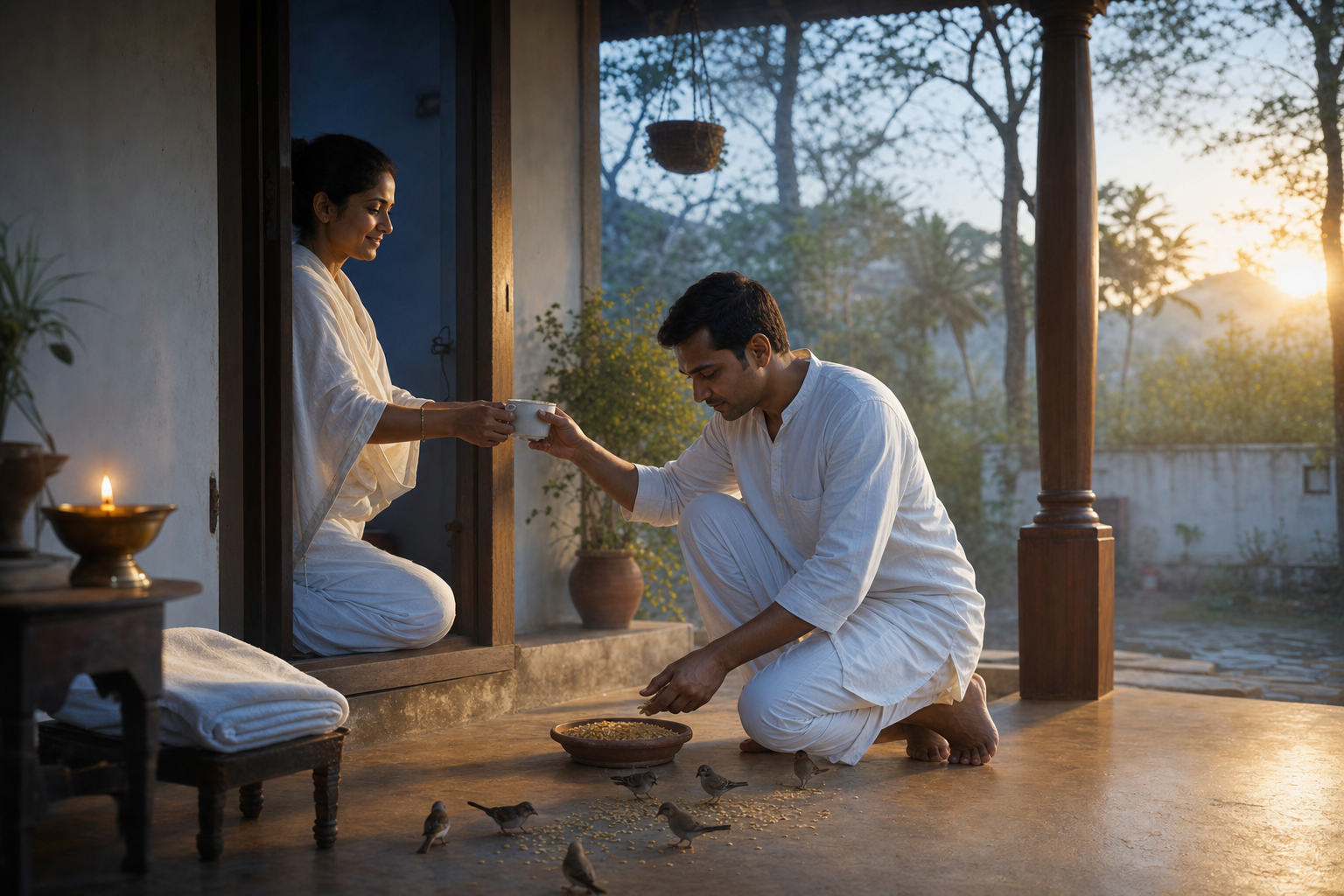
The Padma Purana praises disciplined snana during Magh, and the tradition associates the observance with purification and the dissolution of past transgressions. That language should deepen responsibility, not weaken it. Where there has been harm, purification asks for remorse, restraint, and corrective conduct. Repeating the same cruelty after bathing empties the ritual of its ethical force.
- Turn truthfulness into one decision. Identify the convenient falsehood, exaggeration, or concealment you are most likely to use that day, and refuse it.
- Turn ahimsa into restraint at the point of friction. Watch the sharp reply, humiliating joke, needless argument, or dismissive gesture. The test arrives after the peaceful morning, when another person interrupts your plans.
- Turn purification into release. Choose one resentment, possessive habit, or repetitive angry thought to stop feeding. This does not require pretending that wrongdoing was acceptable; it means refusing to let agitation govern your next action.
- Turn daana into lokasangraha. Let some part of the observance support the wider community through selfless giving, practical help, or care for a shared place.
This inner standard also prevents a common misunderstanding among the Dharmic traditions. Hinduism, Buddhism, Jainism, and Sikhism remain distinct paths with distinct rites; Magh Snan should not be projected onto all of them as an identical requirement. Their shared ethical insight is narrower and stronger: outer cleanliness cannot substitute for less anger, less attachment, more compassion, and less harm.
Care for water belongs inside the observance, not beside it as a modern extra. Carry reusable necessities, avoid disposable plastic, take packaging home, and do not introduce soap, oil, or rubbish into a river or lake. If a bank is littered, support a safe cleanup rather than adding another ceremonial object to the burden. Reverence for Ganga, Yamuna, Narmada, Godavari, Brahmaputra, or a local watershed becomes credible when the water and its banks are safer and cleaner after worshippers leave.
Key takeaways for a faithful observance
- Use your local sunrise as the practical boundary and complete the bath beforehand; follow a more exact inherited rule when your tradition provides one.
- Choose a tirtha when pilgrimage is possible, a safe local water body when appropriate, or a mindful home bath when distance or conditions prevent immersion.
- Do not mistake cold, darkness, crowds, or physical risk for spiritual merit.
- Keep the sankalpa short enough to remember and specific enough to shape one action after the bath.
- Join snana to japa or prayer, sunrise arghya where customary, and daana or service that is actually completed.
- Judge the observance by its fruit in conduct: greater truthfulness, restraint, ahimsa, compassion, and care for shared water.
Tonight, locate sunrise, choose the safest setting, place your towel and prayer text where you will need them, and write one sentence of sankalpa. Decide the act of daana as well. When the water comes before dawn, let your intention be concrete enough to survive breakfast, work, disagreement, and the rest of the day. That is how Magh Snan becomes sustained dharmic practice rather than a seasonal gesture.
References
