
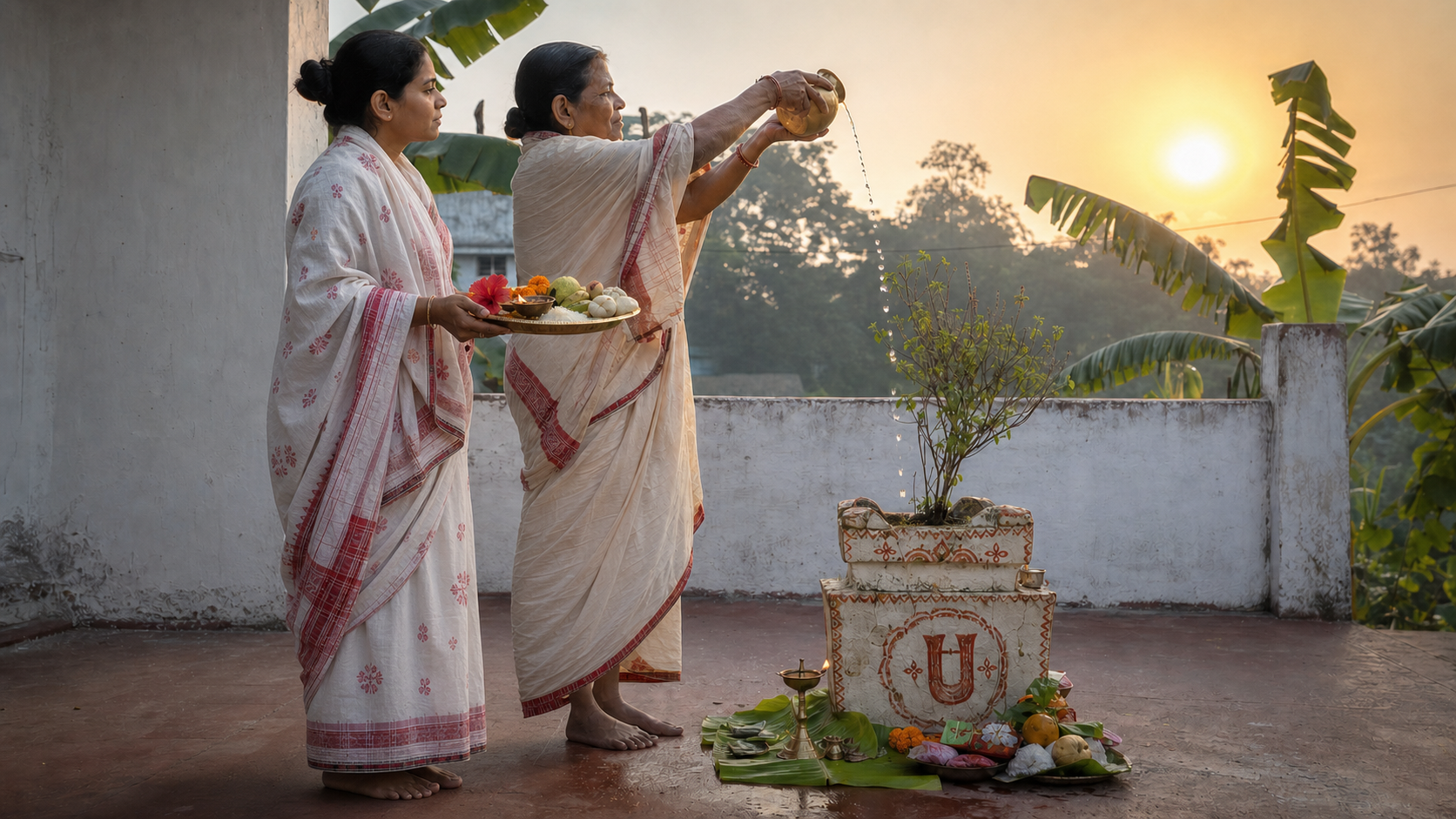
You may remember Samba Dashami as the morning when an Odia household woke before sunrise, prepared pitha, and turned toward Surya Bhagwan. But if you are now responsible for the observance yourself, the practical questions arrive quickly: Which date should you follow? What belongs in the puja? Which customs are central, and which depend on your family?
You do not need to recreate every detail at once. Begin with the right tithi, a clear place for sunrise arghya, the form of prayer your family recognises, and food prepared with care. Those elements keep the vrat grounded in both Surya worship and Odisha’s living household tradition.
Choose the day by tithi, not by last year’s date
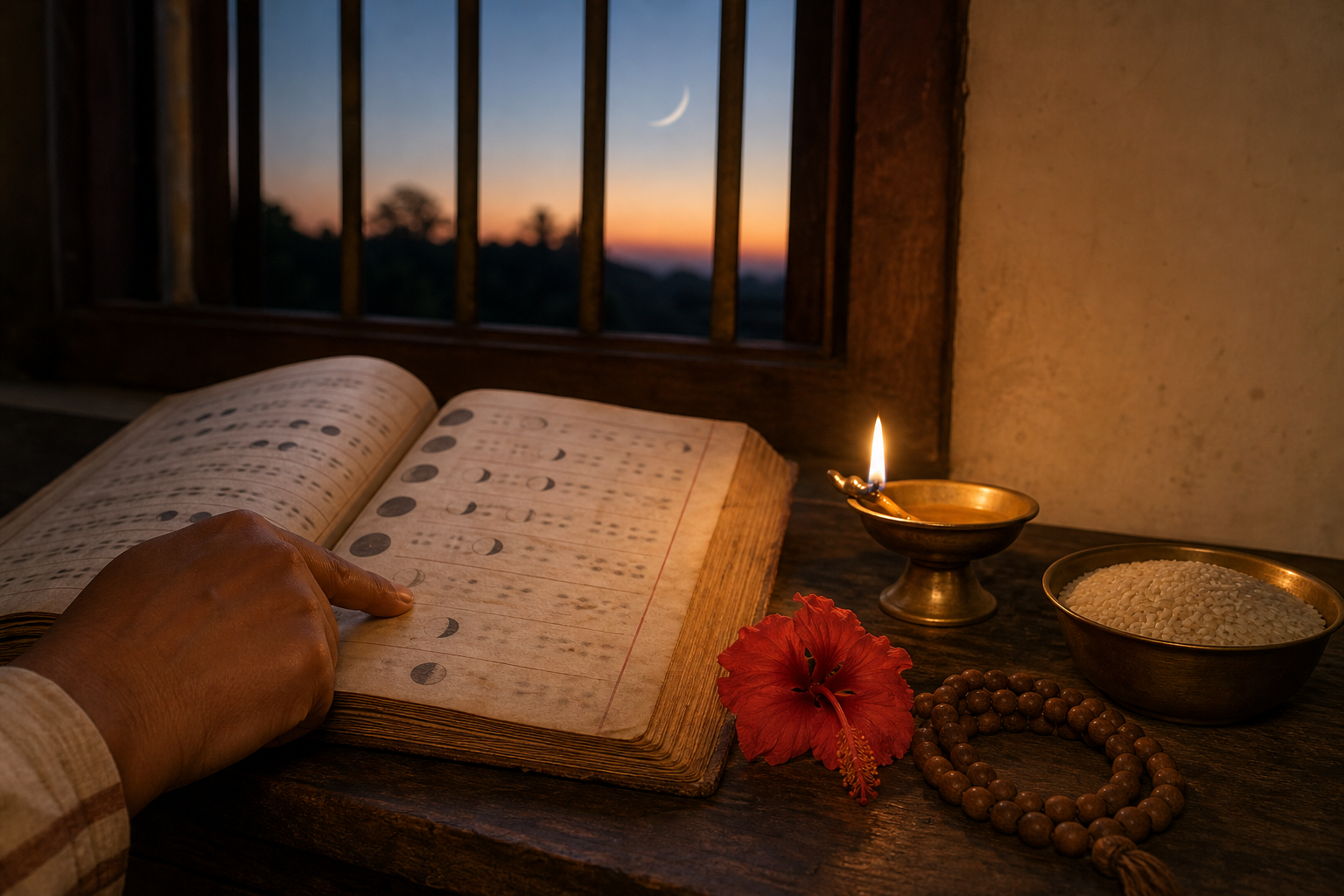
Samba Dashami falls on Dashami tithi of Shukla Paksha in the month of Pausha. Because a lunar tithi is not tied permanently to one Gregorian date, copying the date from an old calendar can put your observance on the wrong morning.
Consult a panchang calculated for your location and note both the Dashami timing and local sunrise. A tithi does not necessarily begin at midnight, which is why two calendar entries may appear to disagree when they are actually showing different locations or conventions. If your family follows a particular temple, priest, or regional panjika, use that system consistently rather than combining timings from several calendars.
Make these decisions before the day of the vrat:
- Record the local date, Dashami tithi timing, and sunrise time.
- Confirm whether your household has a customary mantra, stotra, vrat katha, fasting rule, or sequence of offerings.
- Choose an open, safe puja space where the morning light is unobstructed.
- Decide who will prepare the pitha and other prasada so that the work does not crowd out the worship itself.
- Set aside the vessel, ingredients, flowers, and puja materials the previous evening.
This preparation matters because sunrise is the fixed point around which the morning practice is organised. If you leave the calendar check, cooking plan, and puja setup until dawn, the ritual can become hurried precisely when it is meant to cultivate attention.
Understand the healing story without turning it into a medical claim

The emotional centre of the observance is the Samba Dasami Vrat Katha. Samba, the son of Sri Krishna and Jambavati, is remembered as suffering from a grave illness and regaining health through the grace of Surya. Odia families therefore connect the vrat especially with prayers for their children’s health and the wellbeing of the household.
The katha should shape the intention of the day: illness does not remove a person’s dignity, adversity need not destroy discipline, and gratitude belongs alongside the desire for recovery. Tell it as a sacred narrative about devotion, resilience, and Surya’s compassion. Do not present it to a sick child or adult as a promise that ritual will cure disease. Prayer can accompany medical care; it must not replace diagnosis, prescribed treatment, or urgent help.
This distinction protects rather than weakens the vrat. The worshipper is not bargaining for guaranteed results. The worshipper is acknowledging dependence on light, nourishment, time, and a cosmic order larger than personal control.
Surya worship also carries a wider Dharmic resonance. The Sun is praised in Vedic hymns, appears within Buddhist and Jain cosmological understandings, and can be recognised within the Divine order that sustains creation in Sikh teaching. These traditions should not be flattened into one theology. Their shared ethical insight is simpler: life depends on realities we did not manufacture, and gratitude should change how we live.
A simple household sequence for sunrise Surya puja
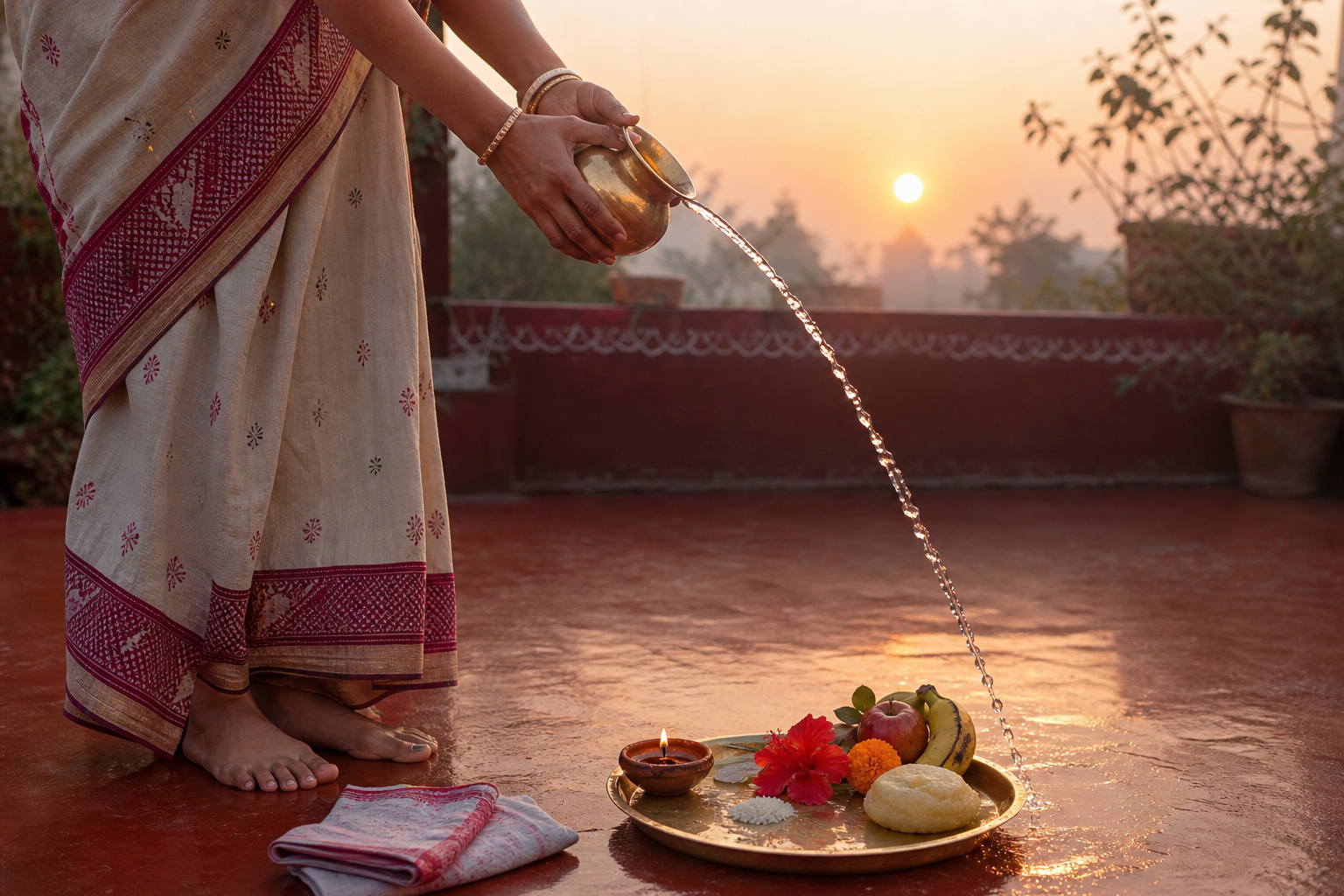
Every Odia family may preserve its own paddhati, so inherited instructions should take precedence over a generic checklist. If you are beginning without a complete household sequence, the following order keeps the documented elements of Samba Dashami together without pretending that every optional detail is mandatory.
- Prepare the place before sunrise. A courtyard or another open area with unobstructed morning light is suitable. Many households worship near a Tulasi plant. Keep the ground stable and the path clear, especially if an elder will carry the arghya vessel.
- Prepare the arghya. A copper lota is commonly used. Place it within easy reach before the sunrise moment rather than carrying several loose items at once.
- Arrange the prasada. Set out the pitha, kheeri, fruit, jaggery, betel leaves, and any other offerings required by your family custom. The arrangement can be modest; care and order matter more than an unnecessarily large display.
- Offer arghya at local sunrise. Stand in the prepared space, offer the water to Surya Bhagwan, and recite the Surya mantra or stotra used in your household. You do not need to stare at the Sun; avoid looking directly at it.
- Make the prayer specific. Hold the wellbeing of children and other family members in mind, naming people where that is your custom. Follow the recitation with a quiet interval instead of moving immediately to phones, photographs, or household errands.
- Carry the discipline into the rest of the day. Some devotees fast, while others keep a simple sattvic diet. Choose the form appropriate to your health, family practice, and any vow you have actually undertaken.
Fasting is not a test of who is most devoted. Children, pregnant or nursing people, older adults, anyone who is unwell, and anyone whose medication depends on food should not change meals or medicines merely to imitate another person’s vrat. Use an appropriate sattvic meal when fasting would be unsafe, and seek medical guidance when a health condition makes the choice uncertain.
If work, weather, mobility, or apartment living affects the setup, protect the core intention while adapting the logistics. Choose the safest accessible place with morning light, follow building rules, and use a stable receptacle where pouring water onto the ground is impractical. Check any adaptation against your family custom rather than assuming that an internet checklist can settle a ritual question for every lineage.
Let Odia offerings carry memory, not performance pressure
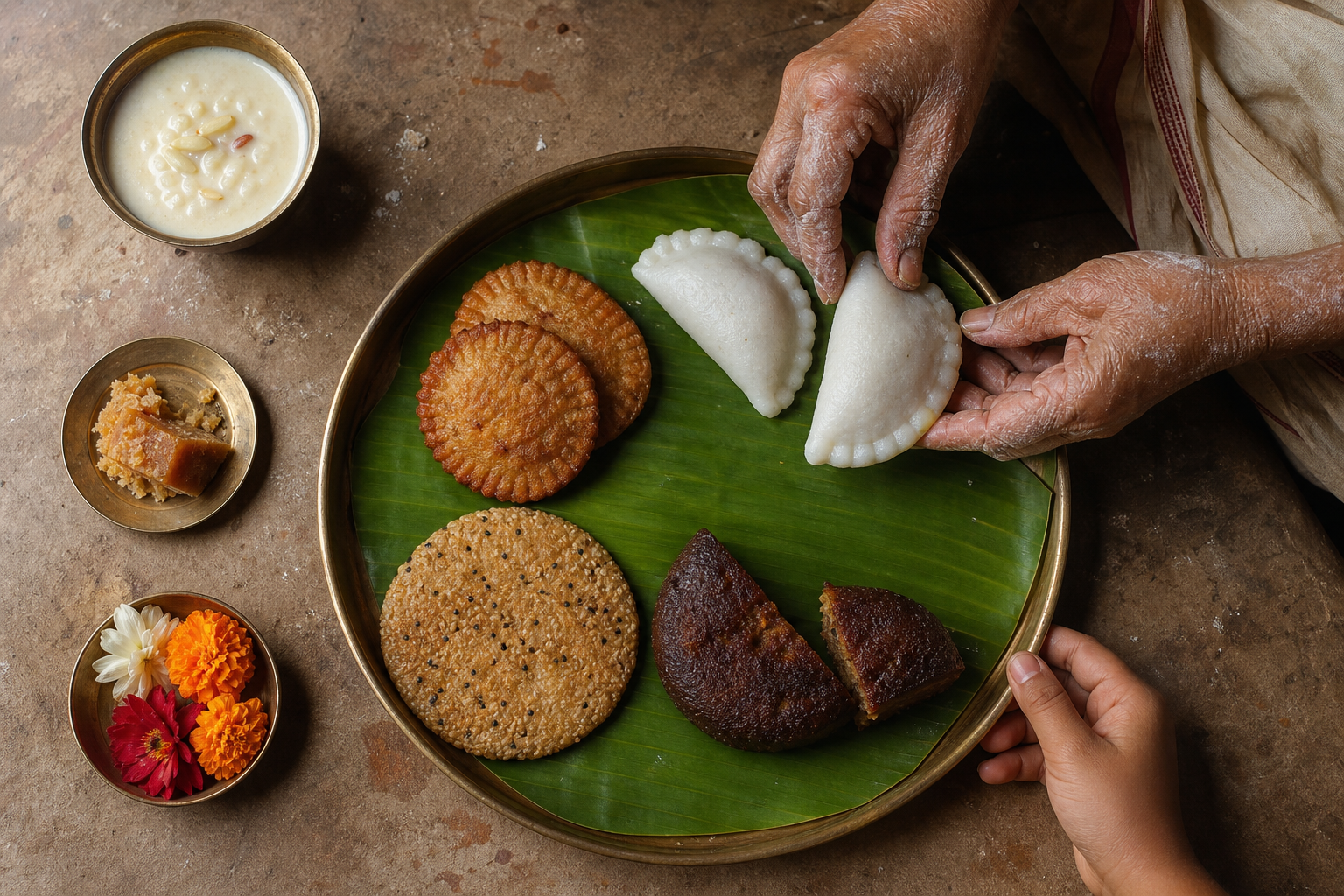
The food is not an incidental decoration. Arisa, manda, and kakara pithas, along with kheeri, seasonal fruits, jaggery, and betel leaves, place the worship unmistakably within an Odia home. Their preparation links the Surya vrat to household knowledge transmitted through ingredients, gestures, names, and remembered sequences.
- Pitha: Choose arisa, manda, kakara, or the combination established in your family.
- Sweet preparation: Kheeri is among the customary offerings.
- Produce and sweetness: Seasonal fruit and jaggery can accompany the cooked items.
- Traditional puja item: Include betel leaves where they belong to your household practice.
Do not treat that list as a demand to cook everything. If time, money, health, or distance limits what you can prepare, first ask which item your family regards as central. Make a smaller menu attentively. Buying or producing a crowded spread while the worshipper is exhausted misses the discipline the vrat is meant to foster.
This is also the moment to preserve knowledge deliberately. Ask an elder what each preparation is called locally, who taught them the recipe, which item was offered first, and whether the household has a distinctive prayer. Write the answers down. Invite younger family members to measure ingredients, arrange fruit, fill the lota, or read the katha. Participation transfers a tradition more effectively than asking children merely to watch.
Use natural flowers, biodegradable offerings, and reusable copper or clay vessels where practical. Avoid unnecessary plastic packaging in the puja area, and dispose of offerings in a way that does not litter a courtyard, waterway, or public space. Reverence for the life-giving Sun sits naturally beside care for the environment that receives the ritual materials.
The remembered image of mothers and grandmothers rising before dawn matters because Samba Dashami has often been carried through intimate household labour. Honour that inheritance by sharing the work. Devotion should not require one person to cook through the night while everyone else arrives only for the finished puja.
Key takeaways for observing Samba Dashami well
- Find the date through Pausha Shukla Dashami and your local sunrise, not by reusing a previous year’s Gregorian date.
- Keep sunrise arghya, Surya prayer, the Samba vrat katha, and household wellbeing at the centre of the observance.
- Receive Samba’s healing narrative as a teaching about devotion and resilience, never as a substitute for medical care.
- Let family paddhati decide which pithas, mantras, fasting practices, and ritual details are required in your home.
- Use the preparation to transmit Odia knowledge: record recipes, explain the katha, involve children, and divide the work fairly.
- Prefer natural, reusable, and biodegradable puja materials so that the offering does not leave avoidable waste behind.
Before the next Samba Dashami, take three concrete steps: save the correct panchang entry, speak with the elder who knows your household sequence, and write one combined puja-and-cooking checklist. When dawn arrives, you will be free to offer arghya with attention rather than trying to reconstruct the tradition in a hurry.
References
