
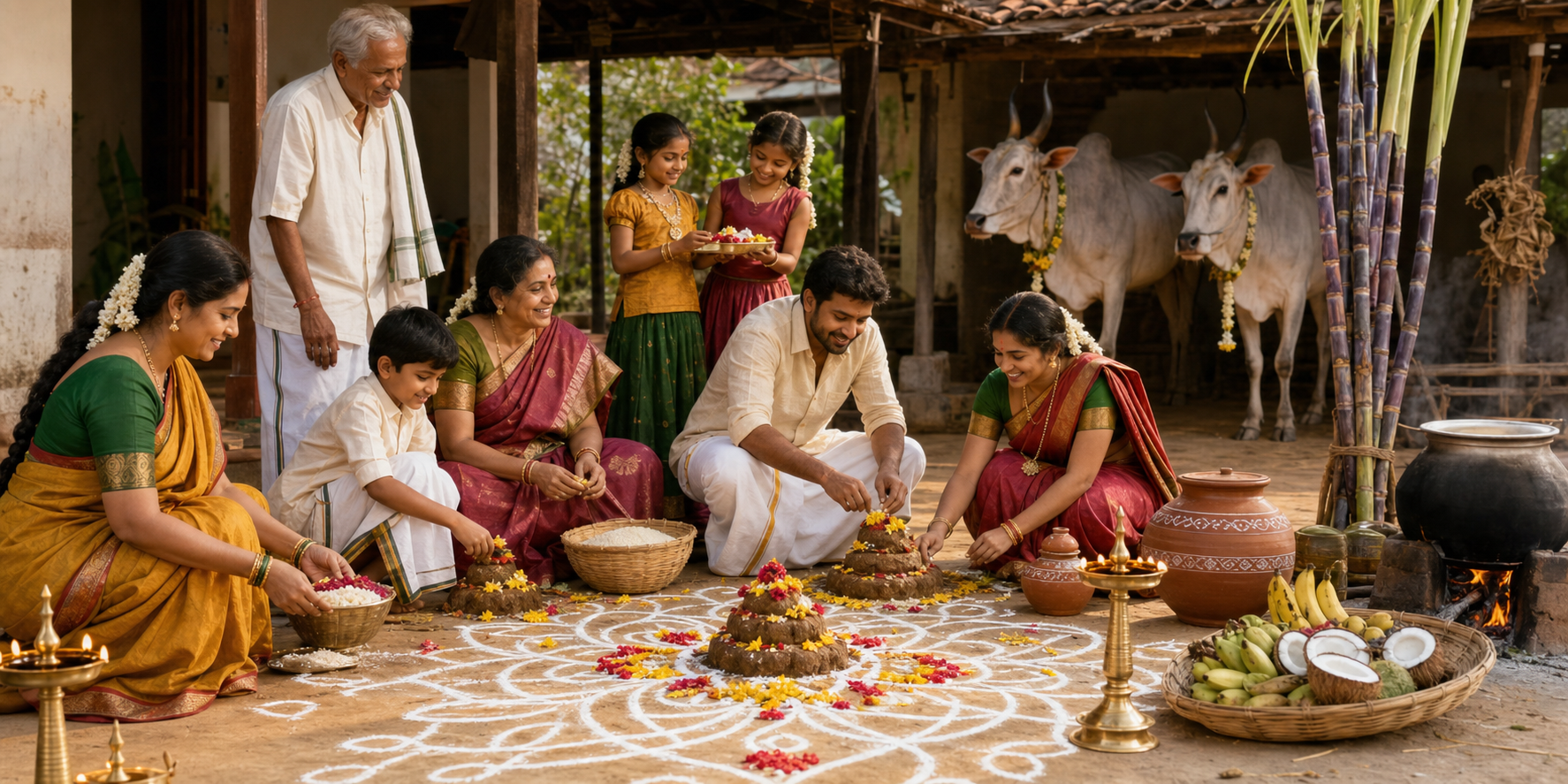
You may know the names Bhogi, Makara Sankranthi, Kanuma and Mukkanuma, yet still wonder how to turn them into a coherent family observance. That question becomes especially practical when you live in an apartment, have no cattle at home, or inherited only fragments of your family’s Andhra customs.
You don’t have to reproduce every village practice to preserve the festival. Keep its four-day order, give each day its proper focus, and involve other people. Once those elements are in place, even a modest observance can carry devotion, agrarian gratitude and cultural memory.
Keep each day distinct instead of compressing the festival
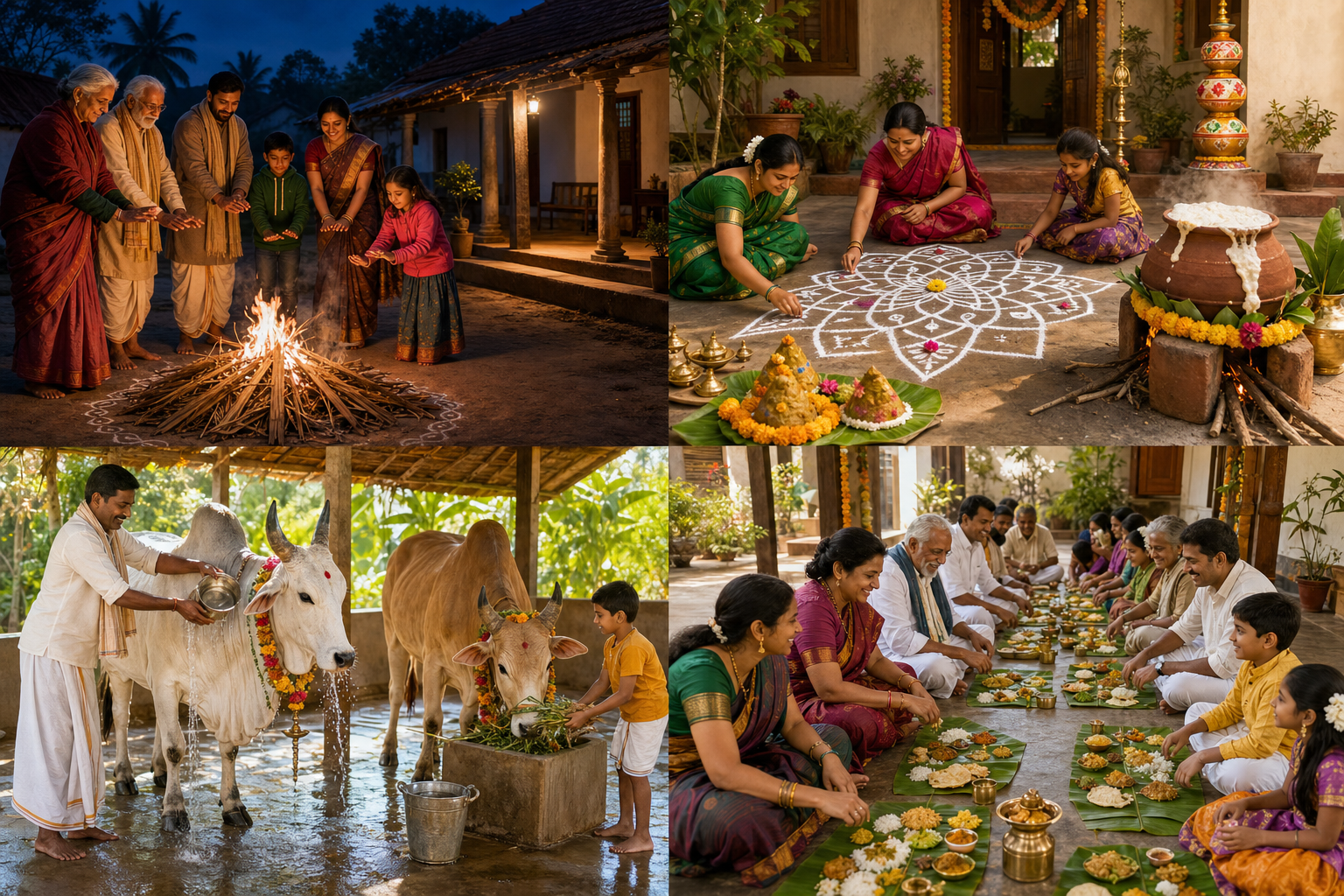
Andhra Sankranthi works as a sequence. Bhogi, Makara Sankranthi, Kanuma and Mukkanuma move the household through renewal, solar worship, gratitude toward cattle and the land, and a communal conclusion. If everything is compressed into one festive meal, the celebration remains enjoyable but loses much of its inner structure.
| Festival day | Central purpose | A manageable home observance | Community expression |
|---|---|---|---|
| Bhogi | Household renewal and preparation | Clean the entrance or courtyard, prepare the muggu, and ready the Bommala Koluvu if your family keeps one | Join an established Bhogi Mantalu gathering where it is permitted and safely organized |
| Makara Sankranthi | Surya worship and gratitude for the new harvest | Offer seasonal food, pray to Surya, and share the meal with the family | Visit a temple, distribute prasadam, or welcome relatives and neighbors |
| Kanuma | Gratitude for cattle, nature and agrarian livelihoods | Perform Go puja where cattle can be approached responsibly, or teach children why animal labor and the land are honored | Participate in a family or community cattle observance under the animal keeper’s direction |
| Mukkanuma | Completion of the festive cycle and, in participating homes, Bommala Nomu | Offer naivedyam, make a simple sankalpa, and conclude the koluvu respectfully | Receive final visitors, share prasadam, and thank everyone who helped |
This structure also helps when time is limited. Do one defining act each day rather than attempting every custom at once: renewal on Bhogi, Surya worship on Sankranthi, compassionate agrarian gratitude on Kanuma, and a deliberate conclusion on Mukkanuma.
Do not assume that a date or ritual hour used in one year will carry over unchanged. Observances can depend on tithi, regional convention and temple practice, so confirm the calendar and local timings with a trusted panchang, your family elders, or the temple you plan to visit.
Build the home observance around entrance, food and story
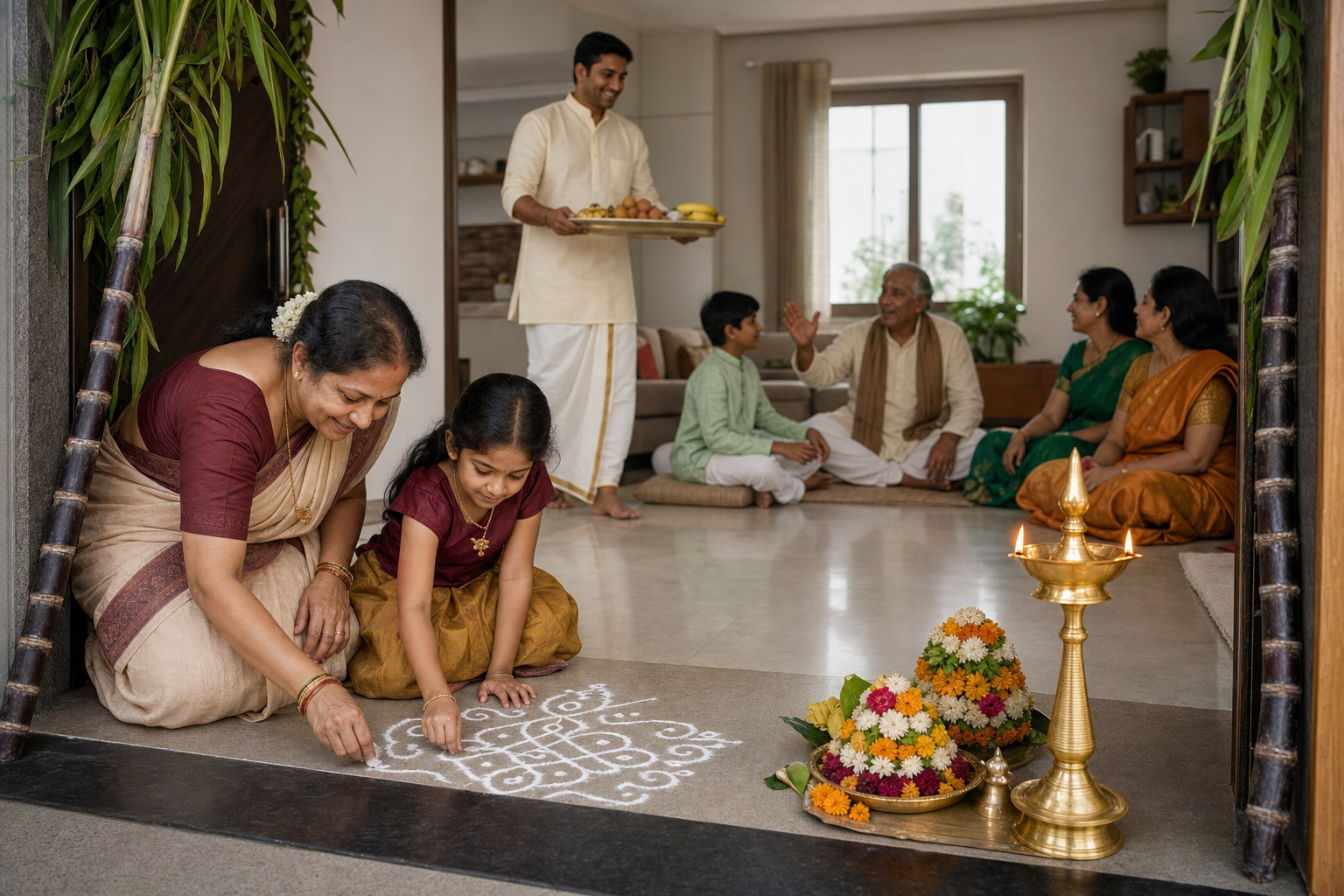
A useful home plan has three anchors. The muggu marks the household threshold as a festive space. The new-harvest offering turns food into gratitude before it becomes a meal. The Bommala Koluvu, where observed, gives children and guests a visible way to enter the stories of the tradition.
Give the muggu a ritual purpose
Begin by cleaning the courtyard or entrance and drawing a festive muggu. In an apartment, a smaller design near the doorway is enough. Its value does not depend on occupying a large space; it establishes that the household has consciously entered the festival.
Give children a defined part of the work rather than asking them merely to watch. They can help prepare the area, choose a simple pattern, or explain to a visitor why the entrance has been decorated. Participation turns a seasonal image into remembered practice.
Make the offering before making the menu elaborate
The meal should communicate harvest gratitude, not household competition. Pongal, fresh produce, sugarcane and til-jaggery preparations are among the seasonal foods associated with the koluvu and Sankranthi setting. Choose what your household genuinely prepares well, set aside the naivedyam according to your family practice, and then share the food without turning abundance into waste.
If relatives follow different recipes, preserve those distinctions. Andhra Sankranthi is not made more authentic by forcing every family into one standardized menu. Ask which preparation belongs to your own family memory, record who taught it, and give that dish a clear place in the celebration.
Use Bommala Koluvu as a narrative altar
Bommala Koluvu is more than a display cabinet opened for a festival. Its ordered tiers can hold deities, saints, animals, artisans, village scenes, the harvest and episodes from Itihasa-Purana. The arrangement lets a child move from the sacred world to everyday social life and notice that both belong within the same cultural imagination.
In families that observe it, preparation can begin on the day before Bhogi and conclude with Bommala Nomu on Mukkanuma. You can organize a small koluvu without losing that pattern:
- Choose one clear theme, such as the harvest, village occupations, a Ramayana episode, or a Mahabharata episode.
- Inspect heirloom dolls before arranging them. Clean and repair what can be preserved instead of replacing the collection for the sake of novelty.
- Place sacred icons on the upper tier and cultural or everyday scenes below. Use a stable structure suitable for the space and the objects you own.
- Give each child one figure or scene to understand. Ask the child to tell its story when guests arrive.
- On Mukkanuma, offer prayers and naivedyam and make a simple sankalpa for health, prosperity and harmony. Use inherited wording if your family has it; otherwise state the intention plainly and reverently.
- After the observance concludes, wrap and store the figures carefully. Note any repairs needed before the next Sankranthi.
A smaller collection with remembered stories is more valuable than a crowded arrangement no one can explain. When adding new figures, look first to regional artisans and durable natural materials. That choice supports living craftsmanship while keeping the koluvu connected to the people whose work it depicts.
Make hospitality carry the tradition beyond your household
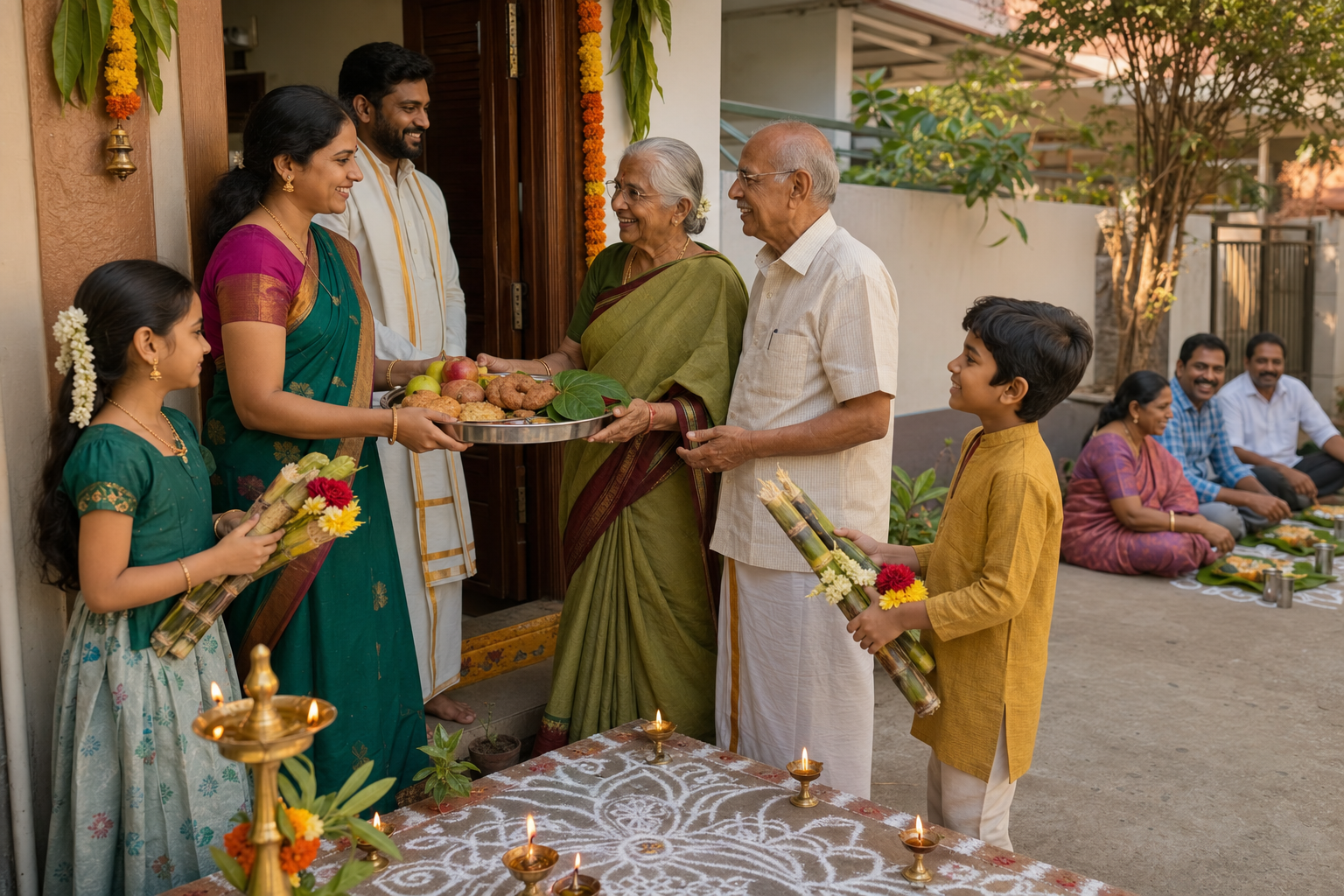
A ritual becomes a community tradition when another person can enter it, understand it and carry something away. Andhra Sankranthi hospitality therefore needs more than an open door. Give the visit a simple shape so guests encounter the meaning as well as the food.
- Welcome guests through the decorated entrance and briefly explain the day’s place in the four-day cycle.
- Invite them to see the koluvu, if you keep one, and let a child or elder tell one short story from it.
- Offer a prayer or devotional song appropriate to your household rather than filling the entire visit with conversation.
- Share prasadam and seasonal food.
- Where your family observes haldi-kumkum, follow its inherited etiquette and prepare the customary exchange before guests arrive.
In many participating homes, women and girls invite one another, exchange items such as betel leaves, fruit and sugarcane, sing devotional songs and share prasadam. The objects are modest; the repeated visit is what renews the relationship. If you are reviving the custom after a gap, contact a knowledgeable elder before inventing rules from memory.
Include neighbors and friends without pretending that every Dharmic community follows identical ritual forms. You can explain the specific Andhra Hindu practice while also recognizing values that a Buddhist, Jain or Sikh guest may readily understand: gratitude, seva, restraint, reverence for life and communal well-being. Honest hospitality preserves difference without building distance.
Children should have jobs with visible consequences. One can welcome visitors, another can explain a doll, another can help serve prasadam, and another can accompany elders during the Kanuma observance. A child who has been trusted to transmit one small part of the festival is more likely to remember it than a child who was dressed for photographs and then sent away from the ritual.
If your neighborhood no longer has an established Sankranthi gathering, start with one manageable invitation rather than announcing a large event. Invite a few households to see the koluvu, sing, pray and share prasadam. Repetition across years builds community more reliably than scale in the first year.
Put animal welfare and temple discipline ahead of spectacle
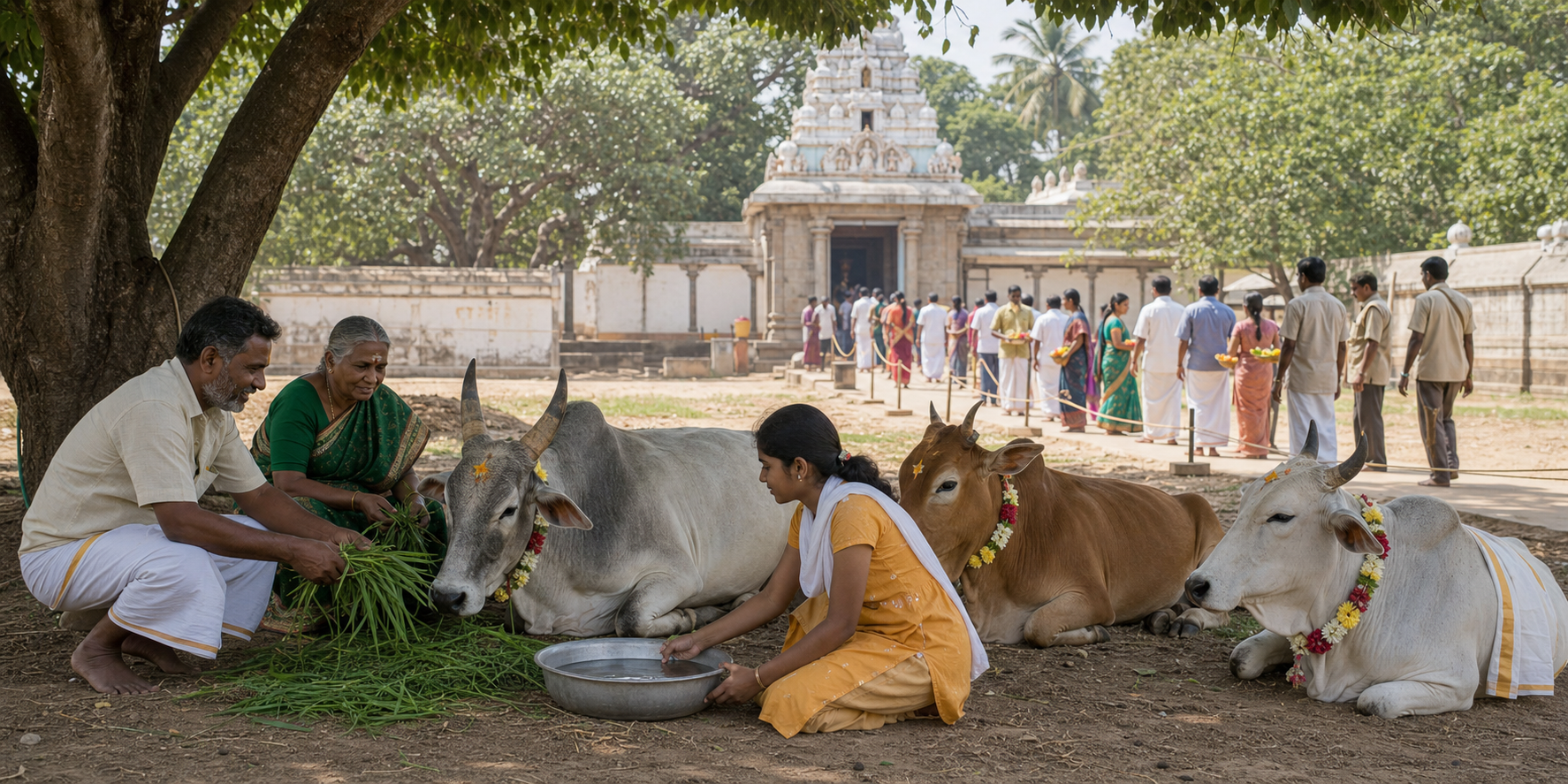
Approach Go puja as gratitude, not entertainment
Kanuma makes the agrarian foundation of the festival explicit. Cows and bulls are honored because the harvest depends on relationships among people, animals, land and natural cycles. The worship is also associated with Sri Krishna’s protection of farming communities through the Govardhana episode.
A customary observance may include turmeric, kumkum, flower garlands, freshly prepared naivedyam and pradakshina. Go puja is generally conducted after sunrise, often during the forenoon, subject to household and local practice.
Reverence must govern the method. Approach cattle only with the owner’s or keeper’s permission. Let an experienced handler guide children. Use decorations gently, avoid anything that agitates the animal, and feed only what the keeper confirms is suitable. A frightened or overfed animal contradicts the purpose of the worship, however attractive the ceremony may look.
If your household has no responsible access to cattle, don’t manufacture an encounter. Use Kanuma to teach children how farms, animal care and human labor support the food placed before them. You can still offer prayers of gratitude and seek a trusted community observance where animal welfare is visibly respected.
Plan an Arasavalli visit around worship, not the queue
For devotees able to travel, Makara Sankranthi at Arasavalli gives the solar meaning of the festival a concentrated temple form. Special Abhishekam and Archana are performed for Lord Suryanarayana Swamy, and devotees approach darshan with prayers for health, prosperity and renewed purpose.
Check the temple’s current schedule before leaving, especially if you hope to participate in a specific seva. Arrive early, wear modest attire, expect an orderly queue, and keep the sanctum precincts quiet. Allow time after darshan rather than planning the visit as a hurried stop between social engagements.
If Arasavalli is not practical, keep the same devotional center at home: greet the Sankranthi morning with Surya worship and a new-harvest offering. The pilgrimage is a powerful expression of the festival, but the household’s disciplined gratitude should not depend on travel.
Key takeaways
- Preserve the sequence: Bhogi renews the household, Makara Sankranthi honors Surya and the harvest, Kanuma honors cattle and agrarian life, and Mukkanuma brings the cycle to a deliberate close.
- Confirm dates and ritual timings with a local panchang, family elders and the temple you intend to visit.
- Build a workable home observance around three anchors: muggu at the entrance, a new-harvest offering, and a story-bearing koluvu where that custom belongs to your family.
- Treat Bommala Koluvu as intergenerational teaching. Give every displayed scene a story and every participating child a role.
- Use invitations, devotional songs, haldi-kumkum where customary, and prasadam to renew actual relationships rather than staging a decorative festival.
- During Go puja, follow the animal keeper’s direction and put the animal’s comfort before photography or display.
- For Arasavalli darshan, check the schedule, arrive early and leave enough time for prayerful attention.
Before the next Sankranthi, write four lines on a page: one defining observance for each day, one person responsible for it, and the relatives or neighbors you want to involve. That small plan is enough to move the festival from good intention into a tradition your household can repeat and hand forward.
References
- DharmaRenaissance Blog — Kanuma 2026: Date, Rituals, and Heartfelt Traditions of Sankranthi in Andhra Pradesh
- DharmaRenaissance Blog — Makara Sankranthi at Arasavalli Temple: Sacred Sun Worship, Blessings, and Living Tradition
- DharmaRenaissance Blog — Sankranthi Bommala Koluvu: Meaning, Rituals, and Community Joy from Bhogi to Mukkanuma
