
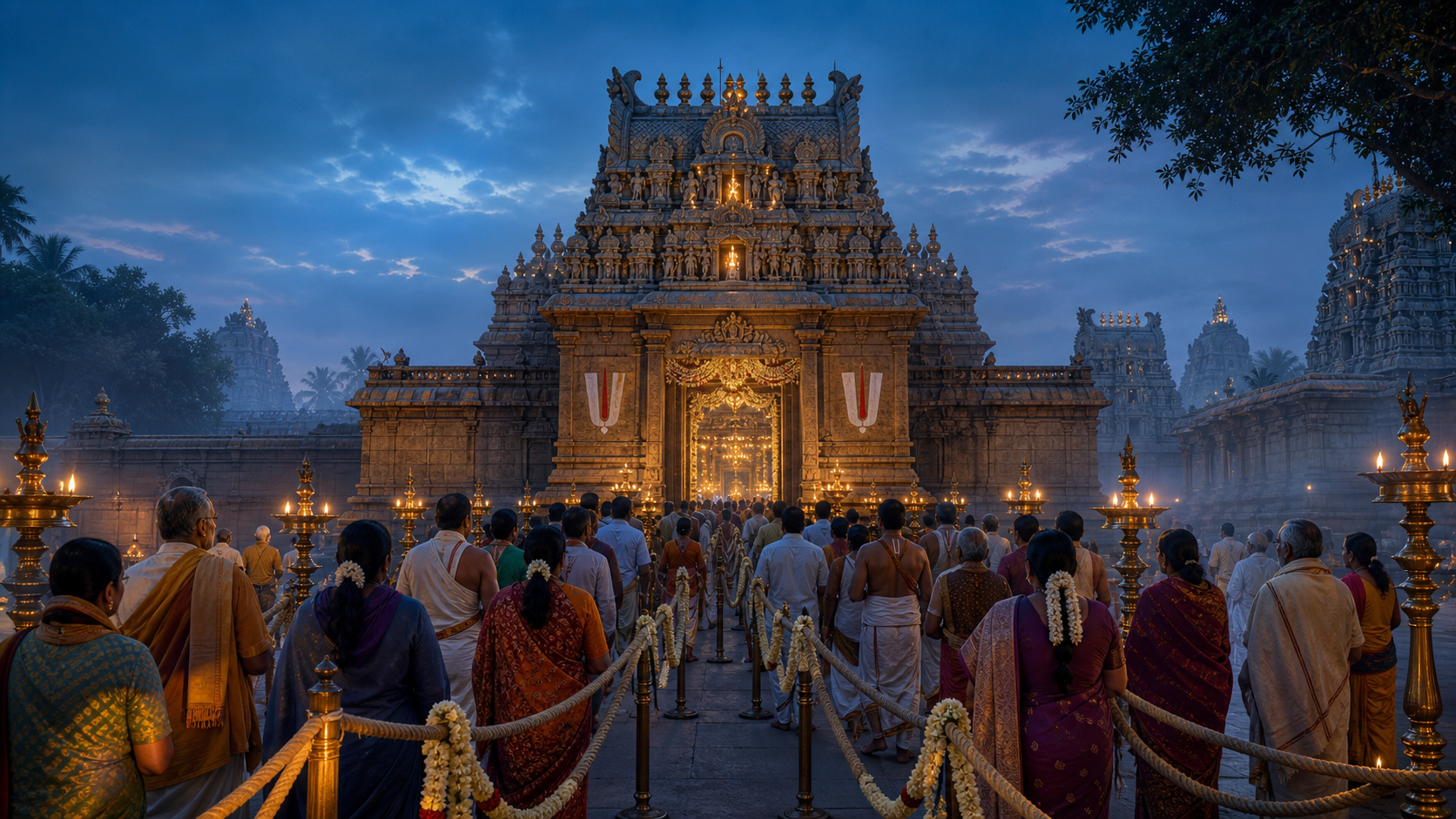
Your main choice is not simply which TTD temple to visit around New Year. It is which observance you want to make: Vaikunta Ekadashi on 30 December, Vaikunta Dwadashi on 31 December, or a Sri Rama-centred visit to Tirupati during January.
Separate those purposes before arranging transport or accommodation. You will know which date matters, what must be confirmed locally, and how to keep a crowded pilgrimage from becoming little more than a hurried queue.
Do not collapse three observance windows into one
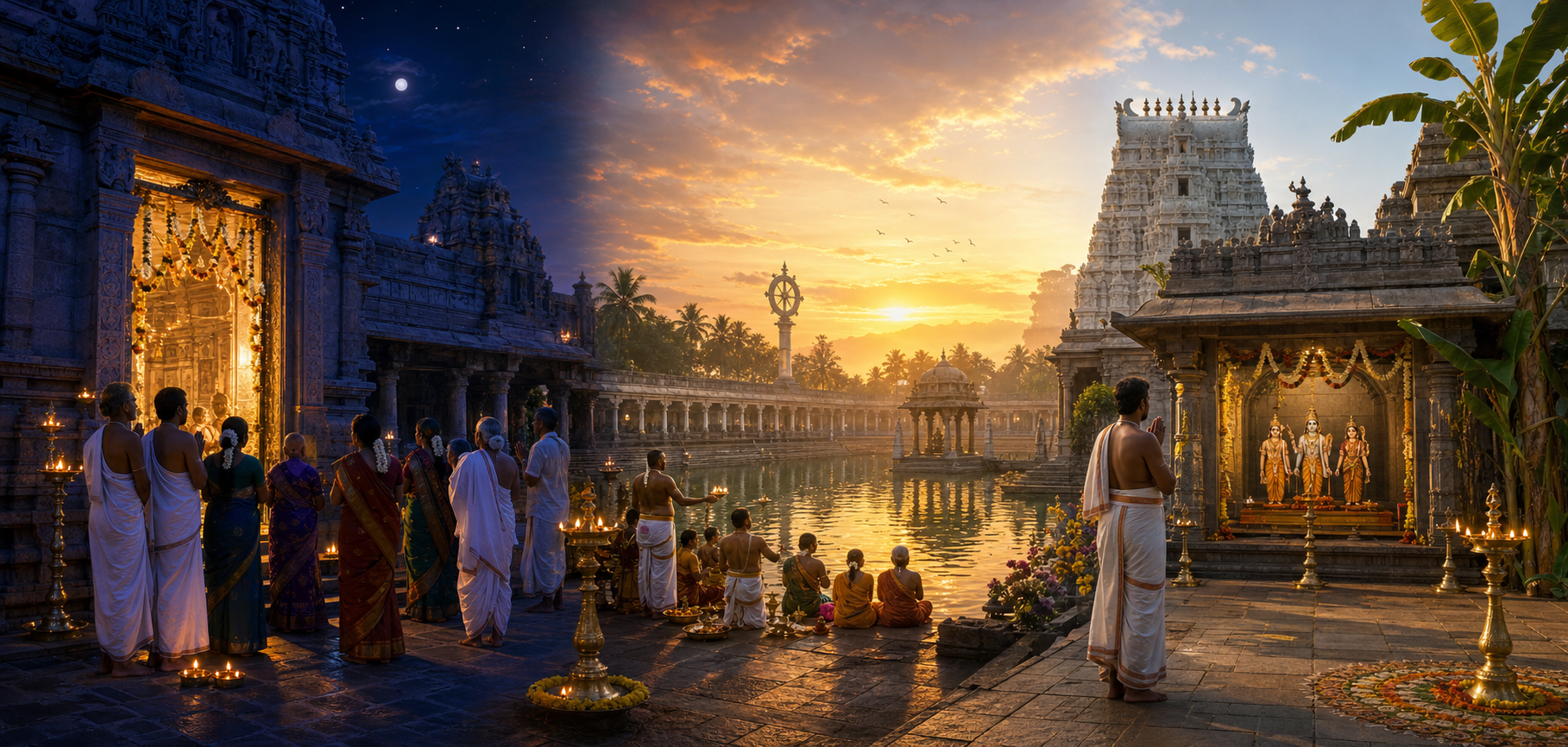
The fixed points are Vaikunta Ekadashi on 30 December 2025 and Vaikunta Dwadashi on 31 December 2025. Their proximity to the civil New Year can create a misleading impression that the entire period is one general celebration. It is better understood as a Vaishnava observance with its own sequence, followed by a separate January calendar at Sri Kodandaramaswamy Temple.
| Observance window | Devotional centre | What you should decide |
|---|---|---|
| 30 December 2025 | Vaikunta Ekadashi, with the customary early-hours opening of the Vaikunta Dwaram or Paramapada Dwaram at participating temples | Choose this date if gateway darshan, Ekadashi restraint and Vishnu-centred parayana are central to your sankalpa. Confirm the actual opening and entry arrangements. |
| 31 December 2025 | Vaikunta Dwadashi and the continuation or completion of the observance | Confirm the local Dwadashi programme rather than assuming that the Ekadashi timetable or gateway access continues unchanged. |
| January 2026 | Daily Sri Rama worship at Sri Kodandaramaswamy Temple, with Makara Sankranti, the broader Pongal period, Ekadashi worship and special alankarams to watch for | Use January for a Rama-centred pilgrimage, but treat every special festival time or extended darshan window as provisional until TTD announces it. |
If the Vaikunta Dwaram is the reason for your journey, 30 December is the date around which to build the plan. The doorway is customarily opened during the early hours of Ekadashi, but a customary practice is not a published time. Each temple may set its own queue, entrance and darshan arrangements.
Dwadashi should not be treated merely as a spare date in case Ekadashi becomes inconvenient. If your household follows a formal upavasa and parana discipline, take the applicable timing and method from your sampradaya, family acharya or trusted local temple authority. The civil midnight separating 30 and 31 December does not by itself determine the ritual transition.
Nor should you assume that 1 January must be the principal temple day merely because it begins the civil year. Begin with the religious observance you intend to keep. Let the travel calendar serve that decision.
Choose the shrine first, then verify the local arrangement
Treat a TTD sub-temple as a destination, not an overflow queue
Preparations outside Tirumala include the ancient Soumyanatha Swamy temple at Nandalur, Sri Prasanna Venkateswara Swamy at Avulapalle in Somala Mandal, the TTD-managed shrine at Borragmanda in Sadum Mandal, Sri Konetiraya and other temples. These sub-temple observances combine Vaikunta worship with local heritage and community participation.
Your nearest suitable shrine may be the sounder choice when you are travelling with children or elders, when a long Tirumala journey would dominate the day, or when you want to remain connected to a local temple community. If architecture and regional temple history are part of your purpose, Nandalur offers a clear heritage focus. If your January sankalpa is specifically directed toward Sri Rama, Sri Kodandaramaswamy Temple in Tirupati is the more coherent destination.
Do not choose solely on the assumption that a smaller temple will be uncrowded. Heightened footfall is expected across the network, and a rural location can still have limited parking, a concentrated pre-dawn arrival and locally designed queue controls. Choose by devotional purpose and manageable travel, then ask how that particular temple will operate.
Ask exact questions before you leave
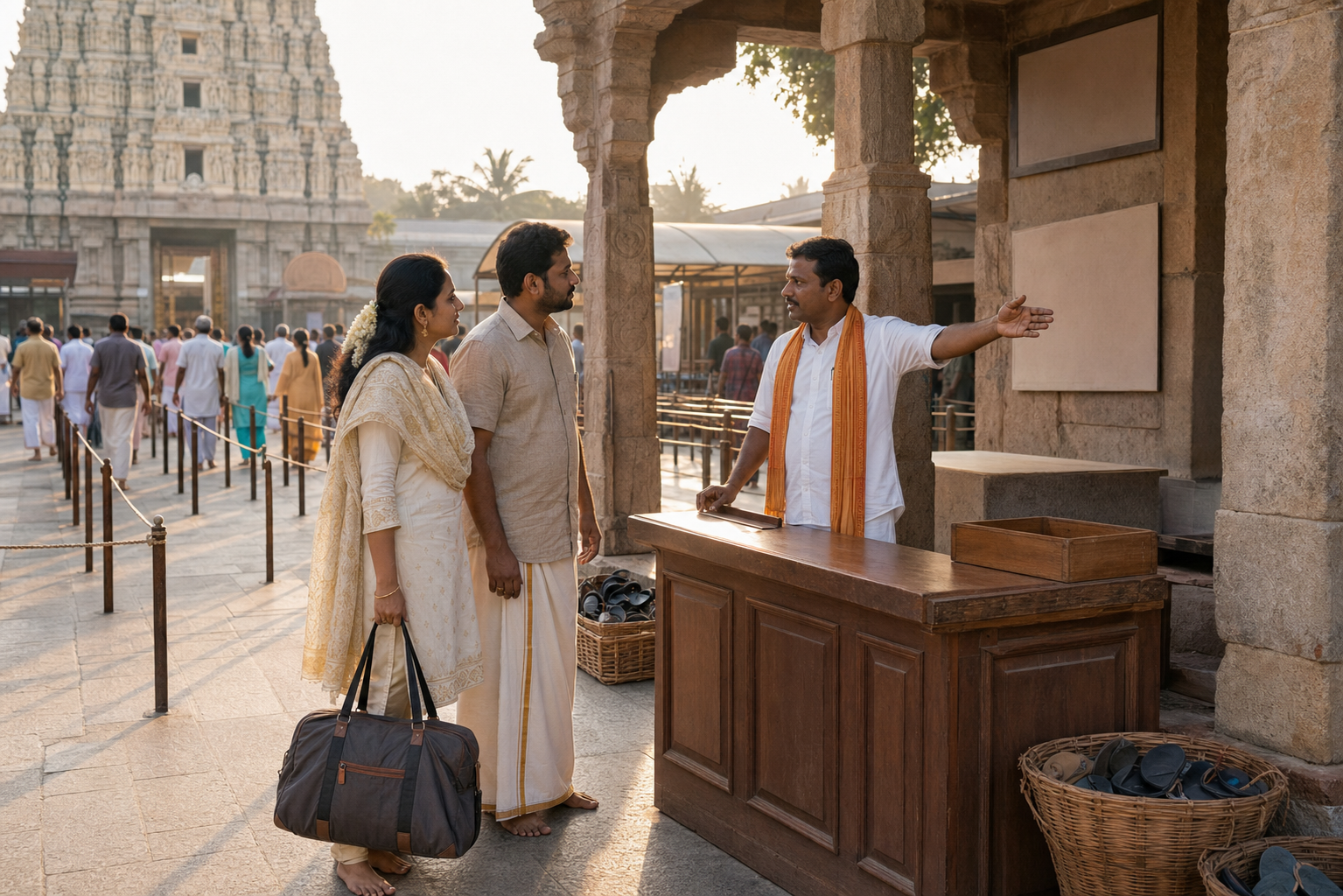
Timings, Vaikunta Dwaram access and arjitha sevas can differ by location. Check the relevant temple noticeboard or official TTD communication when making your plan, and check again before departure. A forwarded message without the temple name and date is not enough.
- Will the Vaikunta Dwaram or Paramapada Dwaram open at this temple, and what is the announced opening time?
- Where does the correct queue begin, and is any token, ticket or separate entry procedure required?
- What access, if any, continues on Vaikunta Dwadashi, 31 December?
- Which arjitha sevas will operate, and which regular sevas will be changed, limited or suspended?
- Where are the authorised parking and passenger drop-off points, and which items will security permit inside?
- What assistance or route is available for an elder, a person with limited mobility or a family with young children?
- Will annaprasadam be distributed, and where should pilgrims go without obstructing the darshan queue?
The most common planning error is to ask only when the temple opens. The useful question is when the specific entrance you need opens and how you reach its queue. That distinction matters most before dawn, when an incorrect gate or parking point can consume the very period you intended to devote to worship.
Turn waiting, fasting and seva into one coherent vrata
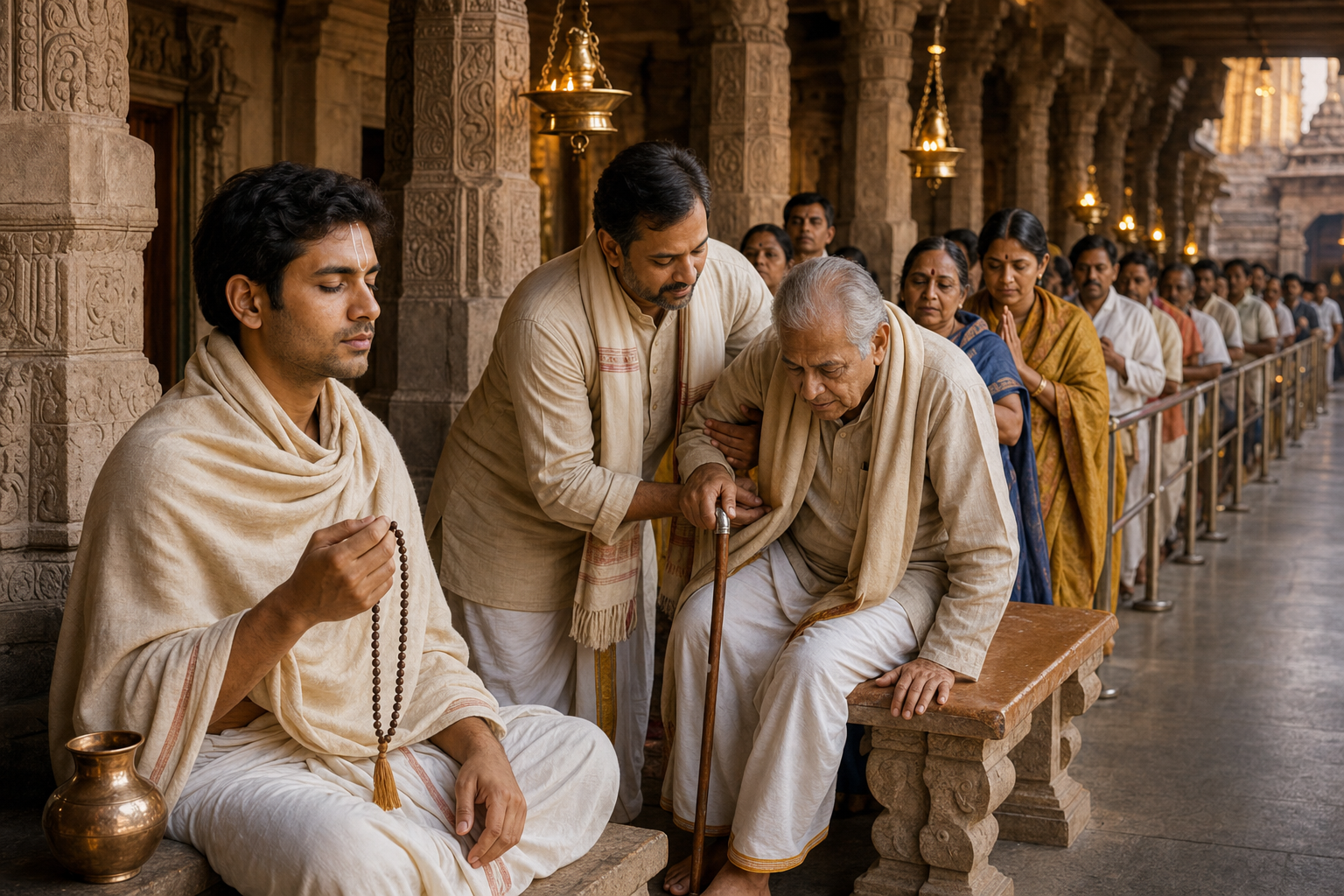
The expected devotional programme includes Vishnu Sahasranama parayanam, Tiruppavai during Margazhi, bhajans and Vishnu-centred sevas. You do not need to attempt every practice. Choose one primary discipline and support it with conduct appropriate to a crowded sacred space.
- Before departure: State your sankalpa plainly. It might be attentive Vaikunta Dwaram darshan, Vishnu Sahasranama recitation, service to an accompanying elder or a day of restrained speech and truthful conduct.
- In the queue: Use quiet japa, parayana or participation in an organised bhajan. Do not play private audio aloud or turn a family group into a competing performance.
- Near the sanctum: Put away distractions and follow the movement directed by temple staff. A brief, attentive darshan is more meaningful than resisting the queue in an attempt to prolong it.
- After darshan: Receive prasadam respectfully, avoid waste and make room for the next pilgrim. If annaprasadam is available, follow its separate queue rather than blocking an entrance.
- As a family: Agree on a meeting point before entering a dense queue. Keep only permitted essentials, place necessary medicines with a responsible adult and follow security instructions rather than relying on what was allowed during an earlier visit.
Fasting should express restraint, not unsafe physical strain. If a food fast could conflict with a health condition, prescribed medication, pregnancy or age-related needs, do not improvise. Seek appropriate medical guidance and consider a non-food discipline such as simpler sattvic meals, reduced speech, japa, truthfulness or seva. Severity is not a measure of bhakti.
This is also where the larger dharmic meaning becomes practical. Vaikunta Ekadashi is distinctly Vaishnava; it need not be made vague or detached from Sri Vishnu to appear inclusive. Its disciplines of restraint, compassion, non-harm and service can still be recognised by Hindu, Buddhist, Jain and Sikh families as part of a wider ethical kinship. Respecting that kinship begins with respecting the particular form of worship taking place.
Queue discipline is therefore not an administrative inconvenience placed outside the ritual. Giving way to an elder, keeping the passage clear, listening to volunteers and refusing to waste prasadam are themselves ways of keeping the vrata intact.
Use January at Kodandaramaswamy for a Rama-centred sankalpa
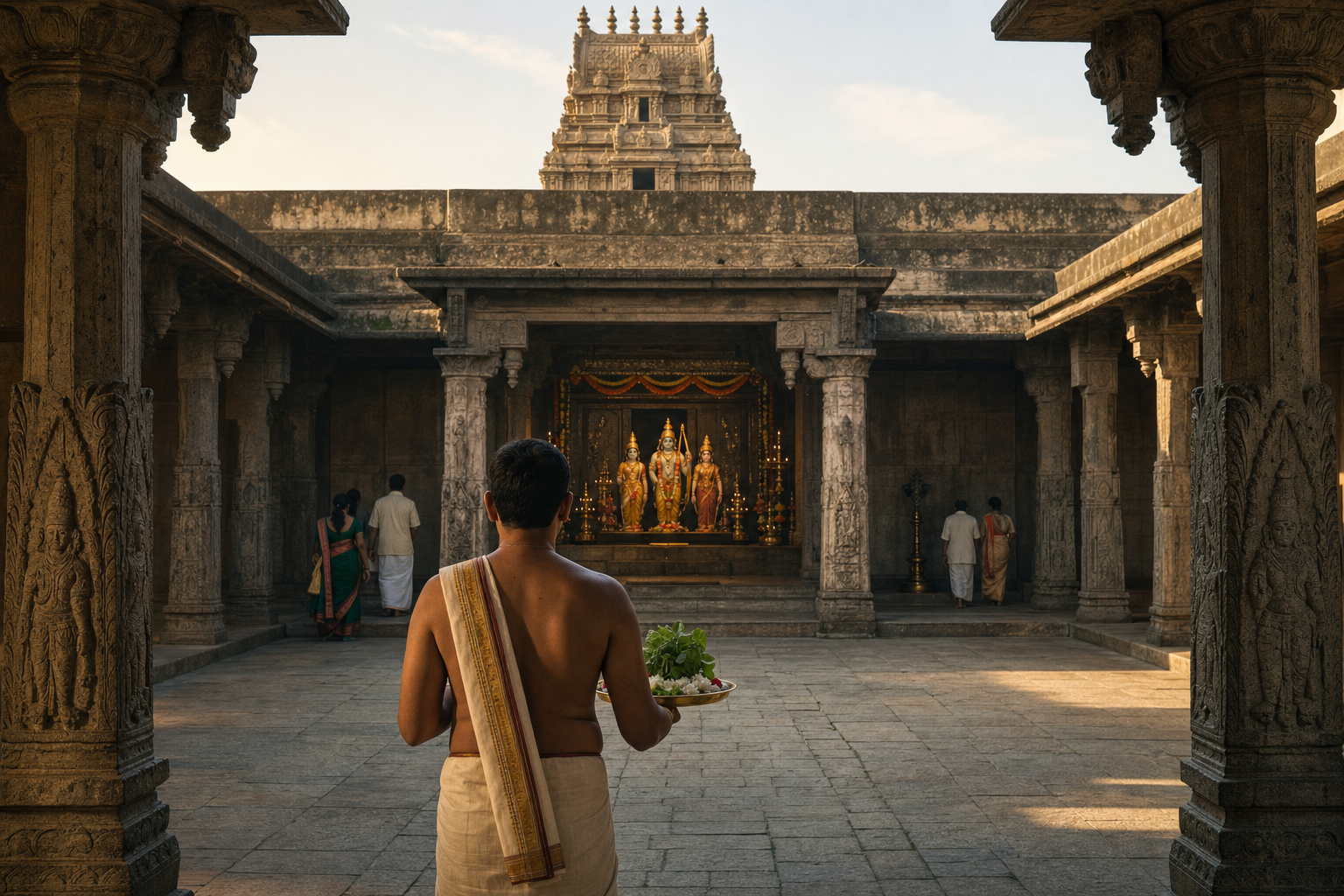
Sri Kodandaramaswamy Temple gives you a different way to carry the sacred momentum into 2026. The Tirupati shrine, traditionally attributed to a tenth-century Chola patron, centres darshan on Sri Ramachandra Swamy with Sita, Lakshmana and Hanuman. Its usual January rhythm includes morning awakening prayers, nitya archana, alankarana, harati and Veda parayana.
Makara Sankranti and the wider Pongal period are the principal January windows to monitor. Ekadashi-related worship, special alankarams, Ramayana-centred recitation and extended darshan may also be announced. None should be treated as confirmed for a particular date or hour until the temple administration publishes the final schedule.
If January is your only available travel period, you do not need to postpone the pilgrimage while waiting for a special-event announcement. An early visit aligned with the temple’s daily worship can provide a complete Rama darshan. Watch the festival notices if a particular alankaram or seva matters to you; otherwise, build the visit around the established daily cadence.
If you can make both parts of the observance, let them perform different work. Use 30 December for Ekadashi restraint, Vishnu remembrance and Vaikunta Dwaram darshan. Use the January visit to place a concrete resolution before Sri Rama. The resolution should name conduct, not merely an aspiration: speak truthfully in a difficult responsibility, serve a family member without resentment, resume a neglected recitation, or take a defined duty in your local temple community.
Sri Rama’s ideals of truthfulness, compassion and righteous conduct make this more than a seasonal promise. The useful test is whether your sankalpa tells you what to do when convenience and dharma pull in different directions. If it does not, make it more specific before you stand for darshan.
Key takeaways
- Plan 30 December 2025 around Vaikunta Ekadashi; do not assume that 31 December or 1 January offers the same ritual access.
- Treat the customary early-hours Vaikunta Dwaram opening as a reason to verify the local timetable, not as an exact time.
- Consider Nandalur, Avulapalle, Borragmanda, Sri Konetiraya and other TTD sub-temples as pilgrimage destinations in their own right.
- Confirm the entrance, queue procedure, Dwadashi programme, arjitha sevas, parking, accessibility and annaprasadam arrangements for your chosen temple.
- Keep fasting moderate and medically safe; restraint, japa, truthfulness and seva can carry the vrata when a strict food fast is unsuitable.
- For January at Sri Kodandaramaswamy Temple, rely on the daily worship rhythm and treat special Sankranti, Pongal, Ekadashi or alankaram timings as unconfirmed until announced.
Before making the journey, write down three things on one line: the temple, the date and the practice that matters most. Verify the local arrangement against that line. The pilgrimage then begins with clarity rather than with the first queue.
References
- DharmaRenaissance Blog — Sacred Gateways Open: Vaikunta Ekadashi at TTD Sub-Temples, 30-31 December 2025
- DharmaRenaissance Blog — Tirupati Sri Kodandaramaswamy Temple: Unmissable January 2026 Festivals and Ritual Guide
