
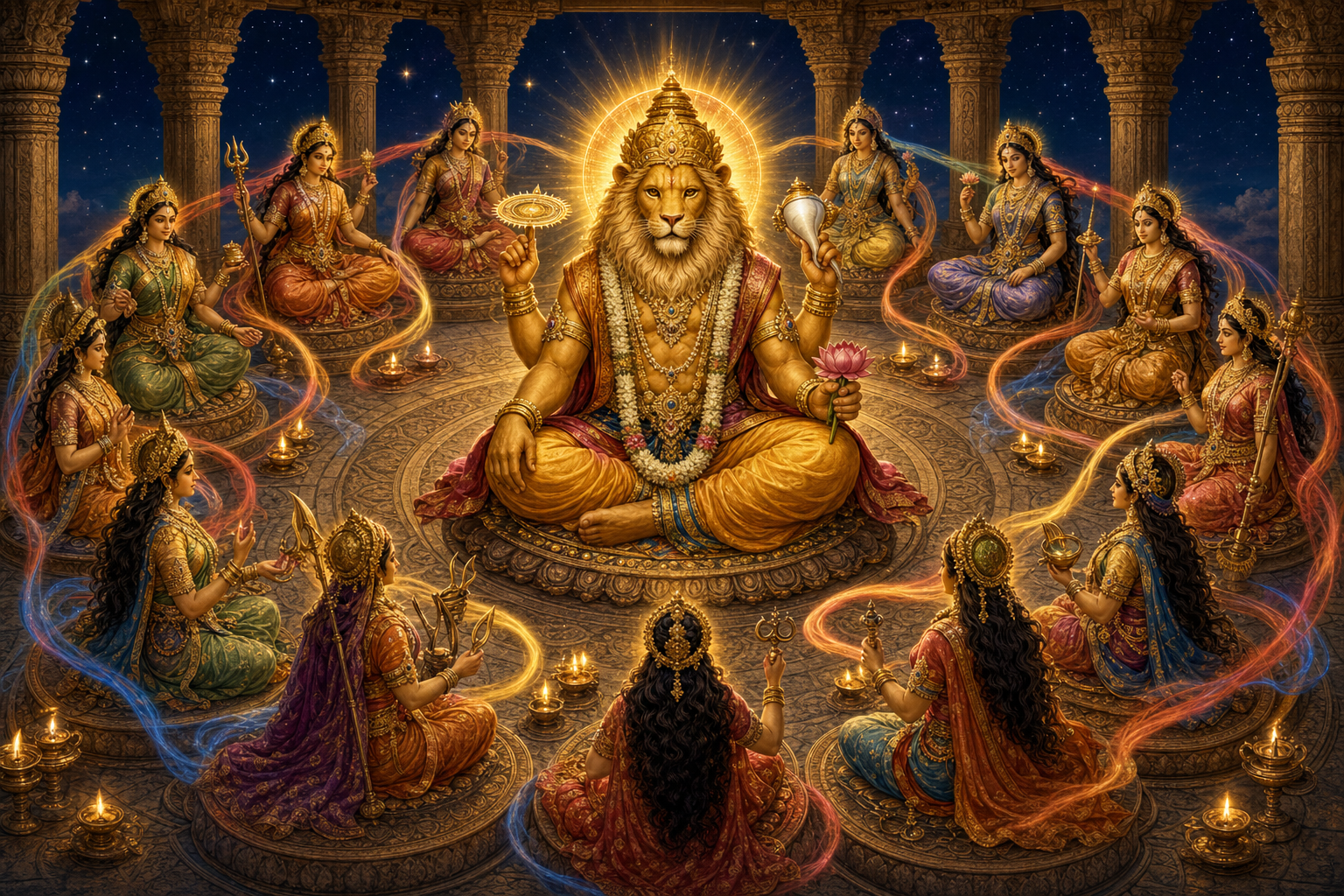
If you know Narasimha chiefly as Vishnu’s man-lion protector, the appearance of tantric Yogini Shaktis beside him can seem to join two unrelated worlds. It does not. The central idea is that divine form and divine power are inseparable: Narasimha establishes the purpose of protection, while Shakti makes that protection active.
This distinction gives you a practical way to approach the tradition. Instead of trying to memorize a speculative pantheon, you can examine four questions: What must be understood? What must be protected? What should be brought into being? What would restore right order?
Do not separate Narasimha from his operative power
Shakti is often translated as power or energy, but neither English word fully conveys its theological force. Shakti is not merely something a deity possesses, like an instrument that can be picked up and put down. It is the capacity through which divine presence becomes effective.
Narasimha gives this relationship a particularly sharp form. His fierce appearance identifies protection as an urgent divine act. The Yogini Shaktis express the vigilant, enlivening and boundary-guarding dimensions of that act. One reveals the form of sacred protection; the other reveals its movement.
When the account speaks of Narasimha bringing forth Yogini powers, therefore, you need not imagine a previously powerless deity manufacturing separate female assistants. The deeper reading is an unveiling: the avatara’s purpose becomes operative through Shakti. Form requires power to act, while power receives direction and intelligibility through form.
This also clarifies the meaning of divine fierceness. Narasimha is not a religious justification for uncontrolled anger, intimidation or vengeance. His force is directed toward the defeat of adharma and the protection of what should not be violated. The Yoginis likewise represent protective and enlivening powers that uphold dharma and sanctify sacred space.
Use that ethical direction when you encounter a fierce sacred image. Do not stop at asking why it looks frightening. Ask what the form guards, which disorder it confronts, who is being protected and what condition it seeks to restore. Fierceness becomes intelligible when its object and limit are clear.
Tantric language can distract modern readers because Tantra is often reduced either to secrecy or to spectacle. In this setting, its more useful features are concrete: mantra gives power a sacred sound; ritual encirclement establishes a protected field; and iconography gives invisible functions a visible place. The concern is not unusual imagery for its own sake. It is the organization of sacred power.
The four Vyuhas turn theology into a sequence of action
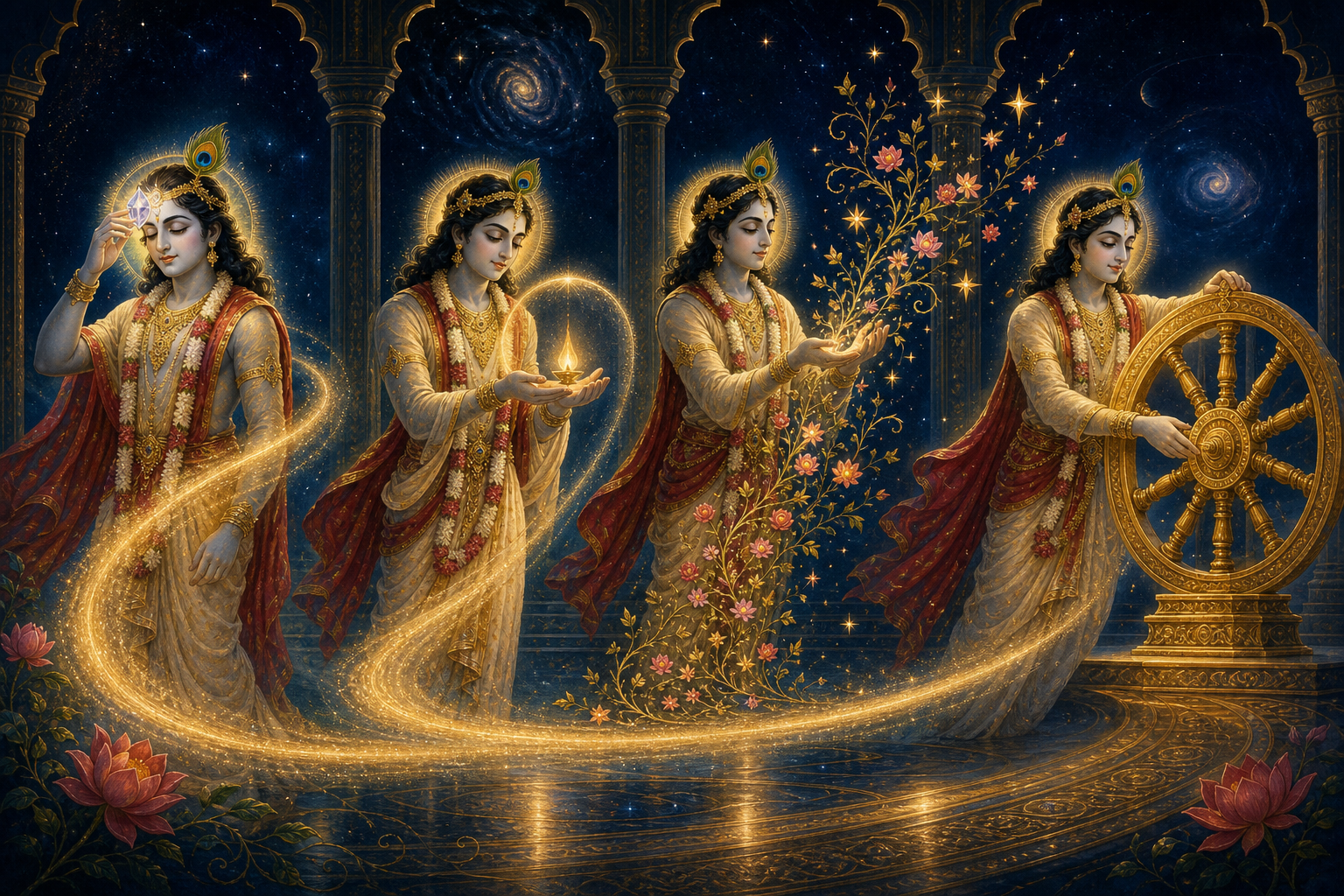
Vaishnava thought distinguishes four Vyuhas: Vasudeva, Sankarshana, Pradyumna and Aniruddha. They articulate different modalities of divine presence rather than four competing ultimate realities. Their corresponding Vyuhashaktis show how those modalities work as illumination, protection, creative intention and restorative guidance.
A disciplined way to read this fourfold movement is:
| Vyuha | Function in this fourfold reading | Question for contemplation |
|---|---|---|
| Vasudeva | Wisdom that illuminates | What is true, and what must be seen clearly before anyone acts? |
| Sankarshana | Strength that protects | What sacred boundary, principle or vulnerable being requires protection? |
| Pradyumna | Intention that creates | What constructive response should now be brought into being? |
| Aniruddha | Guidance that restores right relation | What would re-establish order rather than merely defeat an opponent? |
This is more useful than treating the four powers as a personality test. You are not meant to choose clarity instead of courage, or protection instead of restoration. The sequence disciplines power. First see the situation. Then protect what must be protected. Next create a response. Finally judge that response by whether it restores dharmic relation.
Imagine that a community discovers disrespect toward a sacred space. Immediate outrage may feel like strength, but the fourfold reading demands more. Establish what actually occurred. Identify the people, practices and boundaries requiring protection. Decide what repair or constructive action is needed. Then ask whether the response will restore dignity and order or simply prolong hostility. The framework does not weaken resolve; it prevents resolve from becoming directionless.
The final movement is especially important. Victory and restoration are not always identical. An adversary can be silenced while distrust, humiliation and disorder remain. Aniruddha’s restorative function asks what right relation should look like after the immediate danger has passed.
This fourfold reading identifies functions, not a universally binding list of Yogini names. Tantric and Vaishnava lineages can organize theological relationships differently. Do not fill gaps with confident-sounding correspondences merely because four powers and four Vyuhas appear together. The sound conclusion is that Shakti renders each divine modality effective; anything more specific requires lineage-grounded evidence.
Yogini imagery teaches you to read the protected whole
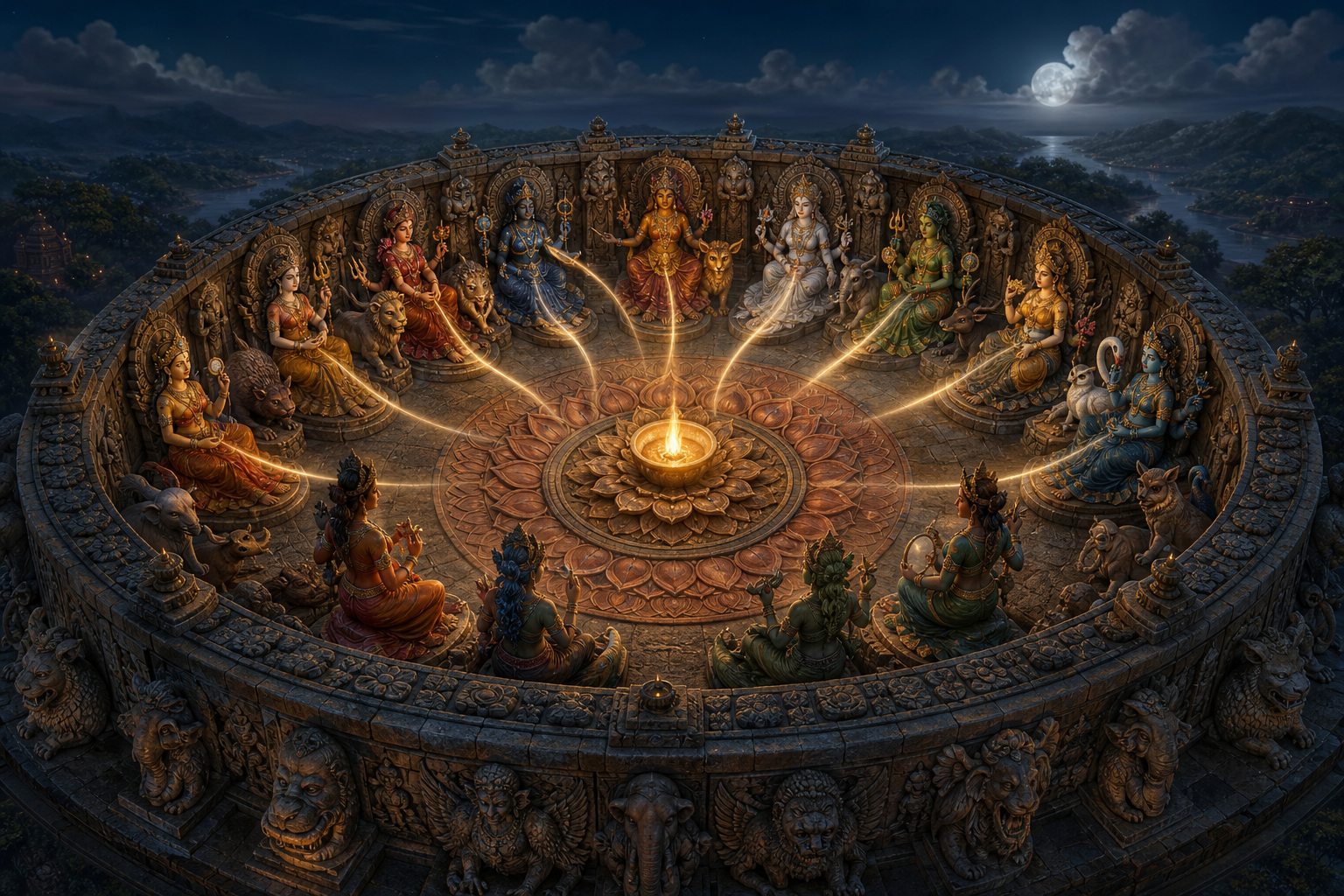
A central deity naturally attracts the eye, but Yogini traditions ask you to notice the field around the centre. Guardianship operates at boundaries, directions and transitions. Ritual encirclement gives this insight a spatial form: sacred presence is not only enthroned at a centre but made effective throughout a protected domain.
This helps explain the relevance of the 64 Yoginis and the appearance of Narasimhi among the Matrikas in certain temple corpora. These related forms place feminine power within sacred geography. They show that protection concerns entrances, edges, orientation and the integrity of the whole space, not merely the prestige of its central icon.
Several terms must still be kept distinct. Yogini can indicate a class of powerful feminine beings associated with tantric sacred organization. Matrika identifies a maternal grouping. Narasimhi appears among the Matrikas in some settings. Vyuhashakti describes a theological function corresponding to a Vyuha. These ideas can illuminate one another, but they are not automatically interchangeable labels.
That distinction protects you from two common mistakes. The presence of Narasimhi does not by itself prove that every site teaches the same four-Vyuha scheme. Nor does the number 64 authorize an invented calculation in which every Yogini must be assigned to a fourfold subdivision. Visual kinship is a reason to investigate context, not permission to manufacture a system.
When you visit a temple, study a photograph or examine an iconographic plan, use a short set of observational questions:
- Is the feminine figure solitary, grouped, encircling another form or associated with a threshold?
- Does the arrangement emphasize a centre, the directions, a boundary or movement around a sacred field?
- Is the figure locally identified as a Yogini, a Matrika, Narasimhi or by another name?
- Does the local ritual understanding describe protection, illumination, fertility, restoration or another function?
- Which conclusions come from the site’s own context, and which ones are assumptions imported from elsewhere?
Begin with placement and relationship before searching for a universal definition. In sacred art, where a figure stands and what surrounds it can matter as much as the figure’s isolated name.
The same spatial lesson applies inwardly. A person may have a strong centre of conviction but poorly guarded boundaries, confused intentions or no path back to balance after conflict. Yogini guardianship asks whether the whole field of life has been ordered around dharma. Devotion is not complete merely because the centre is affirmed; its surroundings must also be made coherent.
Use the symbolism for contemplation, not improvised initiation
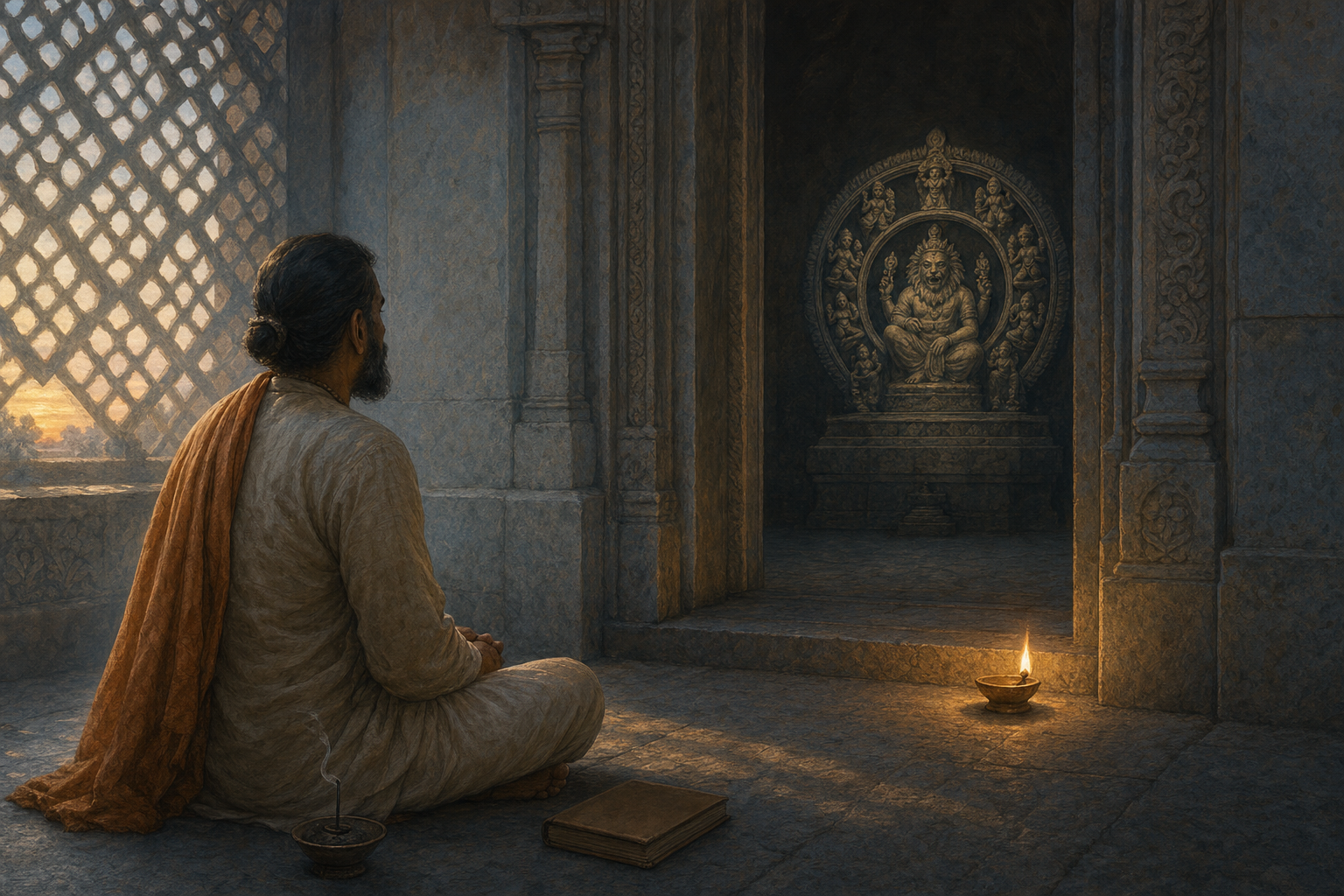
You can work responsibly with this theology through study, meditation and darshan without pretending to perform a transmitted tantric rite. The distinction matters. A contemplative exercise interprets the four functions and applies their ethical logic. A lineage practice may involve particular mantras, ritual sequences and forms of authorization that cannot be reconstructed from a general explanation.
The following is a reflective method based on the fourfold symbolism. It is not a substitute for instruction in a specific sampradaya:
- Choose one real pressure point. Name a conflict, responsibility or threatened boundary without turning it into a vague meditation on everything that is wrong.
- Begin with Vasudeva’s illuminating function. Separate what you know from what you fear, suspect or assume. State the known problem in one plain sentence.
- Move to Sankarshana’s protective function. Identify exactly what requires defence: a person, a duty, a sacred place, a truthful account or an ethical boundary. Do not confuse protecting dharma with protecting pride.
- Move to Pradyumna’s creative function. Choose a constructive act that can be performed, communicated or organized. Mere denunciation does not satisfy this stage because it creates no better condition.
- Move to Aniruddha’s restorative function. Describe the right relation you want to exist afterward. Then test whether your proposed act leads toward that condition.
Apply three ethical checks before you act: dignity, non-harm and harmony. These do not require passivity. A firm boundary can preserve dignity. Resistance to adharma can prevent harm. Clear consequences can make future harmony possible. But humiliation for its own sake, pleasure in vengeance or deliberate injury to uninvolved people fails the test, however forcefully it is presented.
If you are drawn to mantra or a formal Yogini practice, do not invent syllables, ritual placements or initiatory claims from symbolic correspondences. Learn the practice within a tradition that can explain its deity, mantra, boundaries and purpose. Study and darshan can prepare attention; they should not be misrepresented as initiation.
Compare dharmic traditions without declaring them identical
The broader dharmic world contains several ways of joining insight to effective action. Buddhist thought often pairs prajna, or wisdom, with upaya, skillful means. Jain traditions honour disciplined inner energy and ethical self-mastery. Sikh devotional and heroic language can invoke Bhagauti as divine power. These are meaningful resonances, but they do not erase the theological differences among the traditions.
Use comparison to ask a precise civilizational question: How does spiritual clarity become courageous, ethical action? Do not use it to claim that Shakti, prajna, tejas and Bhagauti are simply different spellings of one doctrine. Each belongs to its own vocabulary, practice and community of interpretation.
This method allows you to recognize a shared concern without flattening distinct paths. Wisdom without effective action remains incomplete. Power without ethical insight becomes dangerous. The traditions meet at that problem even when they answer it in different ways.
Key takeaways
- Narasimha and the Yogini Shaktis should be read as divine form and operative power, not as unrelated masculine and feminine camps.
- The four Vyuhas provide a disciplined movement from clarity to protection, constructive intention and restored order.
- Yogini guardianship directs attention to thresholds, directions and the integrity of the entire sacred field.
- Narasimhi, Matrika, Yogini and Vyuhashakti are related ideas in some contexts, but they are not interchangeable terms.
- The framework can guide study, meditation and ethical reflection; specific tantric mantras and rites require tradition-grounded instruction.
- Comparisons with Buddhist, Jain and Sikh concepts are most useful when they reveal a shared question without erasing doctrinal differences.
The next time you encounter Narasimha with feminine protective powers, read the arrangement before trying to decode every name. Find the centre, the boundary, the threatened good and the movement toward restoration. If you want to bring the teaching into daily life, take one present difficulty through the four questions. Begin with clarity. Protection that begins before clarity can easily defend a projection rather than dharma.
References
