

You may have arrived wanting a clean verdict on Thomas Jefferson: visionary, hypocrite, man of his time, or something harder to name. The honest answer is that none of those labels can do the work by itself. His declaration of equality was morally important, and his slaveholding was not a minor exception to it.
You can reach a clearer judgment by separating four questions: What principle did Jefferson proclaim? Whom did he recognize as morally human? What remedy did he accept when equality became costly? What did his exercise of power actually produce? That method lets you preserve a true principle without granting its author an undeserved acquittal.
The contradiction was not hidden from Jefferson
Jefferson placed the words “all men are created equal” at the center of the Declaration of Independence. Yet he enslaved hundreds of human beings and freed only a few. The distance between those facts is the equality-slavery paradox in its starkest form.
Calling it hypocrisy is justified but incomplete. Hypocrisy tells you that conduct violated a professed standard. It does not explain why a person capable of articulating universal equality repeatedly restricted its political meaning when the standard threatened his social order, property, and vision of the republic.
The familiar defense that Jefferson was simply a product of his time also fails as a verdict. Historical context can explain the pressures surrounding a choice, but Jefferson’s own words prove that the injustice was available for him to see. Influenced by Scottish moral-sense philosophy, he treated human beings as possessing an innate capacity to perceive moral truth. He did not deny that capacity to Black people.
In Notes on the State of Virginia, Jefferson wrote that he trembled when he remembered that “God is just” and expressed hope for “total emancipation.” He also described mastery as a school of despotism: the enslaver rehearsed domination, the enslaved person endured forced submission, and children learned tyranny by watching it. He therefore understood that slavery injured the character of the republic as well as the people held in bondage.
This matters when you judge responsibility. A person who cannot see an injustice and a person who names it but refuses the obligations it creates are not in the same moral position. Jefferson belongs largely in the second category. Context explains part of his hesitation; his own recognition makes simple exoneration impossible.
Use four tests instead of choosing between praise and erasure

A useful historical judgment does not require you to make Jefferson either a stainless sage or a figure from whom nothing can be learned. Apply these four tests to him, and then use them on any revered leader whose language and conduct diverge.
- Test the principle for universality. Ask whether the stated rule applies to the people with the least power, not merely to the speaker’s political community. Jefferson’s equality proposition can be true even though he failed to honor it. A moral claim does not become false because its author violates it, but its truth does not absolve the author.
- Test the person’s moral recognition. Ask what suffering the leader could identify in his own time. Jefferson recognized the moral capacity of Black people, the tyranny exercised by masters, and the possibility of emancipation. That evidence sharply limits the claim that he knew no better.
- Test the proposed remedy. Liberation is incomplete if it requires the liberated person to surrender home, citizenship, or belonging. Jefferson’s preferred answer was emancipation followed by racial removal. His remedy protected the white republic from the demands of coexistence.
- Test the consequences of power. Private doubts and elegant sentences matter less once a statesman can shape institutions. Jefferson’s major political choices helped slavery expand geographically and economically. Consequence does not reveal every intention, but it does reveal which interests received practical protection.
These tests prevent two common mistakes. The first mistake is presentism without evidence: condemning a person only because modern values differ from historical norms. Jefferson’s case does not depend on that shortcut because his own moral analysis supplies contemporary evidence against slavery. The second mistake is founder worship: treating a brilliant sentence as compensation for the people excluded from its protection.
Racial theory converted moral recognition into political evasion

Jefferson could recognize Black moral capacity while still advancing claims of Black inferiority in reason, imagination, artistic achievement, and physiology. Those assertions are now recognized as racist pseudoscience. In his political reasoning, they helped turn an institution created and maintained by coercion into an allegedly natural racial problem.
He feared that white prejudice, Black memories of injury, future provocations, and supposed natural differences would produce permanent racial conflict. Part of that diagnosis contained a real insight: ending a law does not instantly remove the habits, resentments, injuries, and power relations formed under it. Legal emancipation alone could not erase generations of domination.
But Jefferson drew the wrong moral conclusion from that insight. He treated the damage caused by oppression as a reason to separate the oppressed from the country of their birth. Instead of asking how the republic should repair injustice and establish equal citizenship, he proposed sending freed Black Americans “beyond the reach of mixture.” Freedom was offered without belonging.
This distinction is one you should notice whenever a reform is presented as generous. Does the remedy restore agency, membership, and equal protection? Or does it remove the injured people so that the dominant group can avoid changing? A policy can end one legal status while preserving the hierarchy’s central demand: that the formerly subordinated remain outside the shared civic home.
Jefferson’s fear of coexistence therefore reveals the limit of his equality. He could imagine Black people as morally human and potentially free. He could not imagine them securely included in the same political community as equals. His universal language reached farther than his civic imagination.
Statecraft made the moral failure larger
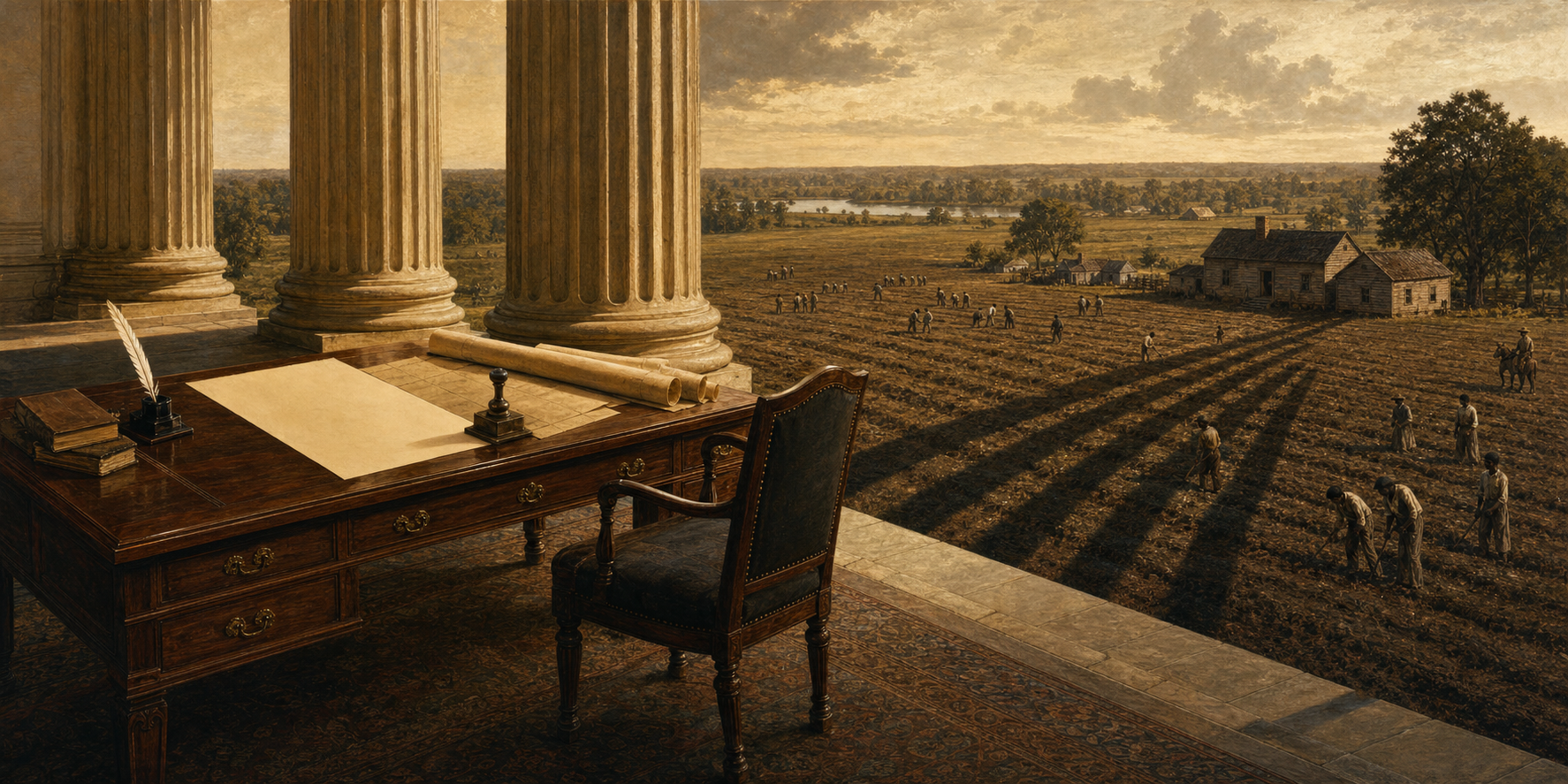
The decisive evidence lies not only at Monticello or in Jefferson’s private convictions. It lies in what happened when he possessed public power. The Louisiana Purchase of 1803 doubled the territory of the United States and opened enormous areas to slave-based cotton cultivation. The expanding plantation economy accelerated the domestic slave trade. Hundreds of thousands of enslaved people were sold away from families and forced in coffles toward Alabama, Mississippi, Louisiana, and Texas.
Territorial expansion was therefore not morally neutral. An expanding “empire of liberty” enlarged opportunity for white citizens while enlarging the domain in which Black people could be bought, sold, and compelled to labor. Liberty and domination grew through the same geography, but they were distributed to different populations.
The Missouri crisis of 1819-1820 offered another revealing test. Jefferson opposed restrictions on slavery’s expansion and treated the “extension of slavery” as less important than preserving his larger vision of the union and its growth. When universal principle collided with a political order built partly upon slaveholding, the order again received protection.
By the end of Jefferson’s life, slavery in the United States was larger, wealthier, and more deeply entrenched. He manumitted only a small number of the people he enslaved, most of them connected to Sally Hemings, who was his late wife’s half-sister. Limited private exceptions did not amount to a public program capable of confronting the institution he condemned in principle.
This is why consequences deserve their own test. A leader may sincerely fear an injustice, and sincerity is relevant to understanding character. But people living under policy experience institutions, not the private intensity of a statesman’s unease. When you weigh a legacy, ask what became easier, more profitable, and more secure under that person’s authority. In Jefferson’s case, the answer weighs heavily against the moral promise of his language.
A Dharmic judgment joins insight, restraint, and belonging

Hinduism, Buddhism, Jainism, and Sikhism are distinct traditions; they should not be flattened into one political formula. Yet a Dharmic reader can bring several durable moral disciplines to this paradox. Ahimsa directs attention to harm. Karuna demands that another person’s suffering enter our moral reasoning. Human dignity forbids treating a person merely as property, labor, a racial category, or a problem to be removed.
From that perspective, Jefferson’s failure was not a shortage of abstract moral perception. He saw enough to know that slavery brutalized both the dominated and the dominator. The failure came when insight demanded sacrifice, restraint, and a shared future. He separated knowledge from duty.
Ahimsa also exposes why emancipation followed by expulsion is inadequate. Non-harm cannot mean merely ending direct ownership while denying the freed person a homeland and equal civic standing. Karuna cannot remain pity felt at a safe distance. It must affect the structure of the relationship between the powerful and the injured.
A Dharmic reading should not become a device for judging only Western civilization. Apply the same discipline to every civilization, community, and honored personality, including our own. If we celebrate universal truth in scripture or political speech while protecting exclusion in practice, we reproduce the same moral structure: lofty recognition above, restricted belonging below. Dharma becomes credible through conduct.
Key takeaways
- Keep the truth of Jefferson’s equality claim separate from your judgment of Jefferson. The principle remains valid; his conduct remains answerable to it.
- Do not use historical context as automatic acquittal. His own recognition of slavery’s injustice shows that a moral alternative was imaginable in his time.
- Examine the remedy, not only the promise. Emancipation tied to racial removal offered freedom without citizenship, home, or shared belonging.
- Give policy consequences greater weight than private anxiety. Territorial expansion and resistance to limits on slavery strengthened the institution he feared and criticized.
- Use ahimsa and karuna as practical tests: identify the harm, restore the injured person’s agency, restrain the powerful, and build conditions for shared dignity.
The next time you meet a revered founder whose ideals outran his actions, resist both reflexive defense and effortless denunciation. Ask whom the principle included, what injustice the person recognized, what remedy he accepted, and what his power produced. Then decide precisely what deserves preservation, what requires rejection, and what inherited wrong still calls for repair.
References
