

You may be carrying out your duties while a loss, conflict, illness, limitation, or uncertain outcome keeps pulling your mind away from the present. You do not need a philosophy that orders you to feel peaceful. You need a way to keep pain from deciding your conduct.
Dharmic resilience begins there. It does not make you invulnerable, and it does not require you to deny anger, fear, or grief. It helps you recover enough inner space to discern the next right action, take it with care, and stop making your peace dependent on a result you cannot command.
Find the next duty before trying to solve the whole crisis

Adversity compresses time. The mind treats every uncertainty as if it must be settled immediately: the final outcome, other people’s reactions, the meaning of the event, and what life will look like afterward. That mental expansion makes a difficult situation feel limitless.
Dharma gives you a smaller and more serious question: what is actually yours to do now?
In the Bhagavad Gita’s language of Karma Yoga, disciplined action and non-attachment belong together. You act wholeheartedly, but you do not make ethical action conditional on guaranteed success. This is why samatva, or equanimity, can coexist with effort, compassion, and clear judgement. Equanimity is not indifference to consequences. It is freedom from being ruled by them.
When a problem feels too large, separate it into three parts:
- The fact: What has happened, without prediction or self-accusation?
- The reaction: What emotion, bodily tension, or repetitive thought is present?
- The duty: What truthful, non-harming, role-appropriate action is available to you?
Suppose a family conversation has broken down. The fact may be that harsh words were exchanged. The reaction may be anger mixed with fear of rejection. Your duty may be to pause, correct what you said, set a necessary boundary, or return when both people can speak without escalating. Your duty is not to manufacture reconciliation on demand. Reconciliation requires another person’s participation; honest conduct does not.
This distinction protects you from two errors. The first is passivity disguised as surrender: doing nothing and calling it non-attachment. The second is control disguised as responsibility: believing that if you perform every action perfectly, you can force the desired outcome. Dharma asks for committed action without either illusion.
Use a six-move reset when emotion is driving the moment
Insight is hardest to access when your posture is tense, your attention is scattered, and the mind is rehearsing an argument. Do not begin by demanding a grand spiritual interpretation. First become steady enough to make one sound decision.
- Stop adding momentum. Do not send the message, make the accusation, or announce the irreversible decision while you are visibly escalating.
- Settle the body. Place your feet or seat securely, soften unnecessary tension, and let the breath become natural. Do not force deep breathing or hold the breath. The purpose is collected attention, not a display of endurance.
- Name what is present. Use plain words such as anger, grief, shame, fear, or confusion. Naming an emotion acknowledges it without granting it authority over the next action.
- State the fact without a verdict. Replace statements such as everything is ruined with a description of what has actually occurred. A fact can guide action; a totalising verdict usually feeds reactivity.
- Identify one Dharmic action. Ask what truthfulness, ahimsa, responsibility, courage, or compassion requires in this particular situation. Choose something you can genuinely do rather than an outcome you hope to obtain.
- Act, then release the mental bargain. Complete the call, apology, boundary, application, treatment step, prayer, or act of service that is yours. Notice when the mind begins insisting that correct action must now produce immediate relief or recognition.
This reset can precede a difficult meeting, a medical appointment, a family decision, or an evening in which rumination has taken over. Its purpose is not to eliminate emotion before you act. It is to prevent the strongest emotion in the room from becoming your sole adviser.
Afterward, use a short stabilising discipline: japa, quiet meditation, reflective self-inquiry, gratitude, or a modest act of seva. These practices train return. Each time attention wanders into resentment or catastrophic prediction, you bring it back to remembrance, inquiry, breath, or service. That repeated return is abhyasa in lived form.
Spiritual steadiness must never be used to tolerate violence, neglect urgent care, or conceal overwhelming distress. If adversity includes immediate danger, an inability to stay safe, serious physical symptoms, or a mental-health crisis, seek appropriate emergency, medical, or psychological support. Dharmic practice can accompany competent care; it should not replace it.
Match the discipline to the point where you are stuck
The Dharmic traditions do not offer one interchangeable technique. They provide distinct languages and disciplines, yet several of them answer the same practical problem: how can you meet change without abandoning awareness, compassion, or ethical action?
Choose the practice that addresses your present friction:
- When attention will not stop circling: use steady japa or naam simran. Give the mind a sacred point of return instead of letting it rehearse the same fear without resolution.
- When the body and mind are agitated: use gentle Yoga, unforced breath awareness, pratyahara, or meditation to reduce sensory and mental scattering before making a consequential choice.
- When you are obsessed with the result: use Karma Yoga. Define the work that belongs to you, perform it carefully, and recognise that its reception and final outcome are not fully yours.
- When judgement has become rigid: use the Jain discipline of anekantavada, or many-sided understanding. Ask which part of the situation you may not be seeing. This does not mean every claim is equally true; it means your first view may not be complete.
- When grasping is intensifying fear: use aparigraha. Notice what possession, identity, status, or preferred future the mind is treating as indispensable, then distinguish a legitimate need from attachment.
- When pain has made your world contract: practise metta, compassion, or seva in a form you can sustain. Service interrupts self-enclosure while keeping your attention connected to another being’s dignity.
- When discouragement is draining courage: draw on the Sikh ideal of chardi kala alongside naam simran and seva. An uplifted spirit is expressed through faithful conduct in difficulty, not through compulsory cheerfulness.
Buddhist upekkha, Jain aparigraha, Sikh sehaj, and Hindu samatva each illuminate steadiness without erasing their traditions’ differences. The practical disciplines surrounding them include mindfulness, meditation, self-inquiry, remembrance, non-attachment, Yoga, and service. You do not need to collect them all.
For a difficult season, choose one inward practice and one outward practice. Your inward practice might be japa each morning or quiet breath awareness before difficult conversations. Your outward practice might be caring for a relative, keeping a promise, or offering regular seva. Staying with a small discipline is more useful than repeatedly changing methods whenever discomfort remains.
Satsang can add a third support when isolation is distorting your judgement. A trustworthy spiritual community, teacher, or mature practitioner can help you distinguish perseverance from stubbornness, acceptance from resignation, and self-examination from self-blame.
Let limitation change the form of practice, not its purpose
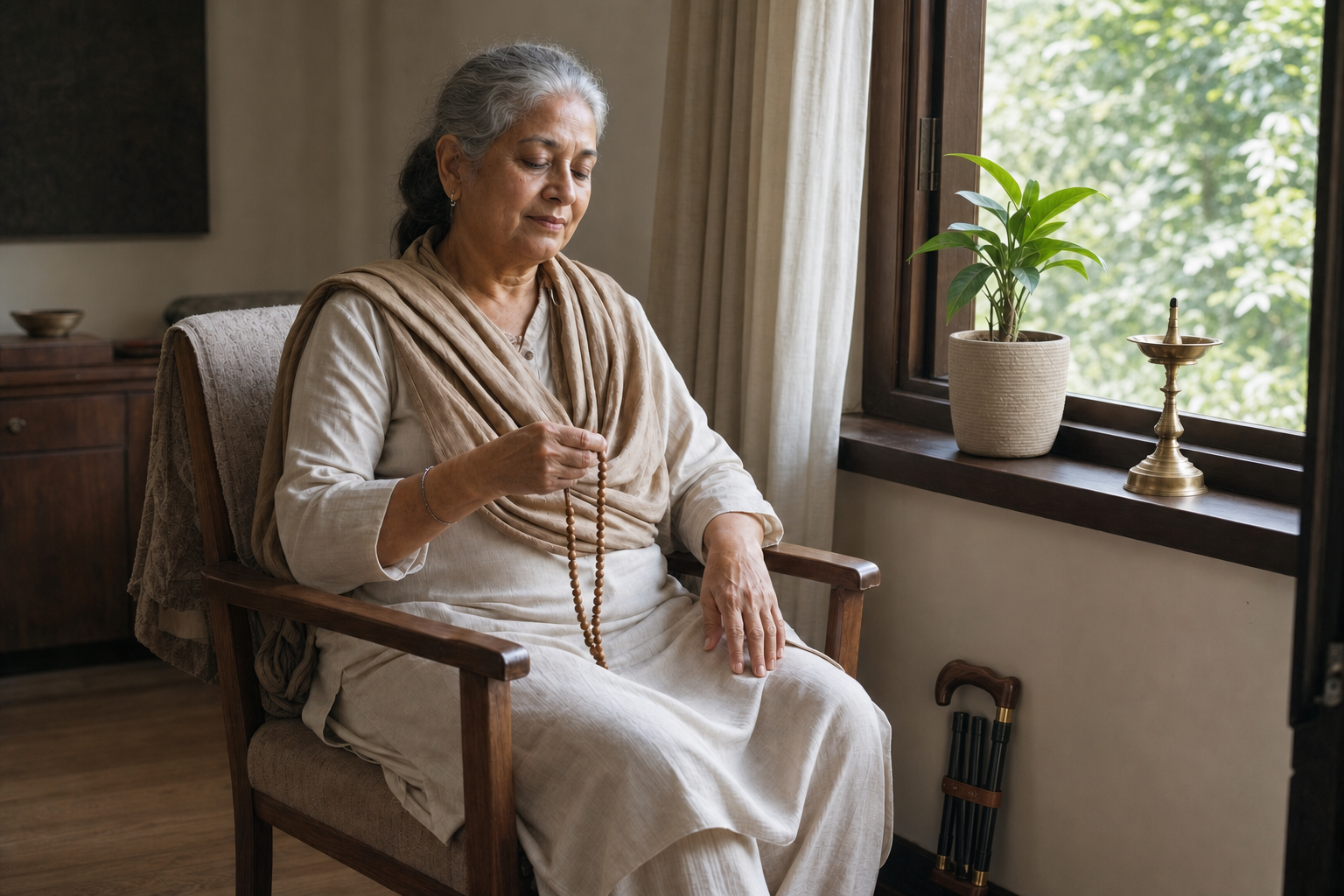
Adversity sometimes removes an option rather than merely making it harder. The body may not cooperate. Energy may be limited. A former role may no longer be available. At that point, resilience cannot mean restoring yesterday by force.
Dharmic memory repeatedly refuses to treat bodily form as a measure of spiritual worth. Ashtavakra’s bent body does not constrain his non-dual insight, Ganesha’s broken tusk becomes an instrument of resolve, and Surdas’s blindness does not extinguish bhakti. Their significance is not that every limitation must produce greatness. It is that incompleteness in the world’s eyes does not disqualify a person from wisdom, devotion, dignity, or meaningful action.
No person owes others an inspiring transformation of disability, illness, grief, or frailty. Nor should karma be used as a convenient explanation for another person’s suffering. The useful question is much narrower: given the condition that is here, what form can Dharma take now?
If seated practice causes pain, use a supported position or a form of remembrance that respects the body. If fatigue makes a long routine unrealistic, shorten the practice instead of turning one missed session into abandonment. If physical seva is unavailable, service may take the form of listening, teaching, organising, praying, sharing knowledge, or helping someone make a sound decision. Adaptation protects the purpose of practice from attachment to one preferred form.
This also applies to identity. Losing a position, capacity, relationship, or familiar social role can expose how tightly the self was tied to that form. Self-inquiry asks what remains when a role changes. Bhakti asks how devotion can continue. Karma Yoga asks what work is still yours. Seva asks who can still be served. None of these questions denies the loss; each prevents loss from receiving the final word about your worth.
Measure resilience by conduct, not by a permanently calm mood

A difficult week may still feel difficult after sincere practice. That does not prove the practice has failed. Calm is a changing condition. Resilience is better observed in the quality of your return.
At the end of the day, ask five direct questions. Did I describe the situation truthfully? Did I avoid adding unnecessary harm? Did I fulfil the nearest duty I could actually perform? Did I mistake control of the outcome for responsibility? When I became reactive, did I return?
Do not use the answers to stage another trial against yourself. Choose one correction for the next day. You may need to apologise sooner, reduce one avoidable distraction, resume japa, ask for help, keep a boundary, or complete a neglected duty. Resilience grows through correction and return, not through an unbroken performance of strength.
Key takeaways
- Equanimity means preserving discernment through changing conditions; it does not mean becoming indifferent or emotionless.
- Separate the fact, your reaction, and your duty before acting under pressure.
- Karma Yoga joins full effort to non-attachment: perform the right action without demanding control of its result.
- Choose a discipline for the actual obstruction, such as japa for circling attention, anekantavada for rigid judgement, aparigraha for grasping, or seva for self-enclosure.
- Adapt the form of practice when the body or circumstances change. Limitation does not cancel dignity or Dharma.
- Judge progress by how truthfully, compassionately, and consistently you return after being unsettled.
Before your next difficult conversation or decision, do the smaller work first: steady your posture, let the breath become natural, name the fact, identify the duty, and act without bargaining for a guaranteed result. Then return to your chosen practice. That return, repeated through changing conditions, is how Dharmic resilience becomes a way of living rather than an idea reserved for easier days.
References
- DharmaRenaissance Blog — Happiness Beyond Problems: Hindu Wisdom for Unshakable Inner Peace and Resilient Living
- DharmaRenaissance Blog — From Limitation to Liberation: How Physical Weakness Fuels Spiritual Power in Dharmic Wisdom
