
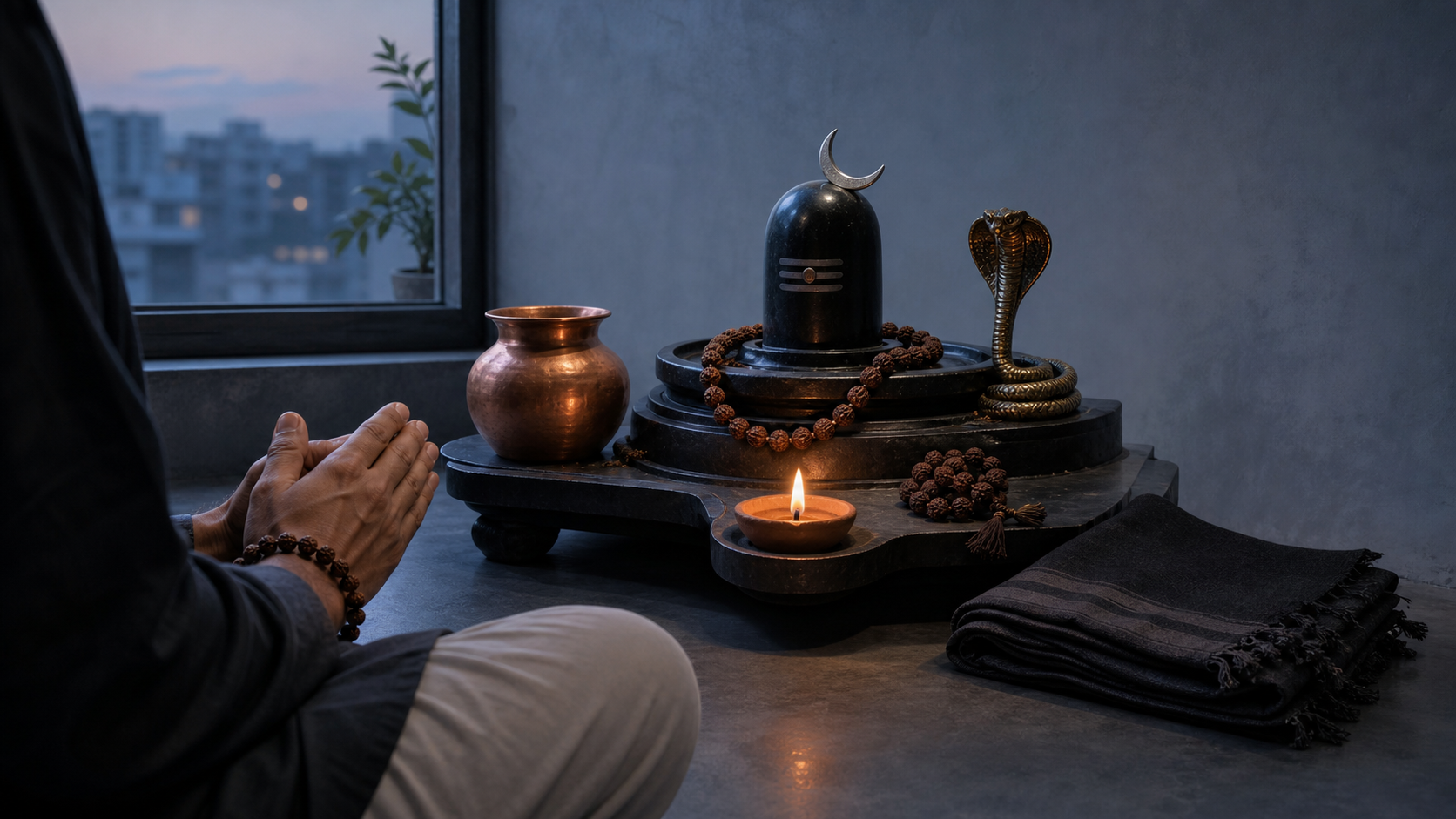
You may be considering black clothing for an observance, looking at the crescent and serpent in Shiva’s iconography, or wondering whether a sacred symbol can really protect you. The useful question is not whether the object works by itself. It is what dharmic duty the symbol asks you to remember when pressure arrives.
A symbol can carry inherited sacred meaning while also training attention. Dark clothing limits display. The crescent cools reaction. The skull cuts pride down to size. The serpent keeps watchfulness awake. Matted locks suggest that energy must be contained before it can be directed. Protection and discipline meet when bhava, conduct, and community custom point in the same direction.
Key takeaways
- A protective symbol is not a guarantee that nothing harmful will happen. It is a sacred aid that should make you steadier, more vigilant, and more responsible.
- Black can signify protection, austerity, humility, and karmic discipline, but its proper use varies among families, temples, regions, and observances.
- Shiva’s jata, crescent, skull, and serpent form a practical sequence: contain your energy, cool your mind, release your pride, and remain alert.
- Similar colours and motifs appear across Hindu, Buddhist, Jain, and Sikh settings, but their meanings and ritual uses are not interchangeable.
- Choose one symbol from your own tradition and connect it to one observable act. If it does not change your conduct, adding more symbols will not solve the problem.
Protection begins by governing the person who seeks it

Dharmic protection has an outward and an inward dimension. A devotee may understand a colour, image, mantra, or sacred object as protection against harmful influences. The same symbol can guard the inner threshold by interrupting panic, vanity, resentment, or carelessness before these states control action. The first meaning belongs to faith and inherited practice. The second can be tested in your conduct.
Across several Hindu settings, black is associated with protection, Shani’s discipline, Muneeswarar’s guardianship, and the vratham of Ayyappa devotees. These uses share a colour, but they should not be collapsed into a single rule.
In popular observance connected with Shani, black recalls patience, justice, endurance, and karmic accountability. Black sesame and oil may also appear in devotional offerings, and some devotees choose black on Saturdays. The disciplined response is not merely to put on the colour. It is to stop evading a duty, accept the consequences of your choices, and meet delay without turning frustration into blame. If the colour changes nothing about how you carry responsibility, its ethical meaning has been left behind.
During the vratham preceding the Sabarimala pilgrimage, Ayyappa devotees commonly wear black or dark blue. Simple dress reduces outward display and supports austerity, humility, equality, seva, and fellowship. Here the uniform does protective work by narrowing distractions and strengthening a shared commitment. Its force comes from the vow and the life organised around it, not from using dark clothing as a detached fashion statement.
Muneeswarar’s association with guardianship gives black another devotional setting. Treat that setting on its own terms. If the practice belongs to your family or local temple culture, follow the guidance attached to it rather than assembling instructions from unrelated traditions.
The belief that black wards off negative influence or the evil eye should likewise be described as a traditional belief, not as a universal or measurable guarantee. You can honour it without becoming fearful. A sound practice should increase composure and appropriate caution. If it produces constant anxiety about colours, omens, or other people, the symbol has stopped serving discipline.
Spiritual protection also does not replace practical protection. If you face violence, harassment, illness, fraud, or another concrete danger, seek the relevant medical, legal, financial, or community help. A sacred symbol may support courage and clarity while you act, but it cannot perform those practical functions for you.
Shiva’s crown gives you an inner sequence to follow
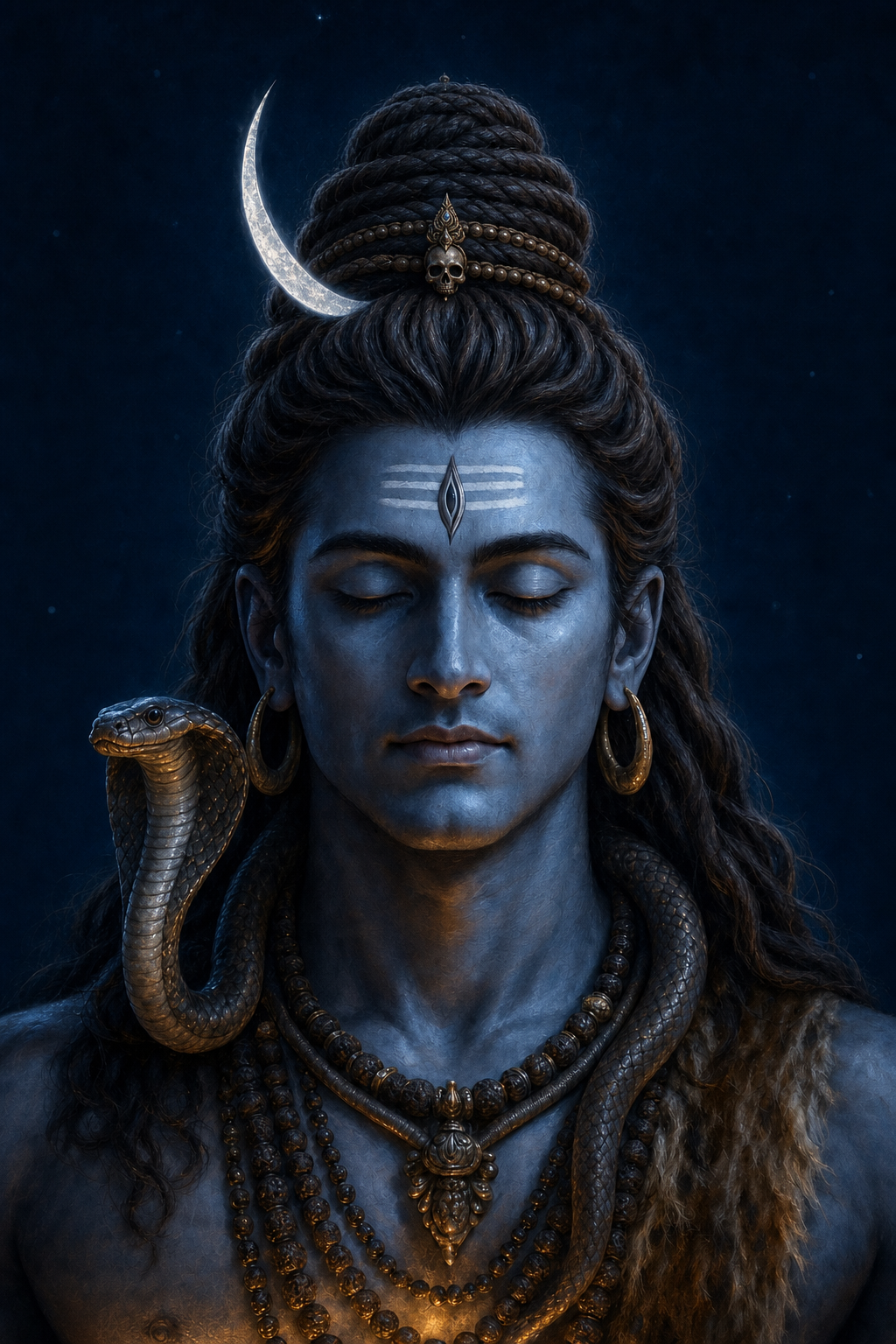
Where dark clothing can discipline outward appearance, Shiva’s crown turns the same principle inward. The Jata Mukuta brings together matted locks, Kaumudi, Kapala, and Sarpa as images of restraint, equanimity, impermanence, and alert energy. You do not need to flatten this iconography into a motivational formula. You can, however, let each feature expose a specific weakness in your practice.
Jata: contain energy before directing it
Shiva’s matted locks signify tapas and mastery, not neglect. They present power held in order. The practical question is where your own energy leaks away. If you begin sadhana and immediately chase every thought, notification, argument, or new undertaking, intensity will not become discipline. Let the jata remind you to return attention to the duty already chosen.
Containment is not suppression. It is the decision that every impulse does not deserve immediate expression. When anger rises, containment creates the interval in which dharma can govern speech. When enthusiasm rises, it prevents you from making a vow that your habits cannot sustain.
Kaumudi: cool the mind without becoming passive
The crescent moon, or Kaumudi, evokes cooling light, emotional equanimity, and the rhythm of waxing and waning time. Its lesson becomes clearest during conflict. Coolness does not mean refusing to defend truth or justice. It means lowering the heat enough to distinguish the real issue from wounded pride.
When a conversation becomes heated, use the crescent as a mental cue: steady your breathing, lower your voice, and state the point that actually requires an answer. If you cannot describe that point without attacking the person, your mind has not cooled enough to act cleanly.
Kapala: let mortality expose the ego’s performance
The skull, or Kapala, confronts impermanence. It is not present to make spiritual life morbid. It removes the fantasy that status, possession, praise, or the body itself can provide permanent security.
Use this symbol when correction feels like humiliation. Ask whether truth is under attack or only your preferred image of yourself. Kapala does not require self-contempt. It requires enough humility to surrender an error before the error becomes part of your identity.
Sarpa: transform fear into vigilance
The serpent, or Sarpa, signifies alert awareness, protection, and transformative energy. In yogic interpretation it can also evoke kundalini. Its immediate discipline is simpler: stay awake without becoming frantic.
Fear tends to produce two failures. You may ignore a real danger because acknowledging it is uncomfortable, or you may exaggerate an uncertain danger until it controls you. Serpent awareness does neither. It identifies what is present, checks what can be checked, and responds with proportionate courage. Wearing a serpent motif does not awaken this quality automatically; practising alertness does.
The full sequence is demanding but usable. Jata contains scattered energy. Kaumudi cools reaction. Kapala removes the ego’s claim to permanence. Sarpa preserves the alertness needed for action. When you are under pressure, move through that sequence before deciding what to say or do.
Shared motifs do not make different traditions interchangeable

Dharmic traditions often meet at the level of ethical aspiration: equanimity, humility, vigilance, detachment, courage, and responsibility. Their images can therefore resonate across communities. Resonance is not sameness. A shared colour or serpent form does not erase differences in doctrine, lineage, ritual, or the sacred figure being represented.
Within parts of Vajrayana Buddhism, Mahakala’s black protector iconography represents the absorption of negativity and the safeguarding of ethical practice. The naga Mucalinda sheltering the Buddha offers another image of protection, while the kapala has a particular place in Vajrayana symbolism. These meanings should be explained within their Buddhist setting, not presented as alternate names for a Shaiva practice.
In Jain iconography, the serpent canopy over Tirthankara Parshvanatha is a recognisable protective form. Jain reflection on sama, or equanimity, also gives the cooling of mental disturbance a distinct ethical context. In some Jain lay settings, understated colours may support simplicity and reduced sensory stimulation. None of this requires importing Shaiva ideas about kundalini into the Jain image.
In Sikh settings, dark attire can appear at solemn gatherings or during remembrance, where it conveys dignity and collective reflection. Teachings on mortality, serenity, and remembrance of the Divine can sound familiar beside other Dharmic reflections, yet Sikh practice must still be understood through Gurmat rather than treated as a variation of a Hindu vrata.
Even within Hindu traditions, a colour accepted for one vrata may be discouraged at a festival or temple elsewhere. Family practice, regional custom, temple guidance, and the nature of the observance all matter. If you do not know the convention, ask the authority nearest to the living practice: the relevant temple, family elders who observe it, or a teacher from the lineage. This is more reliable than assuming that a pan-Dharmic resemblance creates permission for ritual mixing.
Turn one inherited symbol into conduct you can observe

Begin with a symbol that already belongs to your tradition or an observance you are genuinely undertaking. You do not need a collection of protective objects. You need a clear relationship between sacred meaning and behaviour.
- Name the context. Is the symbol connected with a daily sadhana, a Saturday observance for Shani, an Ayyappa vratham, pilgrimage, meditation, temple worship, or solemn remembrance? Context prevents a general impression from becoming an invented rule.
- Confirm the custom. Check whether the colour or symbol is appropriate for that temple, family, community, festival, or lineage. Do this before public display or ritual use, not after someone objects.
- Choose the quality it demands. Black may call you to restraint or accountability; the crescent to composure; the skull to humility; the serpent to vigilance; the jata to containment of attention.
- Bind the quality to a visible act. During conflict, the crescent can mean lowering your voice before answering. Kapala can mean admitting a correct criticism without self-defence. Sarpa can mean checking the facts before fear spreads. Black during a vrata can mean simpler dress and less concern with display.
- Judge the fruit. Notice whether the practice makes you more truthful, steady, responsible, and considerate. If it mainly produces fear of omens, contempt for people who follow different customs, or pride in appearing spiritual, correct the practice rather than blaming the symbol.
Suppose you choose black for a Saturday observance associated with Shani. Confirm that this is consistent with your community’s practice. Wear it simply. Identify a responsibility you have been avoiding, carry it without blaming others, and observe whether you meet delay with greater patience. Any required ritual details should still come from your tradition, but the ethical discipline is already clear.
Start with the symbol already nearest to you and give it one sentence joined to one action: the crescent means you cool your speech; Kapala means you release the need to appear infallible; Sarpa means you stay awake to reality; black means you accept restraint. Keep that action the next time it costs you something. That is where a symbol of protection becomes a discipline rather than decoration.
References
- DharmaRenaissance Blog – Why Black Matters in Dharmic Life: Powerful Protection, Inner Confidence, and Devotion
- DharmaRenaissance Blog – Decoding Shiva’s Timeless Jata Mukuta: Kaumudi, Kapala, Sarpa and Dharmic Unity
