
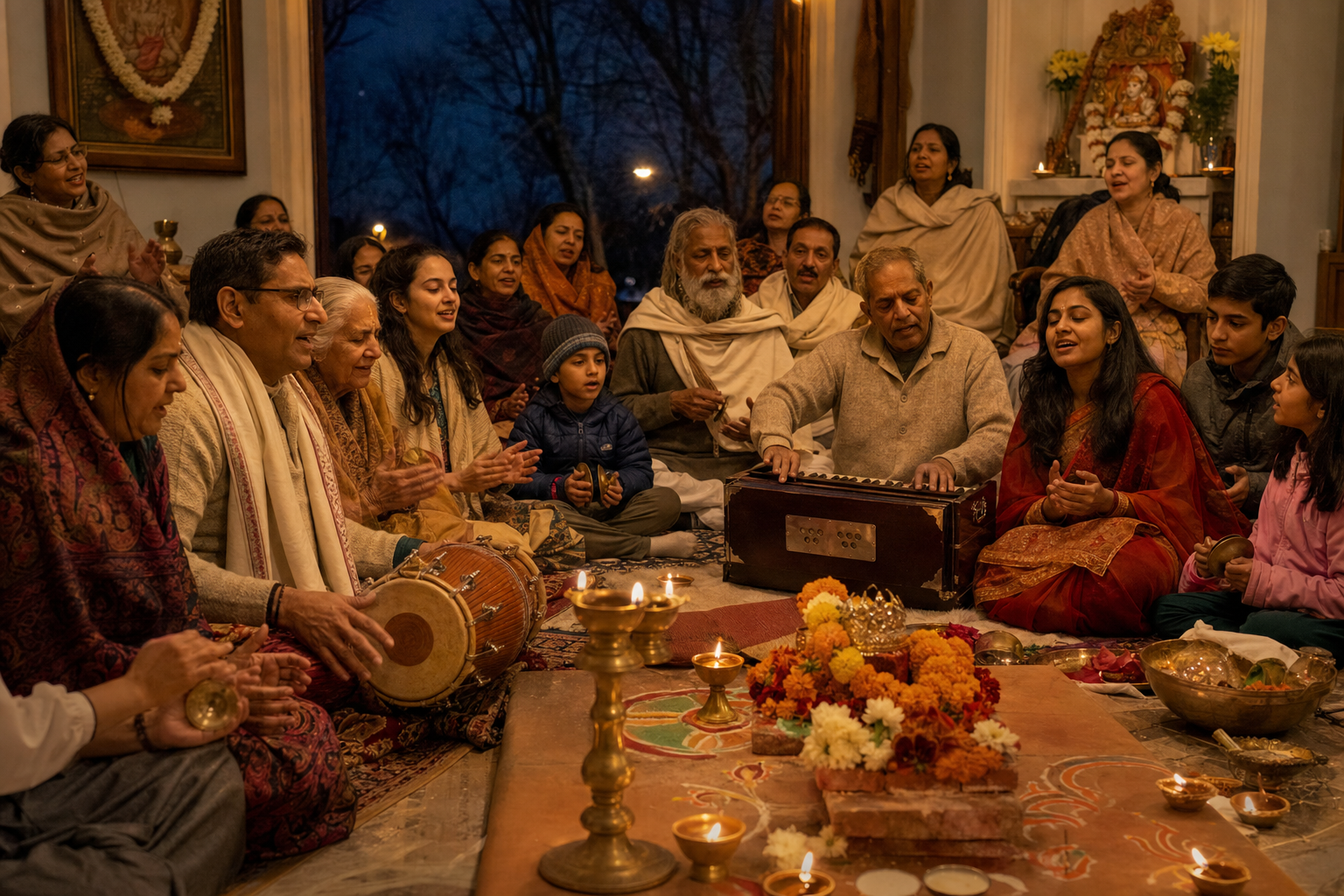
If you are responsible for New Year’s Eve at a temple, gurukula, spiritual centre, or neighbourhood satsang, your hardest choice is not the decoration. It is deciding what the gathering should do for people before they go home. A devotional celebration should help them cross the calendar boundary with remembrance, gratitude, and a practical commitment to seva.
You do not need an elaborate production. You need a clear devotional arc. Kirtan, children’s contributions, silence, reflection, hospitality, and prasadam should feel like parts of the same journey rather than unrelated items squeezed into a festive programme.
Decide what the turning of the year should mean
Begin your planning meeting by completing this sentence: When this gathering ends, we want people to be ready to…
Your answer might be to remember the Divine more deliberately, restore a neglected family practice, undertake a form of community service, or feel that they have a spiritual home. Choose a primary answer. If you try to give equal weight to entertainment, education, worship, fundraising, networking, and ceremony, the programme will become crowded without becoming meaningful.
A gathering centred on chanting, reflection, sacred remembrance, and shared prasadam can make community belonging part of the devotional experience. That purpose should govern what stays in the programme. If an item does not deepen remembrance, relationship, or service, place it before the main observance or leave it out.
Be equally clear about what the calendar change does not mean. A Dharmic celebration does not have to treat midnight as spiritually powerful in itself. The calendar provides an occasion. The sacred meaning comes from what your community chooses to remember, offer, and begin.
Build an arc that moves from arrival to offering
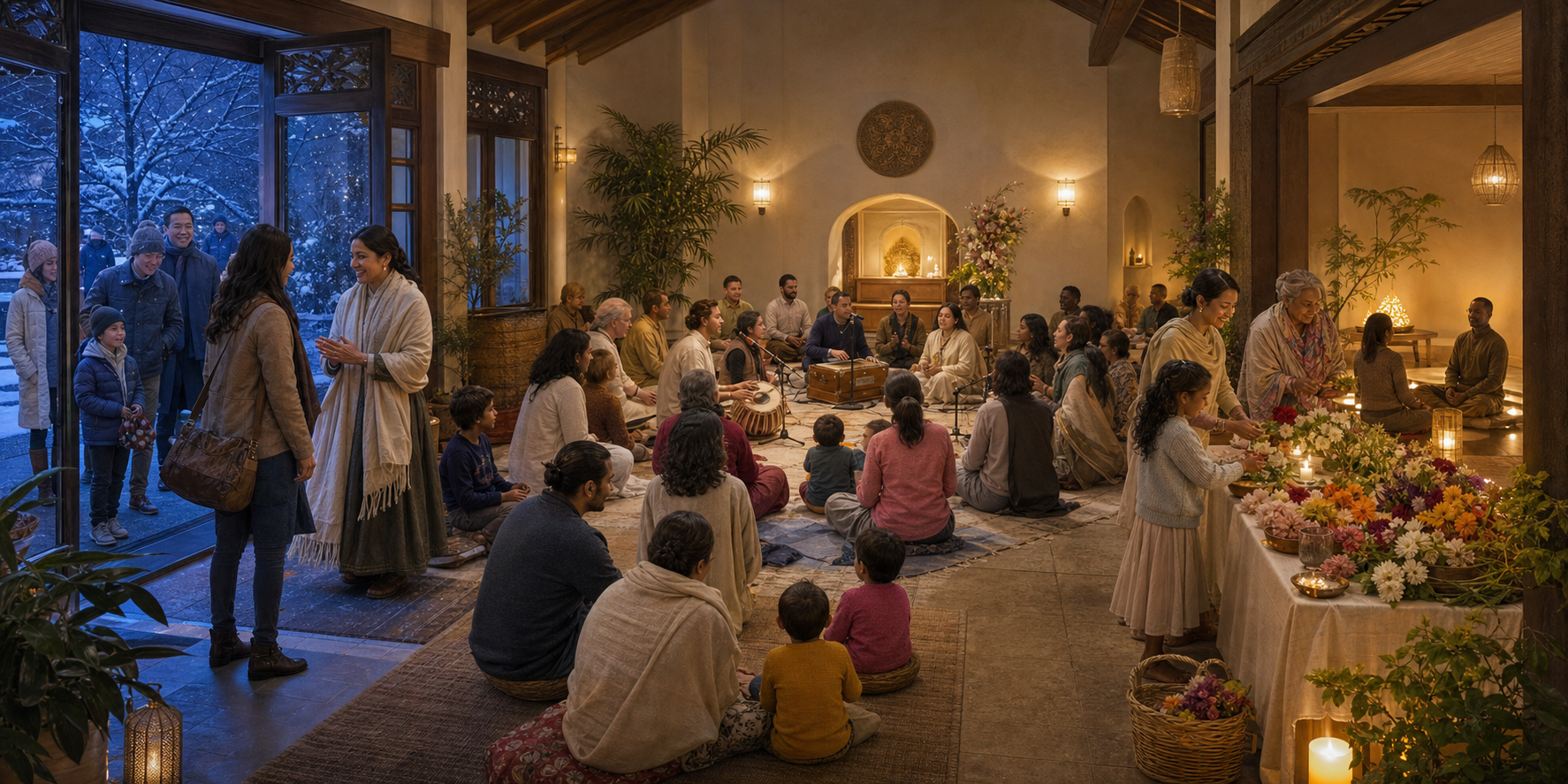
The order of the evening matters. People usually arrive carrying unfinished conversations, travel stress, family responsibilities, and the restless mood of a public holiday. Do not expect instant contemplation. Let the programme guide them gradually from social arrival into devotional attention.
- Welcome and settle. Greet newcomers, explain where to sit, and give them the words and response pattern for congregational chanting. Keep announcements practical and brief.
- Offer culture with a spiritual purpose. Use story, recitation, music, or movement to illuminate a virtue, teaching, divine name, or episode from sacred tradition. Explain the connection so that the segment does not become an isolated stage performance.
- Move from watching to participating. Let kirtan or another appropriate congregational practice become the centre of the evening. Tell newcomers when to listen and when to respond. Participation should be invited, never policed.
- Make room for silence. After collective sound, allow a quiet interval for gratitude, remembrance of teachers and departed community members, and prayer for the welfare of all beings.
- Turn intention into sankalpa. Ask each person to name a concrete practice or act of service they can actually begin. A usable resolve identifies an action: joining a seva rota, restoring regular japa, studying with the family, visiting an isolated elder, or offering practical help through the community.
- End with hospitality. Serve prasadam in a way that encourages people to sit, meet, and include anyone who arrived alone. Sharing prasadam and conversation can carry the devotional mood into genuine intergenerational fellowship.
Protect the transitions between these stages. A long technical reset after a reflective prayer can dissolve the atmosphere. Put instruments, microphones, lyric sheets, seating, and serving arrangements in place before the devotional centre of the programme begins. Sacred chanting should not become background music for room changes or loud conversation.
Give children real seva, not a token appearance
Children contribute most meaningfully when their role is connected to the purpose of the gathering. Music, recitation, story, and movement allow them to join cultural learning with devotion while practising memory, teamwork, public expression, and attentive listening.
Match the responsibility to the child’s readiness. A confident child might narrate a sacred story or lead a response. Another might welcome families, prepare lyric sheets, arrange offerings under adult guidance, help with prasadam, or create artwork around the evening’s theme. Do not treat public performance as the only proof of confidence. Quiet, dependable service is also worthy of recognition.
Give children enough context to understand what they are offering and why. Rehearsal should cover meaning as well as sequence. When a child knows that a song expresses gratitude, or that a recitation introduces the evening’s resolve, the contribution becomes seva rather than display.
Protect dignity as carefully as quality. Tell families what participation involves, obtain permission before publishing identifiable photographs, and let a child decline a public role without embarrassment. Devotional education should cultivate composure through preparation and encouragement, not forced exposure.
Welcome Dharmic diversity without flattening traditions
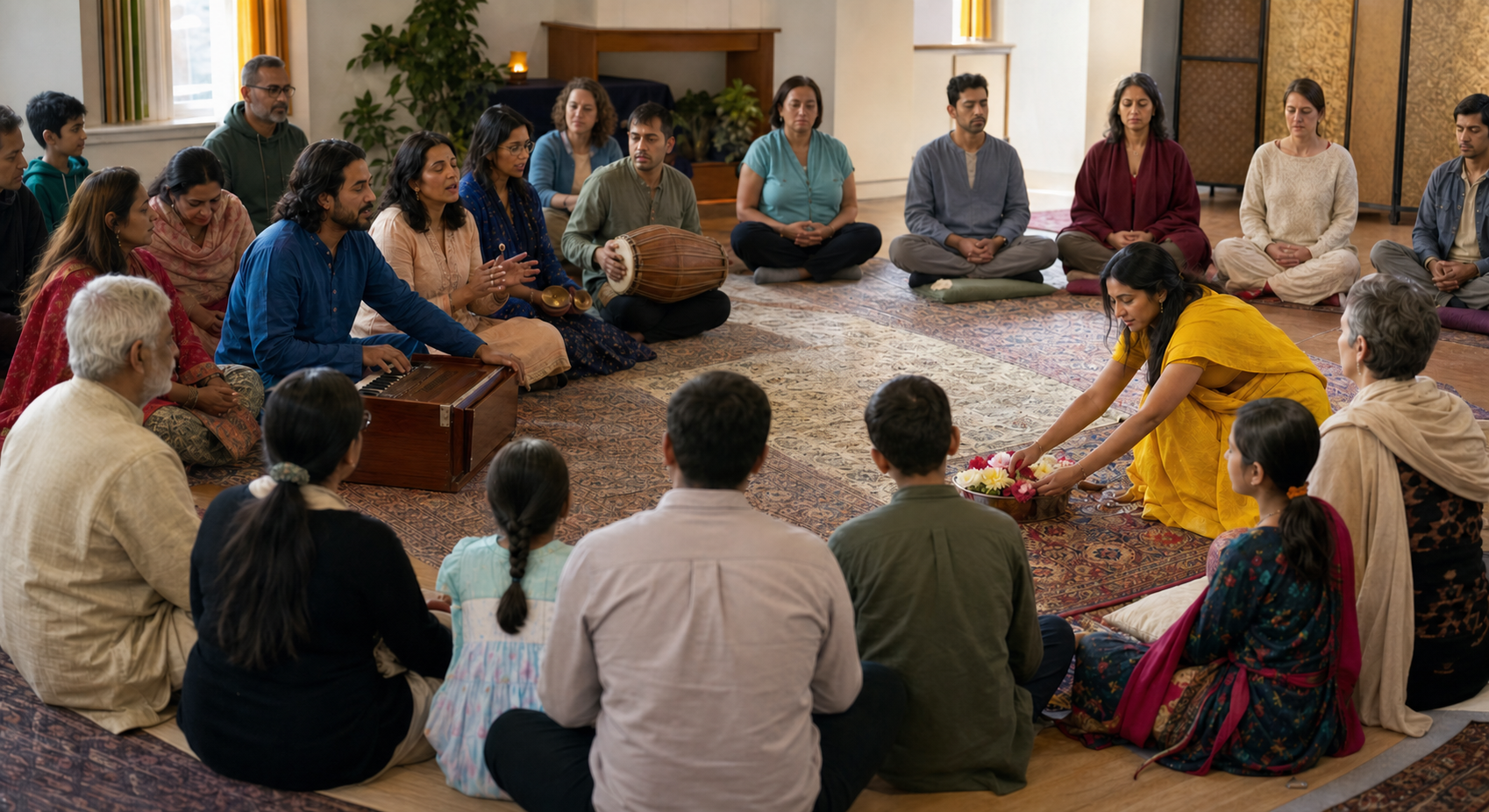
A generous gathering can be firmly rooted in its own lineage. If your community is Krishna conscious, Sikh, Jain, Buddhist, Shaiva, Shakta, or grounded in another sampradaya, name that inheritance clearly. Hospitality does not require a vague programme in which every practice is presented as interchangeable.
Hindu, Buddhist, Jain, and Sikh communities can recognise shared commitments to compassion, mindfulness, ethical living, service, and reverence for the sacred while retaining different doctrines, disciplines, and forms of worship. Kirtan, japa, nam-simran, and contemplative recitation may all use sound and remembrance, but they should be introduced in their proper settings rather than merged into an invented universal ritual.
- Name the practice. Briefly explain its lineage, meaning, and the appropriate way to join it.
- Translate unfamiliar language. Give newcomers enough meaning to participate attentively instead of merely imitating sounds.
- Permit respectful observation. A guest should be able to remain silent without being singled out or treated as resistant.
- Unite around ethical action. Compassion, truthfulness, humility, respect, and service provide an honest meeting ground without erasing theological differences.
- Avoid symbolic representation. Do not ask a single guest to speak for an entire religion. Invite people to contribute from their actual practice and experience.
The host should also explain community vocabulary. Terms such as prasadam, seva, sankalpa, and kirtan may feel natural to regular participants but unfamiliar to visitors or younger family members. A plain sentence is usually enough. Explanation is not dilution; it is hospitality.
Prevent the practical problems that break devotional attention
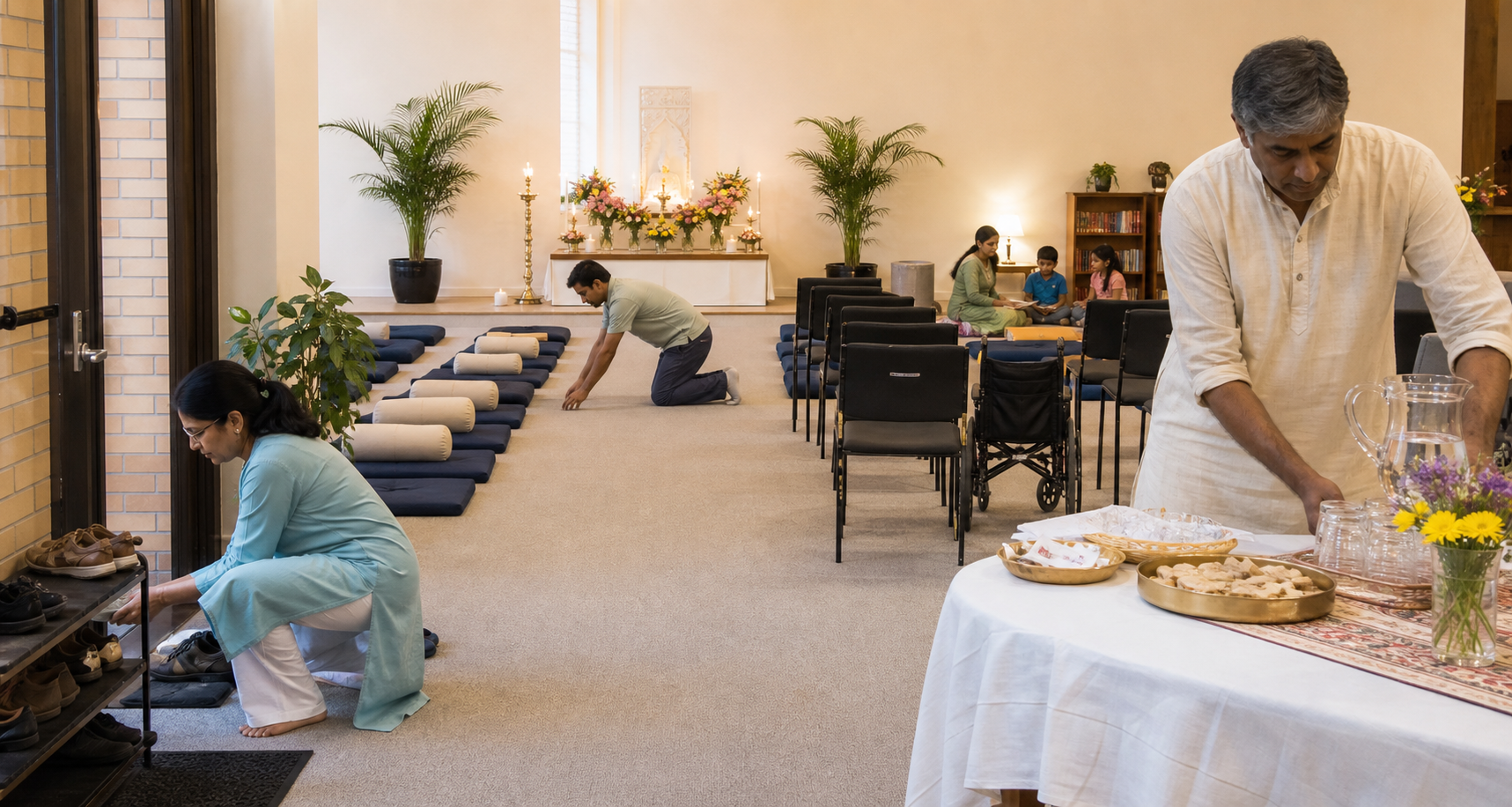
The devotional mood depends partly on ordinary competence. Confused entrances, uncertain transitions, unlabelled food, uncontrolled photography, and nobody responsible for helping a distressed child can undo careful spiritual planning. Put the whole event on a single working sheet with the sequence, the person responsible for each stage, the cue that starts it, and the adjustment to make if the programme runs late.
- Appoint a programme steward. This person protects the sequence and handles changes without repeatedly interrupting the devotional leader.
- Appoint a welcome steward. Give someone explicit responsibility for newcomers, elders, people with accessibility needs, and anyone who seems unsure where to go.
- Confirm child supervision. Families should know where children are expected to be, who is guiding them, and where they reunite after a contribution.
- Prepare participation aids. Check the order of chants, transliteration, translation, response cues, and microphone handovers before guests arrive.
- Plan prasadam as part of the programme. Label ingredients and relevant allergens, organise serving responsibilities, and make sure volunteers can also receive prasadam without abandoning essential duties.
- Set a photography boundary. Identify any camera-free devotional interval and communicate how images involving children may be used.
- Communicate the ending. Tell families when the formal observance ends and what informal fellowship follows, especially when people must arrange transport or care for young children.
Watch for several common forms of drift. A children’s offering can turn into a competition for stage time. A welcome can become a series of speeches. Kirtan can be shortened because earlier items overran. Inclusion can become so abstract that guests cannot tell what the community actually practises. A resolution exercise can produce noble words with no next action.
The correction is the same in each case: return to the purpose sentence. Keep what helps people remember, participate, serve, and belong. Shorten what asks them only to sit through somebody else’s prominence.
Key takeaways for your planning meeting
- Define what you want people ready to practise or serve when they leave.
- Shape the evening as a movement from welcome to cultural offering, participation, silence, sankalpa, and prasadam.
- Give children meaningful responsibilities suited to their readiness, including quiet forms of seva.
- State your lineage clearly while making language, participation, and hospitality accessible to visitors.
- Use a single run sheet with named owners, transition cues, safeguarding arrangements, and a fallback for delays.
At your next planning meeting, write the purpose sentence at the top of the page before discussing performers or decorations. Then build the programme around the devotional moment you most need to protect. If the schedule is already full, remove the segment that contributes least to remembrance, relationship, or seva and give that space back to participation.
The first act of the new year should not be merely leaving an event. Give every participant a visible next doorway into practice: the next kirtan, a study gathering, a family observance, or a specific seva responsibility. That is how a celebration becomes the beginning it promises to be.
References
- Dandavats — Gurukula Children Illuminate New Year’s Eve with Devotion, Culture, and Confidence
- Dandavats — Culture, Community, and Kirtan: A Soulful New Year’s Eve at the Haveli Uniting Dharmic Traditions
