

If someone you love or serve asks you to defend what you know is wrong, Vibhishana’s problem is immediately recognizable. The hardest part is rarely noticing the wrong. It is deciding what loyalty still requires when obedience would help that wrong continue.
Vibhishana offers a demanding answer. Loyalty requires honest counsel, patience, and a sincere attempt at correction, but it does not require participation in adharma. His choices give you a practical sequence: establish your principles before pressure arrives, speak while correction remains possible, and withdraw your support when staying would make you an instrument of wrongdoing.
The decisive choice came before the crisis
Vibhishana’s defining decision did not begin on the battlefield. When he, Ravana, and Kumbhakarna undertook austerities and received boons from Brahma, Ravana sought protection from external threats. Vibhishana instead sought steadfast adherence to dharma, discernment between right and wrong, and the courage to uphold truth. Ravana tried to make his position unassailable. Vibhishana tried to make his conscience dependable.
That distinction matters because a crisis does not give you much time to build character. Pressure narrows attention. Fear enlarges the immediate cost of dissent. Affection makes a loved one’s conduct easier to excuse. Status makes a powerful person’s demand feel more legitimate than it is. If your principles remain undefined until that moment, convenience will often define them for you.
Vibhishana did not ask to avoid difficult choices. He asked for the inner capacity to make them well. You can prepare in the same spirit by answering three questions before your next conflict:
- What action would I refuse even if a relative, employer, political leader, or respected elder requested it?
- What truth would I be obligated to speak even if silence protected my position?
- What personal cost am I willing to accept rather than make myself useful to adharma?
Write the answers plainly. Avoid slogans such as “I will always do the right thing.” Name the conduct at issue: concealing a known wrong, repeating a falsehood, punishing an innocent person, or using authority to silence legitimate correction. A precise boundary is much harder to negotiate away under pressure.
Loyalty to a person is not obedience to every demand
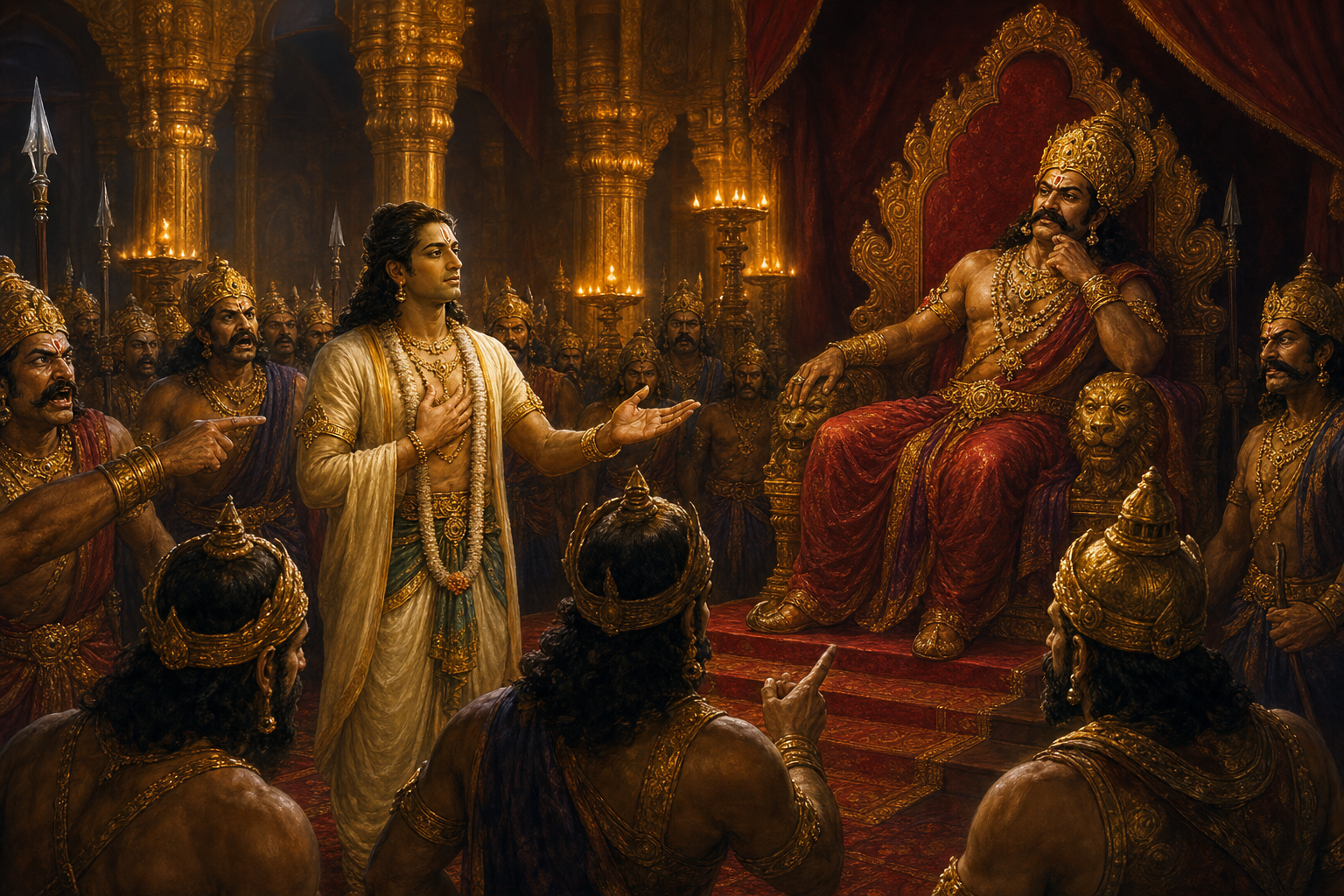
Vibhishana’s first response to Ravana was counsel, not abandonment. He warned his brother against adharma. Only after that counsel failed did he seek sharanagati, or refuge, with Sri Rama. The order is essential to understanding his commitment.
As a brother, Vibhishana owed Ravana truthful concern. As a responsible member of Lanka’s ruling house, he owed the kingdom judgment that extended beyond one ruler’s will. As one committed to dharma, he could not treat kinship as permission to support wrongdoing. These duties became painful because they pointed in different directions, but the higher duty clarified the lower ones.
Faithfulness seeks a person’s genuine good, which sometimes requires correction. Compliance merely supplies what that person wants. The two coincide when a request is just. When it is not, honest resistance can be more loyal than flattering obedience. Ravana wanted support for his course; Vibhishana gave him the harder gift of truth.
This also prevents two opposite misreadings of Vibhishana:
- “Family loyalty requires staying under all conditions.” This turns relationship into moral immunity. No bond can transform adharma into dharma.
- “Dharma permits departure whenever I disagree.” Vibhishana attempted correction before changing allegiance. Wounded pride, inconvenience, and loss of influence are not automatically moral causes.
Before calling a conflict dharmic, remove your ego from the test. Ask whether you would condemn the same conduct if it benefited your rival, and whether you would defend it if it harmed you. If your judgment changes with your advantage, you may be protecting preference rather than principle.
A five-step Vibhishana test for difficult loyalties

You should not copy the outward form of an epic decision without examining your own circumstances. You can, however, use the moral sequence behind Vibhishana’s choice whenever loyalty and conscience collide.
- Name the act, not merely the person. “My leader is bad” is too vague to guide action. State exactly what is being done, what truth is being denied, and who bears the consequence.
- Test your objection against dharmic values. Look for truth rather than convenience, restraint rather than domination, compassion rather than coercion, and service rather than self-protection. A preference becomes a dharmic objection only when a real principle or duty is at stake.
- Offer a path of correction. Say what must stop, what should replace it, and why. Counsel that only displays your purity is less useful than counsel that gives the other person a just way back.
- Examine what your continued presence enables. Are you still able to reduce harm and support correction, or does your reputation now provide cover for conduct you oppose? Staying is not neutral when your position, silence, knowledge, or labour helps adharma function.
- Change allegiance without adopting hatred. Vibhishana did not merely reject Ravana; he sought refuge with Rama and placed his knowledge in the service of a dharmic cause. Non-cooperation should move you toward right action, not toward revenge, humiliation, or chaos.
The third and fourth steps demand the most discernment. Leaving too soon can abandon a duty you still have the power to perform. Staying too long can turn patience into complicity. The useful question is not simply “Am I still inside?” It is “What is my presence accomplishing now?”
This test also travels across the wider Dharmic family without making its traditions identical. Buddhist dhamma emphasizes disciplined right conduct; Jain thought gives exceptional weight to ahimsa and satya; Sikh tradition joins sach with seva; and Sanatana Dharma places action within a larger moral order. Their doctrines and practices differ, but each challenges the belief that power or appetite can justify itself. When your motives are confused, truth, non-harm, restraint, service, and accountability provide concrete points of examination.
Dharma became decisive because Vibhishana acted on it

Vibhishana’s commitment was not a private feeling kept separate from public responsibility. His knowledge of Lanka and his strategic counsel materially aided Rama’s campaign. After Ravana’s defeat, Rama installed Vibhishana as king. Moral clarity affected military judgment, political legitimacy, and Lanka’s future governance.
This is why the charge of opportunistic betrayal does not adequately explain his path within the Ramayana’s dharmic logic. Vibhishana chose dharma before it offered him a throne. He risked his place by counselling Ravana. He sought Rama only after correction had failed. Authority came after the costly decision; it was not the principle by which he made that decision.
Nor was Vibhishana’s stand hostility toward Lanka. A kingdom is not identical to the ruler who temporarily commands it. By separating Lanka’s welfare from Ravana’s will, Vibhishana preserved the possibility that the polity could survive the ruler’s adharma. That distinction remains useful wherever leaders demand that loyalty to an institution be demonstrated through loyalty to them personally.
If you lead a family, organisation, temple committee, community body, or public institution, Vibhishana’s example changes how you should treat dissent. Do not measure loyalty by how quickly people agree with you. Ask one trusted person to identify the strongest moral objection to your intended course. Require a specific account of the harm, principle, and remedy. Then respond to the substance without punishing the person who raised it. A leader who drives away truthful counsel does not eliminate error; the leader eliminates the ability to detect it.
If you are the adviser rather than the leader, make your counsel usable. Describe the wrong without exaggeration, connect it to the duty being violated, propose a correction, and state the boundary beyond which you cannot participate. This approach reveals whether the disagreement is still reparable. It also prevents vague protest from becoming a substitute for courage.
Key takeaways for choosing dharma under pressure
- Form your moral boundaries before affection, fear, or status makes them expensive to enforce.
- Give truthful counsel before concluding that departure is necessary.
- Judge the act by a stable principle, not by whether the actor belongs to your family, faction, or community.
- Distinguish patient presence from complicity by asking what your presence now enables.
- When you must withdraw support, move toward constructive duty rather than resentment.
- Treat authority as legitimate only while it remains answerable to dharma.
Before your next difficult conversation, complete one sentence: “I owe this person honest counsel, but I will not help them do ______.” Then write the correction you will request and the action you will take if that correction is refused. Vibhishana’s commitment becomes useful when admiration turns into a boundary you can actually keep.
References
