
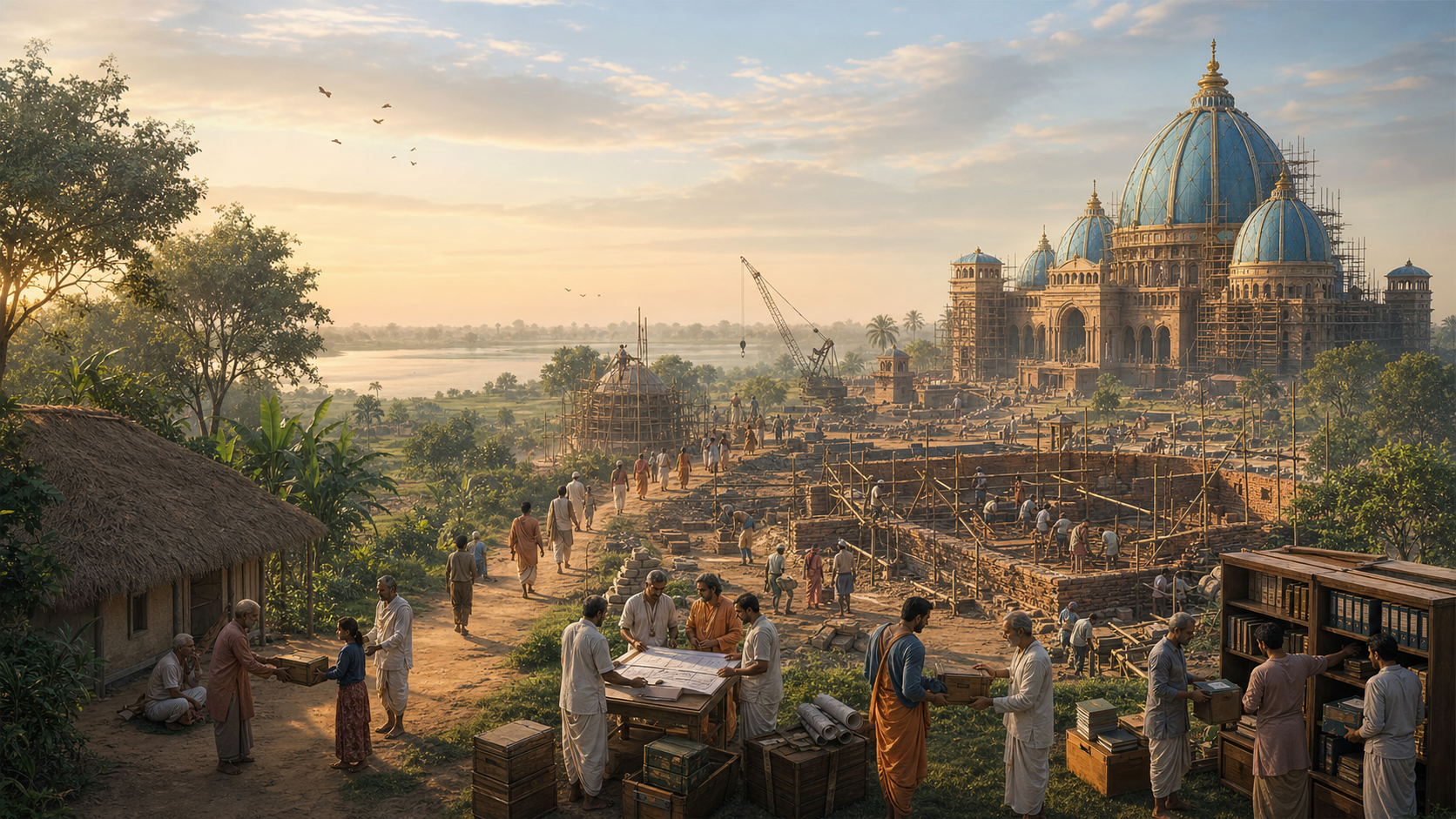
If you see the Temple of the Vedic Planetarium only as a large temple under construction, you miss the question that makes its history useful: how does a sacred intention survive long enough to acquire an enduring institutional form? That question matters whether you are a devotee, donor, educator, trustee, student of temple architecture, or simply concerned about the future of Dharmic culture.
The TOVP’s development from 1971 through 2025 should therefore be read as more than a succession of construction images. The architecture reveals the visible half of the journey. The less visible half consists of transmitted responsibility, sustained service, collective effort, documentation, and the conversion of spiritual purpose into something a wider public can encounter.
The decisive movement was from inspiration to stewardship
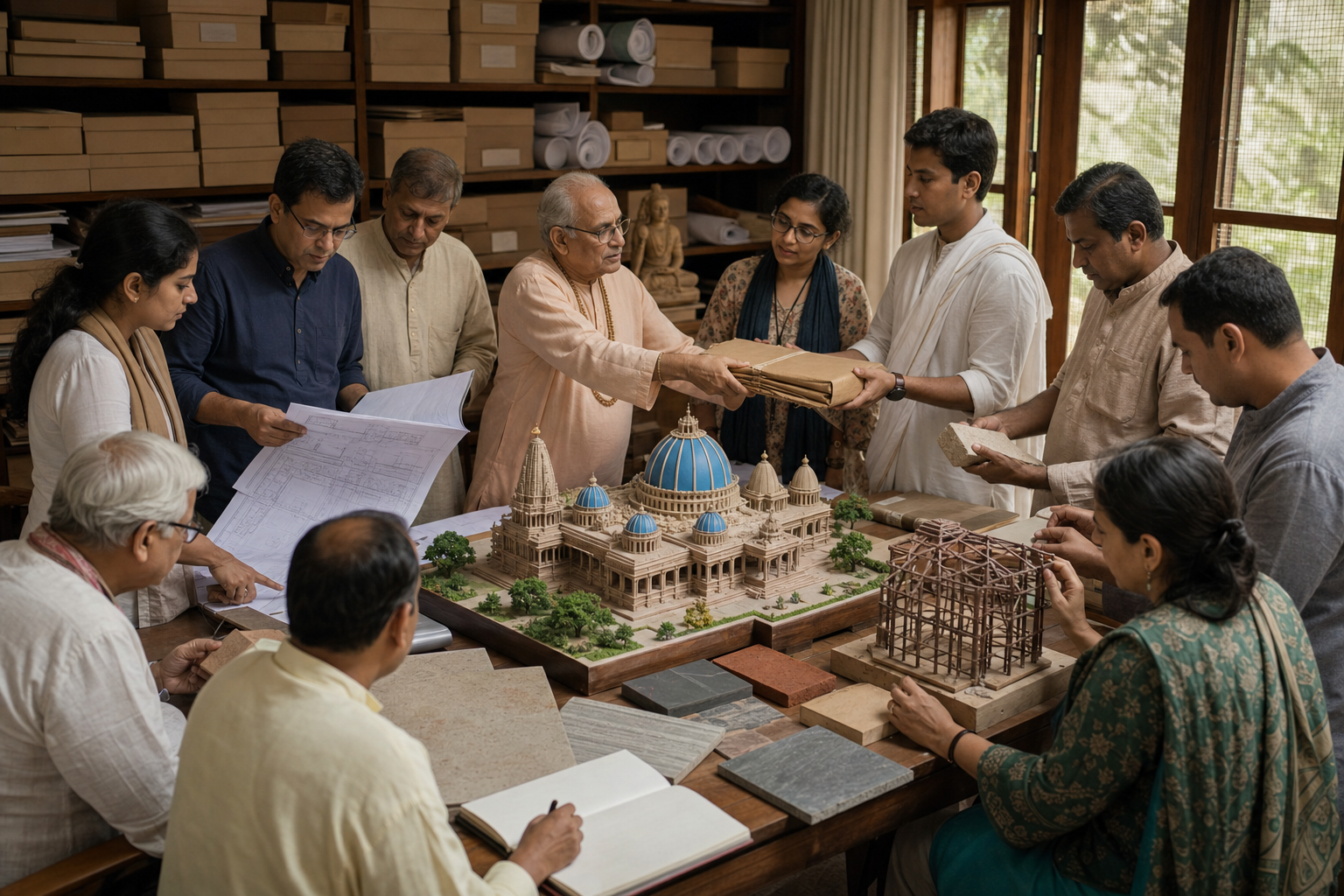
A sacred project does not become an institution merely because its founding vision is powerful. Someone must receive that vision as a responsibility, keep it intelligible, gather others around it, and sustain it across periods when the final form is still distant.
The TOVP’s institutional arc begins with Srila Prabhupada’s initial inspiration in 1971, followed by Ambarisa prabhu’s reception of that aspiration in 1976 and the collaborative work that carried it through 2025. Those dates identify more than two moments on a chronology. They reveal the movement from originating vision to accepted stewardship.
This distinction is important. Inspiration answers, “Why should this exist?” Stewardship answers, “Who will continue serving the purpose when inspiration alone is no longer enough?” Architecture then answers a third question: “What durable form can make that purpose present to others?” Confusing these stages produces shallow temple history. Keeping them distinct lets you see how a spiritual intention becomes a public institution.
The phrase “from kutir to mandir” captures this transformation without making the kutir insignificant. The smaller beginning carries intimacy, concentration, and the seed of purpose. The mandir introduces scale, permanence, coordination, education, and public visibility. The point is not that one is sacred and the other is not. The point is that each demands a different kind of service.
When you examine any long-running Dharmic project, ask four questions:
- What founding purpose remained constant even as the physical form changed?
- At which moment did personal inspiration become an accepted responsibility?
- What work had to become collaborative rather than dependent on one individual?
- How did the project become useful to people beyond its original circle?
These questions prevent a common mistake: treating a completed or advancing structure as though it appeared automatically from a founder’s wish. A monumental building may attract the eye, but institutional continuity is created through repeated acts of responsibility.
Architecture makes continuity visible, but not complete
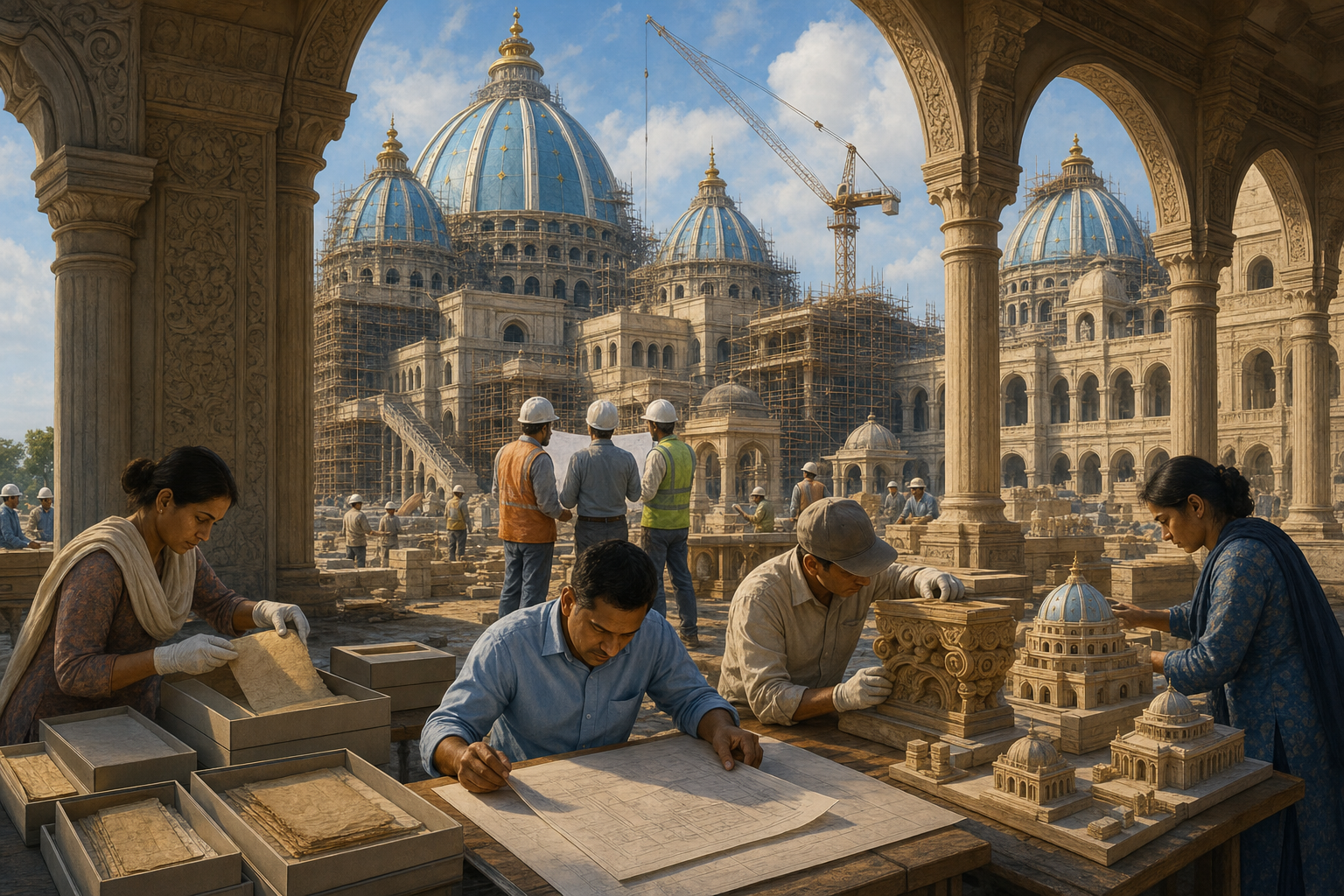
Architecture is especially powerful in a project whose development spans more than five decades. A written aspiration can remain abstract. A sequence of changing structures makes accumulated effort visible. You can notice that the work has passed through stages, that earlier labour supports later form, and that people continued acting before the whole vision could be seen.
Yet photographs of architectural progress should not be mistaken for the entire institutional history. Stone, structure, ornament, and scale can demonstrate material advancement. They cannot, by themselves, explain how responsibility was transmitted, how cooperation was maintained, or how the temple’s intellectual and educational purposes were preserved. The most accurate reading holds the visible and invisible layers together.
| Layer of the journey | What you should notice | The question to ask |
|---|---|---|
| Vision | The purpose that precedes the building | What was the temple meant to make present? |
| Stewardship | The reception and continuation of responsibility | How did aspiration become sustained service? |
| Collaboration | The widening circle of participation | What could no individual accomplish alone? |
| Architecture | The material evidence of cumulative work | Which stages transformed intention into public form? |
| Cultural use | The movement from construction project to learning resource | How can families, students, temples, and communities engage with it? |
This layered approach also guards against two opposite errors. The first is architectural reductionism: admiring the building while ignoring the institution that made it possible. The second is architectural indifference: speaking about lofty purpose while failing to acknowledge that sacred ideas need durable, accessible forms. The TOVP journey matters because purpose, stewardship, and structure can be followed together.
You should also read scale carefully. A larger structure does not automatically prove deeper spiritual life. What scale does demonstrate is a greater requirement for coordination and continuity. The proper question is therefore not, “Is the mandir more spiritual than the kutir?” It is, “What additional responsibilities arise when a private or intimate aspiration takes public, monumental form?”
How to read the 1971–2025 journey without turning it into legend
Devotional respect does not require vague history. In fact, careful chronology honours service more fully because it allows you to distinguish the original inspiration, the acceptance of responsibility, the long process of collaboration, and the visible stages of construction.
A useful reading separates three things: milestone, process, and meaning. A milestone is a dated development. A process connects one milestone to another through continued work. Meaning is the interpretation we draw from that continuity. Problems begin when an interpretation is presented as though it were itself a dated fact.
You can use the free TOVP 2026 visual timeline, which presents the 1971–2025 journey in a viewable, downloadable, and shareable format, with a simple method:
- Begin with the earliest point and state only what the chronology establishes: the originating inspiration and its date.
- Mark 1976 as a transition in stewardship, paying attention to the difference between having a vision and carrying responsibility for it.
- Follow the architectural sequence and identify where an intention becomes materially visible, while remembering that a selected image is not a complete technical construction record.
- For each visible advance, ask what institutional capacity must have continued behind it: coordination, service, documentation, cooperation, or public communication.
- End at 2025 without treating it as the end of the temple’s meaning. A sacred institution must still be taught, interpreted, maintained, and handed forward.
If a date or image does not establish a detail, do not fill the gap with a dramatic story. Record the uncertainty. This discipline is particularly important when presenting temple history to children, students, or community audiences. Reverence becomes more credible when listeners can distinguish evidence from reflection.
The journey can also be placed within a wider Dharmic frame, provided we do not erase real differences among traditions. Hindu, Buddhist, Jain, and Sikh communities have distinct doctrines, practices, and institutional histories. Still, disciplined practice, service, transmission of knowledge, and community uplift offer legitimate points of conversation. The useful comparison concerns how living traditions preserve purpose through people and institutions, not an assertion that all traditions teach the same theology.
That distinction gives educators a practical boundary. Use the TOVP to discuss continuity, sacred architecture, stewardship, and cultural preservation. Do not use it to flatten the Dharmic family into a single undifferentiated tradition. Unity becomes more meaningful when it can accommodate specificity.
Key takeaways
- The TOVP’s 1971–2025 story is institutional as well as architectural: inspiration had to become accepted and sustained responsibility.
- “From kutir to mandir” describes a change in scale and public duty, not a movement from an insignificant beginning to a meaningful end.
- Construction images show cumulative effort, but they do not reveal the whole history of stewardship and collaboration.
- A reliable reading separates dated milestones, continuing processes, and later interpretation.
- The journey is most useful when it supports education, documentation, cultural memory, and informed participation rather than passive admiration.
Turn the timeline into a local act of preservation
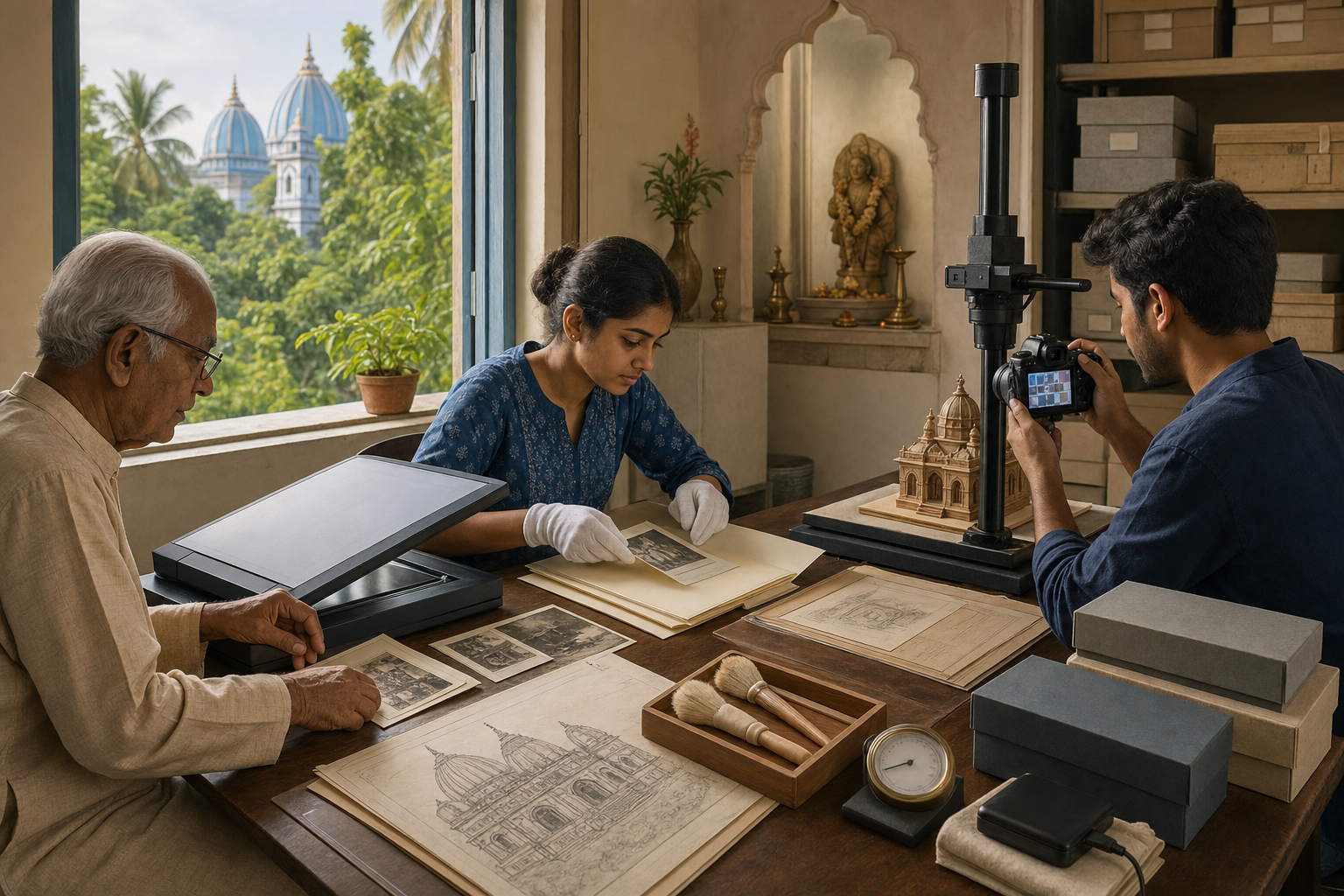
The history becomes valuable when you use it. A family can select an early image, the 1976 transition, and a later stage, then ask what remained constant while the physical form changed. A study circle can assign participants to identify vision, stewardship, collaboration, architecture, and educational use. A temple or cultural organisation can use the sequence to discuss how its own founding purpose is documented and passed to new volunteers.
Researchers and educators should preserve context whenever an image is reused. Keep the date, the identified milestone, the people explicitly connected with it, the status of the work at that moment, and the link from which the information was obtained. An impressive image detached from its context may circulate widely while teaching very little.
Trustees and donors can draw a further lesson. Do not assess the maturity of a sacred project by its facade alone. Look for continuity of purpose, identifiable stewardship, collaborative capacity, accessible documentation, and a serious plan for cultural learning. Architecture deserves support as a vessel of Dharma, but the institution must remain capable of explaining what the vessel carries.
You can view the visual journey online, keep a copy for offline reference, or share it with a temple, school, family group, or cultural organisation. Begin with one transition rather than trying to absorb the whole chronology at once. Trace how the 1971 inspiration became responsibility in 1976 and continued toward visible form through 2025. Once you can explain that movement accurately, you are no longer merely looking at a temple project. You are helping preserve the memory of how a Dharmic institution is built.
References
