
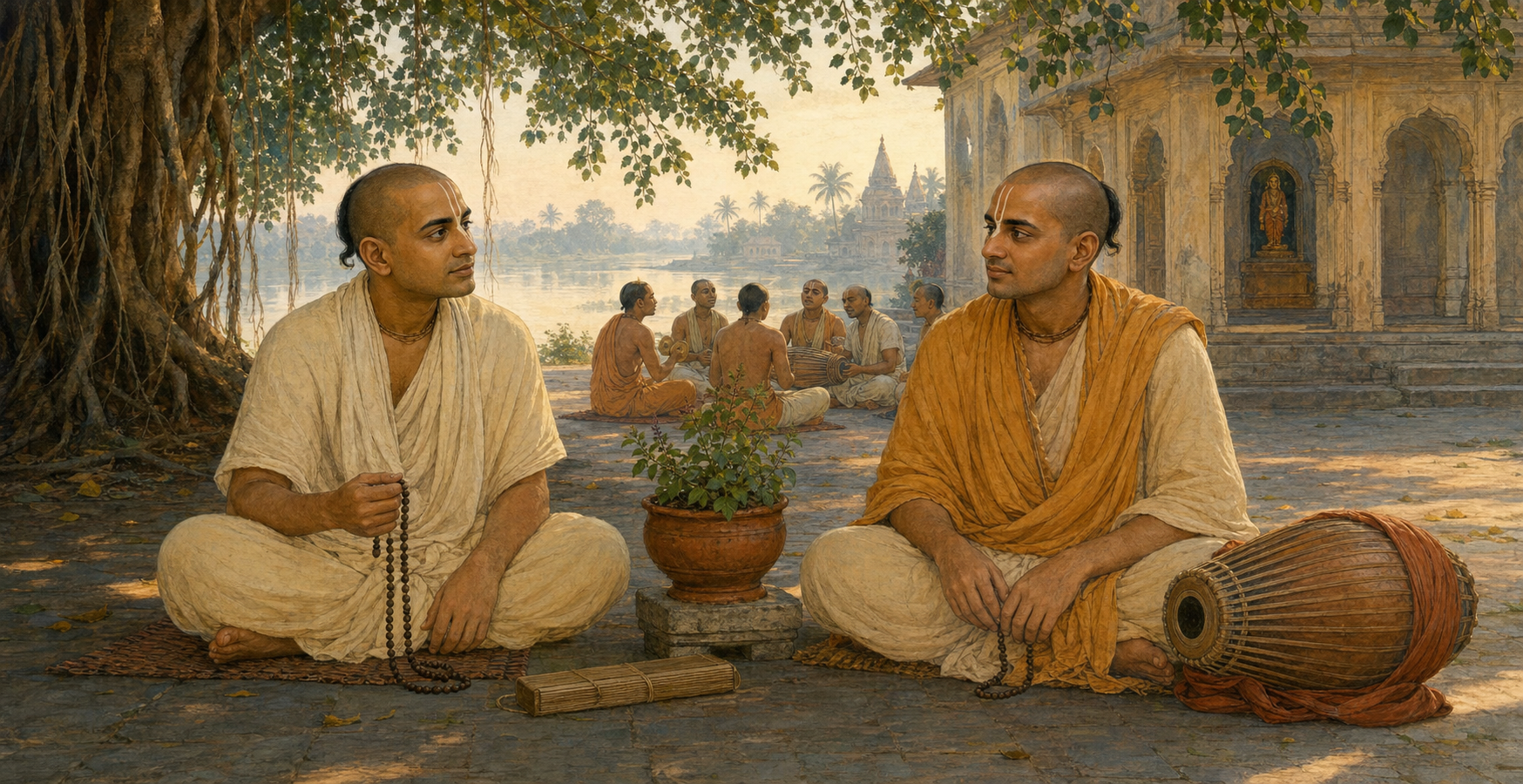
You can be sincere about bhakti and still find that your practice weakens between moments of worship. Before blaming a lack of willpower, look at your association. The people who repeatedly receive your attention help shape what you remember, what you speak about, and what begins to feel normal.
If you have come to Sri Ramacandra Kaviraja’s remembrance wondering what his life means for your own path, begin here: sacred association is not an ornament around spiritual practice. It is part of the environment in which devotion either matures or becomes distracted.
Why Narottama’s request is more than personal praise
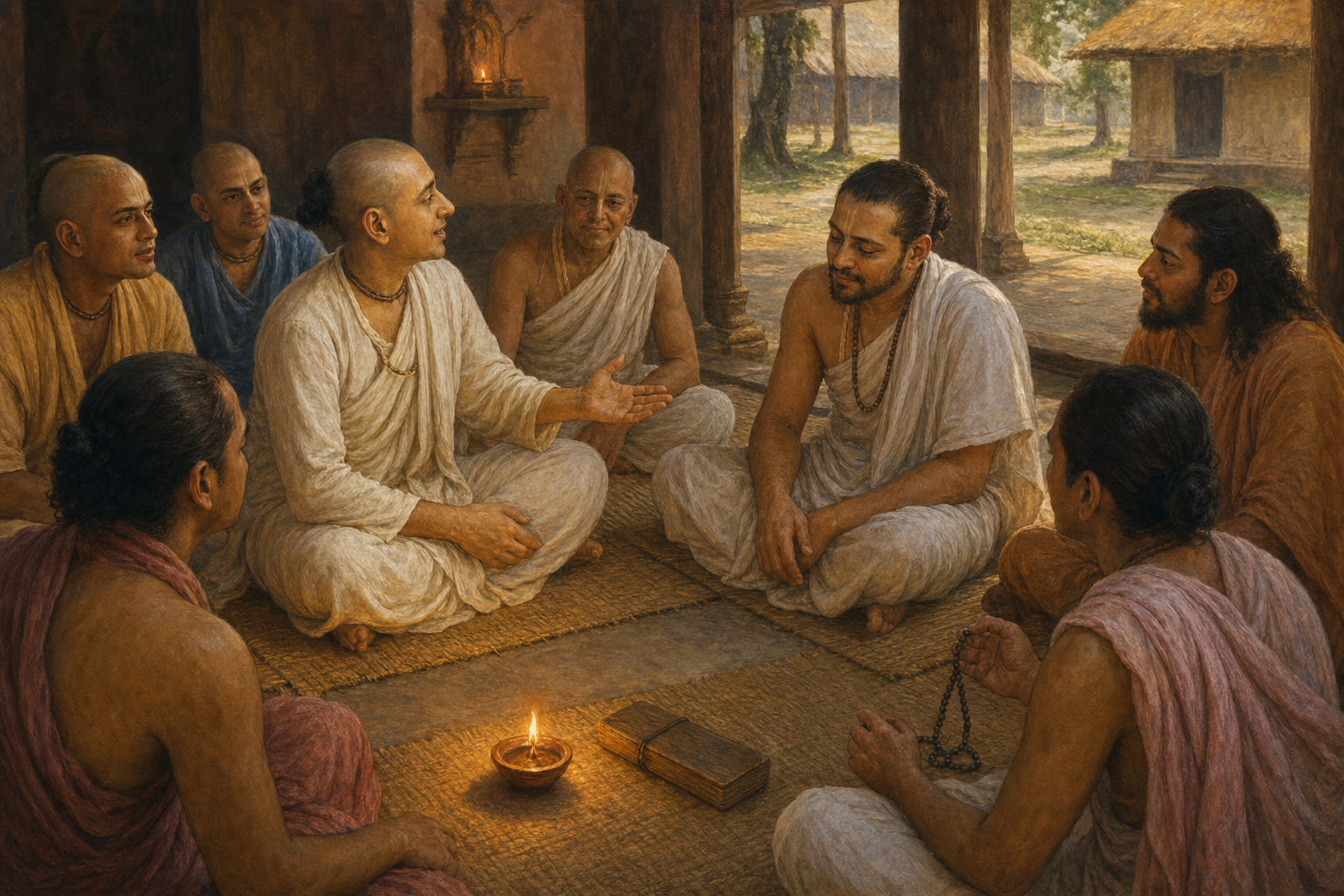
Sri Ramacandra Kaviraja is remembered as an intimate associate of Srila Narottama dasa Thakura, distinguished by steadfast devotion, refined scholarship, and exemplary service. Narottama’s esteem for him is especially revealing because it appears as a request for association, not merely as admiration from a distance.
daya koro sri acarya prabhu srinivasa, ramacandra sanga mage narottama dasa
Srila Narottama dasa Thakura
Narottama asks Srinivasa Acarya for mercy and prays for Ramacandra’s company. The prayer places two relationships side by side: guidance received through the acharya and companionship received through a devoted associate. Direction and association do different work. A teacher clarifies the path; a trustworthy companion helps you remain on it amid the pressures of ordinary life.
This also corrects a subtle form of spiritual pride. A mature practitioner does not assume that personal learning has made good company unnecessary. Narottama’s prayer presents the desire for uplifting association as an expression of humility. You do not outgrow the need for people whose conduct calls your own conduct upward.
Apply that insight by naming the relationships actually supporting your practice. Who can correct you without humiliating you? With whom can you discuss devotion without drifting into gossip or rivalry? Who makes service seem more important than recognition? If no name comes readily, you have identified a practical need rather than a reason for discouragement.
Judge sacred association by what it produces in you

Shared vocabulary, clothing, rituals, or institutional membership can identify a religious community, but they do not by themselves establish the quality of its association. Sacred sanga is recognized through its fruit. The useful question is not simply, “Are these people religious?” It is, “What direction does repeated contact with them give my attention and conduct?”
- After meeting them, do you remember Bhagavan and your commitments more readily, or do personalities and disputes dominate your mind?
- Does the association make your practice more regular and attentive, or does discussion replace practice?
- Are you becoming more willing to serve when no recognition is available?
- Does your speech become more truthful and restrained, especially when speaking about someone absent?
- Can sincere questions and correction be received without mockery, intimidation, or factional punishment?
- Does learning produce humility, or merely give the group a more sophisticated language for pride?
Use these questions to notice a recurring direction, not to pass judgment after one awkward conversation. Healthy companionship will not make every encounter pleasant. Honest correction can be uncomfortable. The important distinction is whether discomfort serves truth and growth or merely protects another person’s status.
Do not confuse emotional intensity with spiritual depth either. A gathering can feel exciting because everyone agrees, condemns the same opponents, or admires the same speaker. If the excitement leaves your actual practice unchanged while making you harsher toward others, it has not produced the fruit associated with holy company.
Build sanga around practice, service, and continuity
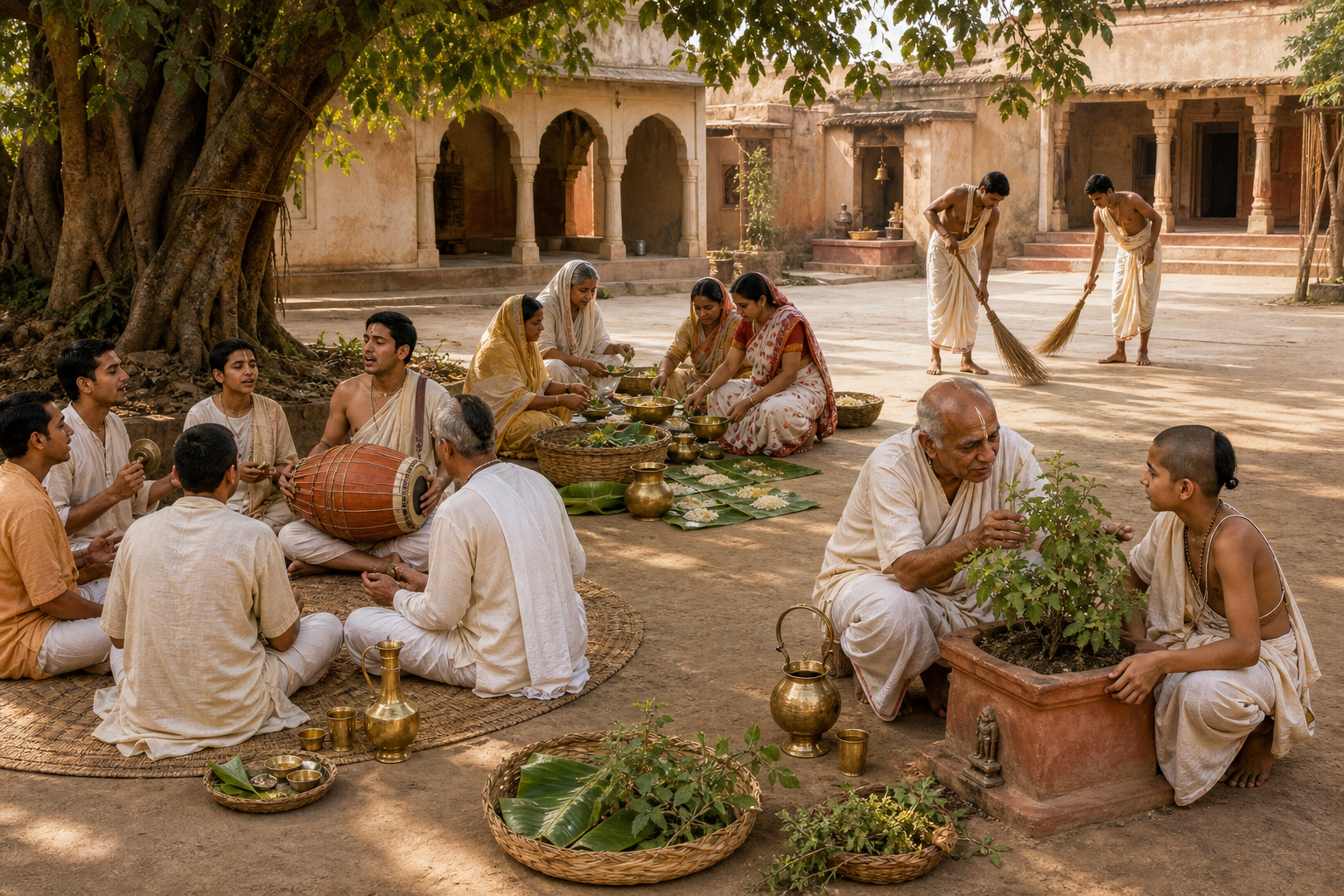
Good association is partly received as grace, but you can make yourself more available to it. Waiting for an ideal companion while remaining passive usually leaves your habits untouched. Begin with the qualities remembered in Ramacandra Kaviraja: devotion, learning, and service held together.
- Choose association by conduct before charisma. Look for people whose knowledge appears in patience, reliability, reverence, and service. Eloquence may attract attention, but repeated conduct tells you whether a person’s influence is safe to imitate.
- Bring a real question from your practice. Instead of asking only for broad inspiration, describe where attention, discipline, humility, or service is breaking down. A concrete question allows a seasoned practitioner to offer concrete guidance.
- Serve alongside others. Help with the worship, meal, study circle, pilgrimage, teaching effort, cleaning, or community duty already in front of you. Shared responsibility reveals character more clearly than casual conversation does.
- Give the relationship continuity. Place the gathering, conversation, or service commitment into your normal rhythm rather than relying on occasional enthusiasm. Sacred association is a relationship to be cultivated, not content to be consumed and forgotten.
- Carry something into action. After receiving guidance, write down the practice you will strengthen, the service you will complete, and the tendency you need to watch before the next meeting. Return prepared to speak honestly about what happened.
Keep spiritual roles clear while doing this. A respected peer is not automatically an acharya, and access to a teacher does not remove the need for dependable companions. Confusing the two can burden a friendship with authority it should not carry or reduce guidance to casual opinion. Narottama’s prayer preserves both relationships without collapsing one into the other.
You should also enter sanga as a contributor. If your main question is whether a community is meeting your needs, you may overlook the simplest way to deepen belonging: become useful. Arrive prepared, listen carefully, complete the duty you accept, and make room for quieter participants. Service changes association from an audience into a fellowship.
Keep sacred association from hardening into a clique

Every community faces a temptation to protect its identity more carefully than its purpose. Sanga begins to harden into a clique when loyalty to personalities becomes the measure of devotion. Learn to notice the shift early.
- Concern for another person repeatedly becomes an excuse to discuss that person’s faults in their absence.
- Questions about conduct are treated as attacks on the tradition itself.
- Correction moves only downward, while influential members remain beyond examination.
- Members become fluent in controversies but less faithful to worship, study, restraint, or service.
- Belonging depends on displaying contempt for another sect, tradition, or community.
Not every imperfection requires a dramatic departure. Address a specific concern privately when that is appropriate, redirect conversations away from fault-finding, and ask a mature mentor how to respond. If the same degrading pattern continues, reduce your exposure to it and invest more attention in relationships that strengthen practice and ethical conduct. Tolerance does not require you to make every influence intimate.
The wider Dharmic family offers a useful perspective here. Hindu satsanga, Buddhist kalyana-mitta, Jain satsanga, and Sikh sangat arise within distinct traditions and should not be flattened into identical doctrines. Yet each affirms, in its own setting, that spiritual companionship matters to the formation of character, insight, and disciplined living.
This shared wisdom gives you a way to combine conviction with respect. Receive lineage-specific teaching from those qualified to transmit it, while recognizing the ethical seriousness of practitioners on other Dharmic paths. Inter-traditional respect does not demand careless mixing. It asks you to speak accurately, listen without contempt, and judge a gathering partly by whether it strengthens integrity and service.
Key takeaways for your own practice
- Treat association as part of spiritual discipline, not merely as a social benefit attached to it.
- Seek both seasoned guidance and dependable companionship; they support different needs on the path.
- Evaluate sanga by its recurring effects on remembrance, speech, humility, practice, and service.
- Bring concrete questions, accept useful correction, and convert guidance into a definite action.
- Contribute through reliable service instead of approaching community only as a consumer.
- Protect sacred association from gossip, personality worship, factional pressure, and contempt for other Dharmic paths.
At your next gathering, do not leave with inspiration alone. Before you go, identify what you will practise, whom you will serve, and which conversation deserves a thoughtful follow-up. Then observe whether that association helps the commitment survive beyond the gathering.
Narottama’s request for Ramacandra Kaviraja’s company invites you to become deliberate about an influence that is already operating. Seek people who help devotion become conduct, and work to become that kind of companion for someone else.
References
