
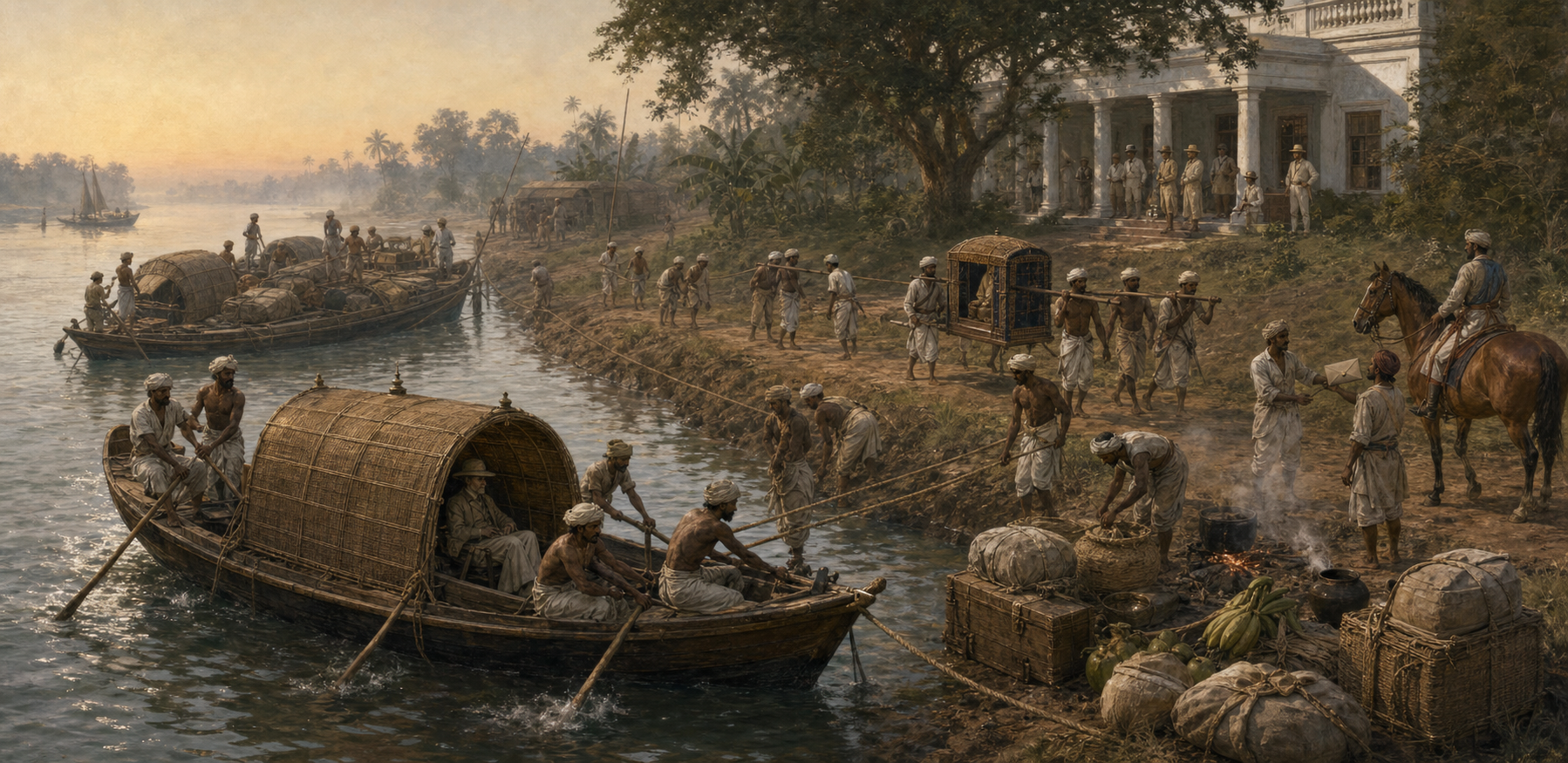
You may be looking at an old journey through Bengal and wondering how a list of boats, dinners, residences, and halting places can tell you anything serious about colonial rule. In 1803, the decisive evidence lay less in the scenery than in what happened before an aristocrat arrived: orders were issued, precedence was fixed, bearers were assembled, hosts were alerted, and political access was prepared.
Follow Viscount Valentia from Calcutta toward Bhagalpur and you can see power becoming movement. His comfort depended on coordinated labor. His knowledge passed through senior officials. The places he noticed were repeatedly interpreted through conquest, commerce, security, or administration. Reading the journey this way gives you a practical method for studying colonial travel without mistaking one privileged visitor’s experience for Bengal as a whole.
Key takeaways
- Elite mobility was an administrative privilege, not merely a private travel choice.
- Bearers, escorts, cantonments, and official residences formed one connected apparatus of movement.
- Dinners and private audiences helped determine what information reached an influential visitor.
- Descriptions of battlefields, cities, forests, and monuments often reveal imperial priorities more clearly than local social realities.
- Roads and public works must be read alongside their human and ecological costs.
Start with who made the journey frictionless
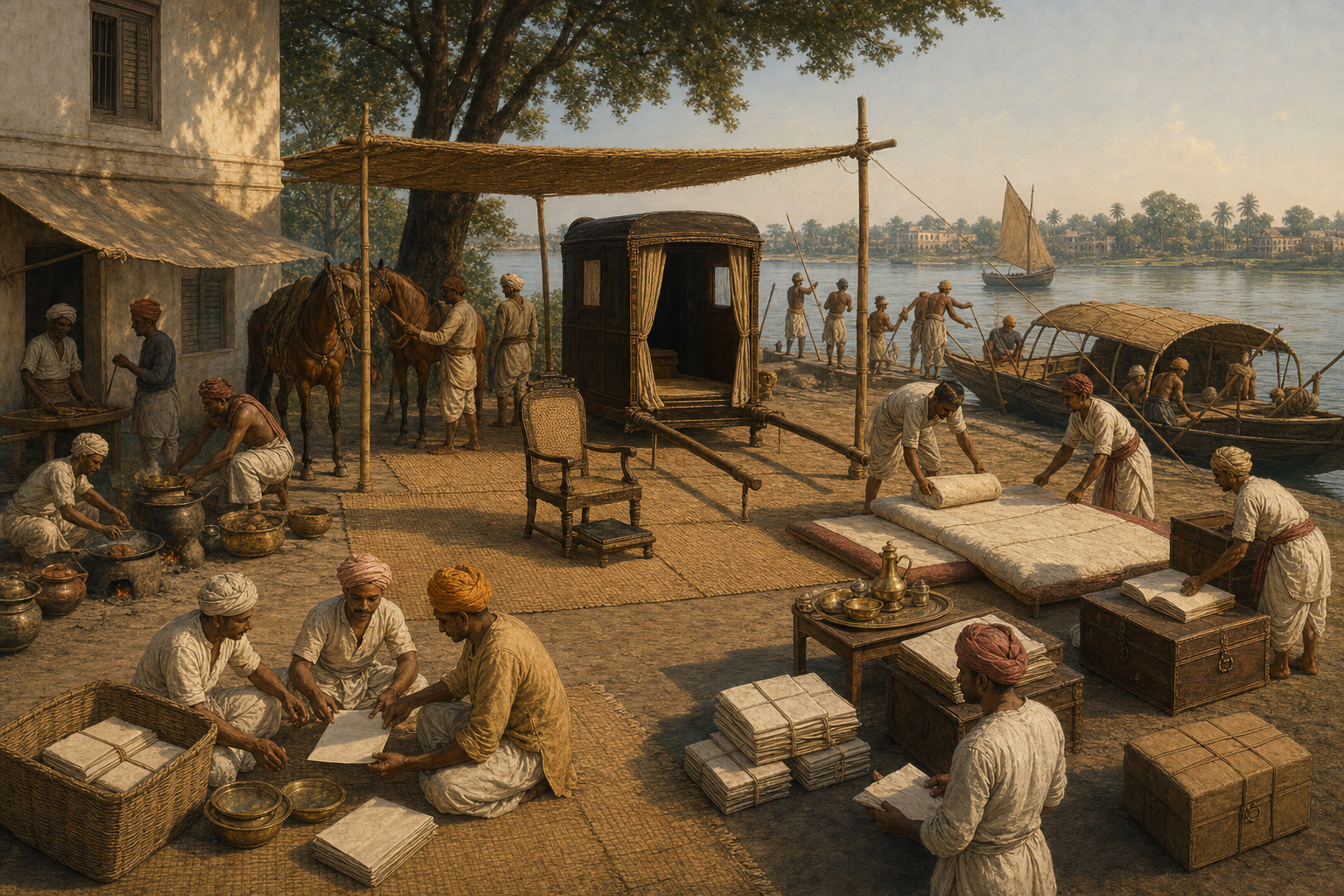
On 27 January 1803, Marquess Wellesley outlined a rapid journey through Bihar, Awadh, and the regions now within Uttar Pradesh. He promised Valentia administrative cooperation, secure passage, and precedence below only the executive officers of the government. Those privileges existed before the traveler covered his first mile.
Nearly a month passed before departure. Illness caused part of the delay, but Valentia also entered an intense round of dinners, calls, and meetings. This distinction matters. A conventional chronology treats that month as dead time between planning and travel. A power chronology recognizes it as preparation: relationships were cultivated, information was exchanged, and the visitor was placed inside the Presidency’s governing society.
Valentia finally left Chitpore Ghat at 11 a.m. on 21 February. He was disappointed to receive a modest reed-covered boat rather than the grand state barge in which he had first been welcomed. That disappointment is evidence of expectation, not deprivation. He had already learned to regard ceremonial transport as appropriate to his rank.
After disembarking at Chinsura, he continued by palanquin to Hooghly and accepted Mr. Brook’s hospitality. He then traveled chiefly at night because he considered Bengal’s flat landscape monotonous during the day. The arrangement allowed him to recline at full length behind blinds and among pillows. Eight bearers carried the palanquin, three mussals or link-boys accompanied it, and additional men handled the luggage.
Do not let that palanquin shrink into a picturesque antique. Put every person back into the frame:
- One aristocratic passenger rested inside the vehicle.
- Eight men supplied the force that moved it.
- Three men provided light for night travel.
- Other workers carried the possessions required for elite comfort.
- Officials and hosts reduced uncertainty at the next halt.
The contrast is the argument. Ease for the traveler required exertion, coordination, and obedience elsewhere. Colonial hierarchy did not simply wait at the collector’s office or cantonment gate. It traveled down the road in the distribution of comfort and effort.
When you read another elite itinerary, therefore, do not begin with distance or speed. First identify the patron who arranged the passage, the rank that opened doors, the risks transferred to escorts and workers, and the labor concealed inside words such as “convenient” or “comfortable.” The journey begins wherever those arrangements begin.
The guest list doubled as an intelligence network
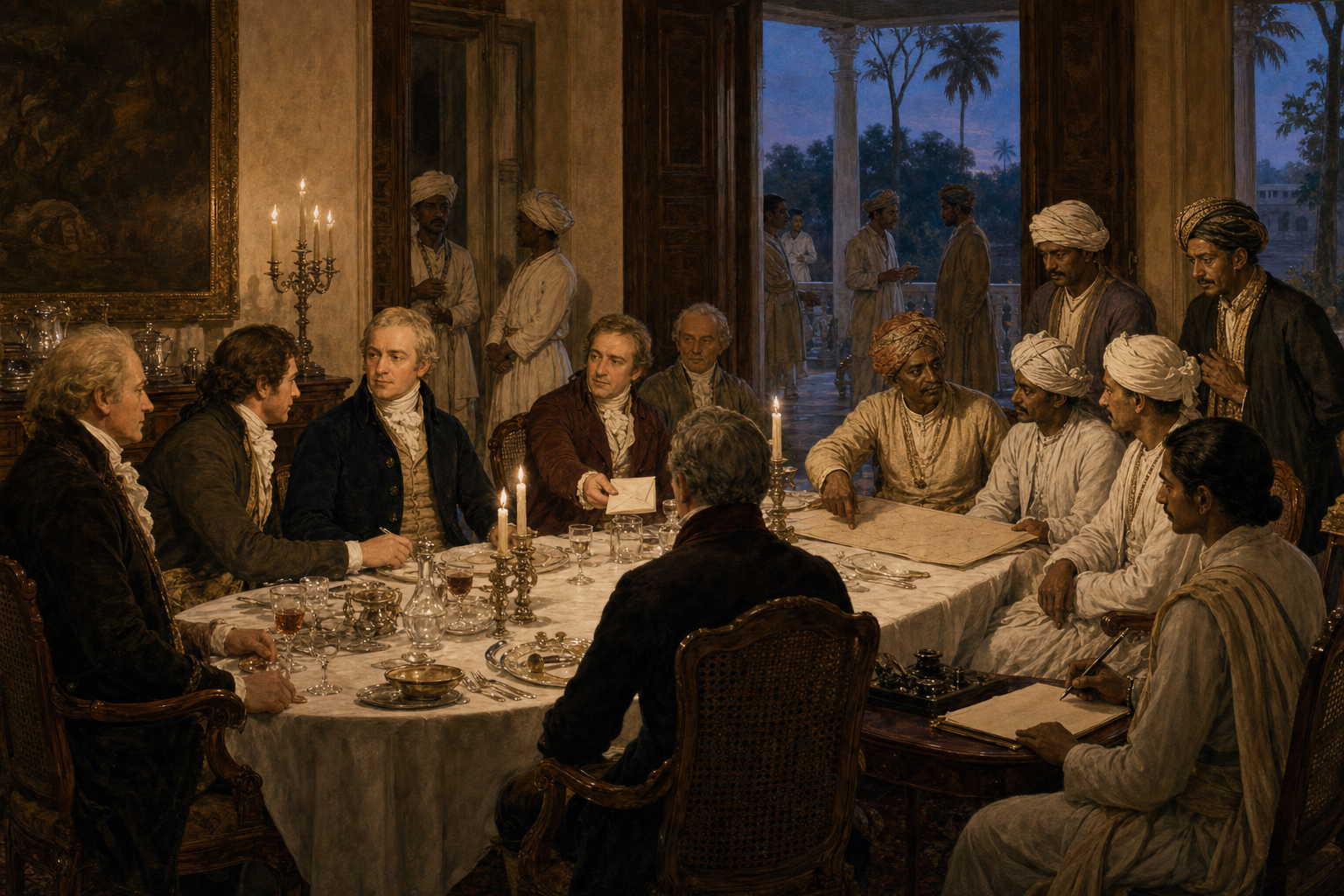
Colonial mobility moved information as well as people. Before leaving Calcutta, Valentia met judges, physicians, botanists, and senior officers. These were not random encounters in a traveler’s social diary. Each meeting connected an aristocratic visitor to a different branch of knowledge and influence within the Bengal Presidency.
A private audience on 20 February made the political dimension explicit. Wellesley promised "manly, open, and generous" help in matters of political intelligence. The two men had compatible interests. Valentia wanted privileged knowledge for his travels and eventual return to England. Wellesley had reason to cultivate a well-connected observer capable of carrying impressions into British political society.
This is why hospitality deserves to be treated as infrastructure. A residence supplied food and rest, but it also supplied introductions, conversation, local interpretation, and reassurance. Mr. Brook received Valentia around Hooghly. Captain Parby hosted him at Berhampore, one of six major military stations. Major Shaw received him at Bhagalpur, and Captain D’Auvergne did the same at Munger after Valentia arrived there at 7 a.m. Each host joined travel, administration, and information in one place.
The repeated passage through cantonments and senior officers’ homes also shaped what the visitor could see. Officials anticipated security problems even where British dominance appeared secure. The route insulated Valentia from many uncertainties while exposing him to the people who represented Company authority. His resulting field of vision was extensive, but it was not neutral.
You can test this influence with four notes beside every halt:
- Host: Who received the traveler?
- Office: What military, judicial, commercial, scientific, or administrative position did that person hold?
- Access: What information or protection became available through the relationship?
- Absence: Which local communities were described but never allowed to explain themselves?
This prevents a common historical error. Access to many officials can create the appearance of comprehensive knowledge, even when every doorway leads into the same ruling network. The number of meetings matters less than the social range of the people permitted to speak.
The landscape became an imperial balance sheet
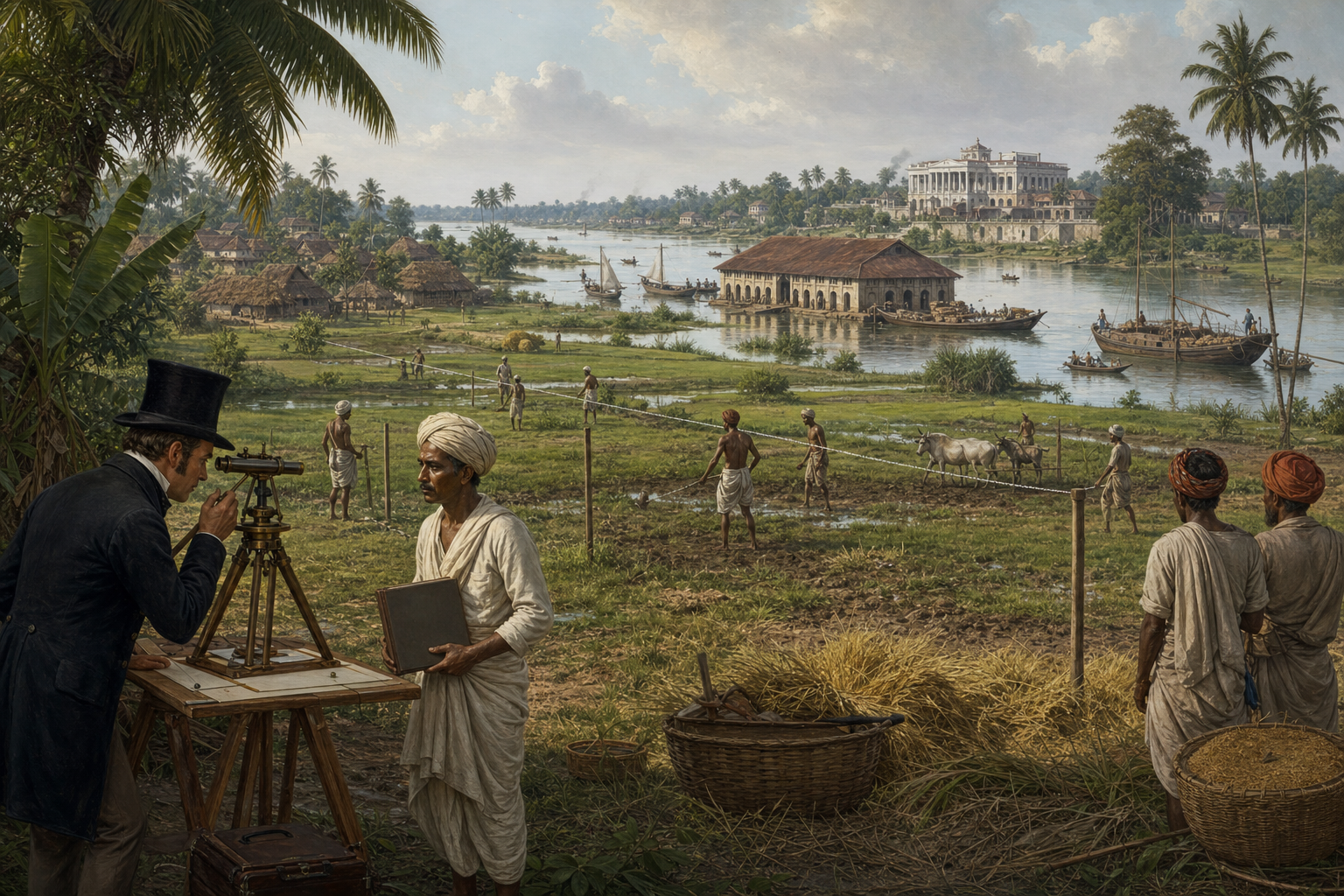
Valentia did not approach every place with the same curiosity. Palashi stirred him because Robert Clive’s victory there represented the turning point that made the British "masters of Bengal." The battlefield mattered as a marker of acquisition. It translated a complex landscape into a legible moment of British military and fiscal ascendancy.
Berhampore appeared through its military importance. Jangipur, reached on 25 February, appeared as a thriving center of silk manufacture. Rajmahal marked his final halt within Bengal. Such descriptions organized space according to the needs of an expanding power: a battlefield demonstrated conquest, a cantonment secured force, a production center promised commerce, and a boundary halt organized movement.
This pattern does not make every observation false. It tells you why some details became prominent while others remained unasked. Calling Jangipur a silk center establishes its commercial importance, for example, but it does not by itself tell you how its artisans lived, who controlled production, or how the value of their work was distributed. Those become the next questions rather than facts you are free to invent.
Murshidabad makes the limits of a simple conquest story especially clear. Murshid Quli Khan had established it as a center of Nawabi power, and British supremacy had subsequently displaced that political order. Yet older forms of prestige had not simply vanished. Munni Begum, the widow of Mir Jaffar, retained great wealth, authority within the royal household, and formidable social standing. Her designation as "Mother of the Company" captured the entanglement: Company dominance could coexist with, use, and ceremonially recognize an influential figure from the Nawabi establishment.
Valentia’s judgments about household finances and social change require more caution than his identification of people and places. An elite colonial visitor could record what he encountered while still filtering it through assumptions about Indian households and British improvement. You should therefore separate the occurrence from the interpretation. His meeting with an influential woman is historical evidence. His social judgment about her world is evidence of his own viewpoint as well.
The same discipline applies to his complaint that Bengal’s flat terrain was visually monotonous. Flatness can be treated as a physical observation. Monotony is an evaluation produced by the observer’s expectations. It cannot stand in for the meanings that cultivators, residents, pilgrims, traders, or river communities attached to the same land.
When you annotate colonial travel writing, use three labels:
- Observed: a person, structure, route, payment, crop, or practice the traveler encountered.
- Evaluated: a word such as dull, improved, disorderly, generous, backward, or civilized.
- Claimed: a larger conclusion about society or government drawn from the observation.
The labels keep a vivid adjective from quietly becoming a social fact. They also help you recover the difference between Bengal as a lived region and Bengal as an imperial inventory of military sites, revenue prospects, commodities, and administrative reputations.
Roads, bounties, and monuments reveal the unequal bill
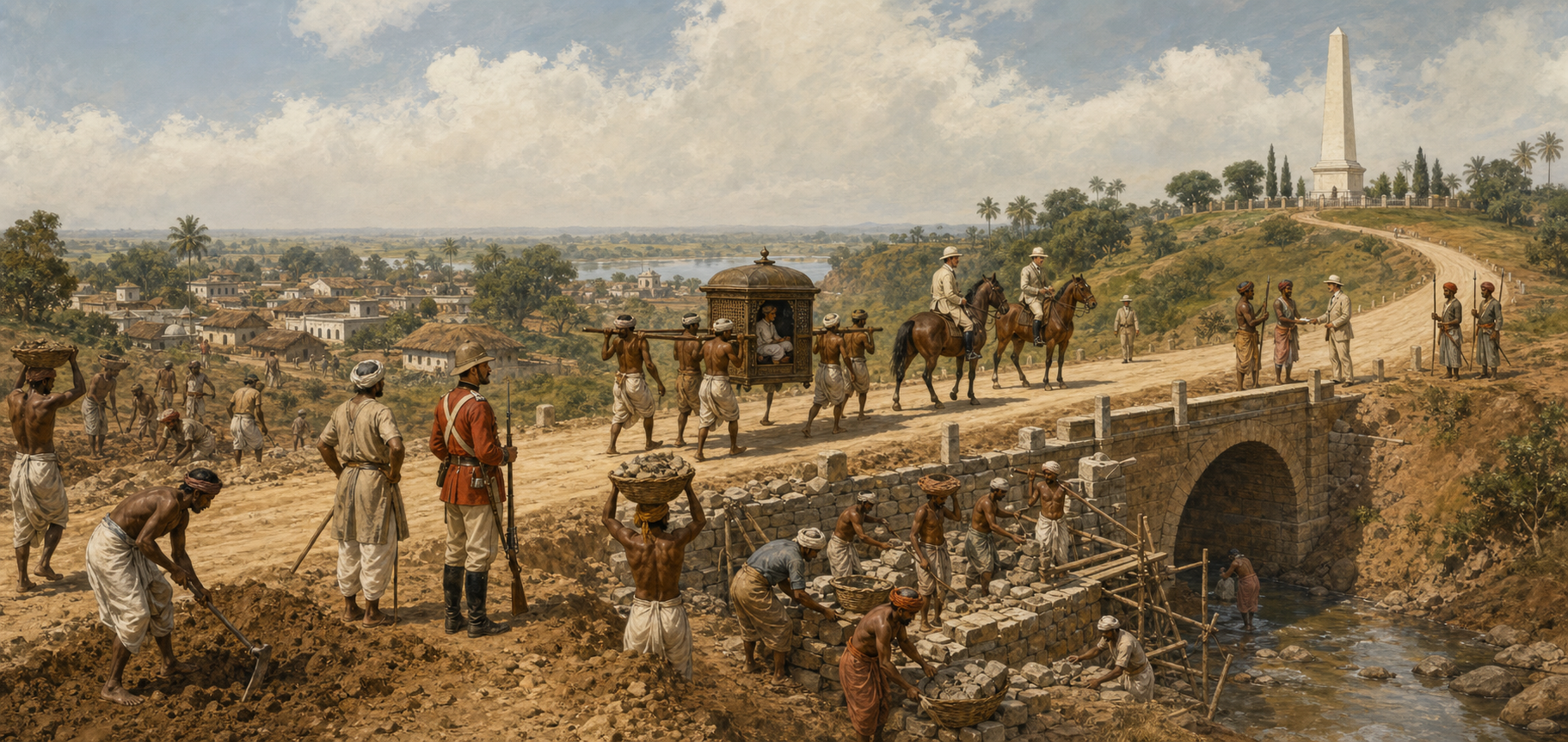
Colonial travel could make infrastructure look like an uncomplicated good. The route toward Bhagalpur complicates that picture. Beyond Rajmahal, forested hills, ravines, and narrow passes tested the palanquin-bearers. Valentia wanted better roads and criticized the East India Company’s preference for dividends over durable public works. Yet his criticism remained compatible with imperial possession. He wanted the ruling power to build more constructively; he did not question its right to rule.
That distinction is worth carrying into any reading of colonial criticism. A traveler can condemn neglect, corruption, or short-term policy without opposing empire. Before treating criticism as resistance, ask whether it challenges a particular decision, the method of government, or the legitimacy of domination itself.
At dawn on 27 February, fields of what Valentia called European grain signaled that Bhagalpur was close. A few miles farther on, he saw convicts laboring on a road. The same road could improve official movement and display penal discipline. Calling it development without naming the labor would hide half of the historical relationship.
The ecological costs were just as concrete. At Cossimbazar, Valentia encountered a Company bounty regime and reported that tiger and leopard populations had been heavily reduced. The listed reward was ten rupees for a tiger’s head and five rupees for a leopard or a tiger cub. Fiscal policy had turned the killing of predators into paid activity. The bounty schedule is therefore more than a colorful detail about wildlife: it shows administrative money altering human incentives and the surrounding ecology.
A monument near Bhagalpur performed a related operation in public memory. The Cleveland Memorial at Tilaka Manjhi honored Augustus Cleveland, the Collector and Judge of Bhagalpur and Rajmahal. Colonial commemoration praised his conciliatory approach to the hill zamindars of the Jungleterry as a "conquest over their minds." The phrase converted administrative penetration into moral victory. It celebrated persuasion while pushing the unequal structure behind the encounter out of view.
Do not treat an official memorial as a neutral summary of the person it honors. Read it as an argument constructed in stone. Ask who selected the virtue, who supplied the approving language, which community became the object of improvement, and whether those people were given any voice in the commemoration.
Four questions will expose the unequal bill behind the language of improvement:
- Mobility: Who gained faster, safer, or more comfortable movement?
- Labor: Who carried, built, guarded, illuminated, or worked under punishment?
- Ecology: Which animals, forests, and local relationships were altered by official incentives?
- Memory: Who was memorialized as a benefactor, and whose interpretation was excluded?
For a dharmic audience, this is not merely an exercise in replacing one set of imperial heroes with another. The moral question concerns right relationship: whether authority bears responsibility toward people, communities, and the natural world, or treats them as instruments of revenue, mobility, and prestige. Hindu, Buddhist, Jain, and Sikh traditions remain distinct, but their readers can meet here in a shared refusal to erase the lives beneath an official celebration of power.
A five-pass method for reading any elite itinerary
You do not need specialist terminology to examine a colonial journey carefully. Use five passes, keeping factual claims separate from the questions the surviving evidence cannot answer.
- Find the sponsor. Identify the official who authorized the route, issued letters, promised protection, or established precedence. Date the journey from this administrative preparation, not only from departure.
- Reconstruct the labor. List every named bearer, boatman, link-boy, luggage carrier, escort, domestic worker, road laborer, and host. Record exact numbers when they are available. Do not collapse several kinds of work into the word “entourage.”
- Map the institutional nodes. Mark ghats, official residences, cantonments, courts, production centers, and memorials. Then note which nodes supplied transport, security, intelligence, commerce, or legitimacy.
- Separate sight from judgment. Distinguish what the traveler physically encountered from how he evaluated it and from the political conclusion he attached to it. A battlefield is a place; calling it the foundation of mastery is an imperial interpretation of that place.
- Audit benefits, costs, and silences. For every road, bounty, reception, or monument, identify the beneficiary, the laboring or disciplined group, the ecological consequence, and the people who appear only through someone else’s description.
At the end, write both a claim and a limit. A defensible claim here is that Company officials could coordinate protected, labor-intensive travel for a high-ranking British visitor from Calcutta through Bengal’s administrative and military network. The corresponding limit is equally important: such coordination does not establish the ordinary travel conditions of Bengali residents, artisans, cultivators, pilgrims, or traders.
That paired habit keeps you from making colonial testimony either all-powerful or useless. Elite testimony can reveal routes, payments, official relationships, environmental policies, and governing ideals with remarkable clarity. It becomes unreliable when one observer’s preferences are allowed to speak for an entire society.
Recovering Bharat’s historical memory does not require claiming that every precolonial institution was just or that the subcontinent was socially uniform. It requires refusing to let the colonial administration’s preferred image become the whole history. Bengal’s courts, households, workshops, forests, sacred geographies, and local communities exceeded the categories through which an imperial guest viewed them.
The next time you encounter a colonial journey, begin with the first official favor rather than the first mile. Follow the workers, hosts, cantonments, bounties, road gangs, and memorials. Then place two questions beside every impressive description: who made this encounter possible, and whose understanding is missing? That small discipline turns a picturesque itinerary into usable evidence about how colonial power actually moved.
References
