
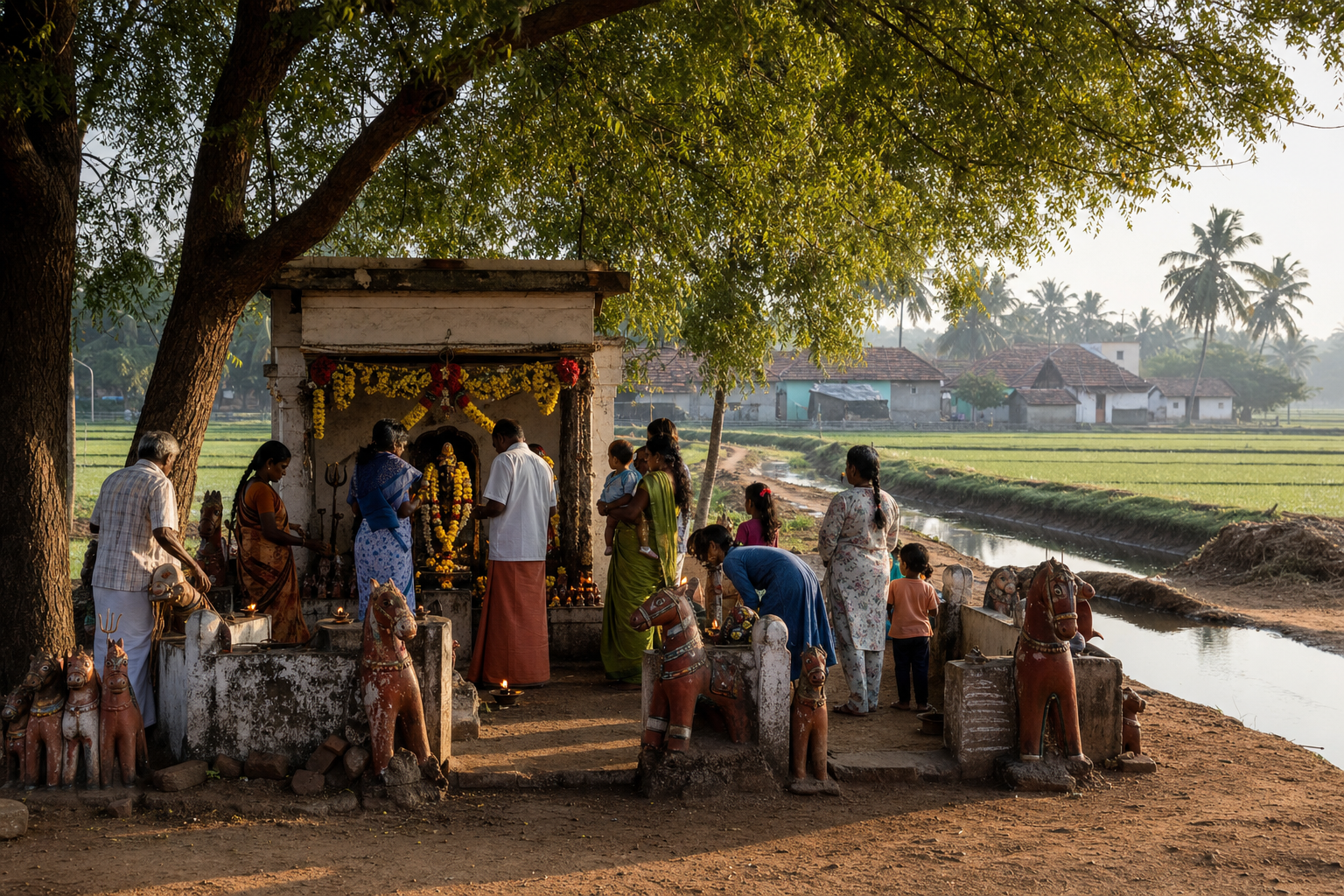
You enter a Tamil village shrine and find that the deity, offering, or ritual does not match what you have seen in a large urban temple. Perhaps the deity is remembered as a protective elder. Perhaps the prasadam includes food you do not personally eat. The useful question is not whether the practice looks familiar. Ask what relationship the shrine preserves between the divine, the land, and the people who live there.
That shift changes what you notice. A village deity tradition becomes intelligible through its obligations: who is protected, what event is remembered, when the community gathers, how an offering is prepared, and which virtues are passed to the next generation. This approach will help you understand the tradition without romanticising it, dismissing it, or forcing every shrine into a single theory.
Read the deity through relationship and obligation
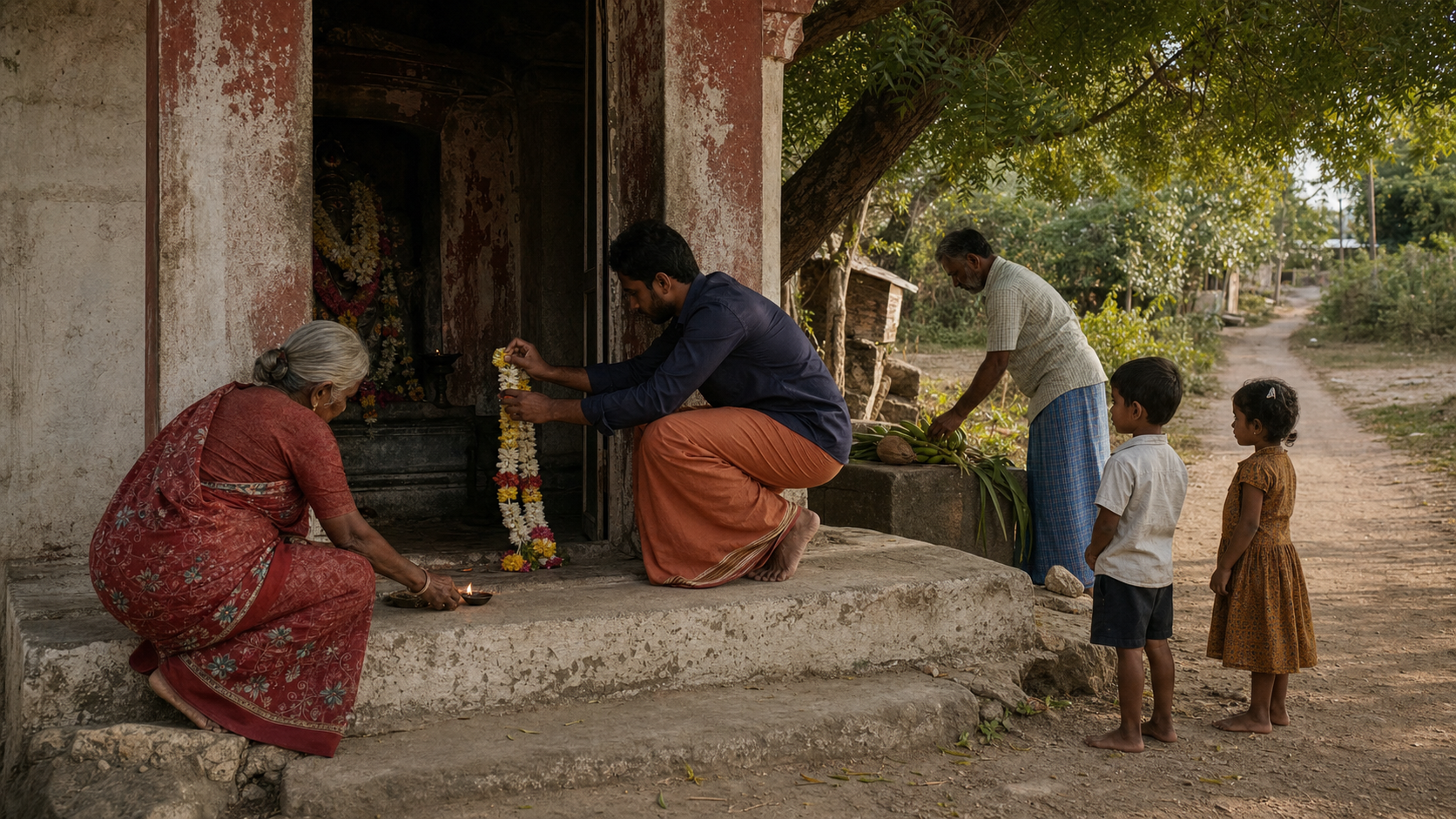
Village deity is a broad description, not the name of one uniform category. A locally revered presence may be understood as a guardian, an ancestral protector, a remembered hero, or a deity whose worship has become inseparable from a particular settlement. These identities can overlap. The village’s own account should therefore come before any label brought from outside.
The Annanmar Swamy tradition shows why relationship matters. In Kongu Nadu, Ponnar and Shankar are remembered as courageous brothers who defended their people and were subsequently venerated as protective elders. Their memory survives in village shrines, household altars, harvest observances, life-cycle rites, and moments that call for moral resolve. Worship here is not detached from social memory. Courage, service, kinship, land, and divine guardianship meet in the same tradition.
When you encounter such a shrine, begin with four questions: What name do local worshippers use? What does the deity protect? Which families or communities maintain the observance? What event, duty, or virtue is remembered? These questions produce more understanding than trying to classify the image by appearance alone.
They also prevent a common mistake. A modest shrine is not necessarily a minor shrine. Its importance may be measured less by monumental architecture than by the number of relationships for which it serves as a sacred centre: households, fields, vows, festivals, memories, and duties to the dead or the living.
Food, land, and oral memory are part of the worship
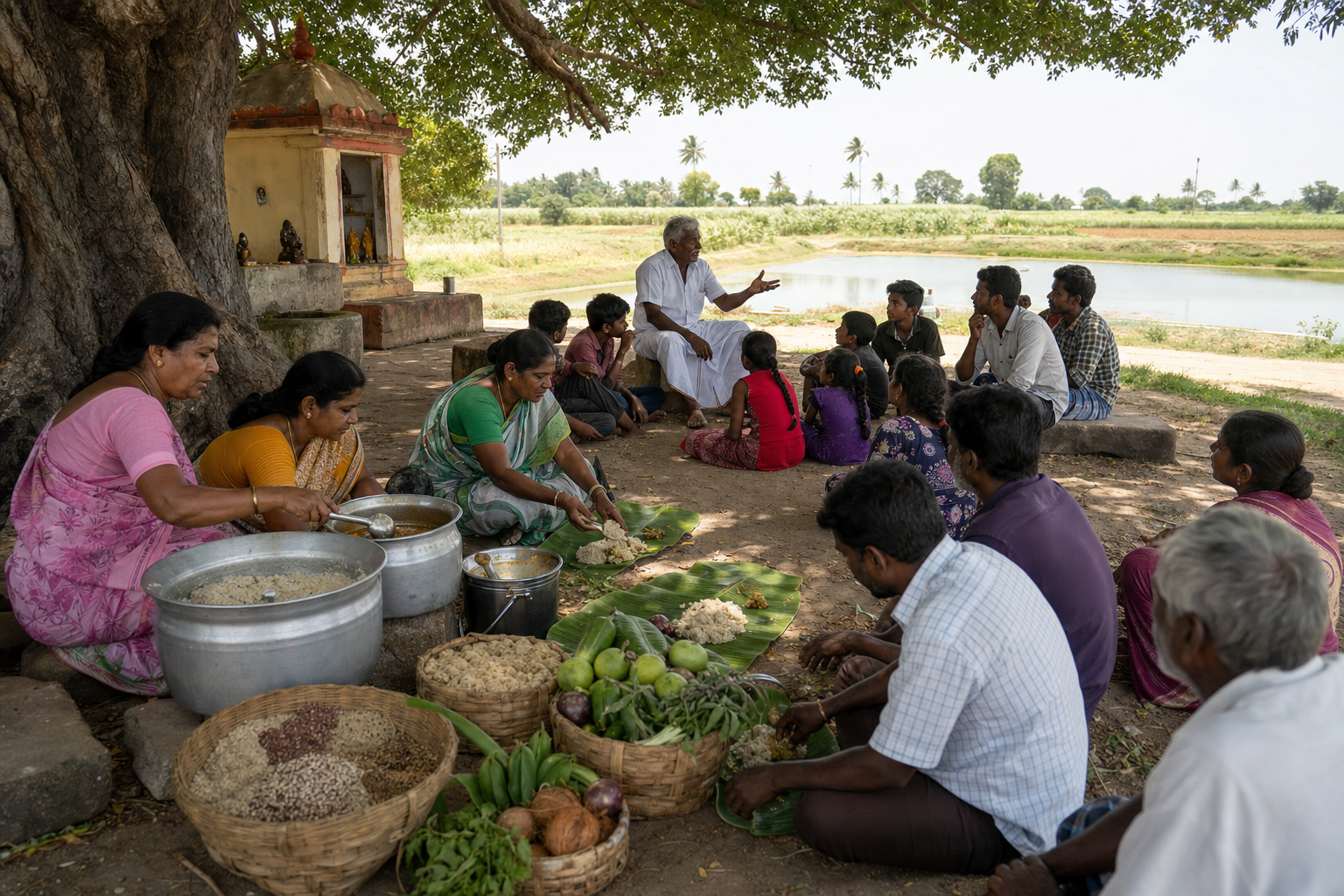
Offerings are not decorative details. They reveal how a community understands reciprocity with the deity. At the Muniyandi Swami temple in Vadakkampatti, in the Thirumangalam area of Madurai district, an annual festival has distributed mutton biryani as prasadam for nearly ninety years. The observance is held in the third week of January and often falls near the Pongal season.
The sequence matters. Community members and volunteers organise the cooking as part of the sacred work. The food is prepared with ritual care, offered to Muniyandi Swami, and only then distributed. Calling it merely a public meal misses the offering. Treating the presence of meat as proof that the festival cannot be Hindu misses the community’s own categories of bhakti, prasadam, and annadanam.
You do not have to adopt another community’s diet in order to understand its worship. You do have to distinguish personal dietary discipline from a claim that every Hindu community must make the same offering. The respectful response is precise: recognise what the food means locally, follow your own dietary commitments without contempt, and do not reduce a sacred observance to its most unusual-looking feature.
The distribution also turns devotion into a social act. Volunteers cook at scale, people receive the offered food together, and nourishment moves beyond individual households. The familiar substance of a meal becomes the means through which grace, gratitude, and belonging are made tangible. The mechanism is practical rather than abstract: people work together, an offering is completed, and prasadam is shared across family and social lines.
A reader from another Dharmic path may recognise an ethical family resemblance here. Hindu annadanam, Sikh langar, and traditions of dana in Hindu, Buddhist, and Jain life do not constitute one interchangeable ritual. They do, however, show how giving food can carry service, dignity, and communal responsibility. Notice the shared ethic without erasing the distinct theology and custom of each practice.
Oral memory works in a similar way. The Annanmar narrative belongs to a living tradition described as roughly five centuries old. Its continuity does not depend on a single fixed narration. Shrines, family observances, local festivals, and stories told by elders carry the memory together. If two custodians tell somewhat different versions, variation is not automatically evidence that the tradition is meaningless. It may show how a living inheritance is transmitted by different communities.
Local does not mean isolated, primitive, or interchangeable
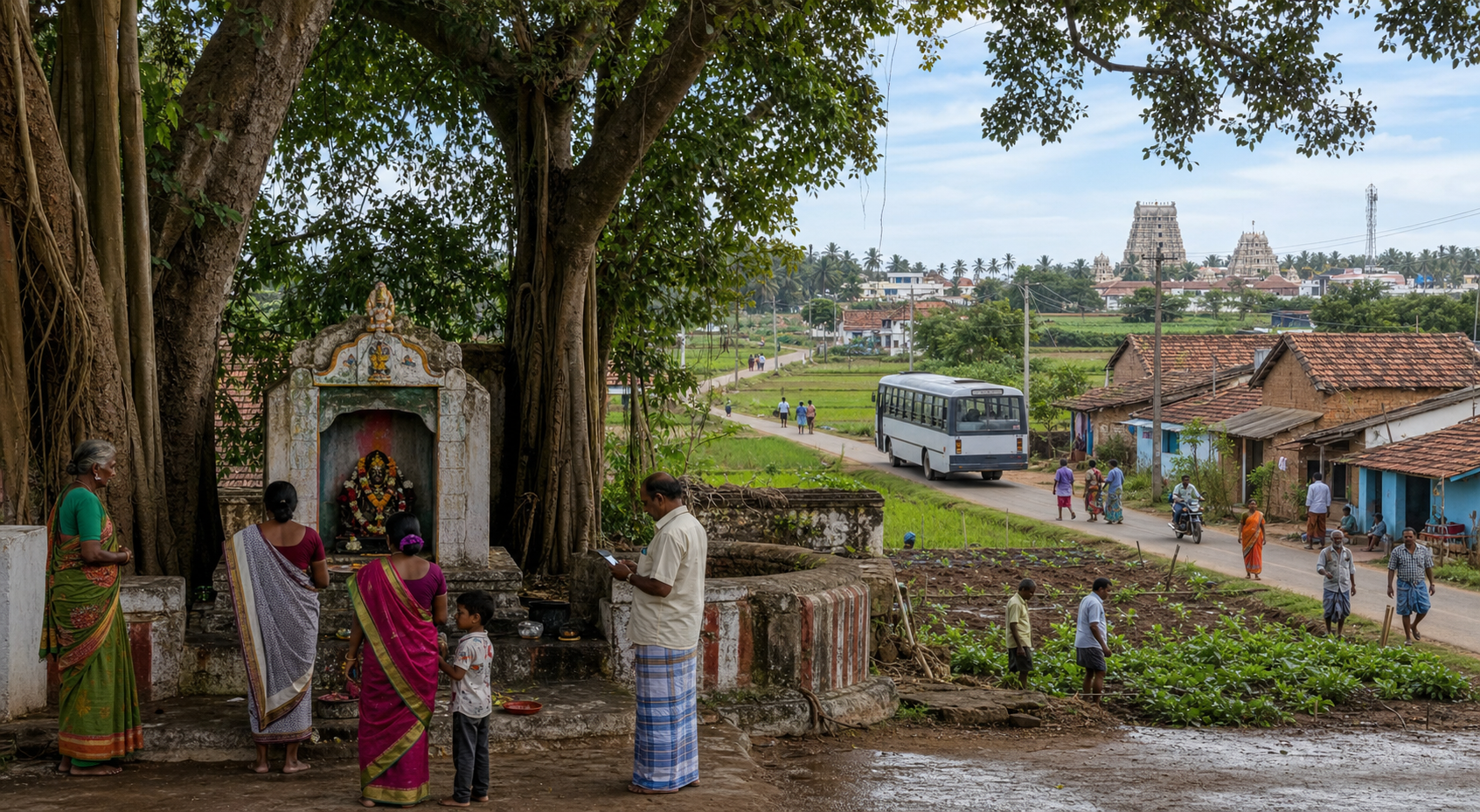
Tamil village worship is local because it is rooted in particular relationships, not because it stands outside Hindu civilisation. In these traditions, recognisable Dharmic ideas are already present: bhakti, prasadam, annadanam, seva, dharma, gratitude, protection, sacrifice, and remembrance. Their expression is shaped by the history and needs of a place.
A second mistake is to place every local tradition into one undifferentiated village religion. Vadakkampatti’s Muniyandi festival is organised around an annual offering and shared meal. The Annanmar tradition of Kongu Nadu preserves the memory of Ponnar and Shankar as courageous protectors associated with households, harvests, and communal duty. Both connect worship with lived society, but that resemblance does not make their deities, narratives, or rituals identical.
A third mistake is to confuse cultural visibility with authority over the tradition. The Tamil film PONNAR SHANKAR carried the brothers’ story to audiences beyond Kongu Nadu, but a cinematic retelling is an entry point, not a replacement for shrine practice and oral transmission. If you want to understand what the Annanmar mean to worshippers, attend to the occasions on which they are invoked and the virtues attached to their memory, not only to a screen narrative.
Historical claims also require discipline. A long-standing oral tradition establishes the endurance of remembrance and worship; it does not by itself verify every incident in every version as modern documentary history. You need not choose between dismissing the entire account as folklore and treating every narrative detail as archival fact. Keep historical verification, sacred memory, and ethical meaning distinct enough that each can be examined honestly.
This distinction strengthens rather than weakens a Dharmic reading. Ponnar and Shankar matter because communities have preserved them as exemplars of courage, righteousness, service, and protection. Muniyandi Swami’s festival matters because disciplined offering and food-sharing continue to bind devotion to communal care. In each case, practice carries an ethical instruction that can be seen in what people repeatedly do.
How to visit or document a village shrine respectfully
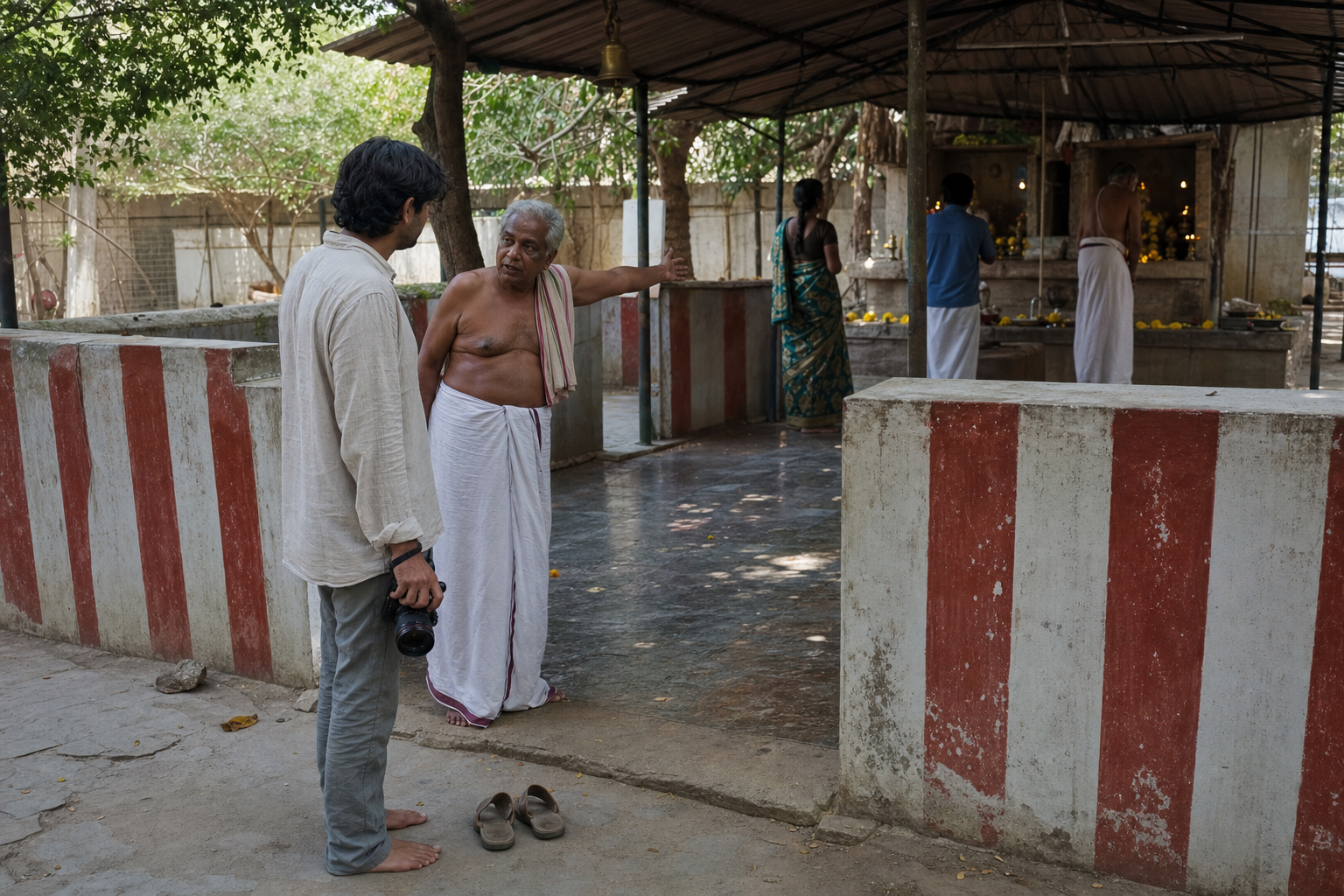
There is no universal visitor protocol for every Tamil village shrine. Local custom governs details such as access, photography, offerings, and participation. A respectful visit therefore begins with observation and a few direct questions, not with assumptions borrowed from another temple.
- Learn the local name first. Use the name worshippers use and ask how they understand the deity. Do not replace a specific identity with a generic label merely because that label is familiar to you.
- Ask what occasion you are witnessing. A harvest observance, annual festival, household vow, life-cycle rite, and ordinary day of worship may involve different expectations. Knowing the occasion explains more than looking at the shrine in isolation.
- Request permission before photographing people, offerings, or restricted spaces. A shrine is a place of worship before it is heritage content. If permission is unclear, keep the camera away.
- Watch the ritual sequence. At a prasadam festival, preparation, offering, and distribution form one sacred process. Photographing only the cooking or eating can turn worship into a culinary curiosity and erase what makes the food prasadam.
- State dietary limits quietly and without judgement. If you cannot receive or eat a particular offering, ask how to decline respectfully. Do not use your personal rule to lecture those whose inherited practice differs.
- Listen for more than one oral account when documenting history. Record who told each version, where it is maintained, and during which observance it is repeated. Do not combine variants into an invented definitive narrative.
- Ask who performs the work. The people who clean the space, organise ingredients, cook, narrate the tradition, manage queues, and transmit songs or stories are custodians too. Ritual life becomes clearer when you notice service as well as spectacle.
If you are writing about the shrine afterward, preserve the distinctions you learned on site. Name the village or region. Separate local testimony from verified chronology. Explain why an offering is sacred before describing why it appears unusual. Most importantly, let worshippers’ understanding of the deity appear before your own theory about them.
Key takeaways
- A Tamil village deity is best understood through the relationships and obligations the shrine preserves, not through appearance alone.
- Guardian deities may carry memories of courage, kinship, land, protection, and service into present-day worship.
- Prasadam must be read through the full sequence of preparation, offering, and distribution; an unfamiliar ingredient does not explain the ritual by itself.
- Oral variation should be documented carefully rather than flattened into one supposedly final version.
- Local forms can express widely recognisable Dharmic values without becoming identical to one another.
- Respectful visitors ask about names, occasions, permissions, dietary etiquette, and community custodians before interpreting what they see.
The next time you encounter a Tamil village shrine, begin with one grounded question: What does this deity ask this community to remember or do? Follow that question through the story, offering, festival, and acts of service. You will see more than an unfamiliar ritual. You will see dharma taking responsibility for a particular place.
References
- DharmaRenaissance Blog — Muniyandi Temple’s Sacred Biryani: Ninety Years of Faith, Food, and Community in Tamil Nadu
- DharmaRenaissance Blog — Annanmar Swamy of Kongu Nadu: Living Legacy and Valor of Ponnar-Shankar in Tamil History
