
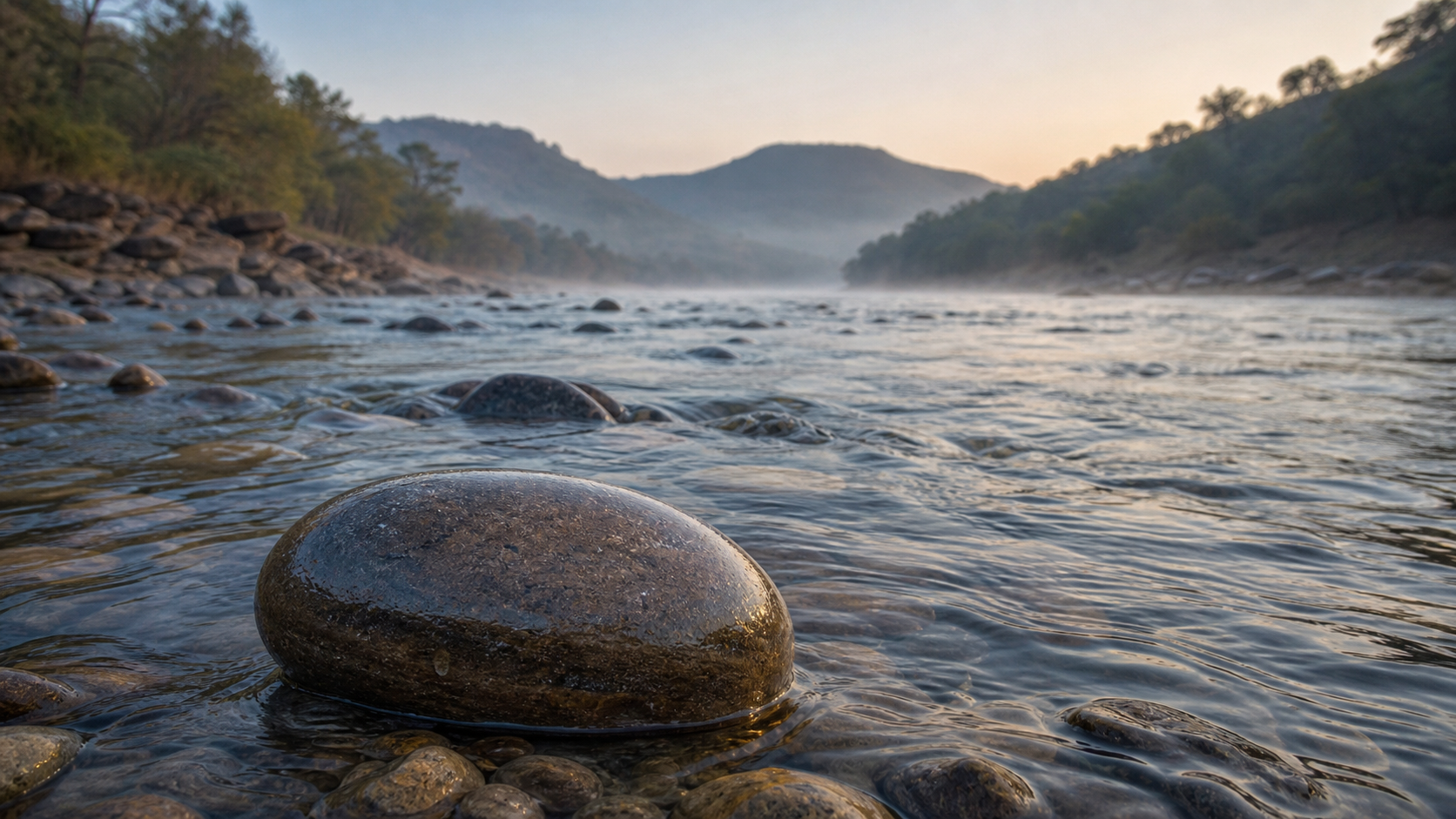
If you have seen a smooth, oval stone called a Banalinga, your first question may be whether it is sacred because of its shape or because it comes from the Narmada. Within the tradition, those two qualities cannot be cleanly separated. The river forms the stone, and the stone makes the presence of Shiva available in an uncarved form.
Understanding that relationship changes how you approach a Banalinga. It is not simply a small object for a shrine, nor merely a stone with an interesting appearance. It belongs to a sacred geography in which flowing water, Shiva’s transformative power, disciplined pilgrimage, and care for the living world form one coherent practice.
Key takeaways
- A Banalinga is a naturally rounded, smooth stone associated with the Narmada and revered as an aniconic manifestation of Shiva.
- Its sanctity lies in the union of natural formation, sacred place, and devotional recognition, not in shape alone.
- Different accounts connect the Narmada with Shiva’s matted locks, tears, sweat, meditation, or cosmic dance. Their details vary, but their theological direction is consistent.
- Narmada Parikrama places restraint, pilgrimage, ecological responsibility, and remembrance into a single embodied discipline.
- If you encounter a Banalinga, honor the river as well as the stone. Reverence for the sacred form while neglecting its landscape misses half the tradition.
Begin with the distinction between made, found, and recognized
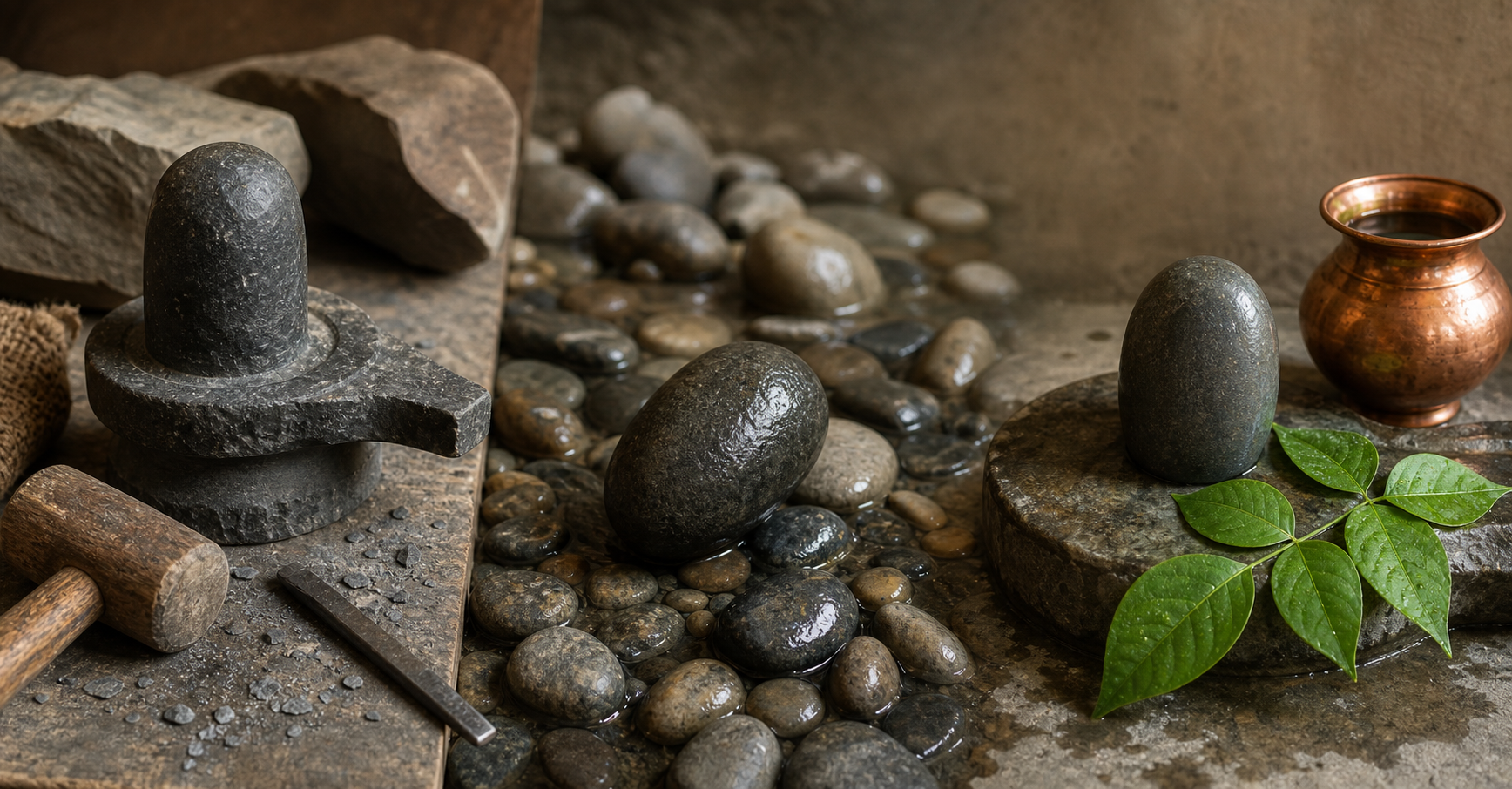
Most sacred images involve intentional human workmanship. A sculptor follows inherited principles to give visible form to a deity. The Banalinga tradition begins elsewhere: with stones made smooth and rounded by the Narmada’s movement. The characteristic form is received from the river rather than imposed by an artisan.
That makes the Banalinga aniconic, but aniconic does not mean spiritually empty or merely symbolic. It means Shiva is approached without a carved bodily image. The stone’s simplicity directs attention away from artistic elaboration and toward presence: the sacred can be encountered in an unworked form that the landscape itself has disclosed.
You do not have to choose between a physical and a sacred account of that form. Water and movement explain how a river stone becomes smooth. Devotional recognition explains why that form is received as Shiva. Confusing those two levels produces needless arguments. The physical process does not cancel sanctity, and sanctity does not require denying the physical process.
This distinction also helps when you are trying to identify what someone is offering or displaying as a Banalinga. Appearance can tell you that a stone resembles the traditional form, but appearance alone cannot prove where it came from. If provenance matters, ask how its connection to the Narmada is known. Do not mistake a seller’s confidence, a polished surface, or an attractive oval shape for evidence of origin.
Three questions keep the tradition in focus:
- Was the form naturally received? The Banalinga’s meaning begins with a stone shaped by the river rather than carved to imitate one.
- Is the Narmada connection being remembered? The stone should not be detached in thought from the sacred river that gives the tradition its setting.
- Is the stone being approached as Shiva? Its importance is devotional, not merely mineralogical, decorative, or commercial.
Why the Narmada’s origin stories take different forms
You may encounter more than one account of the Narmada’s emergence. One associates the river with Shiva’s jata, or matted locks, and describes a nectar-like current becoming life-giving water. Other tellings connect her with Shiva’s tears or sweat during deep meditation or cosmic dance. These are parallel Puranic expressions of Shiva’s tapas and purifying grace, not details that can be combined into a single literal sequence without distortion.
The responsible way to repeat these narratives is therefore simple: identify them as variations and preserve the insight they share. In each, concentrated divine power does not remain withdrawn from the world. It becomes a river that sustains life and offers purification. Tapas becomes flow; transcendence enters geography; grace becomes something a pilgrim can approach.
Vishnu also belongs within this theological horizon. When dharma is endangered and suffering weighs upon beings, Vishnu’s compassion expresses the preserving movement that turns toward a fragile world. Shiva’s power expresses transformation and purification. The two are not competing for possession of the river. Preservation and transformation work together: the threatened order is sustained by being renewed.
This gives you a reliable way to hear the sacred account without reducing it either to a news report about a physical event or to an ornament with no claim on conduct. The details speak in theological language. They tell you what kind of reality the Narmada discloses: divine power responding to disorder by entering the elements that support life.
Puranic memory, including traditions associated with the Skanda Purana, also places the Narmada within Bharat’s wider sacred geography. A river is not sacred only at one shrine or through one local custom. Narrative, pilgrimage, temple life, household worship, and inherited memory connect particular banks and stones to a civilizational map.
What the Banalinga changes about worship
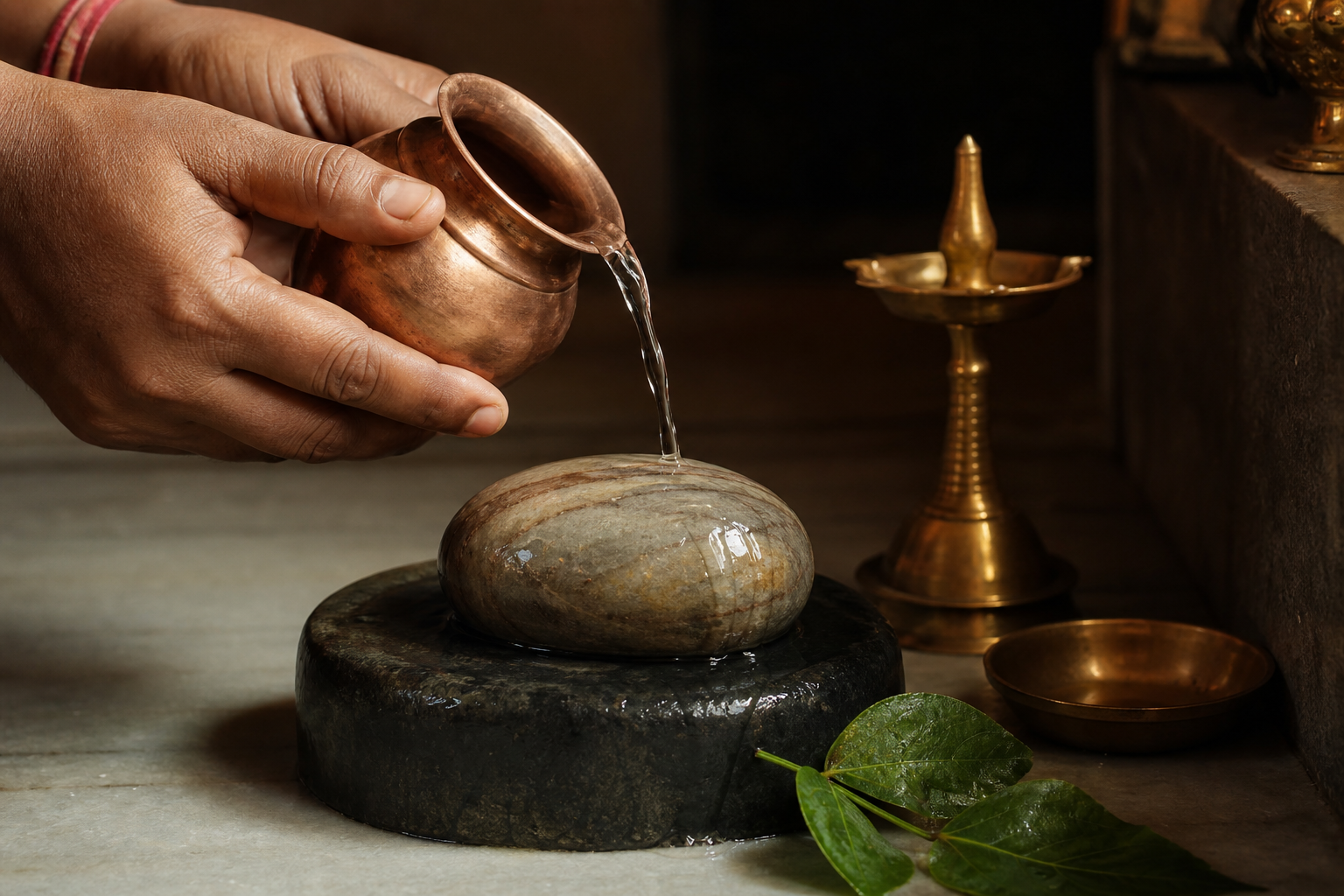
An elaborate image can teach through gesture, adornment, posture, and narrative detail. The Banalinga teaches through concentration. Its form is spare enough to turn attention toward a central Shaiva insight: the divine is not limited to a human likeness or dependent upon visual complexity.
That simplicity has practical consequences. Banalingas can participate in household devotion as well as temple traditions. Sacred presence is not confined to monumental architecture or costly artistic work. A naturally formed stone can gather attention, remembrance, and worship into a modest domestic space.
Accessibility, however, should not become casualness. A Banalinga is small enough to hold, but its meaning is larger than possession. It carries the remembered relationship among Shiva, Narmada, the shaping action of water, and the generations that have treated the river as a place of discipline and grace.
Let your tradition determine the ritual sequence
The natural form of a Banalinga does not by itself establish one universal household ritual. If your family, temple, guru, or sampradaya has given you a method of Shiva puja, let that inheritance govern the details. Do not present one regional custom or personal preference as obligatory for every devotee.
Even before a formal puja, you can approach the Banalinga with three acts of attention:
- Remember the origin. Call to mind the Narmada rather than treating the stone as an isolated sacred commodity.
- Notice the uncarved form. Let its simplicity challenge the assumption that the sacred must always arrive through visual grandeur.
- Turn purification into conduct. Examine mind, speech, and action. If reverence does not make these more restrained and truthful, the outer act has not yet reached its ethical purpose.
This is not a replacement for lineage-based ritual instruction. It is a way to keep the Banalinga’s theological meaning present while you follow the practice you have actually received.
Narmada Parikrama turns sacred geography into discipline
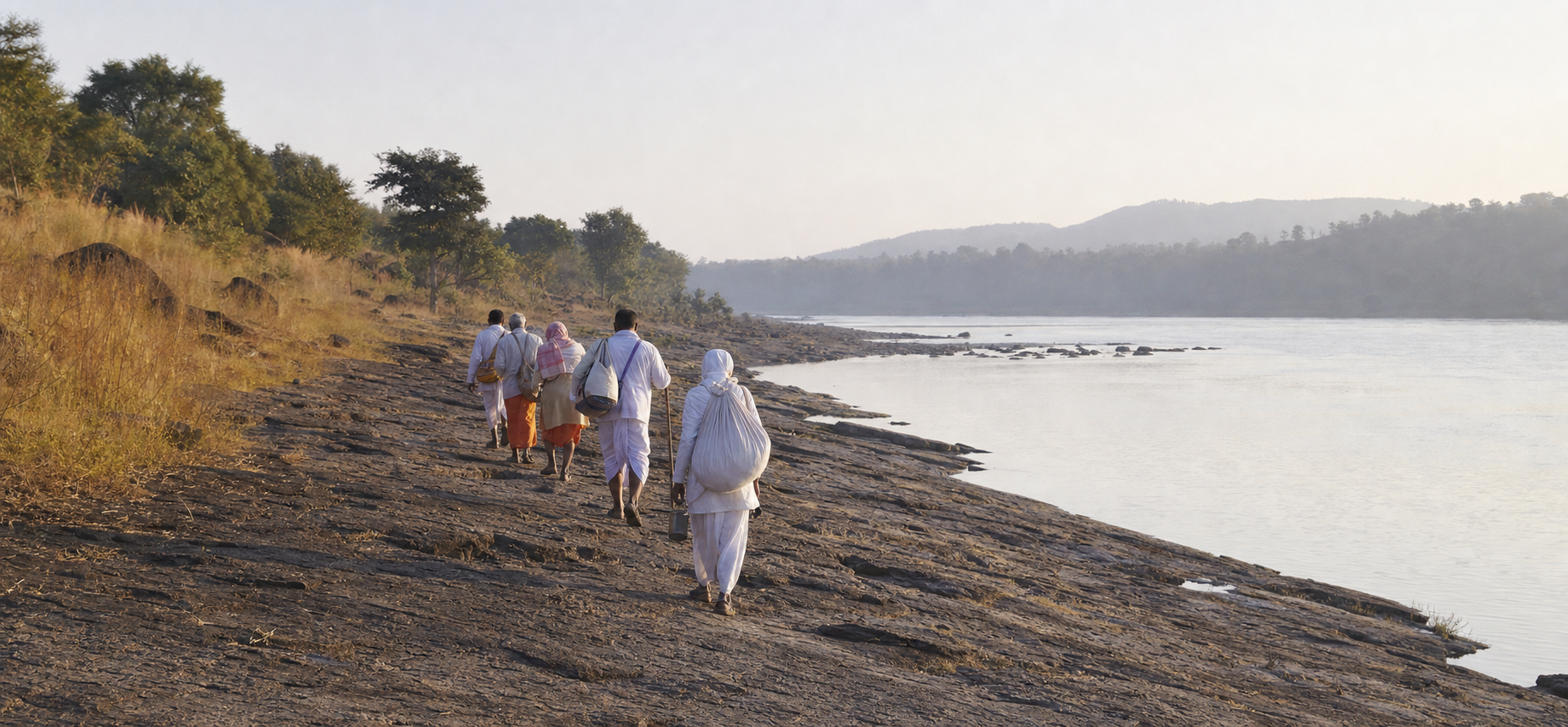
Narmada Parikrama is the disciplined circumambulation associated with the river’s course. Its importance is not exhausted by distance travelled or places visited. The pilgrimage works as a living scripture because the body must submit to the geography: the pilgrim advances through restraint, repeated remembrance, and dependence upon a landscape that cannot be reduced to an idea.
If you undertake or support such a pilgrimage, judge it by more than completion. Ask what habits it is forming:
- Restraint: Does the journey reduce entitlement, haste, and the demand for comfort, or does it merely transport them to sacred places?
- Attention: Are you actually observing the river and the communities formed around it, or only collecting images and objects?
- Ecological reverence: Does your behavior protect the water and banks you call sacred?
- Continuity: Are you approaching the route as an inherited discipline, or redesigning it around convenience while retaining the prestigious name?
The same test applies if you are visiting briefly rather than completing a parikrama. A sacred river is not a souvenir shelf. If you do not know the local and lineage norms surrounding the reception of a Banalinga, do not remove a stone merely because its shape appeals to you. Curiosity can pause long enough to seek trustworthy guidance.
The Narmada also offers a careful point of conversation among Dharmic paths. Hindu traditions place the river and Banalinga within a distinct Shaiva and Puranic theology. Jain emphasis on ahimsa and stewardship, Buddhist recognition of ecological interdependence along riverine settings, and Sikh reverence expressed around sacred waters and sarovars can illuminate shared disciplines of restraint and care. These connections should encourage mutual respect without pretending that the traditions use identical theology or ritual.
You can carry the heart of this discipline even when you are far from the Narmada. When you see or worship a Banalinga, ask whether your response honors both Shiva and the river. Protect water, resist turning sacred forms into collectibles, and let purification become visible in how you speak and act. If the stone receives reverence while the living landscape is ignored, the tradition has been heard only halfway.
References
