
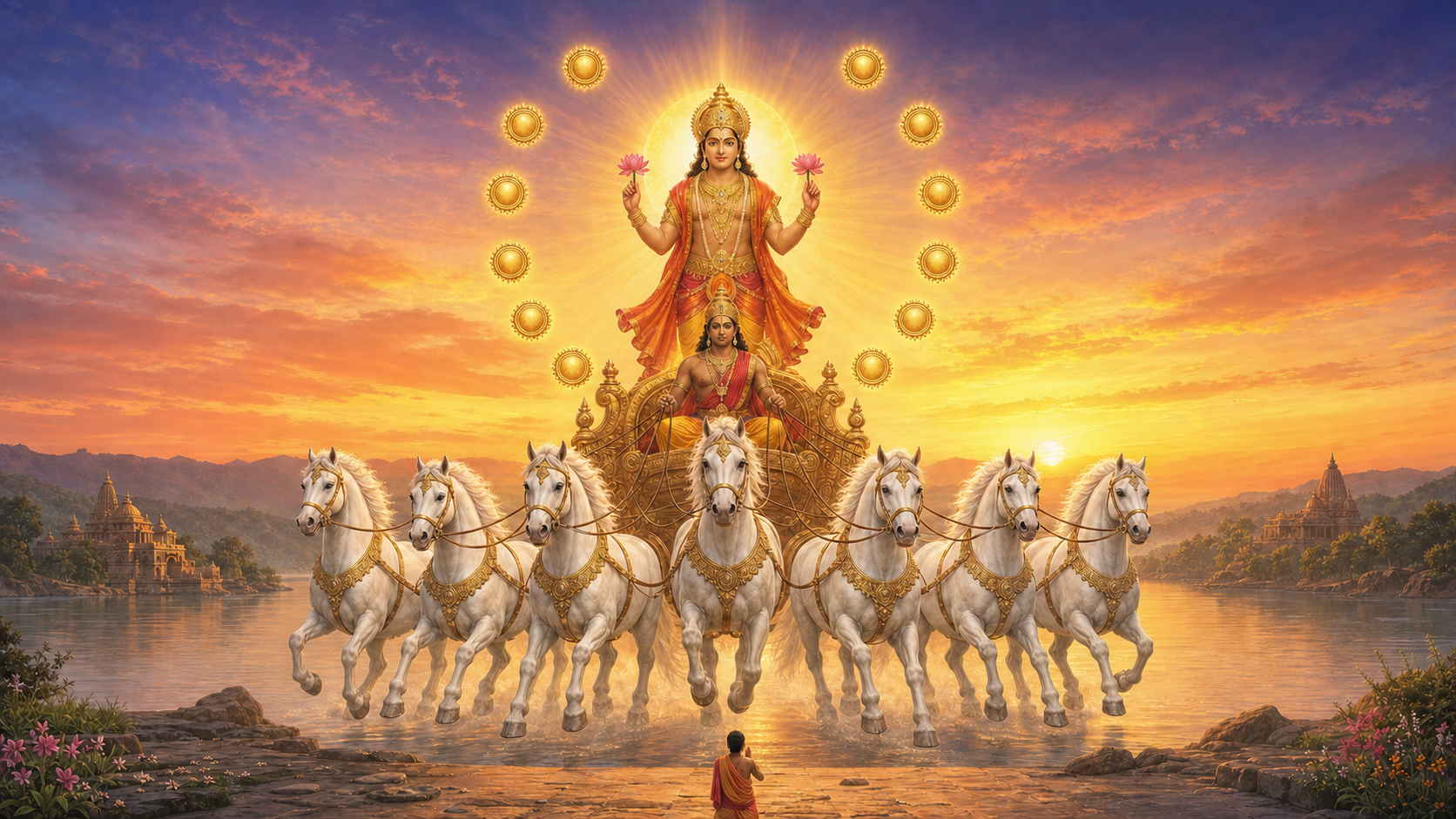
You may know that Surya Bhagavan has twelve sacred names yet still hesitate at the practical questions: What is the correct order? Must you chant at sunrise? Do you need arghya, a mala, or twelve rounds of Surya Namaskar? When every preparation starts to feel compulsory, a short daily practice can become harder to begin than it needs to be.
The essential practice is simple. Learn the names in sequence, recite them attentively, and let the regular return to light shape how you begin the day. Ritual additions can deepen that discipline, but they should support remembrance rather than crowd it out.
What the twelve names ask you to remember
The traditional sequence is Mitra, Ravi, Surya, Bhanu, Khaga, Pushan, Hiranyagarbha, Marichi, Aditya, Savitru, Arka, and Bhaskara. Keep that order while learning. Repetition then carries you from one aspect of solar divinity to the next without requiring you to decide what comes afterward.
The cues below are contemplative prompts, not exhaustive dictionary definitions. Use them to prevent the recitation from becoming a string of unattended sounds.
| Order | Name | Contemplative cue |
|---|---|---|
| 1 | Mitra | Begin with universal friendship: may light widen goodwill beyond personal preference. |
| 2 | Ravi | Attend to illumination that reveals what is already present. |
| 3 | Surya | Meet the visible Sun as a sacred presence and giver of life. |
| 4 | Bhanu | Receive brilliance as nourishment, not merely as spectacle. |
| 5 | Khaga | Remember movement through the sky and the rhythm carried by that movement. |
| 6 | Pushan | Contemplate the power that sustains, nourishes, and supports growth. |
| 7 | Hiranyagarbha | Hold the image of golden creativity and the emergence of possibility. |
| 8 | Marichi | Notice the ray: a precise line of light that makes perception possible. |
| 9 | Aditya | Recall solar divinity within an ordered and sustaining cosmos. |
| 10 | Savitru | Turn the mind toward the generative impulse that awakens life and intention. |
| 11 | Arka | Gather attention around concentrated brilliance and lucid understanding. |
| 12 | Bhaskara | Conclude with the light that enables discernment and makes knowledge visible. |
Read straight down the table until the order becomes natural. On a hurried morning, speaking each name once with attention is already a complete sequence. Do not replace the names with the contemplative cues; pause briefly after a name only when a cue helps you remain present.
A sunrise method simple enough to sustain
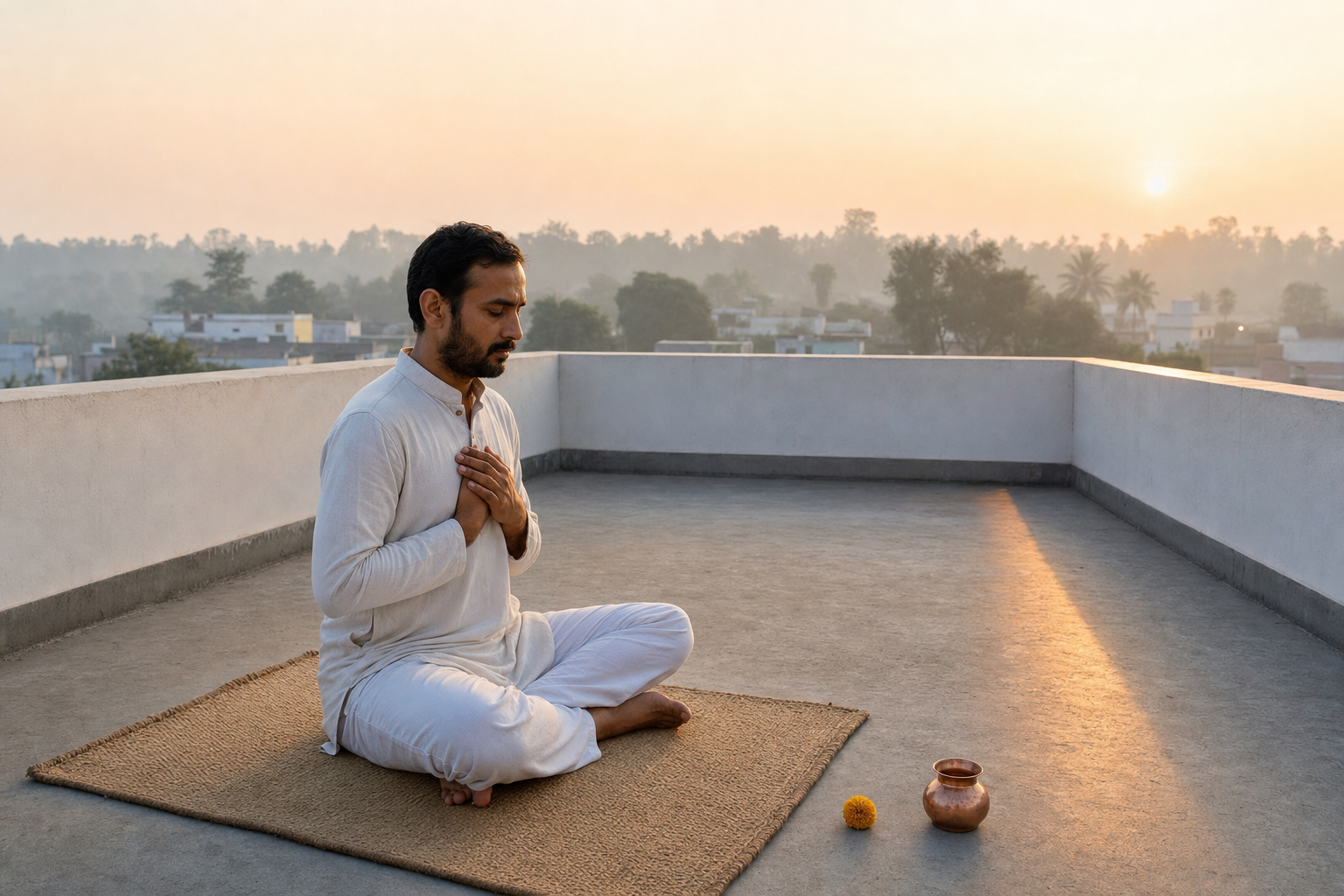
A clean space, a steady seat, and undivided attention matter more than an elaborate arrangement. Early morning after bathing is widely preferred, but the preparation should make the mind available for worship rather than create anxiety about performing every detail.
- Choose a quiet place. Sit on a dedicated mat or other stable seat, or stand safely if you will offer water. At sunrise, face east.
- Settle before speaking. Let the breath return to its ordinary pace. A lamp may be lit if that belongs naturally in your household practice; it is not required for remembering the names.
- Offer arghya if circumstances permit. Pour water gently toward the rising Sun with gratitude. Choose a place where the water will not create a slipping hazard, and do not stare directly at the Sun.
- Recite the names in order: Mitra, Ravi, Surya, Bhanu, Khaga, Pushan, Hiranyagarbha, Marichi, Aditya, Savitru, Arka, Bhaskara.
- Keep the words clear and unhurried. If you stumble, correct the name and continue instead of turning a small error into a reason to abandon the practice.
- Remain silent for a few moments after Bhaskara. Let the final sound settle before reaching for a phone or moving into the next task.
If you want a count, one pass contains twelve names. Three passes give thirty-six recitations, and nine passes give 108. A mala can support the longer forms, but counting should not pull attention away from pronunciation and remembrance.
The smallest complete morning form is an arghya where possible, one pass through the names, and silence. If arghya is impractical, chant without it. If you have time only for one pass, do that pass without rushing. A modest practice repeated faithfully has more formative value than an ambitious routine that repeatedly collapses.
Choose the timing by your real schedule
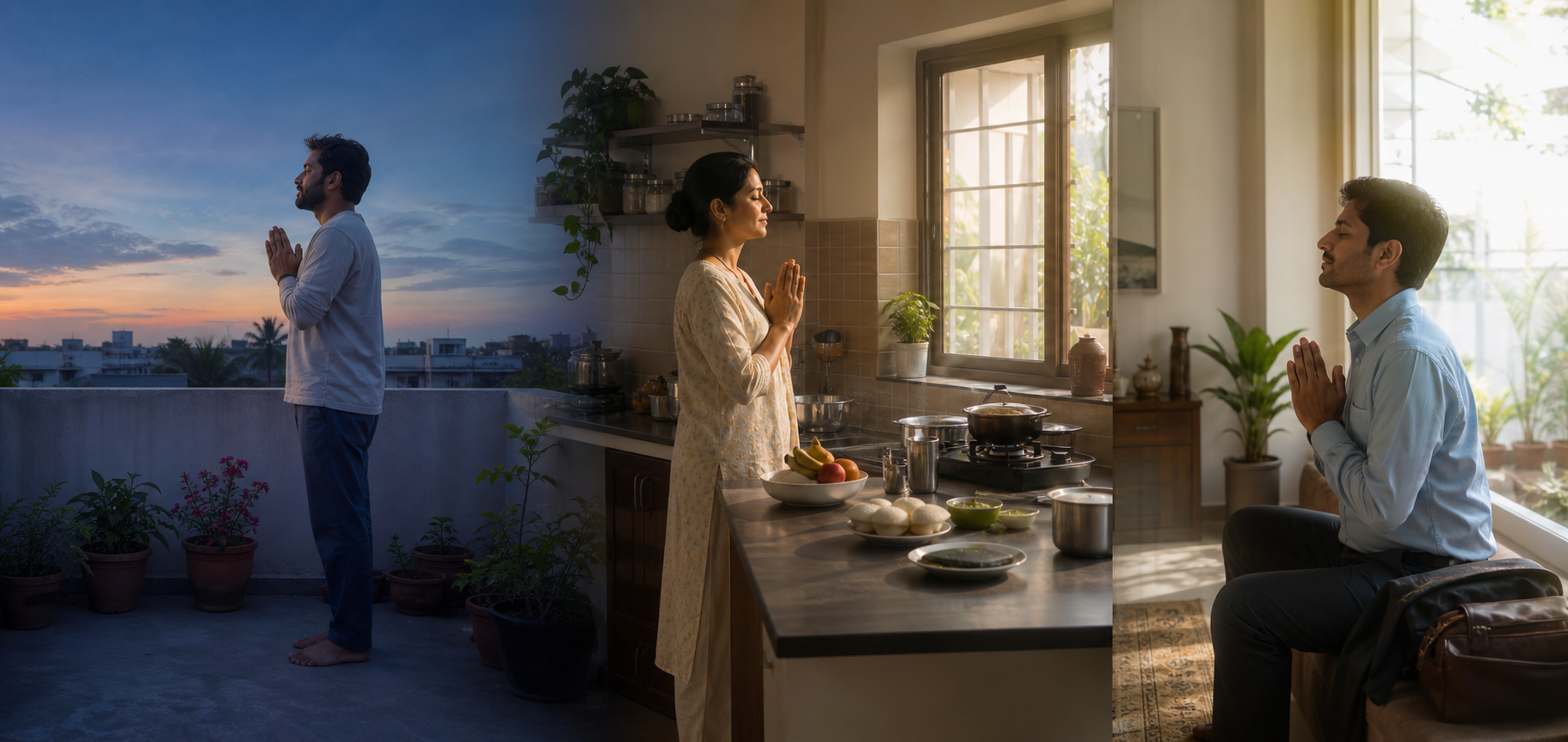
Sunrise is the clearest daily anchor because the outer event and the inner intention coincide: light appears, and you deliberately turn toward clarity. Brahma Muhurta can be used for bathing, settling the mind, or beginning quiet preparation before dawn; the sunrise practice then follows as the horizon brightens.
- For daily practice: Choose sunrise when you can. Face east and keep the routine attached to something dependable, such as bathing or the first quiet moment before work.
- When sunrise is not workable: Use one of the three sandhyas – dawn, noon, or dusk – rather than abandoning the discipline. At dusk, face west in recognition of the setting Sun.
- For a weekly observance: Sunday is traditionally associated with Surya Bhagavan and can carry a longer recitation when weekday mornings are constrained.
- For an intensified observance: Ratha Saptami, monthly Saptami tithis, and Sankranti days are fitting occasions for a fuller practice.
You do not need to wait for an auspicious observance to begin. Special days deepen an existing rhythm; they should not become a postponement mechanism. If your life makes dawn irregular, choose the sandhya you can actually protect and return to it consistently.
Let voice, breath, and movement support attention

Chant clearly without turning pronunciation into a performance
Relax the jaw, keep the gaze soft, and allow each name enough space to be heard. The aim is neither speed nor dramatic volume. Let the breath remain natural and unforced; there is no need to add breath retention merely because the practice is associated with prana.
The names may be recited plainly. Some traditions use Om or Namah with them, but inherited forms and grammatical inflections can differ. If your family, sampradaya, or teacher has given you a form, follow it. If you have not received one, retaining the twelve core names exactly and chanting them plainly is a sound way to begin. There is no need to improvise extra syllables to make the practice appear more advanced.
Add Surya Namaskar only when it strengthens remembrance
Surya Namaskar can join body, breath, and mantra in one solar discipline. A brief routine may use one to three cycles before or after the names; an established practice may align a longer session with twelve rounds. Because schools can count a cycle or round differently, follow the convention you were taught instead of becoming preoccupied with arithmetic.
Movement is an addition, not an entrance requirement. If Surya Namaskar is not suitable for your body, omit or adapt it with appropriate guidance. If coordinating posture and names makes both mechanical, separate them: complete the movement first, sit down, settle the breath, and then chant. The names stand as a devotional practice in their own right.
Key takeaways for keeping devotion ahead of performance
The Vedic framework of the practice connects Surya with prana, or vital energy; rita, the sustaining rhythm and order of life; and jnana, insight. Those ideas become useful when they change what you notice and how you conduct the next part of your day.
- Learn the fixed sequence first: Mitra, Ravi, Surya, Bhanu, Khaga, Pushan, Hiranyagarbha, Marichi, Aditya, Savitru, Arka, Bhaskara.
- Count one pass as a legitimate daily practice. Use thirty-six or 108 recitations only when added repetition preserves attention.
- Prefer sunrise, but use noon or dusk when that is the sandhya you can consistently protect. Face east in the morning and west in the evening.
- Chant the core names plainly unless you have received a particular form using Om, Namah, or another traditional construction.
- Keep Surya Namaskar optional. It should integrate movement and attention, not make the practice inaccessible.
- Judge the routine by steadier attention, gratitude, purpose, and self-discipline rather than by dramatic sensations or immediate results.
A short journal can keep those effects concrete. After chanting, write one line each about your energy, your ability to focus on the first important task, and your emotional tone. This is not a search for supernatural proof. It is a way to notice whether remembrance is producing greater regularity, clarity, and sattva in ordinary life.
Traditional associations with vitality, digestion, mood, and daily rhythm should not be converted into guaranteed medical outcomes. Chanting is not a treatment for persistent fatigue, digestive symptoms, sleep disturbance, or emotional distress. Seek appropriate professional care for those concerns rather than increasing the repetition count as a substitute.
Light also carries a wider language of wisdom, compassion, and ethical clarity across Hindu, Buddhist, Jain, and Sikh settings. That affinity can encourage mutual respect without pretending that all four traditions teach an identical theology. The twelve names remain a distinctly Hindu form of remembering Surya Bhagavan, even as their movement from light toward clarity can be understood by the wider Dharmic family.
For your next practice, place the ordered names where you can read them, meet the coming light, and complete one attentive pass. Then note how you enter the first duty of the day. Once that small form is stable, add repetitions, arghya, or Surya Namaskar one element at a time.
References
