
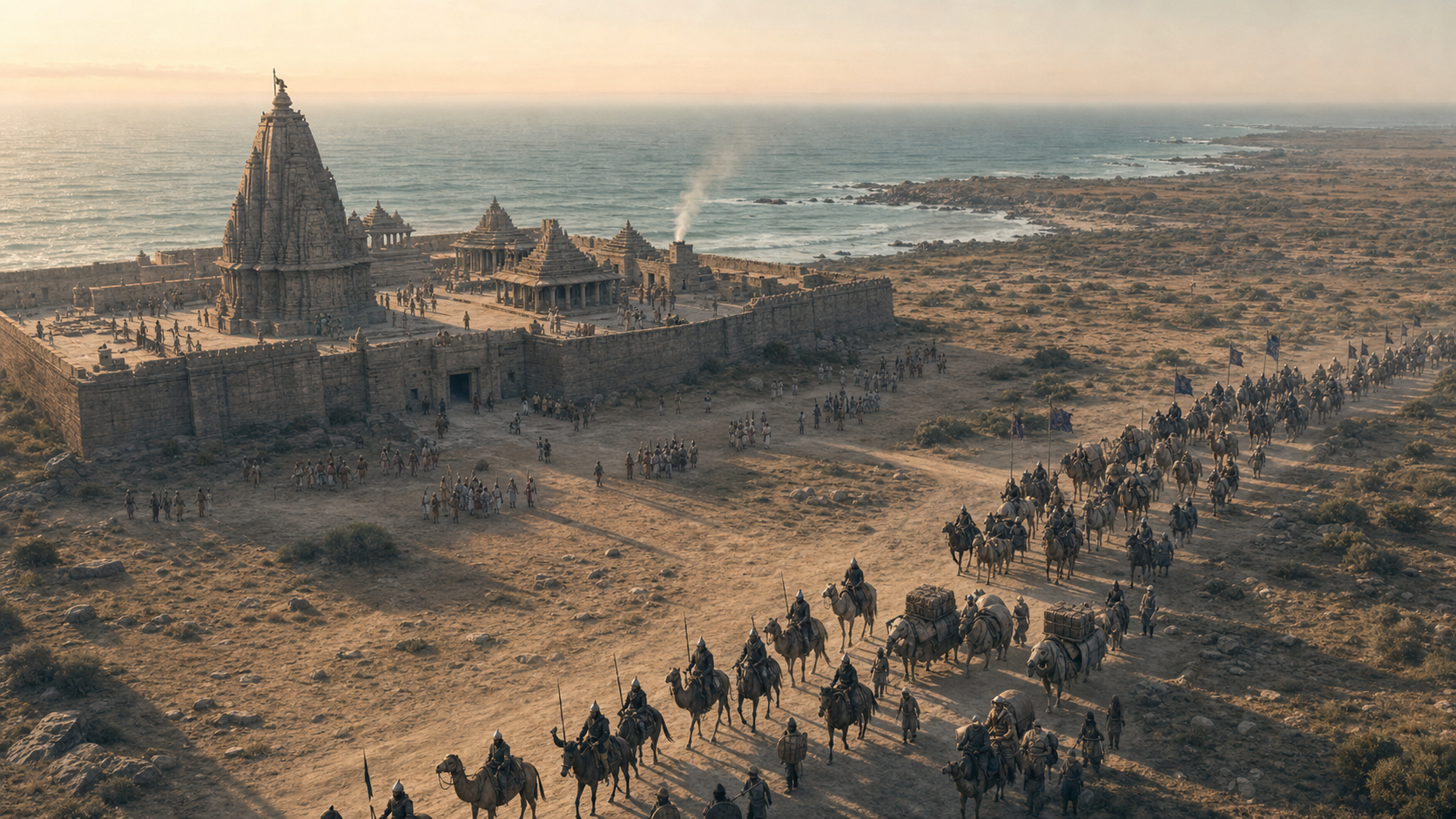
You may have encountered Somnath as a slogan, a grievance, or a dramatic story stripped of context. If your question is simply “What actually happened in 1026?”, the answer is clear at its centre: Mahmud of Ghazni reached Somnath through a deliberately planned military campaign, defeated determined resistance, plundered the sacred complex, destroyed its central murti, and turned that destruction into a public statement.
The harder question is how you should remember it. Denying the iconoclasm empties the event of meaning. Repeating every later detail as equally certain weakens the case. Responsible remembrance requires both moral clarity and historical discipline.
The raid was a planned campaign, not a sudden outbreak
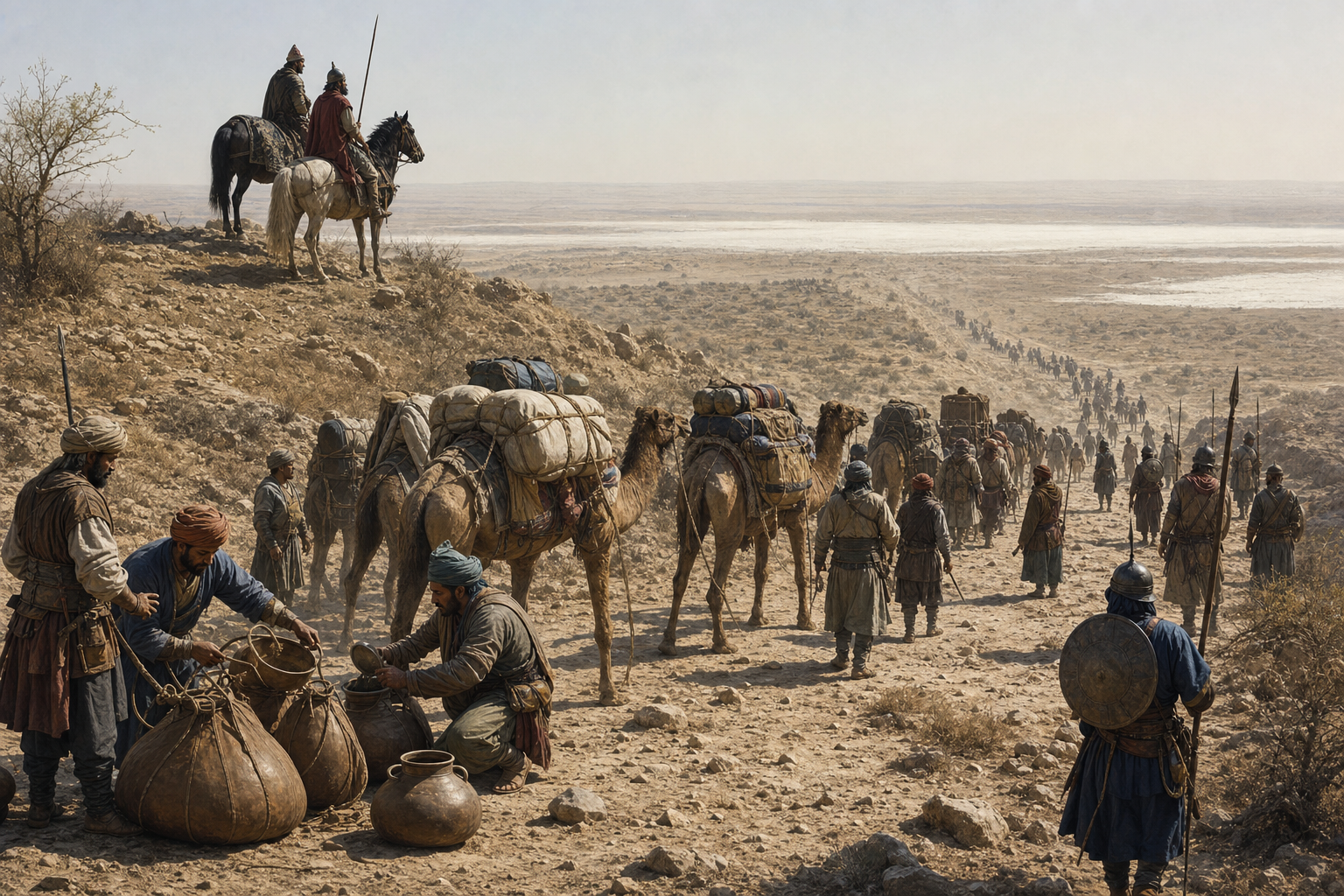
Somnath did not fall to an isolated raiding party that happened upon a wealthy shrine. Mahmud left Ghazni on 18 October 1025 with a large, organized force. The reported scale included about 30,000 regular cavalry and 30,000 camels carrying water and provisions. Medieval army figures must always be handled cautiously, but the route, logistical preparation, and succession of attacks reveal a sustained operation rather than an impulsive act.
- Preparation: Mahmud assembled cavalry, water, provisions, and transport for a long advance from Ghazni.
- The approach: After reaching Multan, he moved southwest through the Thar rather than entering the Ganga-Yamuna region held by powerful Hindu polities. The dangerous desert route reduced the prospect of confronting those powers before reaching Gujarat.
- Regional resistance: The army overran Ludrava, seized Chikudar hill, and threatened Nahrwala, also known as Anahilapataka. Bhima I, the Gujarat Chalukya ruler, withdrew to Kanthkot. Further resistance was encountered around Modhera and Dewalwara.
- The assault on Somnath: Mahmud arrived on 6 January 1026. Defenders initially repelled attacks, but sustained pressure eventually broke the fortified settlement and carried the fighting into the temple precincts.
This sequence corrects two easy misreadings. First, Gujarat was not undefended: resistance occurred repeatedly, including at Somnath itself. Second, bravery at the final position could not repair the absence of unified political and military command. The defenders’ courage was real, but courage alone could not overcome an opponent who had planned his route, supplies, timing, and concentration of force.
Keep the secure core separate from the vivid later details
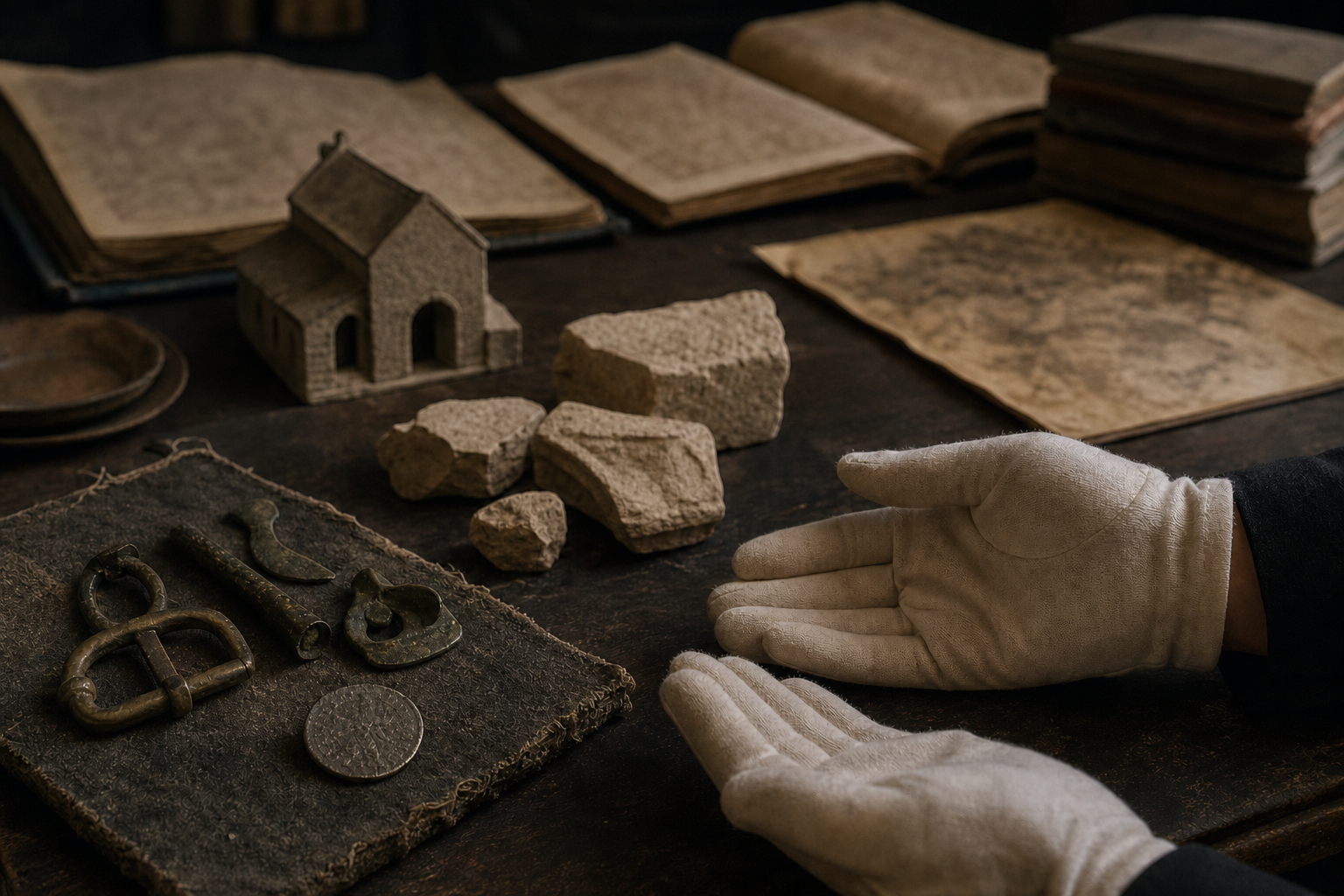
You do not have to choose between accepting every dramatic anecdote and pretending that nothing certain can be known. The evidence supports levels of confidence.
Al-Biruni, close to Mahmud’s own era, identifies the destruction in 416 H, corresponding to 1026 CE. He states that the upper part of the sacred image was broken, that the remainder was taken to Ghazni with valuable coverings and ornaments, and that fragments were placed where they could be deliberately trodden upon. That last act matters because it points beyond ordinary battlefield seizure toward performative humiliation.
Another part of the idol from Somnath lies before the door of the mosque of Ghaznin.
Al-Biruni
Firishta, writing much later, supplies the famous imagery of Mahmud striking the murti with a mace, sending pieces to several destinations, discovering jewels inside it, and refusing a Brahmin offer to ransom it because he wished to be remembered as an idol-destroyer rather than an idol-seller. These details have shaped popular memory, but their later appearance means they should not be placed on exactly the same evidentiary footing as the basic fact of destruction and removal recorded much nearer the event.
- The secure core: a Ghaznavid campaign reached Somnath, overcame resistance, seized wealth, destroyed the central sacred image, and carried material away to Ghazni.
- Reported operational details: precise troop and camel totals, the exact scale of each regional engagement, and some features of the temple economy should be presented as reported figures rather than modern counts.
- Later dramatic elements: the mace blows, jewels concealed inside the murti, destinations assigned to every fragment, and the idol-seller exchange belong to a later and more elaborated narrative layer.
The same discipline applies to casualties. Some accounts place the deaths in the tens of thousands, and the fighting plainly produced grave loss of life. No surviving counting method establishes an exact total, however. Say “estimates in the tens of thousands” if the number is relevant; do not turn an estimate into a verified body count.
This distinction does not excuse the raid. It protects its history. A fragile embellishment can be challenged and used to distract from a well-supported event. The strongest account is the one that states the core confidently and marks uncertainty where it actually exists.
Why Somnath became more than one destroyed temple
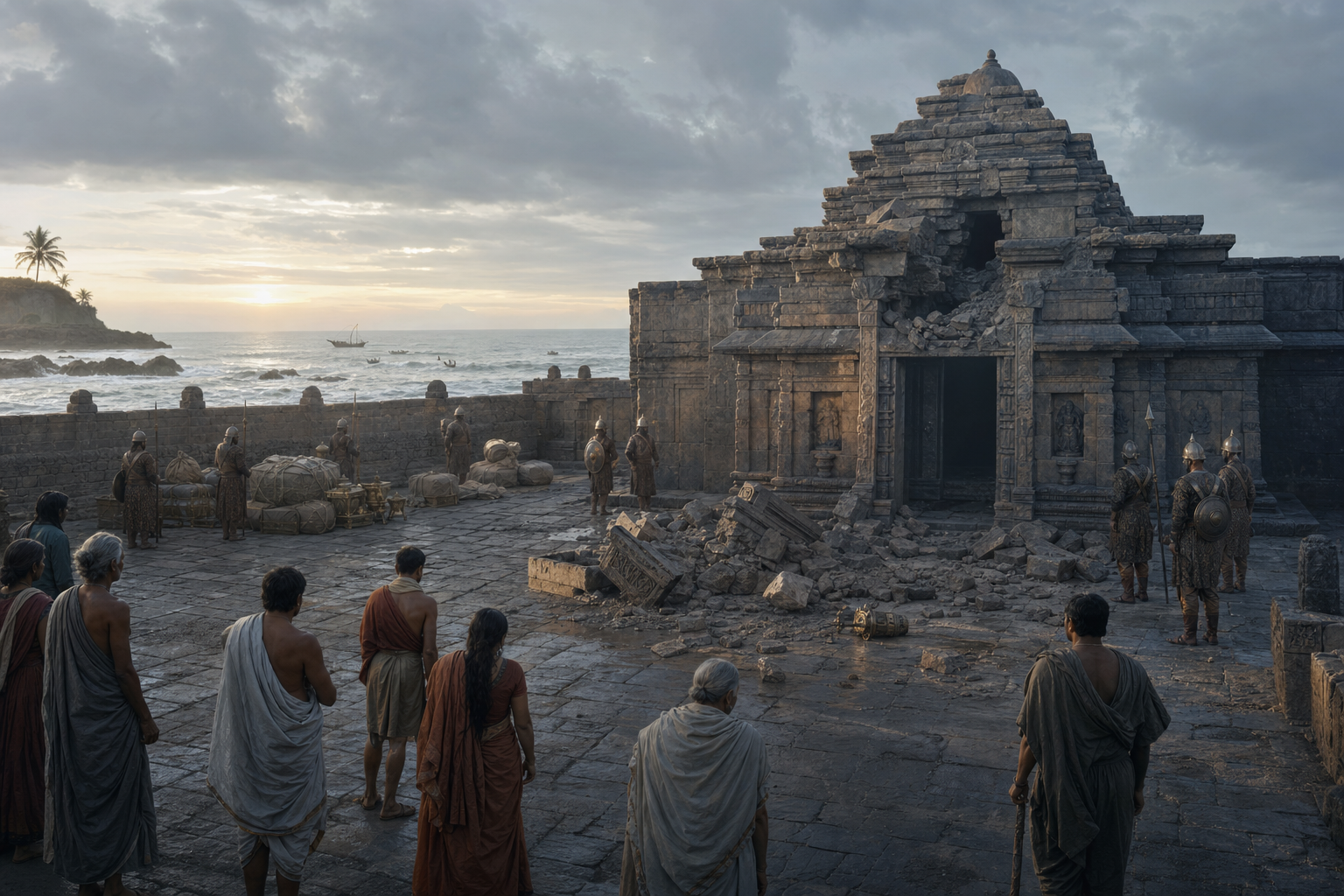
Somnath was not simply a treasury with a shrine attached. It was a Jyotirlinga, a centre of pilgrimage, and the heart of an extensive sacred economy. Priests, attendants, singers, dancers, and other workers served the complex. Endowments and generations of offerings had accumulated wealth around an institution revered far beyond its immediate locality.
That combination of sanctity and wealth created two related incentives. Plunder rewarded Mahmud’s army and strengthened his state. Iconoclasm advertised religious victory and domination. You should resist the false choice between those motives. The seizure of treasure proves that material gain mattered; the deliberate breaking and degrading display of sacred fragments shows that material gain was not the whole meaning of the act.
The raid also entered memory as a failure of protection. Bhima I had withdrawn to Kanthkot. Somnath’s defenders and pilgrims fought, but they lacked the coordinated leadership that the invading force possessed. Some reconstructions describe people expecting divine intervention even after political authority had disappeared. Whether every such portrayal is accepted or not, the institutional contrast is difficult to miss: one side arrived with logistics and command, while the final defenders relied on local courage and sacred commitment.
There was also an intended memory on the conqueror’s side. Ghaznavid praise presented the victory as a triumph of faith. The degradation of fragments in Ghazni made destruction into a continuing spectacle rather than a momentary consequence of battle. Indian remembrance therefore preserved more than the loss of property; it preserved an assault on a sacred relationship between a community, a place, and its deity.
Yet Somnath’s memory is not only the memory of Mahmud. The temple was rebuilt across successive periods. Each reconstruction denied the conqueror the final word. If destruction is remembered without rebuilding, Hindus inherit only humiliation. If rebuilding is celebrated without naming the destruction, resilience becomes detached from the ordeal that gave it meaning. A truthful memory holds both together.
What the failure at Somnath should teach you
Devotion requires capable institutions
The lesson is not that devotion failed. It is that devotion cannot substitute for human responsibility. Dharmic reverence calls people to protect what they have received; it does not release them from planning, leadership, documentation, or coordinated action.
If you serve a temple, archive, monastery, gurdwara, Jain institution, or heritage organization, turn that lesson into five practical questions:
- Is there a current inventory of murtis, manuscripts, inscriptions, ornaments, and architectural elements, supported by photographs and provenance records?
- Are secure copies of those records kept away from the physical collection, so a fire, theft, or local disaster cannot destroy both object and documentation?
- Does everyone know who has authority during an emergency, including who contacts conservation professionals, law enforcement, insurers, and community leadership?
- Are volunteers taught the difference between safe handling and well-intentioned damage, especially for manuscripts, stone, metal, paint, and ritual objects?
- Does public education explain why the site matters historically and spiritually, rather than assuming future generations will understand its importance without being taught?
These tasks are less dramatic than commemorative speeches. They are also how memory becomes stewardship.
Historical accuracy is part of cultural defence
When you speak or write about Somnath, label claims as established, reported, or later tradition. The destruction of the murti and removal of fragments belong to the established core. The large logistical figures are reported details. The most cinematic exchanges and gestures come through later narration.
This is not timid language. It is disciplined language. You can be unequivocal about an act of iconoclasm without pretending that every number and quotation has equal support. Truth gains authority when it does not ask a doubtful claim to carry more weight than it can bear.
Memory must not become inherited collective guilt
Name the responsible agents precisely: Mahmud, his army, the Ghaznavid campaign, and the ideological celebration attached to the conquest. Do not transfer an eleventh-century ruler’s responsibility to living people merely because they share a religion, ethnicity, or geography with someone in the story.
That boundary does not require suppressing ideology. You can acknowledge that religious iconoclasm mattered while refusing contempt for whole present-day communities. Moral precision is stronger than generalized anger. It keeps remembrance directed toward education, conservation, solidarity, and lawful protection rather than retaliation.
The same principle makes Somnath relevant beyond one Hindu sect. Buddhist viharas, Jain temples, Sikh gurdwaras, manuscripts, sacred art, and places of memory all depend on communities willing to document and defend them. Inter-dharmic solidarity becomes meaningful when it moves from sympathetic language to shared expertise in conservation, archiving, teaching, and emergency preparation.
Key takeaways for responsible remembrance
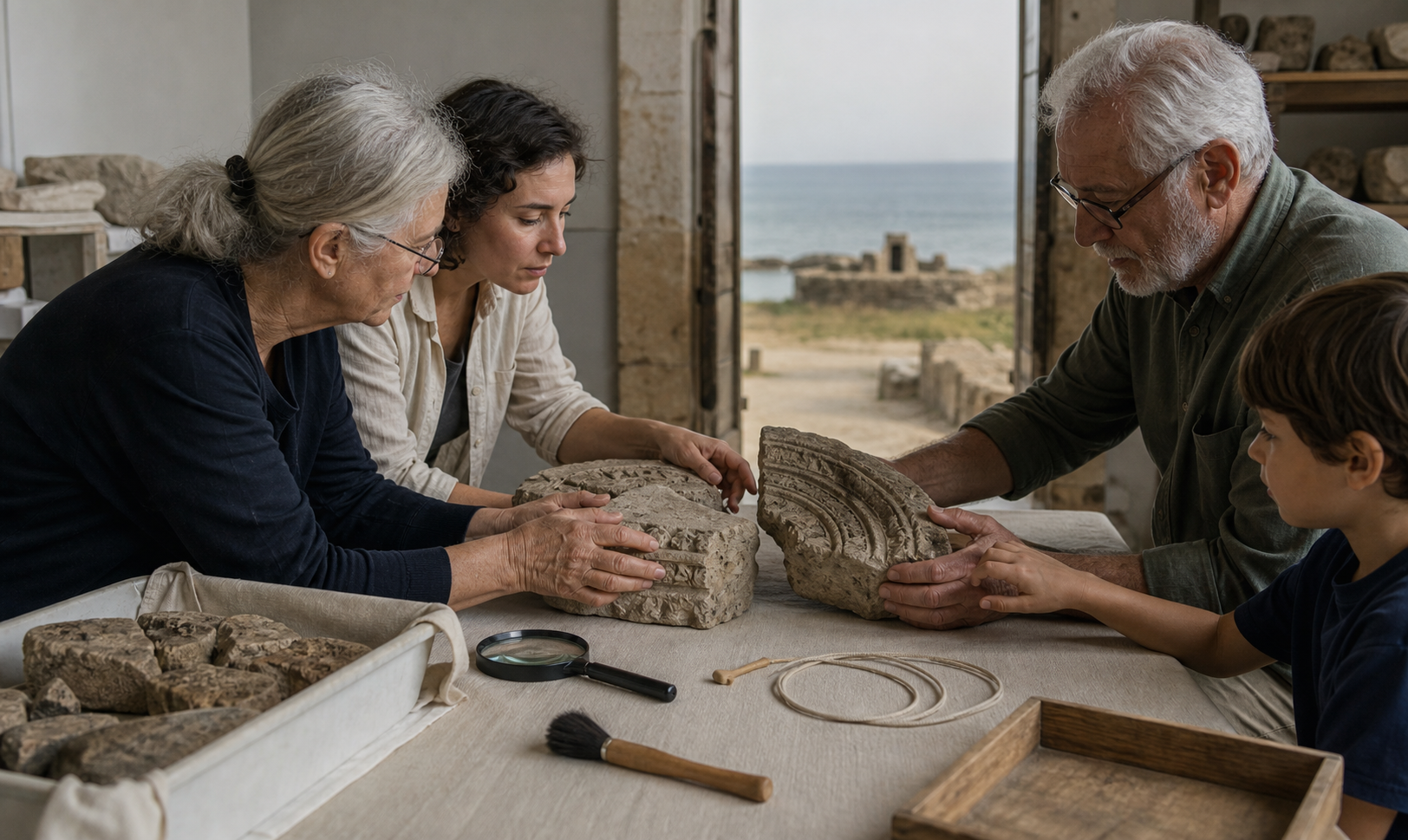
- The 1026 assault was the endpoint of a planned military campaign with deliberate routing, supplies, and command.
- Somnath’s defenders resisted fiercely, but local courage could not compensate for political withdrawal and fragmented leadership.
- Plunder and iconoclasm are not competing explanations. The campaign extracted wealth while the destruction and display of sacred fragments communicated ideological triumph.
- The raid, destruction of the murti, and removal of fragments are central facts; exact casualty totals and dramatic later anecdotes require qualification.
- Somnath should be remembered as both a civilizational wound and a history of reconstruction. Neither truth cancels the other.
- The most useful commemoration is practical: preserve records, teach evidentiary distinctions, strengthen heritage institutions, and act through lawful collective stewardship.
The next time you explain Somnath, use a simple three-part discipline. State what happened without euphemism. Mark what remains uncertain without embarrassment. Then direct the memory toward protection rather than inherited hatred. That is how you honour the people who resisted, the sacred place they defended, and the generations that refused to let its destruction be final.
References
