
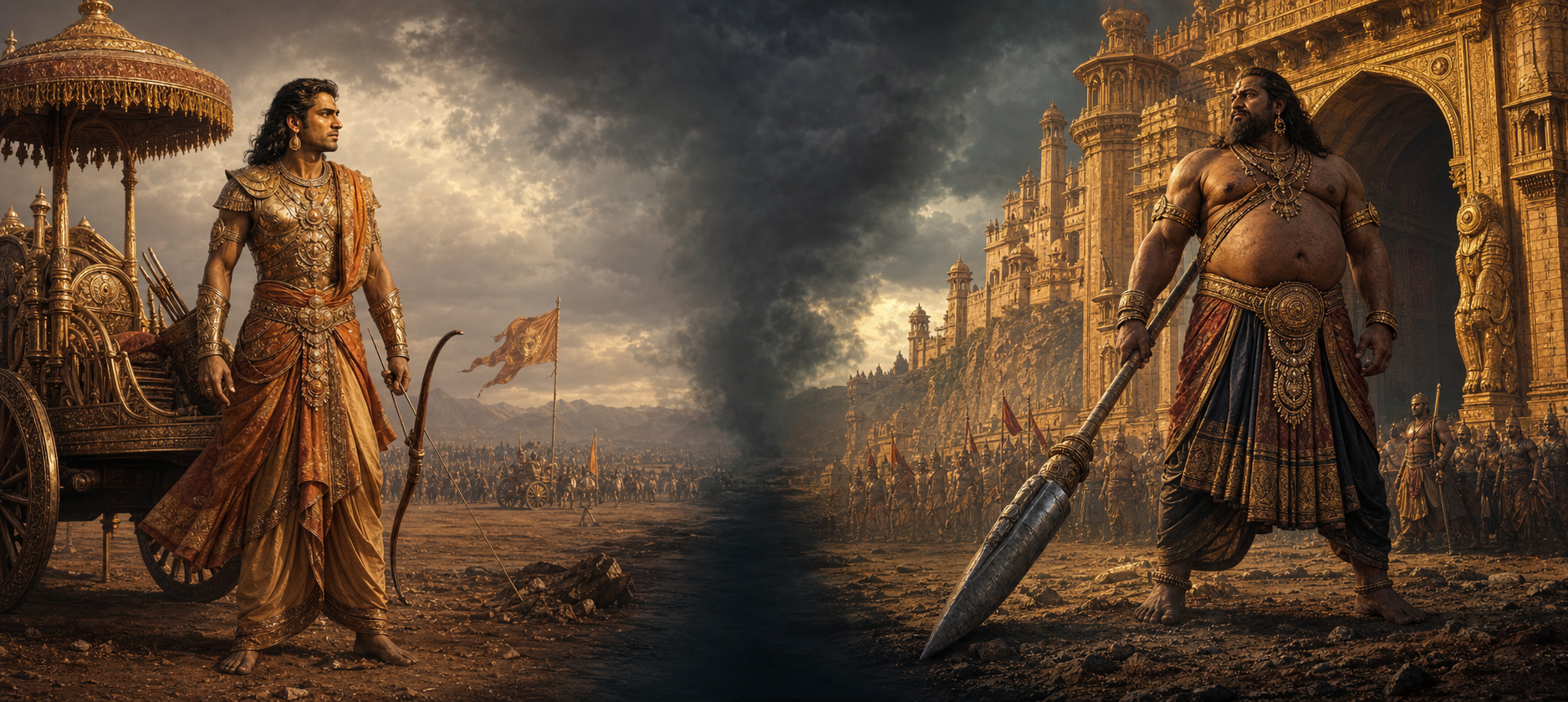
Someone once gave you dignity, protection, or opportunity when others would not. Now that person is asking for support in a matter you believe is wrong. Walking away feels ungrateful; staying feels like a betrayal of conscience.
If you are caught in that bind, Karna and Kumbhakarna offer something more useful than a slogan about loyalty. Their tragedies show how a genuine virtue can become an instrument of adharma – and how to honour a relationship without surrendering moral judgement.
Why loyalty can be noble and still lead you wrongly

Three different judgements often collapse into one:
- Does this person deserve my gratitude?
- Does this relationship deserve fidelity?
- Is the action now being asked of me right?
You can answer yes to the first two and no to the third. That distinction is the heart of tragic loyalty. The loyal person may possess courage, generosity, gratitude, and sincerity, yet place those virtues at the service of a wrongful act or cause.
Dharma therefore cannot be reduced to private sincerity. It asks not only whether you mean well, but also what you are doing, whom your action serves, and who will bear its consequences. A person does not acquire moral ownership over you by helping you. Your debt may be real, but the form in which you repay it must still withstand ethical scrutiny.
This is especially important when role-duty is invoked. Kshatra dharma is not permission to use strength without restraint. Authority, courage, and martial duty have moral purpose only when disciplined by truth, responsibility, and wise counsel. A role can explain why you feel bound; it cannot turn every command into dharma.
When you face divided loyalties, do not begin by asking whether loyalty is good in the abstract. Ask a narrower question: what, precisely, is this loyalty requiring me to do?
Karna shows how gratitude can become moral captivity

Karna’s loyalty is powerful because it is not opportunistic. Raised outside royal privilege despite his heroic ability, he remains bound to Duryodhana by gratitude and honour. He maintains that allegiance even when kingship and reconciliation are placed before him. He does not choose the easier or more profitable side.
His dana, or generosity, reveals the same refusal to live by mere self-interest. His promise to Kunti – protecting her sons except Arjuna – also shows that his conscience remains active. He recognizes competing claims and places a limit on what he will do. Yet the limit operates inside his existing allegiance; it does not lead him to reconsider whether that allegiance itself should govern his conduct.
That is what makes Karna tragic rather than simply corrupt. It would be shallow to treat him as a man without moral awareness. It would be equally shallow to argue that gratitude makes his continued participation righteous. His admirable qualities remain admirable, but they do not automatically sanctify the cause they serve.
Karna’s dilemma exposes three mistakes you should avoid in your own life:
- Gratitude is an obligation, not a transfer of conscience. You may owe someone acknowledgement, fair treatment, assistance, or sacrifice. You do not owe falsehood or cooperation with harm.
- A limited promise does not settle the larger question. Restricting how you will participate in a wrong is not always enough. You must also ask whether you should participate at all.
- Personal sacrifice proves sincerity, not righteousness. Willingness to lose status, comfort, or life can make loyalty moving. It does not erase the cost imposed on other people.
Suppose a mentor defended you early in your career and later asks you to endorse a decision you believe is dishonest. You need not deny the mentor’s past kindness. Name the debt honestly. Then refuse the false account, propose a way to repair the decision, and accept any personal cost attached to your refusal. Rejecting the present wrong does not rewrite the past good.
Kumbhakarna reveals the limit of truthful counsel

Kumbhakarna’s conflict takes a different form. He does not mistake Ravana’s conduct for righteousness. Before entering battle, he advises Ravana to return Sita and avert the consequences of adharma. His counsel is specific: identify the wrong, reverse it, and prevent the ruin that will follow.
He nevertheless goes to war for the ruler and brother whose course he has condemned, accepting an outcome he understands to be inevitable. His clarity makes the choice more poignant, but it also sharpens the ethical problem. He fulfils the duty to speak truth to power. He does not take the further step of withholding his strength from the course he has judged wrong.
This pattern appears whenever someone says, “I warned them,” and then helps carry out the very action opposed. Raising an objection matters. It may show integrity and give a leader an opportunity to correct course. But counsel does not automatically absolve the counsellor of responsibility for what happens next.
Effective moral counsel therefore needs four parts:
<!– wp:list {