

If the Republic Day video from the Taj Mahal stirred your patriotic pride but the official inquiry gave you pause, you do not have to choose between reverence for the Tricolour and respect for the monument. The useful question is simpler: how should patriotic expression work inside a protected heritage site?
The answer begins with disciplined citizenship. Honour the national symbol, learn the rules of the place, obtain permission when an activity goes beyond an ordinary visit, and do not let a meaningful gesture become an avoidable security or conservation dispute.
Do not turn a short video into a final verdict
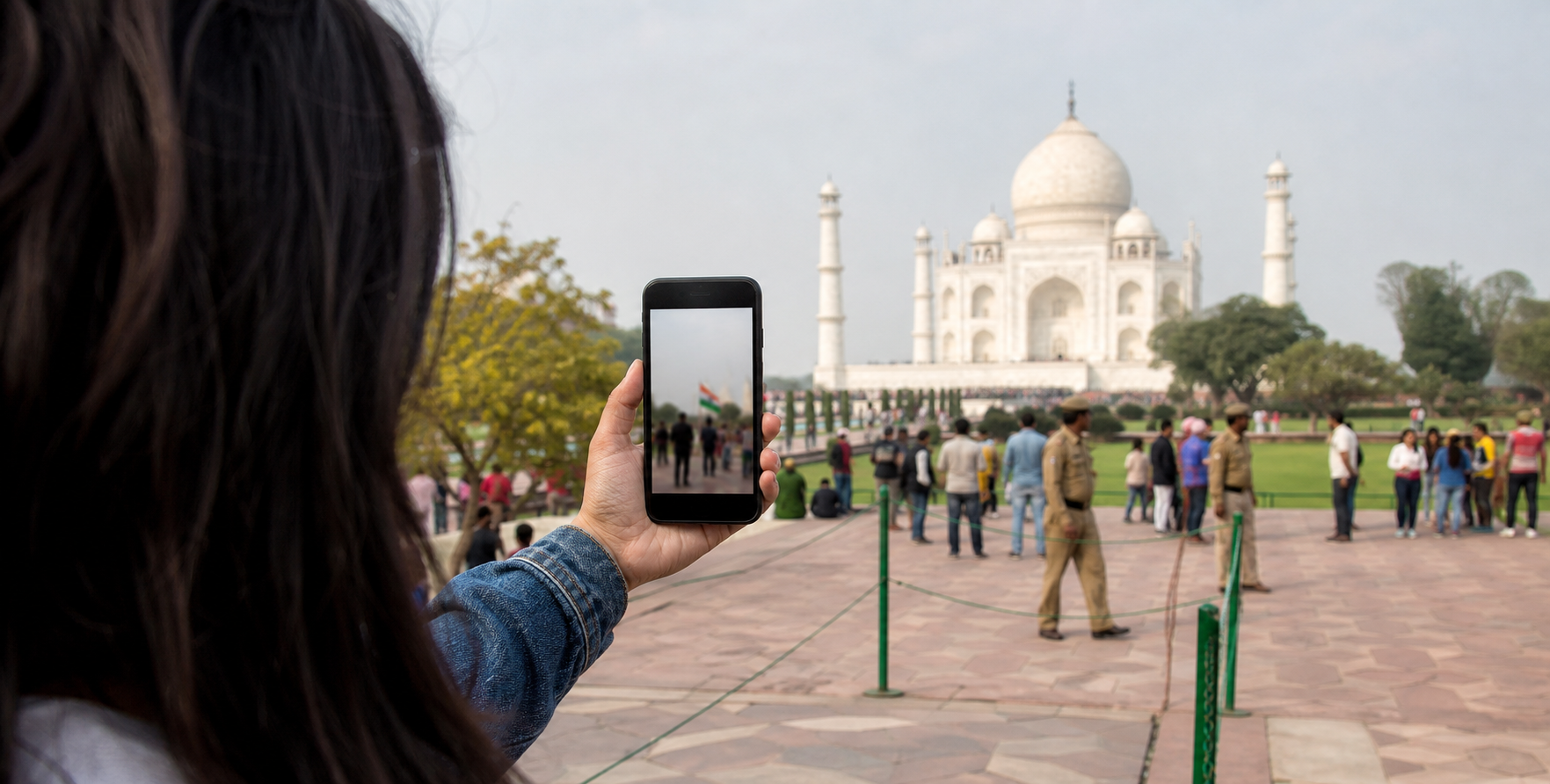
On Republic Day in Agra, members of the All India Hindu Mahasabha reportedly displayed the Tricolour inside the Taj Mahal while chanting Bharat Mata ki Jai. A video circulated widely, and the CISF and ASI began an inquiry into the display, the applicable protocols, and the security procedures surrounding it.
That gives you a confirmed framework, not a completed judgment. A short recording may show that a flag was raised and slogans were voiced. It may not show what happened before filming began, whether anyone requested authorization, what instructions personnel gave, or how the participants entered with the material. Those are precisely the kinds of questions an inquiry must resolve.
Keep three judgments separate when you discuss the incident:
- What is visible: a recorded patriotic display at the Taj Mahal.
- What remains to be established: whether the display complied with site rules and whether security procedures were followed.
- What the act means: a political and ethical interpretation on which citizens may reasonably disagree.
This separation matters because social media rewards instant moral certainty. One side can treat the national flag as proof that no procedural question is legitimate. Another can treat the existence of an inquiry as proof of guilt. Neither conclusion follows. Until the facts are clarified, describe the participants’ involvement as reported, acknowledge that the inquiry is underway, and do not turn a procedural question into an accusation against an entire community or institution.
The Tricolour and the Taj Mahal are not competing loyalties
The Tricolour is India’s national emblem and belongs to every citizen. The Taj Mahal is a protected part of India’s cultural inheritance. Respecting one does not require diminishing the other.
Heritage protocol governs the manner, location, and conditions of an activity. It does not determine whether the feeling behind that activity is worthy. A restriction on an unapproved display inside a protected monument is therefore not, by itself, an insult to the flag. In the same way, sincere patriotism does not automatically confer permission to organize an activity wherever one chooses.
The distinction becomes clearer if you ask what a protected-site rule is trying to prevent. Authorities must manage visitor movement, prevent contact with vulnerable structures, keep security screening meaningful, and avoid a succession of groups treating a monument as an open stage. Prior authorization allows personnel to examine the proposed location, objects, crowd size, timing, and conduct before an event begins. It also creates accountability if something goes wrong.
The national flag has a unique constitutional place; it is not merely one symbol among many. Yet that uniqueness cannot become self-issued permission. Otherwise, anyone could claim that the importance of a cause exempts its supporters from the rules of a shared space. A sound protocol should protect the monument consistently while giving organizers a clear route for seeking approval.
Republic Day sharpens this duty. The occasion honours the Constitution, not only the emotion of nationhood. Civic responsibility, lawful procedure, and restraint are part of its meaning. A patriotic act is strongest when its method can withstand the same public scrutiny as its message.
Use this protocol before planning a patriotic display
The practical dividing line is not whether you love Bharat. It is whether you are making an ordinary visit or organizing a public act. A coordinated flag display, group slogan, posed recording, procession, or activity intended for public circulation should be treated as an organized action even if it will last only a few moments.
- Define the activity before approaching the authorities. State what you want to display, whether it includes a pole or other object, how many people will participate, whether slogans or group movement are planned, where you hope to stand, and whether the event will be recorded.
- Check current instructions through the monument’s official visitor channels and at the site. Do not rely on an older video, a forwarded message, or the claim that another group was once allowed to do something similar.
- Request prior authorization when the activity is coordinated or ceremonial. Ask for a clear response covering the location, timing, materials, number of participants, photography, and any conduct restrictions. If you cannot obtain explicit approval, treat that uncertainty as a reason to choose another venue.
- Plan for zero contact with the monument. Do not attach a flag, pole, tape, fastener, banner, or decorative material to any part of the structure. Do not climb, lean on restricted surfaces, cross barriers, or use the building as support for a staged image.
- Brief every participant before arrival. One person should communicate with officials; everyone else should follow that person’s instructions. A participant who improvises a slogan, unfurls an undisclosed item, or summons a crowd can change the character of the approved activity.
- Comply immediately if personnel change the location, limit the activity, or tell you to stop. You can seek an explanation or pursue a grievance later through the appropriate channel. Arguing at the monument turns a question of authorization into a security confrontation.
Passing through a security checkpoint should not be mistaken for permission to stage an activity. Screening concerns what enters the premises; authorization concerns what you intend to do after entering. If a small flag or other item is not stopped at the gate, that alone does not approve a coordinated display.
If you are visiting as an individual, read the posted instructions and follow verbal directions. If you are unsure whether a particular gesture is allowed, ask before acting. If staff cannot confirm permission, keep the visit peaceful and express your patriotism later in a place where the activity is clearly permitted. Relocating a display does not reduce its sincerity.
Authorities carry responsibilities too. The inquiry is expected to examine both the circumstances of the display and the site’s security procedures. Clear rules, consistent enforcement, trained personnel, and an intelligible permission process reduce the likelihood that citizens experience conservation protocol as arbitrary or selective.
Dharmic patriotism joins right intention to right conduct
For a Dharmic reader, the central issue is not difficult to recognize. Intention matters, but intention is not the whole of dharma. The method, the place, the people affected, and the foreseeable consequences matter as well.
Hindu, Buddhist, Jain, and Sikh traditions differ in their doctrines and disciplines, but each gives serious weight to self-command, responsibility, and conduct within a shared moral world. That perspective helps us avoid two errors. We should not mock genuine devotion to Bharat merely because it is emotionally expressed. We should also not declare every act righteous merely because it uses a sacred or national symbol.
Before joining or defending an action at a heritage site, ask four questions. Is the public description of the act truthful? Is the method consistent with the duties attached to the place? Could the action damage the monument, disrupt other visitors, or create a preventable confrontation? Will the result deepen national cohesion, or will it reduce the flag to a prop in a contest for online attention?
These questions do not weaken patriotic conviction. They keep conviction from being captured by impulse. Restraint is especially important when cameras are present, because the incentive can quietly shift from honouring the nation to producing a dramatic clip. If the success of an act depends on surprise, evading staff, provoking removal, or generating outrage, the performance has begun to displace the principle it claims to serve.
A confident civilizational outlook does not need to prove itself by disregarding stewardship. Bharat’s inheritance survives when citizens protect its places, institutions, symbols, and social bonds together. The higher patriotic standard is not merely to feel strongly. It is to act in a way that leaves the nation stronger after the emotion has passed.
Key takeaways for visitors, organizers, and viewers
- The Republic Day video establishes that a patriotic display occurred; it does not, by itself, establish whether authorization existed or every protocol was followed.
- The Tricolour’s national importance does not eliminate the conservation and security duties attached to a protected monument.
- A coordinated display, slogan, group recording, or ceremonial action should be planned as an organized event, with prior authorization sought before arrival.
- Never attach materials to the monument, cross barriers, obstruct visitors, or continue after security personnel tell you to stop.
- When discussing an unresolved incident, distinguish visible facts from procedural findings and political interpretation.
- Dharmic patriotism requires both sincere intention and disciplined conduct; self-restraint can protect the dignity of the message.
On your next visit, decide before reaching the gate whether you are simply paying your respects or proposing a public action. If it is an action, describe it fully and seek permission first. If permission is unclear, move it to an appropriate venue. At the Taj Mahal, let your conduct show that national pride can protect a shared inheritance rather than place it at risk.
References
