

If you are trying to decide whether a policy, movement, or leader represents Dharmic statecraft, do not begin with symbols or declarations. Ask what will still protect society after the speech ends and the leader is gone.
India’s civilizational endurance offers a demanding standard. Power must defend the conditions in which dharma can be lived, transmitted, debated, and renewed. It must also remain disciplined by the order it claims to protect. This distinction lets you separate civilizational statecraft from ceremonial politics, coercive majoritarianism, and nostalgia without institutions.
Begin with the function of dharma, not the language of identity
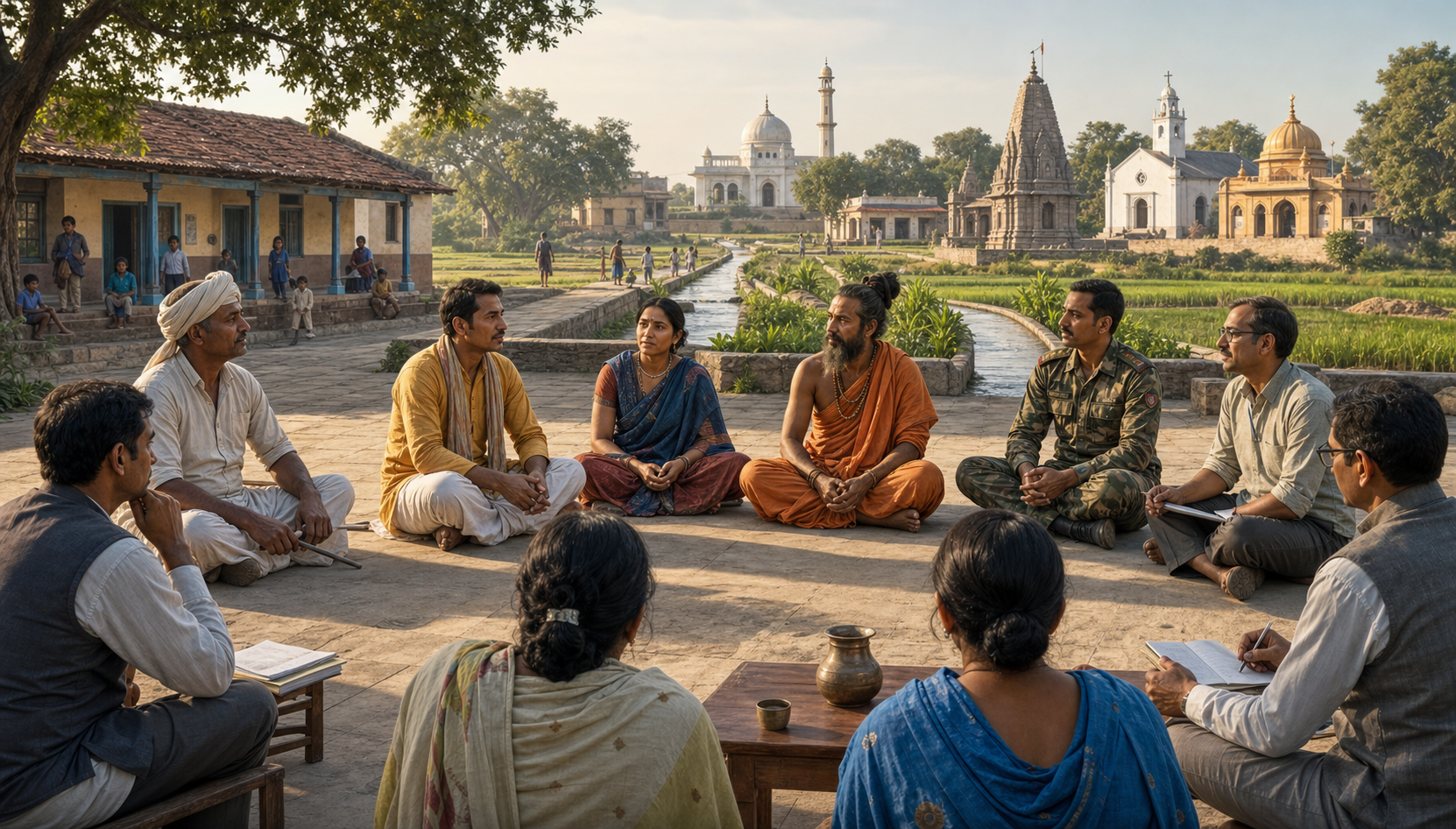
Statecraft organizes power: defense, administration, alliances, revenue, law, and succession. Dharma gives that power a purpose and a boundary. It asks whether authority sustains a just order rather than merely enlarging the ruler, party, dynasty, or bureaucracy.
This makes kshatra, the capacity for disciplined protection, indispensable but not self-justifying. A society that cannot defend life, liberty, learning, sacred places, and lawful institutions becomes dependent on the restraint of others. Yet force detached from ethical limits becomes predation. Dharmic resilience lies in holding protective capacity and moral restraint together.
A useful definition follows: Dharmic statecraft is the ethical organization of public power so that a civilization can protect its people, preserve its institutions, accommodate legitimate difference, and renew itself after disruption. The recurring union of moral purpose, social organization, and protective power is more important than any single dynasty’s uninterrupted success.
When someone labels a proposal dharmic, ask for three concrete answers:
- What is being protected? The answer should identify people, practices, institutions, knowledge, territory, or lawful freedoms rather than invoke civilization as an undefined abstraction.
- What disciplines the use of power? Look for a legal rule, ethical limit, chain of accountability, or stated boundary on emergency action.
- What will carry the purpose forward? A fort, school, temple network, archive, treasury, alliance, administrative office, or succession process is more durable than the virtue of one leader.
If the answers never move beyond identity and intention, you are looking at cultural assertion, not yet at statecraft.
Read Indian history as a map of capabilities, not a catalogue of heroes
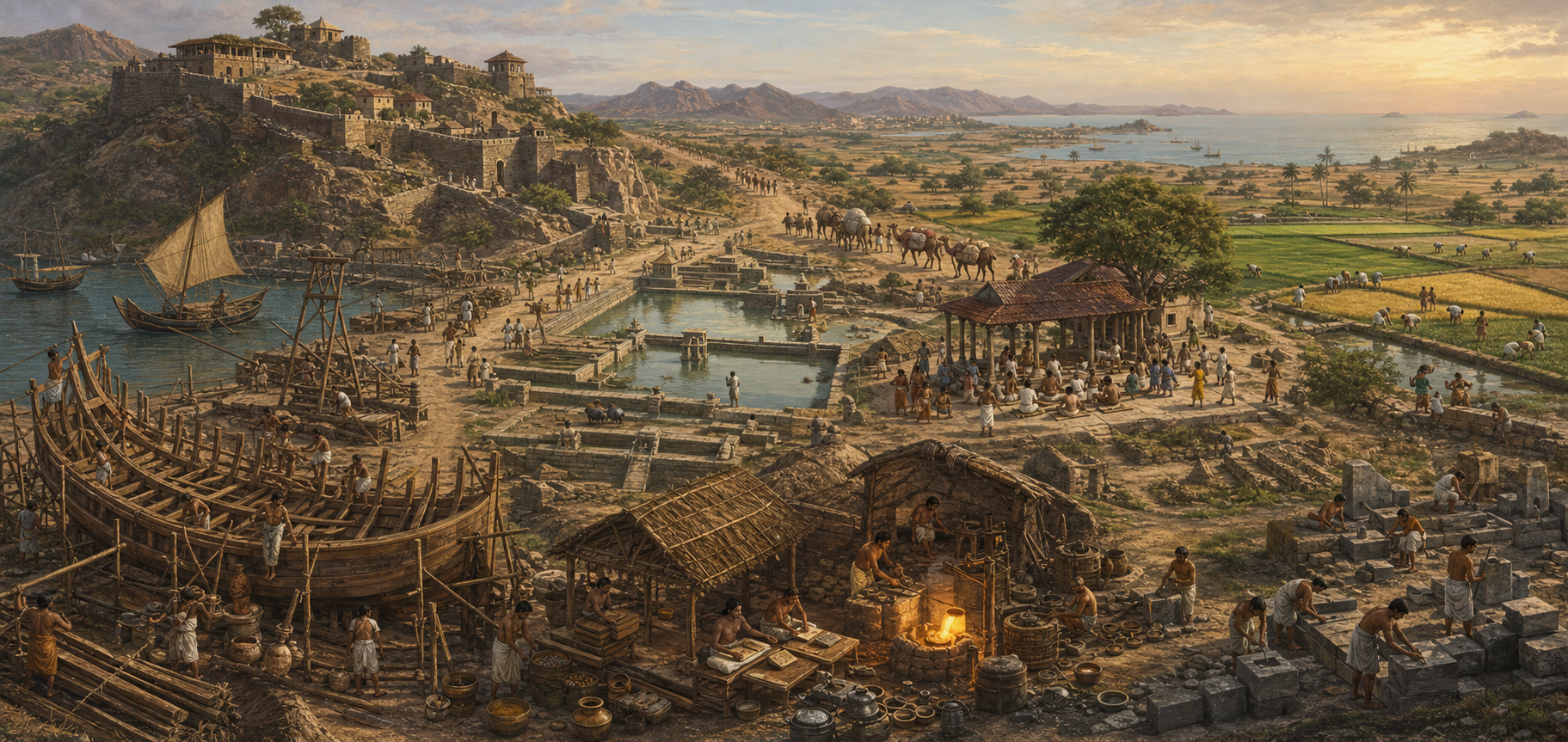
India’s continuity did not depend on one capital, one empire, or one community remaining permanently dominant. Political structures rose and fell while civilizational functions migrated, regrouped, and acquired new defenders. That is resilience: not the avoidance of every defeat, but the preservation of enough memory, legitimacy, organization, and material capacity to begin again.
Five capabilities recur across that history. Each gives you something specific to examine in present-day policy.
- Long civilizational memory. The remembered line from Kautilya and Chandragupta Maurya through Pushyamitra Shunga, Skandagupta, and Yashodharman preserved an intelligible vocabulary of large-scale organization, frontier defense, and political duty. Memory matters strategically when it teaches later generations what a civilization has attempted before. When evaluating cultural policy, ask whether it supports serious teaching, archives, languages, inscriptions, scholarship, and public access. Commemoration without transmission produces sentiment, not capability.
- Distributed centers of protection. The Chalukyas, Pratiharas, Shahis, and regional confederations acted from different centers in response to different pressures, including early Arab incursions, Ghazni’s campaigns, and threats to Somnath. A civilization with several functioning centers has alternatives when one court or frontier fails. In a modern plan, examine whether authority, expertise, reserves, and cultural competence exist outside a single capital or personality.
- Coalition across real differences. Rajput, Bundela, Maratha, and Sikh power arose from distinct regions and political circumstances; their civilizational significance does not require pretending that they formed one permanent centralized bloc. Jain monastic and mercantile networks sustained learning and urban life, while the Sikh tradition’s Khalsa joined spiritual sovereignty to civic courage. A strong coalition names the shared duty while leaving room for different institutions and identities. Before celebrating unity, ask what binds the partners, what each contributes, and which disagreements the coalition can survive.
- Integration of security, learning, and economic life. Under Harihara and Bukka, Vijayanagara joined political renewal to the protection of temples, scholarship, and productive society, with Madhava Vidyaranya and Vedacharya Sayana representing its intellectual dimension. This integration of polity with cultural and economic institutions is the practical lesson. A monument cannot remain alive without practitioners, teachers, records, maintenance, and a supporting economy. Test heritage plans against the whole ecosystem rather than the visible structure alone.
- Self-command in the exercise of power. The relationship remembered between Samartha Ramdas and Shivaji joins inner discipline to public responsibility. Its value is not that a ruler receives religious decoration. It is that political force must be governed by clarity of purpose, duty, and restraint. In contemporary terms, do not accept personal piety as a substitute for institutional accountability; ask how disciplined conduct is made routine when a less exemplary successor arrives.
These capabilities also correct a common historical mistake. Resistance was essential, but resistance alone did not preserve civilization. Teachers, merchants, monastic communities, administrators, warriors, local elites, and reformers carried different parts of the burden. If your model recognizes only the battlefield, it will miss the institutions that made recovery possible after the battle.
Put every claim of Dharmic policy through four tests

A state does not become dharmic merely by supporting familiar symbols. Nor does pluralism require a state to become civilizationally vacant. You can judge a proposal more clearly by testing its purpose, means, institutional form, and treatment of difference.
- The protection test: What civilizational function faces a real obstacle, and how will the proposal remove it? Name the function precisely: physical security, freedom of practice, education, conservation, access, scholarship, economic continuity, or lawful self-administration. If the claimed danger is vague, demand evidence before granting extraordinary power.
- The restraint test: Are the means proportionate to the stated purpose? Identify who may act, against whom, under which authority, for how long, and with what review. Protective force is not a blank cheque. A measure that destroys lawful order in the name of saving it has failed its own Dharmic claim.
- The institution test: Who owns the work after the announcement? Look for a responsible body, trained people, durable funding, records, maintenance, succession, and a way to correct failure. A leader may begin renewal, but only institutions can make it ordinary.
- The plural legitimacy test: Does the proposal protect a shared civilizational habitat without flattening Hindu, Buddhist, Jain, and Sikh traditions into interchangeable labels? Unity should enable cooperation in defense of life, learning, liberty, and sacred practice. It should not demand theological sameness or erase the central historical place of the Hindu civilizational matrix.
Watch for five warning signs:
- A symbol is announced, but no responsible institution, budget, skill base, or maintenance process is named.
- The virtue of a leader is offered in place of rules that constrain power and survive succession.
- Unity is defined as silence about internal differences rather than agreement on a limited common duty.
- An exceptional measure has no review date, limiting principle, or condition for ending it.
- A temple, text, language, or tradition is treated as an object to display rather than a living practice requiring teachers, participants, access, and continuity.
A proposal can pass one test and fail another. Strong defense with no restraint is dangerous. Cultural funding with no transmission plan is fragile. Plural language with no willingness to protect threatened institutions is evasive. Dharmic statecraft has to carry all four responsibilities at once.
Choose resistance, accommodation, and reform deliberately
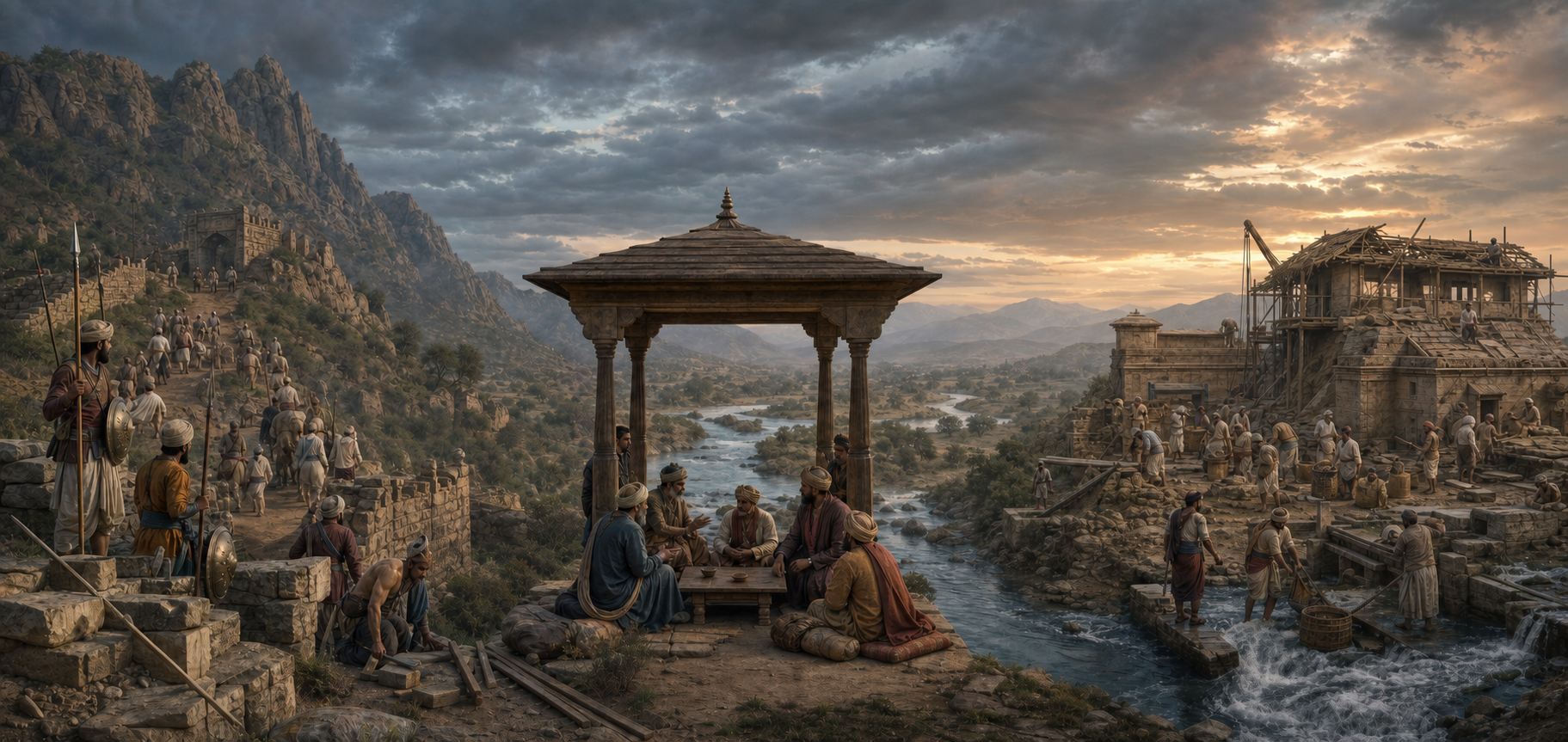
Indian political memory contains more than one honorable posture. Maharana Pratap represents steadfast resistance, while Raja Man Singh’s choices keep open difficult questions about service, accommodation, and influence from within an imperial order. Debates around Jayachandra likewise show why collaboration and dissent cannot be reduced to a single label without examining circumstances and consequences. The historical coexistence of resistance, accommodation, institution-building, and reform is a strategic resource, not an embarrassment to be simplified away.
Use the following sequence when deciding which posture a present situation requires:
- Name the non-negotiable function. Is the issue survival, territorial security, freedom of worship, control of an institution, transmission of knowledge, economic independence, or political representation? Do not call everything existential. A strategy becomes clearer when the protected core is limited and explicit.
- Distinguish the actors. Separate the direct aggressor, political competitor, reluctant intermediary, neutral institution, and potential ally. Treating all outsiders or dissenters as one hostile mass destroys the possibility of a useful coalition and makes intelligence less accurate.
- Select the posture by consequence. Resist when concession would destroy the protected core or make future recovery impossible. Accommodate when limited cooperation preserves the core, gains time, reduces harm, or builds capacity without surrendering the objective. Reform when the decisive weakness lies within your own institutions. These modes can follow one another; they need not become permanent identities.
- State the limits before acting. Define what your side will not do even under pressure. Also define what evidence would justify escalation, negotiation, withdrawal, or review. Limits turn moral language into operational discipline.
- Measure the institution left behind. After the confrontation, ask whether society has gained trained people, stronger networks, reliable records, improved defenses, deeper legitimacy, or greater capacity for learning. A dramatic action that leaves every civilizational function weaker is not vindicated by its rhetoric.
This sequence prevents two equal errors: treating every compromise as cowardice and treating every act of defiance as wise. The Dharmic question is not which posture appears most heroic in isolation. It is which action protects a just order without reproducing adharma through recklessness, cruelty, dishonesty, or the worship of power itself.
Key takeaways: use this seven-question statecraft audit
Before supporting a policy, alliance, cultural campaign, or security measure in the name of dharma, write down answers to these questions:
- Object: Which people, place, practice, body of knowledge, freedom, or institution will be protected?
- Threat: Is the principal failure external, internal, or mixed, and what evidence distinguishes those causes?
- Capability: Which responsible actor, resources, skills, and chain of command will turn intention into protection?
- Restraint: Which legal, ethical, and operational boundaries govern the use of power?
- Coalition: What shared duty binds the partners, what does each contribute, and which disagreements remain legitimate?
- Endurance: What funding, records, maintenance, local capacity, and succession process will survive the initiating leader or emergency?
- Renewal: Will the result strengthen learning, economic life, cultural transmission, and civic confidence alongside immediate defense?
For a working session, score each answer 0, 1, or 2: use 0 when there is no mechanism, 1 when there is an intention or incomplete mechanism, and 2 when the responsible institution, method, constraint, and desired result are explicit. This is not a measure of historical truth or moral worth. It is a decision aid that exposes where rhetoric has outrun design. Several zeroes mean the proposal is not ready for trust, however stirring its language may be.
Use the audit the next time someone asks for your support in the name of civilizational renewal. India’s history gives you more than heroes to praise: it gives you standards by which power can be judged. Memory becomes statecraft only when it trains judgment, and judgment becomes resilience only when it builds institutions capable of protection, restraint, cooperation, and renewal.
References
