
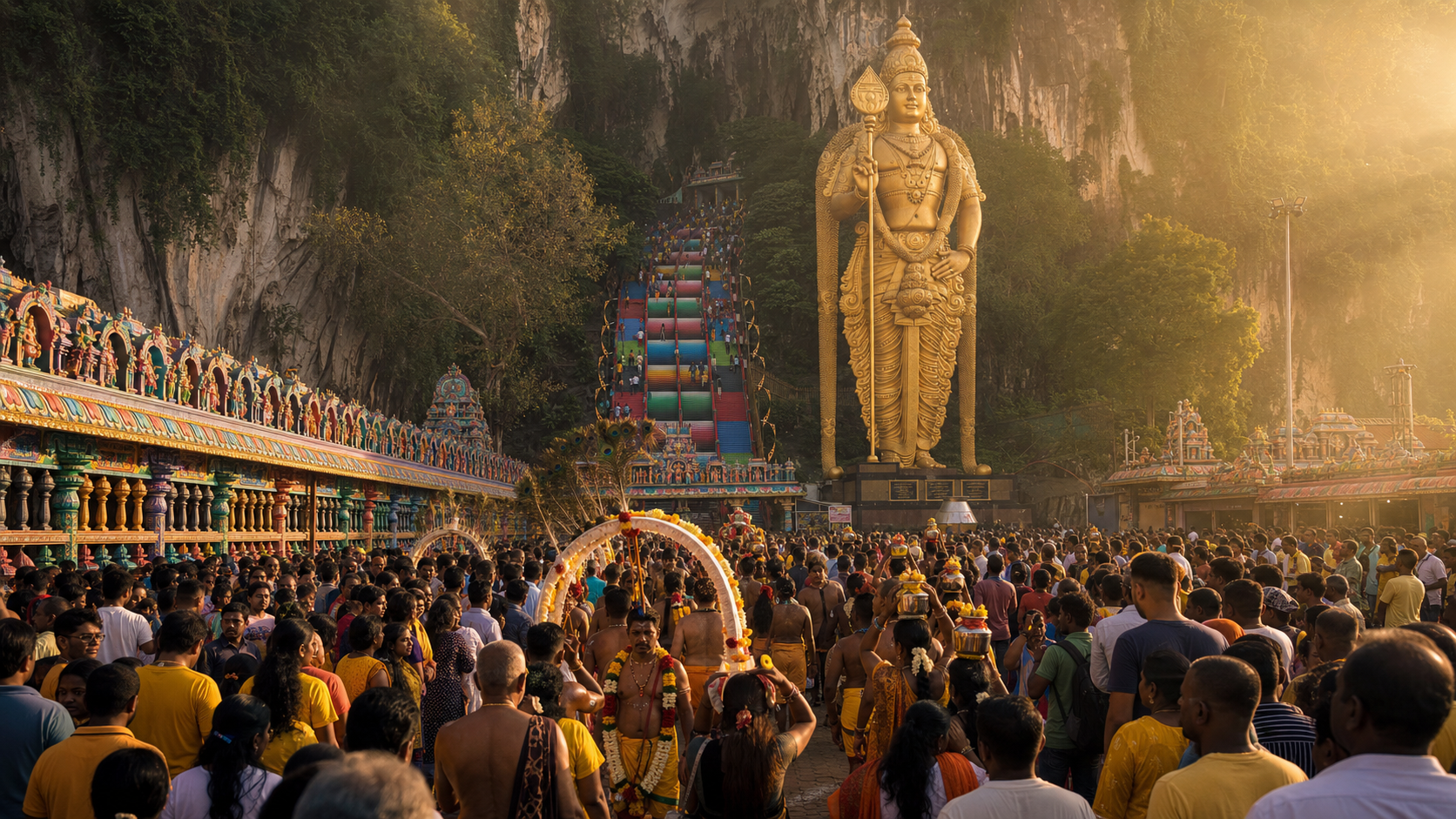
If you are planning to attend Thaipusam at Batu Caves, your first decision is not where to stand or what to photograph. Decide whether you are going as a vow-bearer, a supporter accompanying family, or a respectful witness. Those roles may share the same route, but they do not carry the same responsibilities.
The gathering can draw well over a million devotees and visitors. You therefore need to prepare for two realities at once: a demanding mass gathering and a sacred pilgrimage in which another person’s concentration, privacy, and safe passage matter more than your view.
Know what you are coming to witness
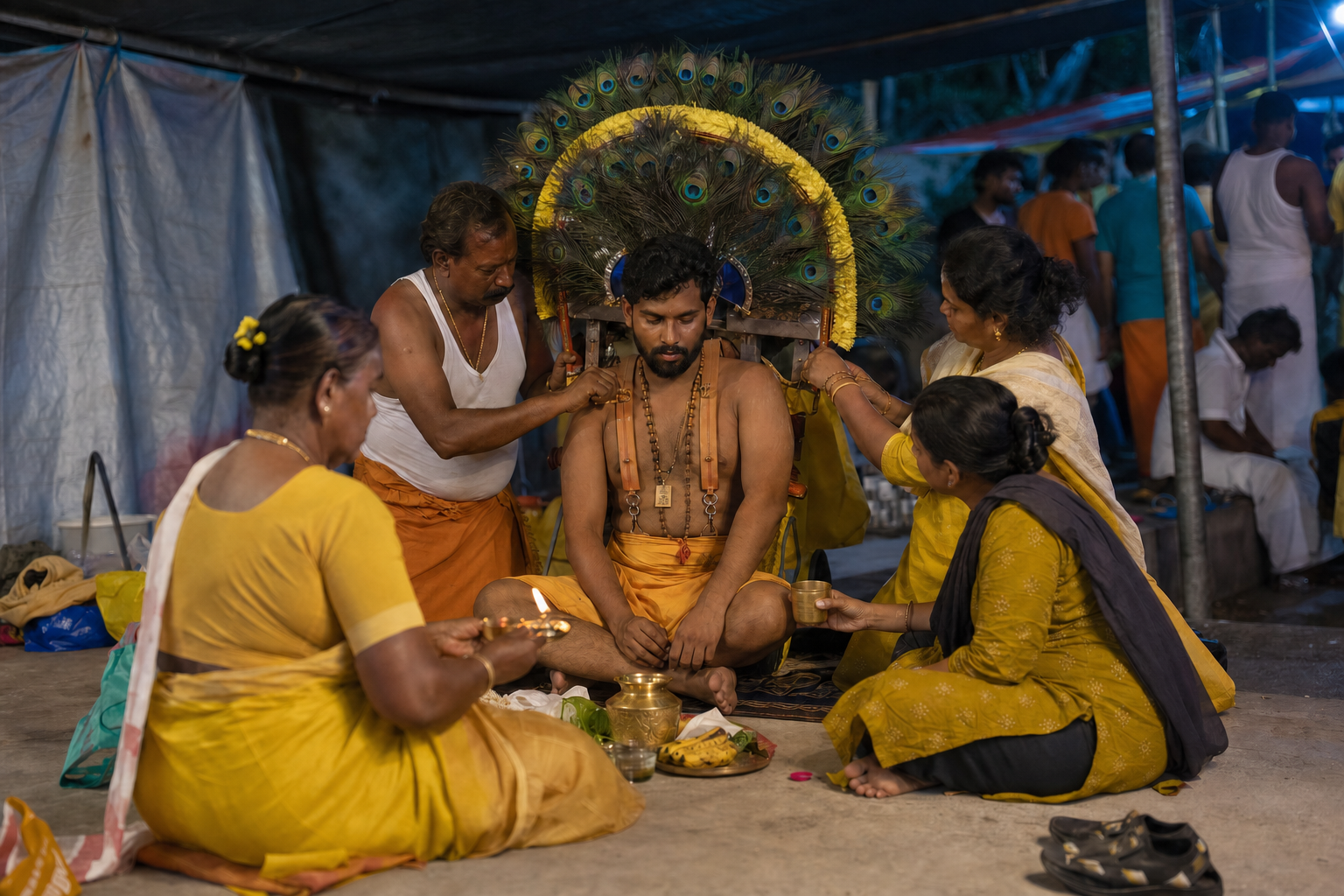
Thaipusam is an observance dedicated to Lord Muruga within the wider Skanda tradition. It is associated with the Tamil month of Thai and the Poosam star. For calendar context, the 2026 observance fell on February 1, aligned with Pournami and Poosam. Do not carry that date into another year without checking the relevant annual calendar.
The visible acts are expressions of an earlier, inward commitment. Devotees may carry a kavadi or a paal kudam, undertake the journey as thanksgiving, or perform an austerity connected with a vow. Piercing is one form of penance where it is undertaken; it is not the definition of Thaipusam and should not be used to rank one devotee’s faith against another’s.
If you are fulfilling a vow, follow the instructions of your temple, family tradition, or those guiding your observance. A general visitor plan cannot decide the form of a personal vrata for you. If you are attending as an observer, you do not need to imitate an austerity to participate respectfully. Your discipline is to make room, keep your curiosity from becoming an intrusion, and avoid interrupting someone in the middle of worship for an explanation or photograph.
This distinction will change what you notice. A kavadi is not a festival prop. A milk pot is not a costume accessory. The ascent is not merely a challenge to complete. Each belongs to a relationship among vow, effort, gratitude, and surrender.
Follow the ritual arc without treating it as a performance
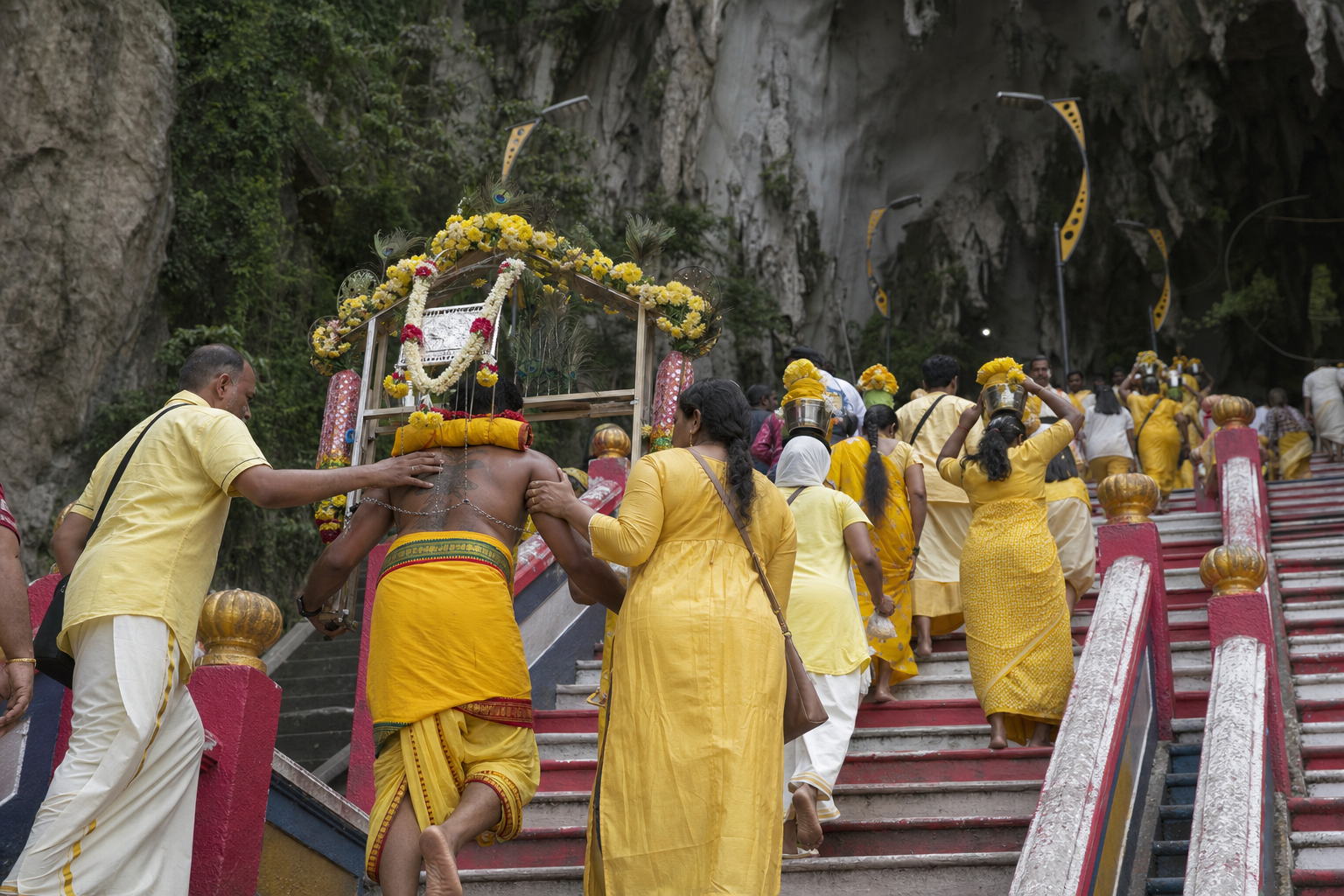
You will understand the gathering more clearly if you know its broad sequence before entering the crowd. The precise flow around you may overlap, and on-site directions must take priority over any general outline.
- The journey begins before the main festival day. On the eve of Thaipusam, the silver chariot procession traditionally travels from the Sri Maha Mariamman Temple in Kuala Lumpur toward Batu Caves. This movement connects the city temple, the pilgrimage route, and the cave sanctuary.
- Vow-fulfilling journeys intensify in the early hours. Devotees begin moving with different forms of kavadi and with paal kudam, or milk pots. Some may undertake piercing as an austerity. Keep the active route clear and let accompanying families or volunteers provide assistance.
- The ascent brings the vow into the temple landscape. Devotees climb 272 steps to the cave temple amid drums, nadaswaram, and chants of Vel, Vel. On a congested staircase, stopping abruptly for a photograph can obstruct both worship and movement.
- The milk offering directs attention back to Lord Muruga. Milk carried through the journey is offered at the temple. The culmination is worship, not the completion of a public spectacle. Give devotees room to finish what they came to do.
You do not need to see every stage to have a meaningful visit. Trying to secure the closest possible view at each point can make you an obstacle. Choose one or two places from which you can observe without blocking the route, then allow the pilgrimage to move past you.
Key takeaways for a respectful and workable visit
- Confirm the date for the year you will attend. Thaipusam follows the religious calendar; the February 1 date applied to 2026.
- Arrive before dawn if you are able. An early arrival can help you approach before the heaviest crowd pressure and make the 272-step ascent in cooler hours.
- Check that year’s public transport notices. Festival services typically expand, but do not assume that a previous timetable will apply to your visit.
- Wear modest clothing suitable for a temple pilgrimage. Follow posted temple guidance and directions from those managing the site.
- Carry water and remain attentive to your condition. If you feel unwell in the crowd, move out of the active route when it is safe to do so and seek the medical assistance coordinated on-site.
- Assess the climb before joining it. The route includes 272 steps amid a very large gathering. If you are accompanying children or anyone with mobility limitations, decide beforehand whether the full ascent is appropriate.
- Agree on a meeting plan before entering the densest areas. A simple meeting point is more useful than trying to make a group decision after people have become separated.
- Keep photography secondary. Do not block a kavadi-bearer, reach into a procession, touch ritual objects, or assume that visible austerity removes a devotee’s right to privacy.
- Use designated routes. Crowd guidance is part of the festival’s safety and seva, not an inconvenience to work around.
If your priority is quiet architectural sightseeing, Thaipusam is not the day to expect an uncrowded temple visit. Attend on the festival because you want to witness living devotion, and accept the movement, waiting, sound, and limited personal space that come with that choice.
Read the Vel, kavadi, milk, and ascent as one language
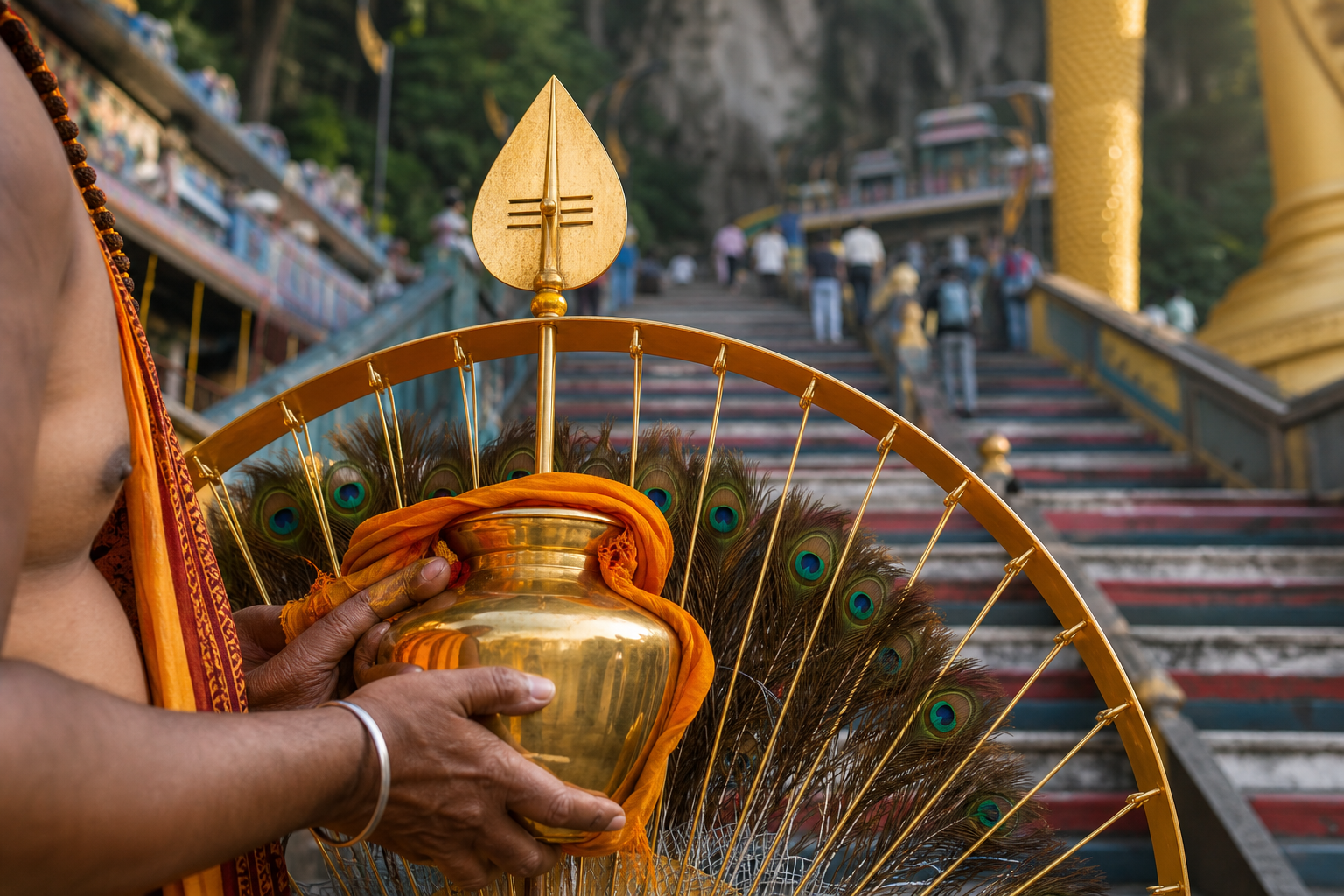
The Vel points toward discernment
The Vel, Lord Muruga’s spear, represents wisdom and protection. Its importance is not confined to an image held above the crowd. The repeated chant of Vel, Vel gathers attention around Muruga and gives a shared rhythm to thousands of separate acts of devotion.
When you hear the chant, notice what it does. It helps a family move together, supports a devotee through exertion, and turns the surrounding crowd toward a common sacred reference. You can receive that moment without competing with it through loud conversation or staged photography.
Kavadi makes a vow visible
The kavadi is a visible marker of vow, surrender, and gratitude. Its outward form may command attention, but the structure alone does not tell you the devotee’s story. Avoid guessing what someone promised, what hardship preceded the vow, or why a particular form of penance was chosen.
Paal kudam places offering at the centre of the journey. The devotee carries milk through the physical demands of the route and offers it to Lord Muruga. Kavadi and milk pots may look different, but neither should be reduced to a test of spectacle or endurance.
The 272 steps turn intention into exertion
Batu Caves joins bodily effort to a striking sacred landscape. The limestone hills, cave sanctuary, and 42.7-metre statue of Lord Muruga give the pilgrimage an unmistakable setting. Yet the statue is the landmark, not the endpoint of understanding. The devotional centre lies in what people carry up the steps and place before Muruga.
For an observer, the climb offers a practical lesson in humility. Move at the pace the route permits. Do not force your way past a vow-bearer for a better position. If you need to pause, follow crowd directions and avoid creating a bottleneck on the stairs.
Let the community’s seva shape your conduct
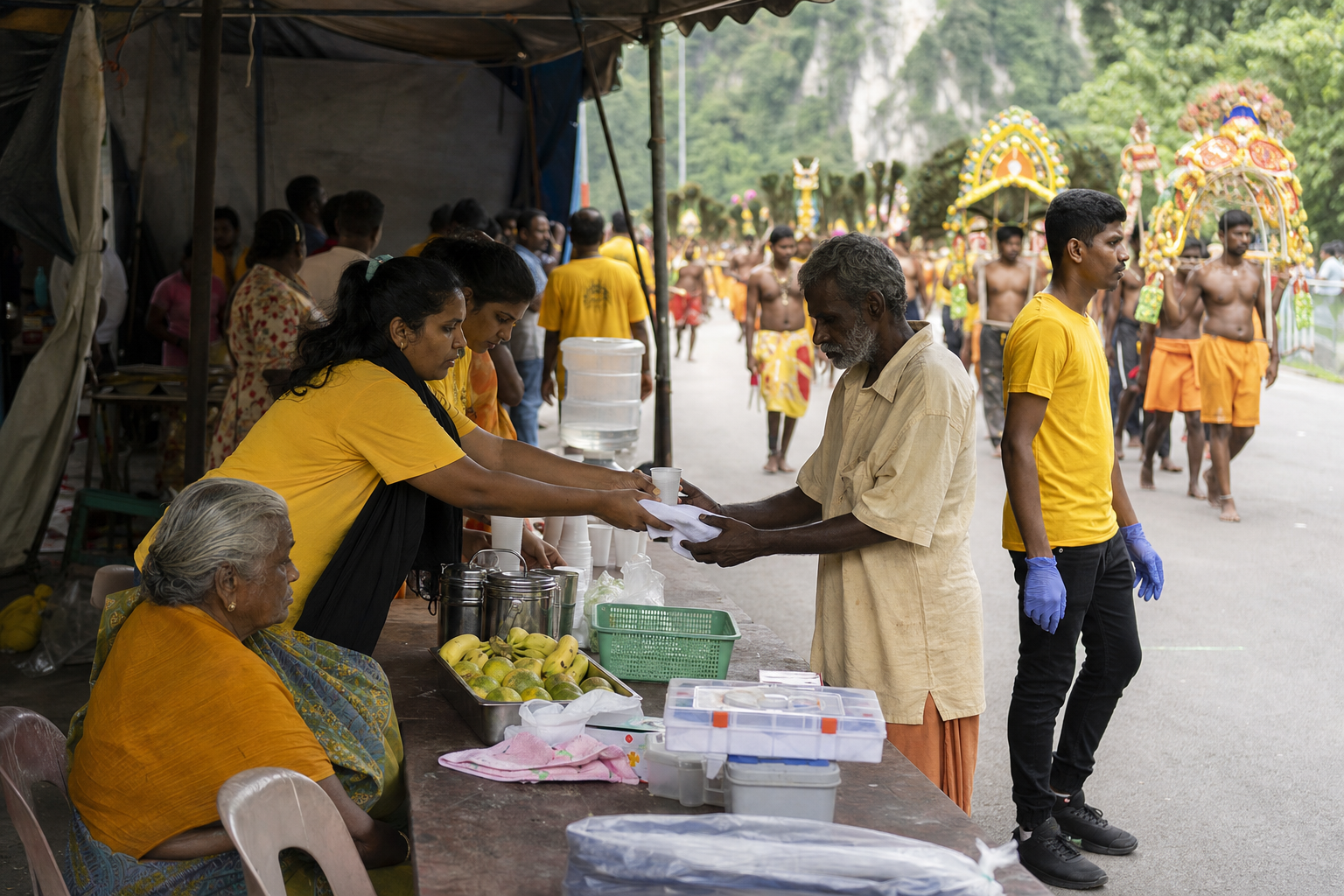
Thaipusam at Batu Caves is sustained by more than individual austerity. Volunteers coordinate crowd movement, medical help, food distribution, and other forms of assistance. Annadanam makes hospitality visible, while the work of guiding people safely through the site turns service into part of the observance.
You participate in that ethic when you cooperate promptly with volunteers, keep access routes open, avoid wasting food, and make room for people carrying offerings. These actions may look ordinary, but in a gathering of this scale they protect both the sacred purpose of the day and the people undertaking it.
Batu Caves also serves as a major pilgrimage centre for the Tamil diaspora. Ritual, language, music, family memory, and artistic tradition meet there across generations. A young person accompanying elders may therefore be doing more than attending a large annual event; the family may be renewing a relationship with Muruga and transmitting a practice that has travelled beyond Bharat.
People from Buddhist, Jain, Sikh, and other backgrounds may attend as witnesses to the gathering’s spirit of unity. That openness should deepen respect rather than flatten distinctions. You do not need to pretend that every Dharmic tradition performs the same rites. The meaningful common ground is ethical: discipline, compassion, non-harm, service, and the effort to refine the self while caring for the community.
Before you leave for Batu Caves, settle three things: the role in which you are attending, the arrival time that fits your physical needs, and the boundary you will keep around photography and procession routes. Then confirm the current year’s date and transport plan, arrive before dawn if practical, and let the needs of worshippers determine your pace. You will understand more by protecting the conditions of pilgrimage than by trying to capture every scene.
References
