
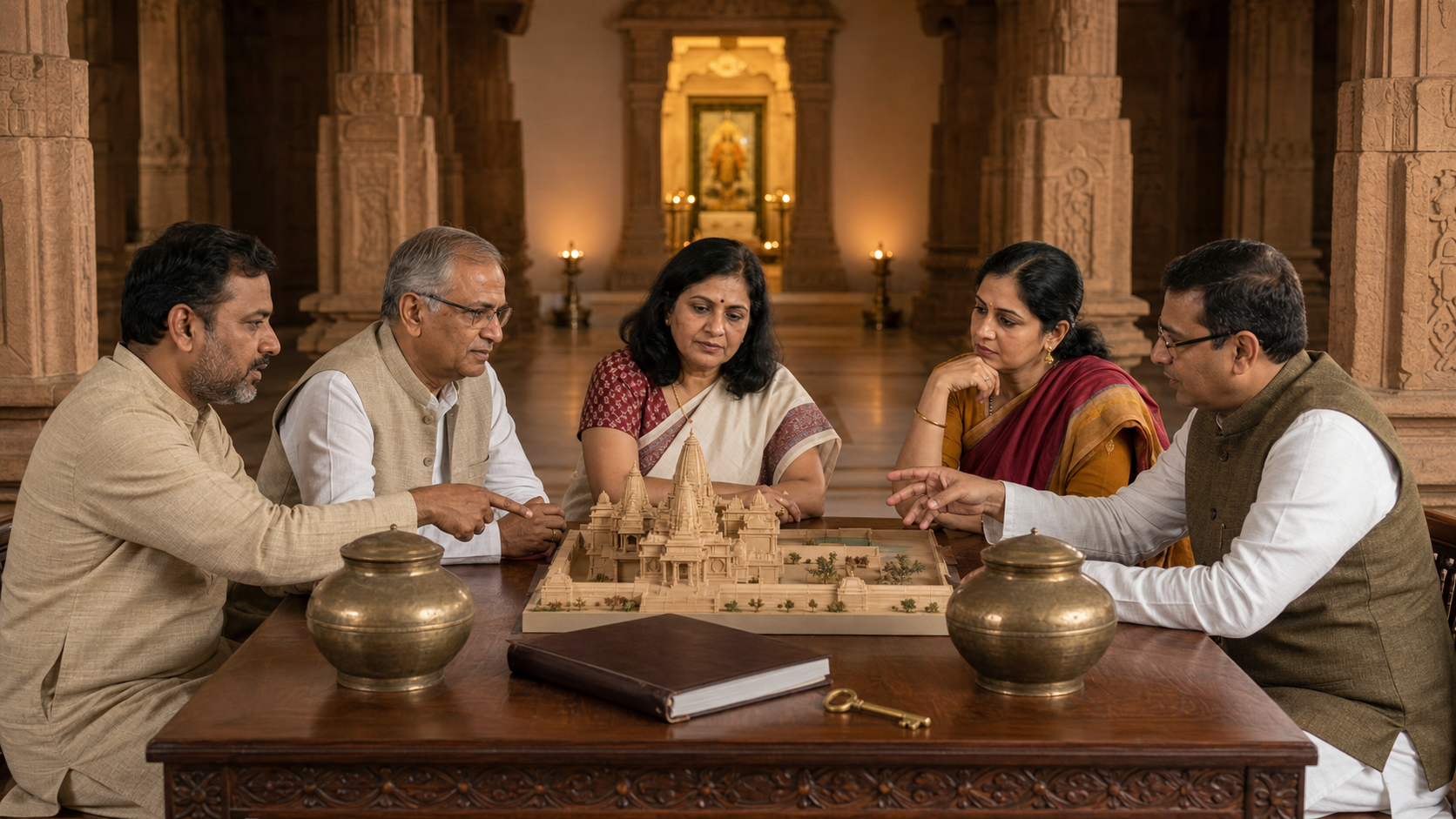
You may be looking at a temple tender, a construction proposal, or a plan to spend accumulated offerings and wondering whether concern is justified. The answer should not depend on which faction speaks loudest. You need to know whether the decision protects the deity’s seva, respects the purpose for which resources were entrusted, and can survive informed public scrutiny.
A sound decision should pass three tests: sacred purpose, lawful authority, and accountable process. If temple administrators cannot explain all three before money is committed or work begins, the responsible step is to pause the decision and repair the record.
Treat sacred trust as a governing duty, not a slogan
A temple is not an ordinary property holding cash, buildings, and visitor facilities. It is a living institution ordered around worship. Its officeholders are therefore stewards of resources that carry devotional intention, ritual obligations, inherited practices, and responsibilities to future generations.
This does not mean every administrative decision must be made by religious specialists alone. It means administration must remain subordinate to the temple’s dharmic mission. Engineers may determine whether a barrier is structurally safe. Accountants may confirm whether funds are available. Lawyers may identify the powers granted by the applicable law or governing instrument. Sevayats and other custodians of practice must explain how the proposal affects darshan, seva, access, sacred boundaries, and ritual timing. The final authority must reconcile those findings and record its reasons.
Before approving a proposal, require a short written note answering three questions:
- Purpose: What temple function will this decision serve? Name the connection to worship, preservation, pilgrim welfare, annadanam, festivals, education, or another activity within the institution’s authorised religious mission.
- Authority: Which law, trust instrument, endowment condition, scheme, rule, or valid resolution permits the expenditure and identifies the person or body empowered to approve it?
- Process: What need was established, which alternatives were considered, who supplied ritual and technical advice, how were conflicts handled, and why was the chosen option preferred?
These tests prevent two opposite errors. Administrative formality cannot transform an unrelated use into a dharmic one. Devotional language cannot cure a decision made without legal power, competent assessment, or financial controls. The same stewardship principle applies, with institution-specific rules, to Hindu temples, Buddhist viharas, Jain institutions, and Sikh gurdwaras: entrusted resources are not discretionary wealth.
Keep sacred money attached to its sacred purpose

A devotee placing money in a hundi or creating an endowment does not ordinarily imagine that the contribution has become ownerless cash. The reasonable devotional expectation is continuity: puja, festivals, preservation of the sacred site, traditional services, annadanam, and community service connected to the temple’s mission.
The word “surplus” does not erase that relationship. It describes an accounting position, not an unrestricted licence to spend. This became concrete when the Madras High Court quashed a proposal to use accumulated and surplus Kallazhagar Temple funds for commercial facilities. That intervention is a warning against assuming that available money may be redirected merely because administrators can identify a development project.
Do not treat that outcome as a substitute for examining the law governing another temple. A trust deed, statutory framework, donor restriction, court-approved scheme, or endowment condition may control a particular fund. If a proposed transfer is disputed, the safe course is to preserve the money and obtain advice from a lawyer familiar with the applicable religious-endowment framework before making an irreversible commitment.
Temple accounts should distinguish at least the following practical classes, using the exact classifications required by the institution’s governing framework:
- Dedicated endowments or corpus: resources governed by the founding instrument or donor’s enduring direction.
- Earmarked contributions: money given for a named purpose such as a ritual, festival, restoration, annadanam, or facility.
- General offerings: contributions without a narrower designation, still subject to the temple’s religious purpose and applicable law.
- Operational receipts: income associated with authorised temple activities, which must remain traceable and properly approved.
For every material fund, maintain a ledger field for its origin, restriction, permitted uses, approving authority, balance, expenditure, and supporting record. This lets an auditor test the actual chain from donation to use. It also stops a budget heading such as “development” from concealing the real destination of sacred money.
A revenue-producing proposal is not legitimate merely because it promises income, nor is every facility with an economic component automatically improper. Ask what the facility principally serves, whether that purpose falls within the temple’s authority, whether restricted resources may finance it, who bears the risk, and where the proceeds will go. If the direct connection to the temple’s mission cannot be written in precise terms, do not approve the expenditure under a vague claim of public benefit.
Contract for safety without treating the mandir as an ordinary worksite
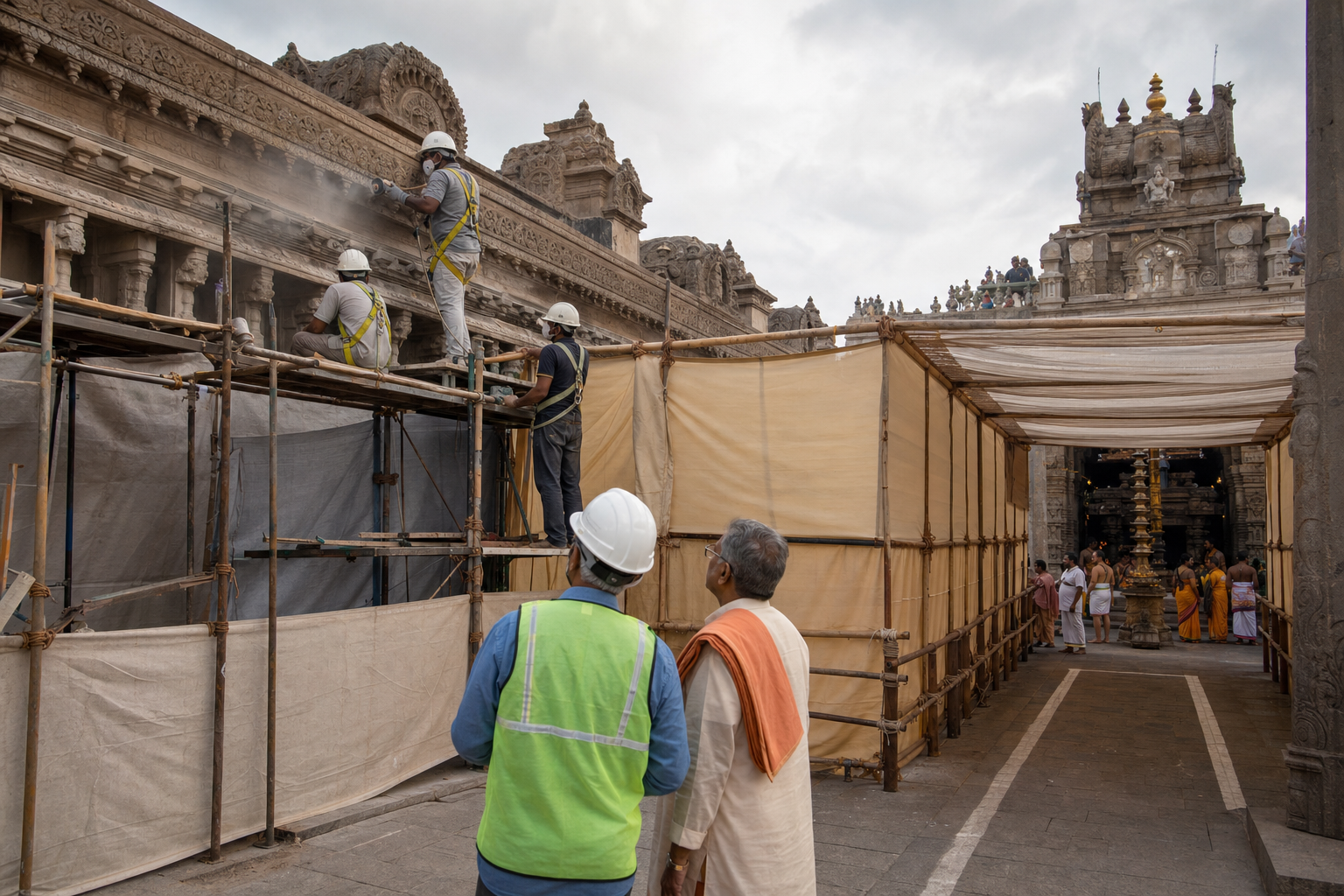
Safety and sanctity are not rivals. A temple responsible for large congregations may need barriers, queues, controlled access, or emergency arrangements. But necessity does not give a contractor an unrestricted licence to alter sacred precincts. A mandir is simultaneously a place of worship, a living heritage site, and a working ritual environment.
Concern at Banke Bihari Mandir arose around a contract to install steel railings inside the sacred complex. The practical need for crowd management did not eliminate questions about tender transparency, heritage compatibility, relevant experience, or respect for ritual protocols. That is the right distinction to preserve: challenge the adequacy of the process without pretending that safety infrastructure is inherently hostile to tradition.
Use this sequence for work that enters or affects sacred space:
- Define the need before seeking bids. Record the safety, access, maintenance, or conservation problem in observable terms. A preferred contractor should not be allowed to define the problem after appearing.
- Write the sacred-site constraints into the brief. Identify restricted areas, permitted working times, ritual interruptions that cannot occur, access rules, conduct expectations, heritage fabric that must not be disturbed, and the authority who may resolve an on-site ritual question.
- Obtain distinct expert assessments. Sevayats should identify ritual constraints; engineers should address structural and crowd-safety requirements; heritage professionals should assess effects on historic fabric; finance and legal officers should verify funds and authority.
- Publish the evaluation method in advance. Disclose the criteria and their relative importance, including safety, structural quality, heritage compatibility, relevant experience, workforce supervision, time, and cost. Do not invent criteria after bids are opened.
- Verify claims rather than accepting a portfolio at face value. Check comparable sacred or heritage work, responsible personnel, proposed methods, references, insurance or guarantees where required, and the bidder’s ability to follow access protocols.
- Bind the workforce to temple conduct. Make orientation on etiquette, dress, restricted spaces, photography, food, substances, cleanliness, and communication part of the contract. The temple must define its own rules rather than rely on a contractor’s assumptions.
- Control changes after award. Require written approval for material substitutions, price changes, drilling, cutting, relocation, or changes that affect movement and ritual use. Record who authorised each variation and why.
- Inspect before accepting the work. Technical completion is not enough. Confirm structural quality, heritage compliance, restoration of affected areas, removal of worksite material, and readiness for ritual use before final acceptance.
The relevant question is not a bidder’s religious label. It is whether the firm and its workforce can satisfy objective requirements for competence, heritage care, access, and conduct. Inclusive procurement does not require cultural indifference. A non-denominational or interfaith contractor can be held to the same demanding temple-specific code, training, supervision, and consequences as any other bidder.
If concern arises after an award, commission a review before work affects the site. The reviewer should examine the original brief, bids, scoring, conflicts, approvals, heritage conditions, and proposed method. If the award cannot be justified under the disclosed criteria, cancellation or retendering may be appropriate under the governing contract and law. Because termination can create financial and legal exposure, trustees should obtain project-specific legal advice rather than act on public pressure alone.
Build a decision record that devotees can actually inspect

Transparency is not a data dump after controversy begins. It is a chain of intelligible records created while the decision is being made. A trustee should be able to follow that chain. A devotee should be able to understand the decision without possessing insider access.
For a material project or expenditure, publish a compact governance packet containing:
- the defined need and its relationship to the temple’s religious mission;
- the approving body’s authority and dated resolution;
- the fund classification, budget, and any use restriction;
- the technical brief and temple-specific heritage and ritual constraints;
- the tender notice, eligibility requirements, evaluation criteria, and scoring method;
- the selected bidder, contract value, reasons for selection, and declared conflicts or recusals;
- major milestones, approved variations, completion findings, and payment status;
- the route and deadline for submitting a documented grievance; and
- the relevant audit finding and the response to any material exception.
Publication does not require exposing personal data, security-sensitive layouts, protected financial details, or legitimate confidential information. Redact the narrow field that requires protection and state why it was withheld. Do not use confidentiality as a blanket reason to conceal the purpose, authority, criteria, cost, recipient, and status of a decision involving sacred resources.
Good consultation also requires clear roles. Ritual custodians define practices that a project must respect. Technical experts establish whether a method works safely. Finance and legal officers test affordability, restrictions, and authority. Trustees make and own the decision. An independent reviewer or auditor checks whether the recorded process was followed. Consultation becomes theatre when everyone is invited to speak but no one can see how the final choice was reached.
Create the review mechanism before a dispute. Name the office that receives objections, require a written acknowledgement, identify who reviews a challenged decision, and record the outcome with reasons. That gives a devotee a lawful path to raise a concern while allowing worship and ordinary administration to continue.
Key takeaways: seven questions to ask before consent
Whether you are a trustee, donor, sevayat, community representative, or concerned devotee, these questions expose most governance weaknesses:
- What exact religious or temple purpose does the decision serve?
- Who has authority to approve it, and where is that authority recorded?
- What is the origin of the money, and what restrictions follow it?
- What evidence established the need and ruled out less intrusive alternatives?
- Were ritual, safety, heritage, financial, and legal requirements defined before a contractor or project was selected?
- Can the public inspect the criteria, decision, conflicts, contract, changes, and audit trail?
- Who can independently review the decision before money or sacred fabric is put at risk?
If an answer is missing, ask for it in writing. Identify the particular resolution, tender, fund, or project rather than making a general accusation. Request the records available under the institution’s rules, use the designated grievance or statutory mechanism, and seek qualified legal advice when a transfer, contract termination, or physical alteration may be irreversible. Keep the challenge focused on purpose, authority, evidence, and process; do not obstruct worship or treat an unproven suspicion as a finding.
The next time a temple proposes a major expenditure or alteration, ask for the purpose-and-process record before the money moves or the worksite opens. A short pause at that stage can protect offerings, sacred fabric, devotee safety, and institutional legitimacy for years to come.
References
- DharmaRenaissance Blog – Vrindavan Concern: Saints Urge Transparent, Respectful Contracting at Banke Bihari Mandir
- DharmaRenaissance Blog – Madras HC Halts TN Plan to Divert Temple Funds, Upholds Sacred Trust and Devotee Faith
