
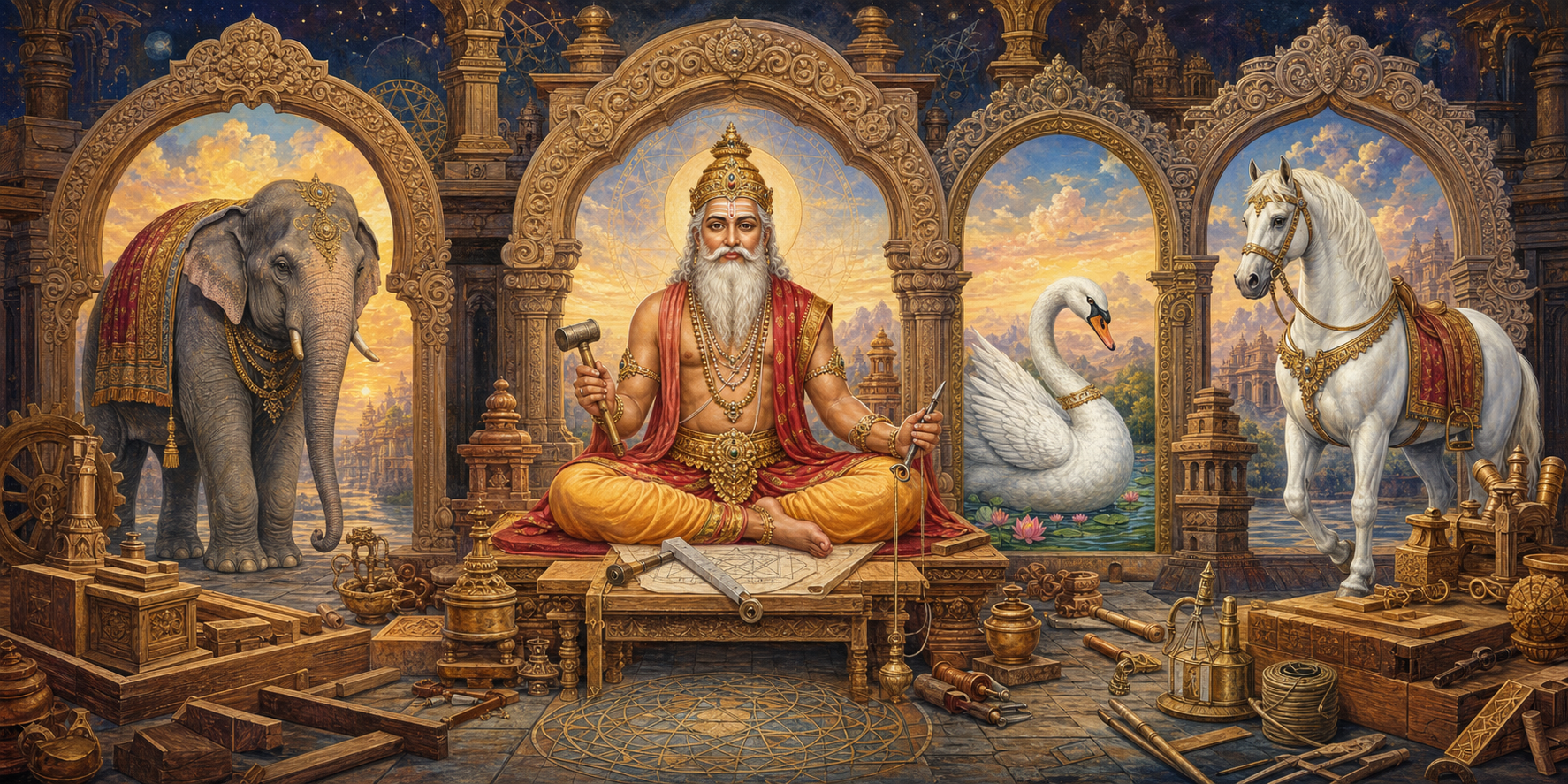
If you are trying to identify a Vishwakarma image, choose one for puja, or caption one for publication, the animal can create needless confusion. One image places the divine architect with an elephant, another with a swan, and another with a horse. The apparent contradiction has a clear resolution: all three forms occur within living Hindu traditions.
You do not need to declare one community correct and the others mistaken. You need to identify the local parampara, read the animal’s symbolism, and describe the image without turning a regional form into a universal rule. This approach is both more accurate and more respectful of Hinduism’s internal diversity.
Why there is no single vahana to memorize
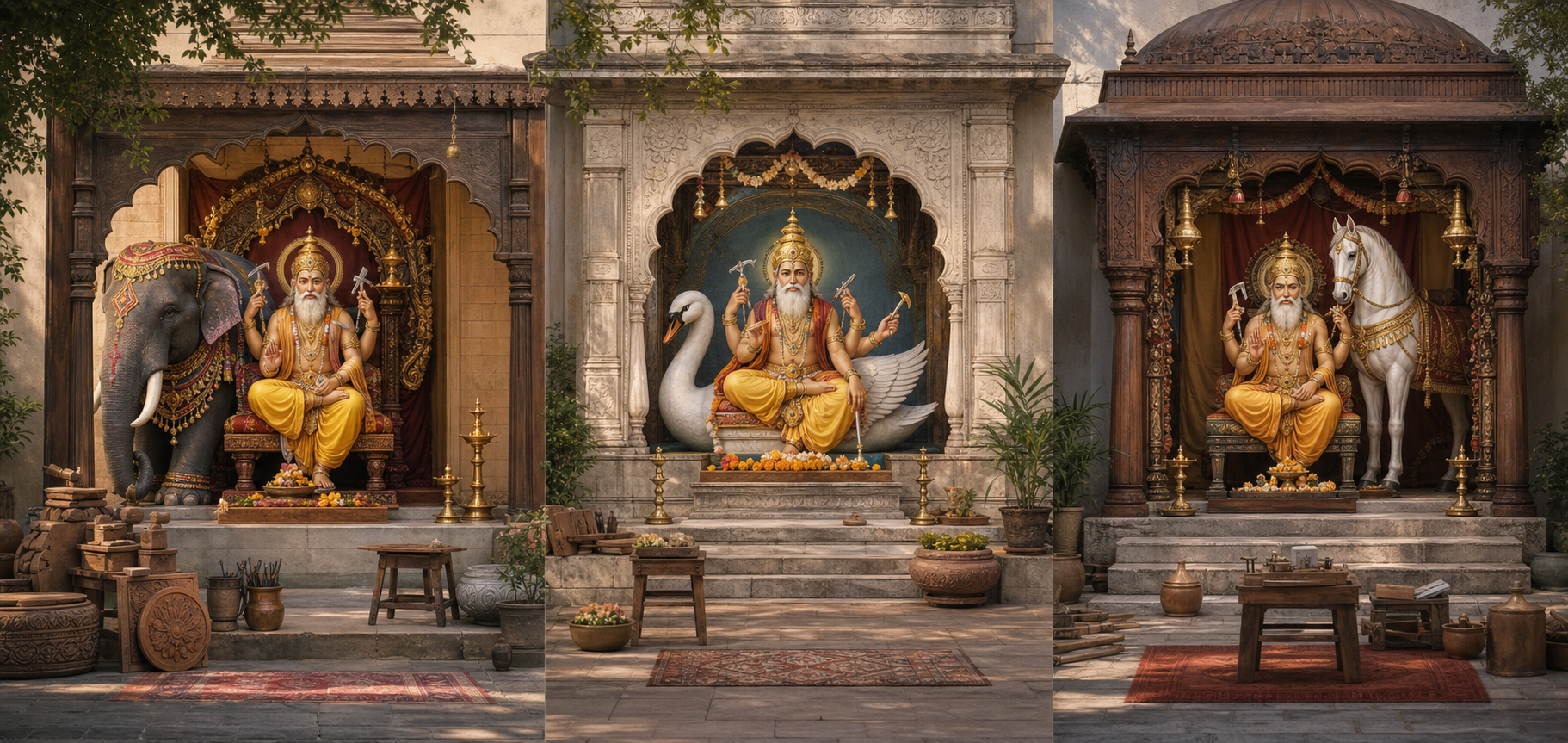
Vishwakarma’s iconography is anchored primarily in his identity as the divine architect and master of skilled creation. Puranic descriptions and shilpa traditions place greater emphasis on his tools, knowledge, and cosmic function than on one universally fixed vehicle. That leaves room for regional communities and professional lineages to foreground different animals.
This does not mean that the vahana is arbitrary. An elephant, swan, or horse carries a recognizable symbolic argument about workmanship. The image tells you which aspect of sacred craft a community wants to bring forward: dependable strength, discerning intelligence, or energetic movement.
It helps to distinguish two questions that are often collapsed into one. If you ask, Which animals appear with Vishwakarma?, the answer is elephant, swan, and horse in different traditions. If you ask, Which form should our family, guild, temple, or workshop honor?, the answer begins with your own parampara.
Key takeaways
- Elephant, swan, and horse representations can all be legitimate; no single animal should be imposed on every Vishwakarma tradition.
- The animal is an interpretive clue, not a sufficient identification by itself. Look first at Vishwakarma’s tools, creative role, and ritual setting.
- Locality matters. Festival images, temple art, workshop icons, and guild emblems may preserve different inherited forms.
- When choosing an image for worship, give inherited community practice priority over a symbolism chart found elsewhere.
- When labeling an image, state the regional or community context whenever it is known.
What the elephant, swan, and horse communicate
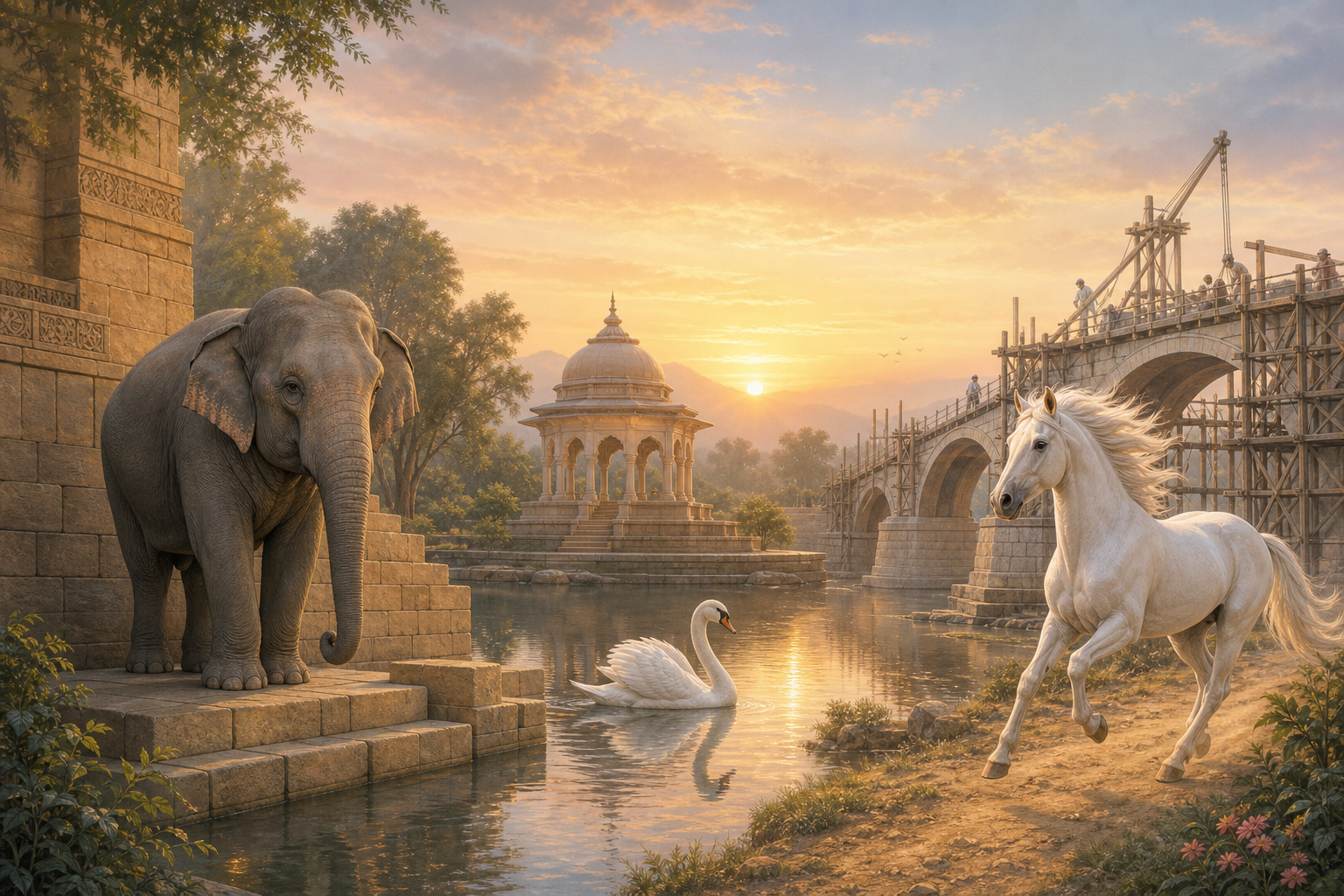
The three animals are not rival answers competing for canonical supremacy. Each makes a different quality of Vishwakarma’s work visible. Read the animal as part of the whole composition rather than as an isolated badge.
Elephant: strength that accepts responsibility
The elephant, or gaja, is found prominently in a number of eastern and northern Indian representations. Its strength and steadiness suit the scale of Vishwakarma’s architectural role. Temples, cities, and sacred infrastructure require more than creative inspiration; they demand the capacity to bear weight, plan for endurance, and accept responsibility for what is built.
Royal dignity also belongs to this symbolic field. Large construction depended historically on organized labor, patronage, and the accumulated abilities of artisan communities. The elephant therefore directs attention beyond the solitary maker to the institutional power required for major works.
Its association with memory adds another layer. A craft lineage survives because knowledge passes from master to apprentice: how a material behaves, how a measurement is checked, which error cannot be hidden, and why a procedure must be followed in a particular order. In this reading, the elephant represents intergenerational mastery as well as physical strength.
If your community uses the elephant form, do not reduce it to a generic symbol of prosperity. Ask what the image says about the duty of a builder. The most faithful practical reading is that strength becomes sacred when it is stable, disciplined, and used for the welfare of others.
Swan: discernment before execution
The swan, or hamsa, brings the intellectual dimension of craftsmanship to the foreground. Its central quality is viveka: the ability to distinguish what should be joined from what should remain separate, the essential from the decorative, and the sound decision from the merely attractive one.
That symbolism fits the work of an architect or artisan with unusual precision. Geometry, measurement, proportion, material selection, and sequence all depend on discrimination. A maker can possess enormous technical energy and still fail through a poor judgment made at the beginning. The hamsa reminds you that the invisible decision often determines the visible result.
Purity of intention belongs here as well. Skill becomes sacred service only when intelligence is governed by an ethical purpose. The swan form therefore does not celebrate cleverness for its own sake. It joins technical understanding to the responsibility to create honestly and carefully.
If you are an engineer, designer, student, or craftsperson drawn to this form, let the symbolism change your working habits. Pause before cutting, casting, coding, or building. Check the measure, test the assumption, and ask whom the finished work serves. That is viveka translated into practice.
Horse: skill that travels and adapts
The horse, or ashva, appears in several guild emblems and regional processional representations. It conveys motion, energy, and the capacity to carry knowledge across distance. This is a fitting image for artisanship that traveled along trade and pilgrimage routes as workshops responded to new patrons, materials, and places.
Movement does not mean rootlessness. A living craft tradition must preserve its discipline while adapting its expression. The horse captures that balance: knowledge remains active because practitioners carry it into new circumstances rather than locking it away.
This form can be especially meaningful in a processional or occupational setting, where momentum and collective labor are already part of the image’s context. Read it as industrious movement directed toward useful creation, not speed detached from judgment.
| Vahana | Quality foregrounded | Question it places before the craftsperson |
|---|---|---|
| Elephant or gaja | Stability, strength, responsibility, and inherited knowledge | Will this work endure, and can you stand behind what you build? |
| Swan or hamsa | Discernment, proportion, knowledge, and ethical intention | Have you made the right distinction before committing to the work? |
| Horse or ashva | Energy, mobility, adaptation, and the transmission of technique | Can your skill respond to a new setting without losing its integrity? |
How to identify an unfamiliar Vishwakarma image
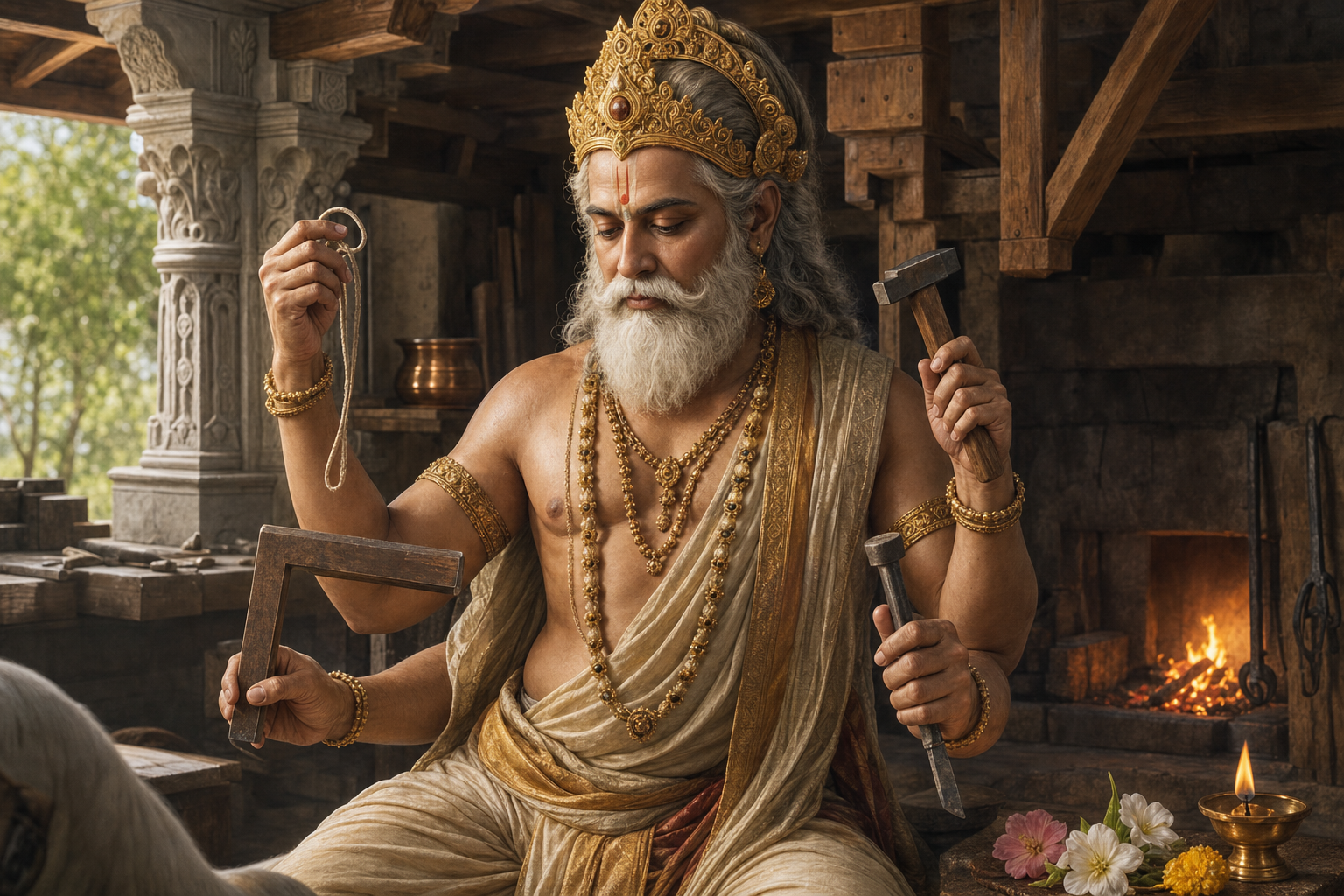
An animal alone is a weak basis for identifying a deity. The same animal may participate in more than one iconographic tradition, while Vishwakarma himself can appear with different animals. Use a sequence that starts with the whole object and narrows toward the vahana.
- Establish the setting. Determine whether you are looking at a temple image, mural, manuscript image, festival murti, processional figure, workshop icon, or guild emblem. The setting tells you what kind of tradition may have shaped the depiction.
- Look for the creative function. Vishwakarma’s tools and identity as divine architect are more reliable anchors than an assumption that he must have one particular animal. Notice whether the composition emphasizes making, measuring, designing, or constructing.
- Trace the local parampara. Record the region, community, occupational lineage, temple, or workshop associated with the image. If someone from that tradition can name the form, preserve that identification rather than replacing it with a generalized label.
- Interpret the animal after identifying the deity. An elephant points toward stability and responsibility, a swan toward discernment and knowledge, and a horse toward energy and movement. These meanings can support an identification, but they should not create one by themselves.
- State uncertainty honestly. If the provenance is unknown, do not invent a precise lineage. Use a qualified caption such as a regional representation of Vishwakarma with a horse; the specific community tradition is not recorded.
This method prevents a common error: seeing an unfamiliar vahana and concluding that the image is corrupt, recent, or wrongly labeled. Difference is a reason to investigate provenance, not an automatic reason to reject the form.
How to choose or caption a Vishwakarma form responsibly
The right decision depends on what you are doing with the image. Worship, original artwork, education, and archival description call for related but distinct standards.
For puja in a home, factory, office, or workshop
Begin with the form your family, artisan community, or workplace has inherited. Vishwakarma Puja images and workshop icons preserve local preferences, and that continuity carries more ritual weight than selecting an animal merely because its symbolism appeals to you.
If there is no inherited practice, you can choose deliberately without claiming exclusivity. An elephant may foreground dependable construction and responsibility; a swan may foreground learning and right judgment; a horse may foreground industrious movement and adaptive skill. Explain the choice as the emphasis of your representation, not as the only correct Hindu form.
For an artist or designer
Keep Vishwakarma’s creative identity at the center of the composition. The vahana should deepen that identity rather than replace it. Decide what the image must communicate, research the tradition in which it will be used, and then align the animal with both the inherited form and the intended symbolic emphasis.
If you combine elements from different regional traditions, say that the work is a contemporary synthesis. Transparency protects viewers from mistaking a new artistic choice for a universal prescription.
For a teacher, editor, curator, or festival organizer
Avoid an unqualified caption such as Vishwakarma’s vehicle is the elephant. It turns one legitimate form into a rule that excludes the others. Name the pictured animal, add the regional or community context if known, and acknowledge plurality when the explanation is intended for a general audience.
Caption template: Vishwakarma is represented here with a [vahana], a form that emphasizes [symbolic quality] in this [regional, community, guild, or festival] context. Other Hindu traditions may depict him with a different vahana.
If the context is unknown, shorten the claim rather than filling the gap with certainty. This image depicts Vishwakarma with a swan is accurate. All authentic images of Vishwakarma show a swan is not.
The deeper unity is sacred workmanship
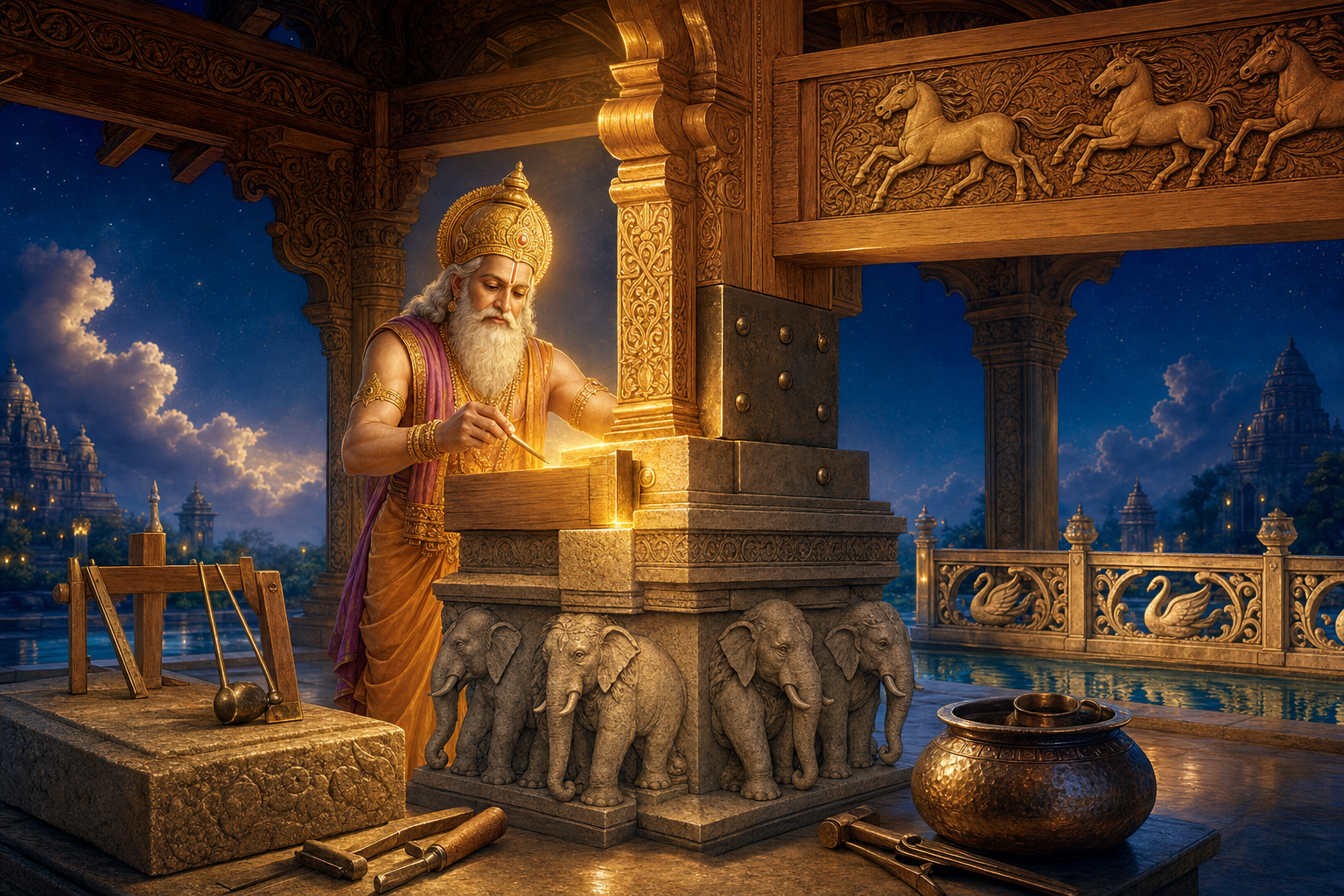
The strongest thread running through these representations is not zoological uniformity. It is the transformation of skilled work into seva. Vishwakarma’s iconography asks whether knowledge, strength, and energy are being used with discipline and for the common good.
You can turn the three vahanas into a practical examination of your own work. The elephant asks whether it is stable and responsible. The swan asks whether it rests on sound judgment and honest intention. The horse asks whether skill can move into changing conditions without abandoning its standards. These questions are a practical application of the symbolism, not a claim that a scripture prescribes a modern professional checklist.
The dignity of sacred building also creates a point of kinship across Dharmic traditions. Hindu temple artisans, Buddhist stupa builders, Jain shilpis responsible for intricate mandirs, and Sikh communities undertaking kar seva all demonstrate that building can be an act of disciplined service. This shared ethic does not erase theological differences, nor does it assign Vishwakarma’s vahanas to every tradition. It recognizes a common respect for work placed in service of something larger than the worker.
The next time you encounter a Vishwakarma image, record where it comes from before deciding what it ought to look like. Identify the tools and setting, ask which parampara preserves it, and let the animal disclose the quality of craftsmanship being honored. That small act of attention protects living tradition while making the iconography more intelligible.
References
