
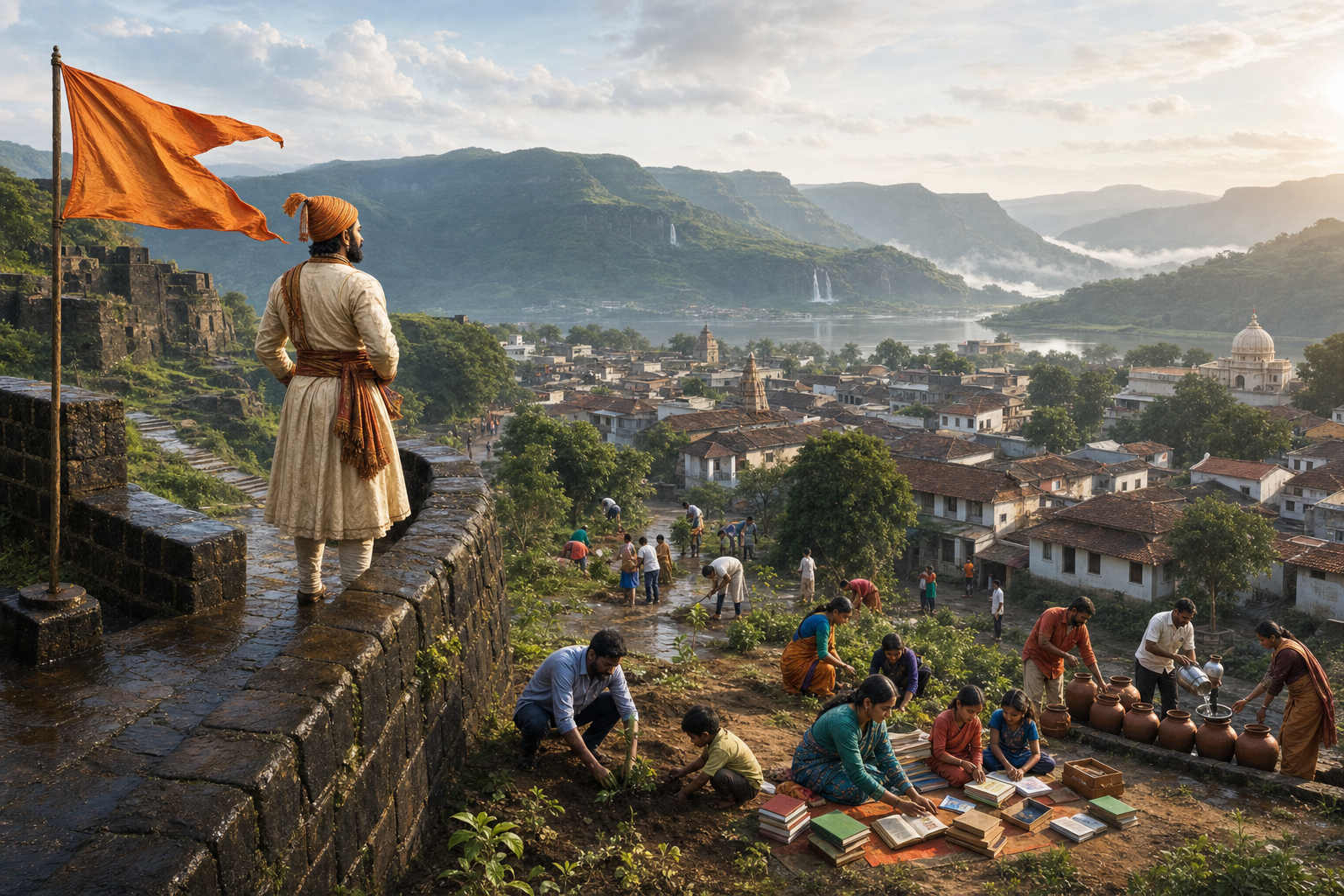
If you honor Chhatrapati Shivaji Maharaj but dislike seeing his name reduced to an annual slogan, the answer is not quieter remembrance. It is more demanding remembrance: history accurate enough to resist careless mythmaking, Hindu confidence disciplined by dharma, and public service visible in your own neighborhood.
Whether you are planning a family observance, school program, mandal gathering, or public procession in Maharashtra, ask one question before choosing the decorations: what will participants understand or do differently after the celebration is over? That question turns cultural memory into civic identity.
Key takeaways
- Use both the civil date and the Hindu tithi without treating them as rivals: one enables broad public participation, while the other preserves the sacred calendar.
- Separate documented history, inherited memory, and dramatic retelling. Each has value, but they should not be presented as interchangeable.
- Translate admiration into a public duty such as historical education, heritage care, a cleanliness drive, or another defined seva project.
- Give young people responsibility for research, logistics, service, and follow-through. Attendance alone does not create civic leadership.
- Keep the remembrance openly Hindu while making its civic expression lawful, self-restrained, respectful, and beneficial to the wider community.
Two calendars can strengthen one public memory
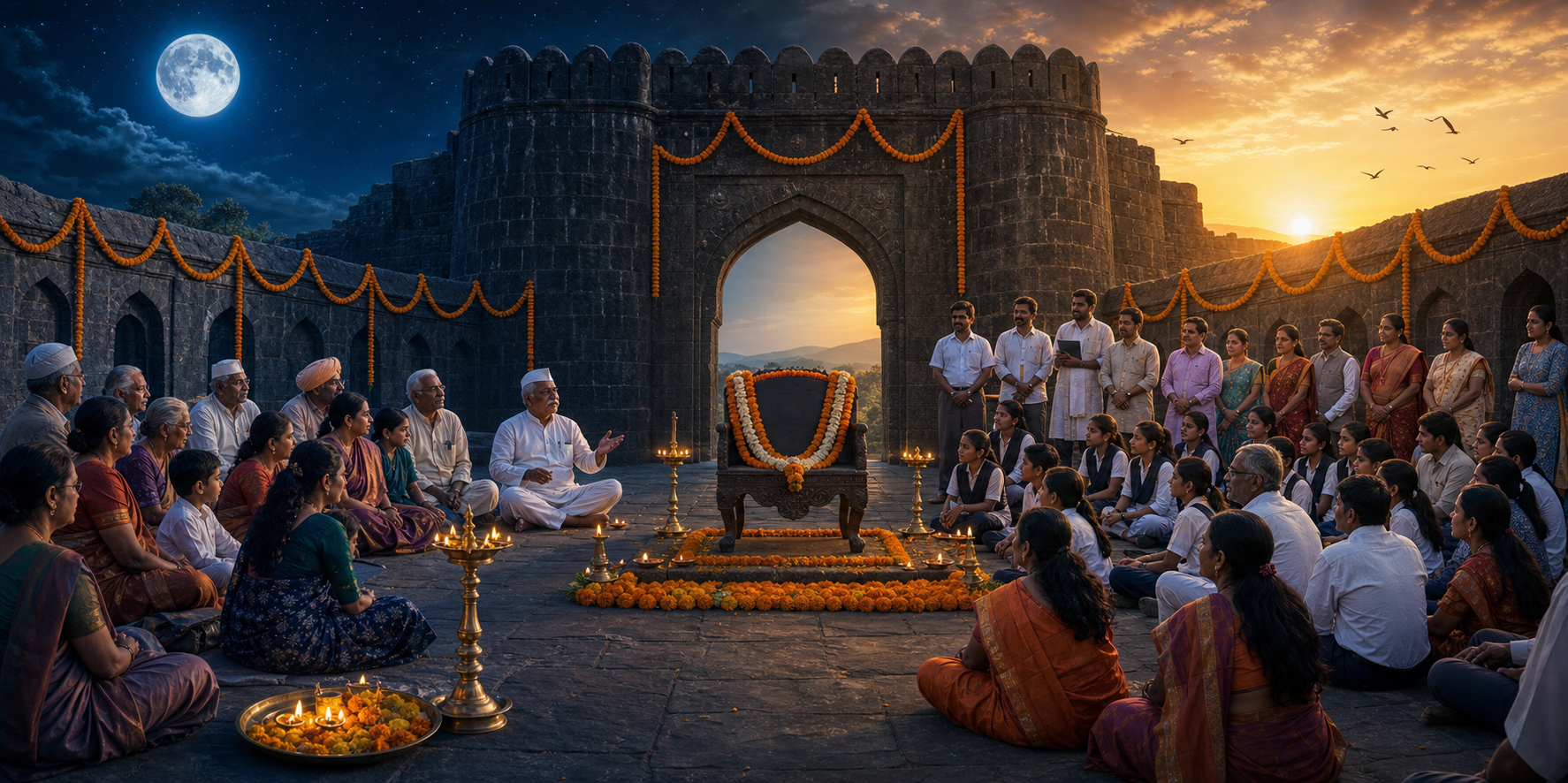
Shivaji Maharaj’s birth is remembered through two related markers. The historical civil date is 19 February 1630, while the Hindu calendar marks Phalgun Krishna Paksha Tritiya. The civil date remains fixed, but the Gregorian date and local timing of the tithi-based observance must be checked in a reliable Panchang.
You do not need to settle an artificial contest between the two. The fixed date gives schools, institutions, civic bodies, and dispersed communities a shared appointment. The tithi places remembrance inside Hindu sacred time, where a birth anniversary is more than a historical timestamp. Observing both acknowledges that Shivaji Maharaj belongs simultaneously to recorded history, Maharashtra’s public culture, and a living Hindu tradition.
For organizers, clarity is more useful than argument. Put both markers on the invitation: state the date of the public program, identify Phalgun Krishna Paksha Tritiya as the traditional observance, and tell participants which local Panchang is being followed for ritual timing. If the two observances occur separately, give them different functions. Use the civil gathering for history, cultural performance, and community participation; use the tithi observance for worship, reflection, family teaching, or a smaller sankalpa.
This distinction also helps children understand how Hindu time works. Ask them to explain why a Gregorian anniversary stays fixed while a lunar tithi moves. They will learn something more durable than a date: Hindu civilization can participate confidently in modern civic time without abandoning its own calendar.
The real test begins after the procession
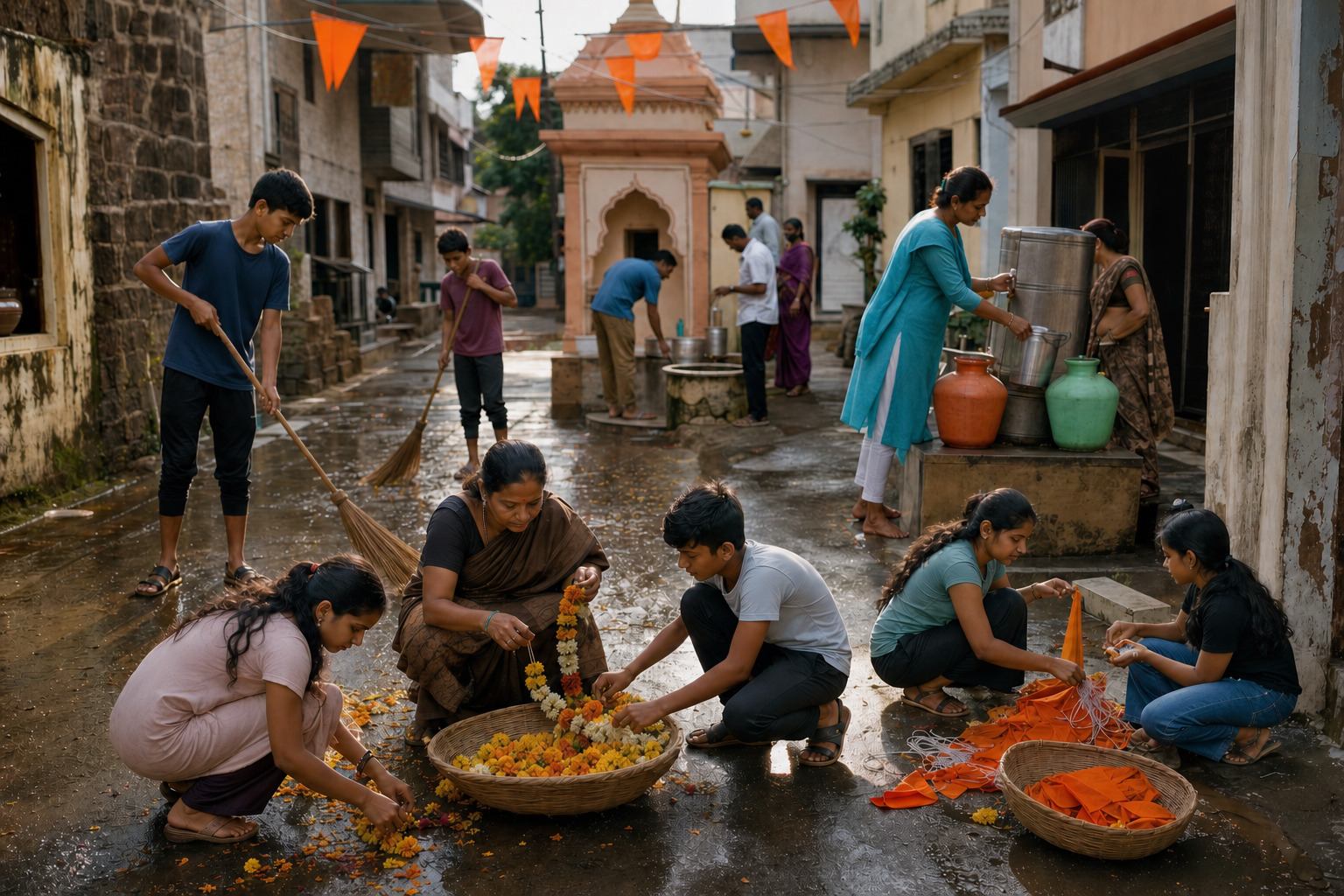
The values commonly associated with Shivaji Maharaj include steadfastness in dharma, protection of cultural heritage, administrative excellence, social responsibility, and respect for spiritual diversity. Those words matter only when they govern conduct. A large portrait or forceful slogan may display admiration, but neither proves that a community has absorbed the example it invokes.
Use four tests when evaluating your remembrance program:
- Truthful memory: Can the speaker distinguish a documented fact from a traditional account or a poetic embellishment? If a quotation, date, or incident cannot be verified, leave it out or identify the uncertainty honestly.
- Public duty: Does the program improve a shared place, strengthen historical education, preserve heritage, or organize continuing seva? If the only output is applause, the civic opportunity has been missed.
- Disciplined courage: Do volunteers remain orderly when inconvenienced, challenged, or asked to follow local rules? Courage governed by dharma includes restraint; aggression is not evidence of strength.
- Continuity: Have children and young adults been entrusted with meaningful work, or are they present merely as an audience? Civic identity grows when responsibility passes between generations.
Historical education needs the same discipline. A powada can awaken memory and make an episode emotionally accessible, but performance and chronology do different jobs. Introduce the setting before the performance. Afterwards, ask three questions: What is the established historical claim? What moral quality does the performance emphasize? What comparable duty exists in our locality? This keeps cultural art vivid without asking it to function as a textbook.
Do not teach children praise alone. Give them a modest historical question to investigate and require them to explain it in their own words. They might examine the purpose of an administrative decision, the demands of leadership under pressure, or the responsibilities involved in protecting cultural institutions. The aim is not to manufacture miniature orators. It is to teach them that reverence includes careful reading, fair judgment, and responsibility for what they repeat.
A local program that produces more than attendance
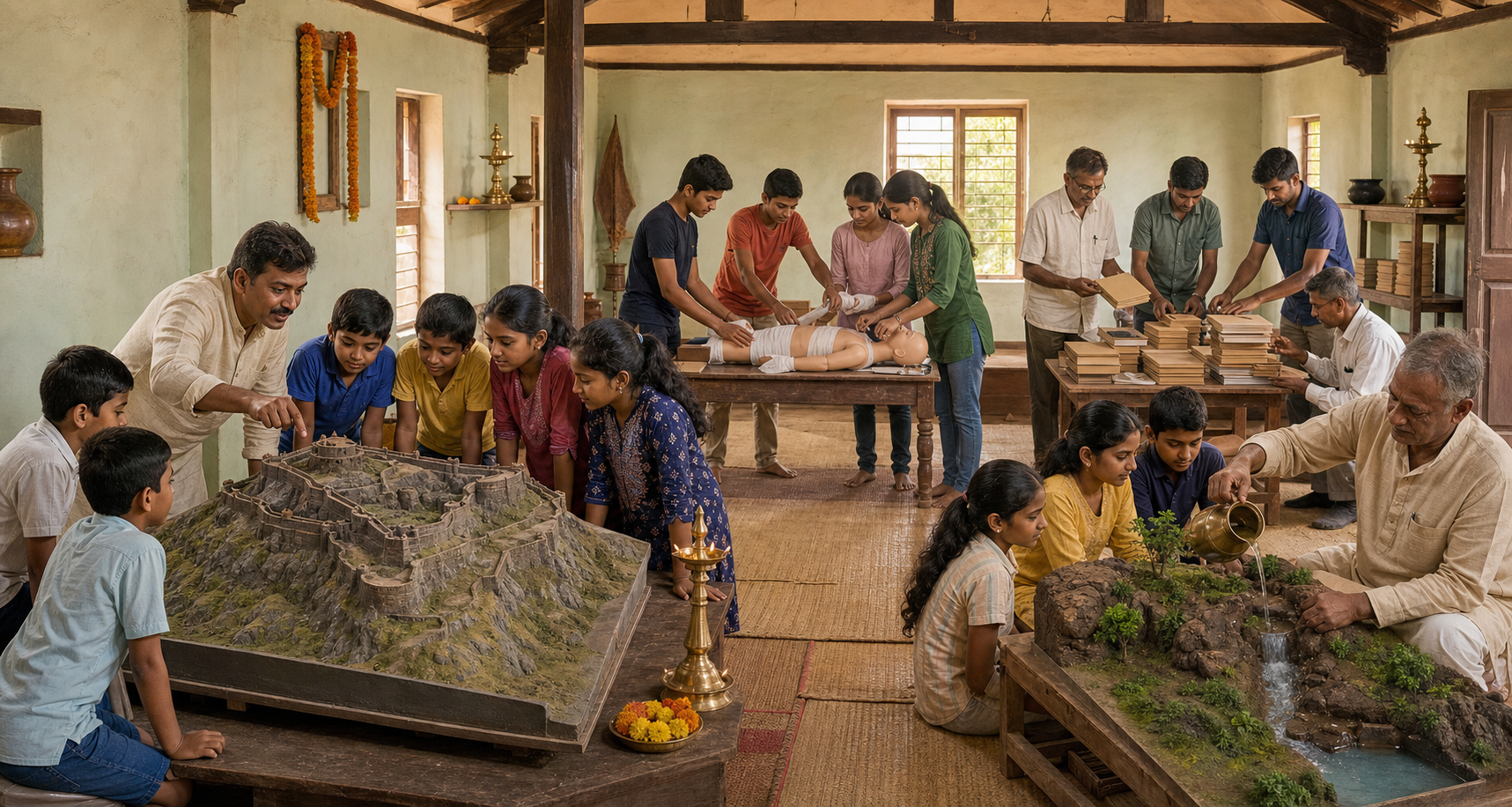
A useful Shivaji remembrance does not have to be enormous. A family, housing society, school, temple group, or neighborhood mandal can run a focused 90-minute program and connect it to one service task completed within the following week. Here is a workable structure:
- First 10 minutes: Explain the civil-date and tithi distinction, state the purpose of the gathering, and name the conduct expected from participants.
- Next 20 minutes: Present one carefully checked historical episode. Keep the timeline visible and distinguish established facts from later interpretation.
- Next 15 minutes: Hold a powada, recitation, reading, or student presentation. Give enough context for people unfamiliar with the episode to follow it.
- Next 20 minutes: Discuss how dharma, administration, courage, or cultural protection applies to a real local problem. Choose a problem the group can actually influence.
- Next 15 minutes: Select one seva project, name its coordinator, divide the work, and set a completion date. Do not announce a project unless someone accepts ownership of it.
- Final 10 minutes: Record the commitments, explain how completion will be reported, and close with a brief collective sankalpa.
Choose a service task that matches your actual capacity. A small project completed well is more faithful than a grand promise abandoned after the photographs. Suitable options include a cleanliness drive at a shared public or heritage space, a guided visit to a museum or Maratha-associated site, support for a local history-learning program, or an eco-conscious improvement to future community celebrations. Whatever you choose, define the location, responsible person, required materials, completion date, and next maintenance step.
A Hindu Rashtra-Jagruti Sabha in Chinchwad provides a useful local example of role-based participation. It brought together more than 200 attendees, with visible youth volunteering, intergenerational participation, involvement from former deputy mayor Sachin Chinchawade, and organizational support from members of the Swami Vivekanand Society. You do not have to copy its label, scale, or format to notice the operating principle: youth energy becomes civic capacity when elders, community organizations, and civic figures give it defined work.
Build that principle into your own event. Assign young volunteers to historical verification, stage management, accessibility, water arrangements, cleanup, photography, and the completion report. Pair each team with an experienced adult, but let the young coordinator speak for the work. This creates a chain of accountability rather than a crowd waiting for instructions.
If you organize a procession, apply the same standard outside the venue. Designate volunteers for route discipline, waste collection, assistance to elders, and communication with local authorities. The devotional atmosphere is not separate from these duties. How participants treat a road, a neighbor, a sanitation worker, or a public rule reveals more about civic character than the volume of the sound system.
Keep the identity confidently Hindu and genuinely civic
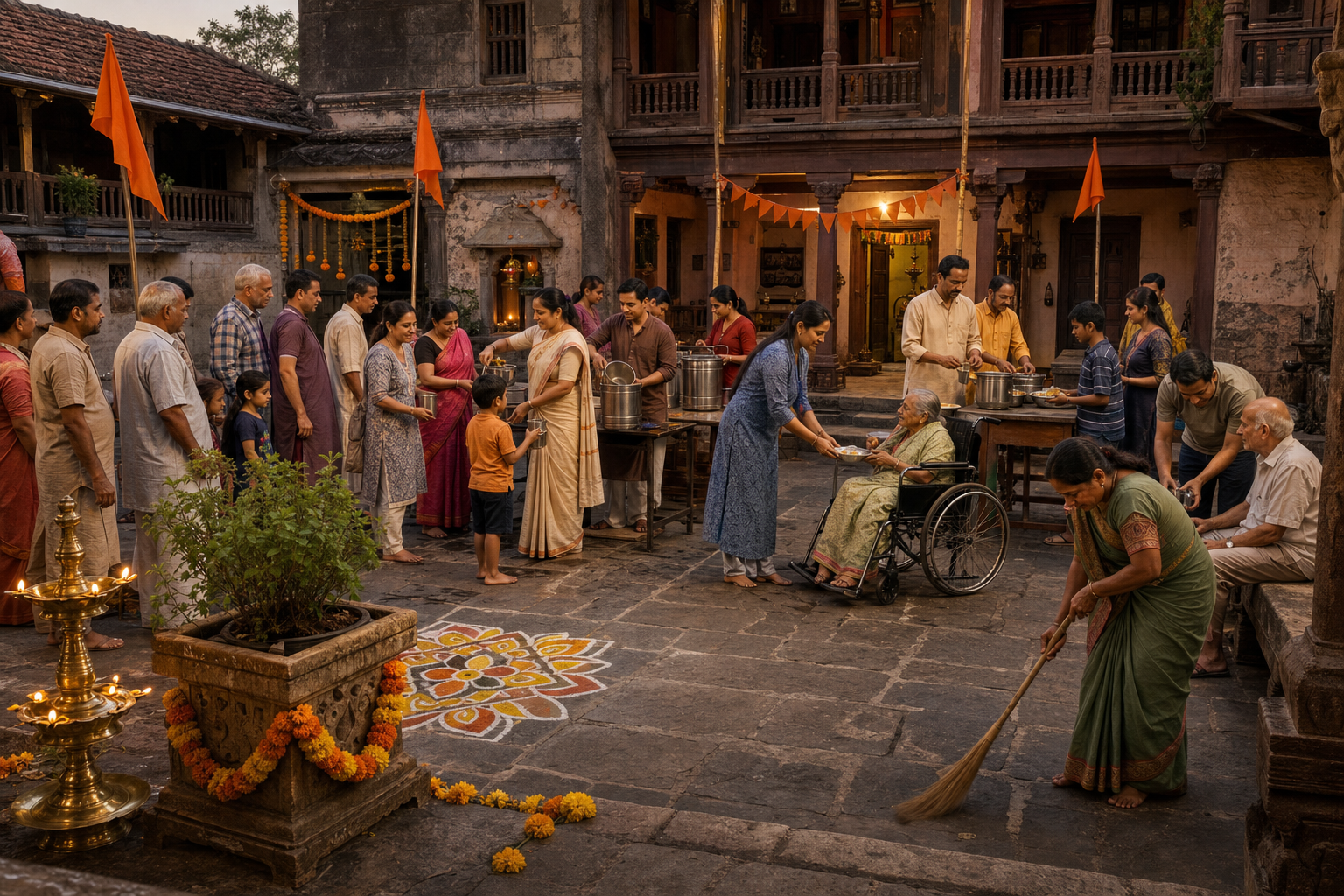
Hindu civic identity should not be difficult to define. Hindu names the civilizational memory, sacred calendar, ethical vocabulary, cultural inheritance, and sense of duty that animate the observance. Civic names the field in which those commitments become public conduct: the neighborhood, school, heritage site, institution, and shared common good.
The two words correct each other. An identity that is Hindu only in symbolism can become performative. An identity that calls itself civic while hiding its Hindu roots becomes evasive. The better path is explicit cultural confidence governed by dharma. It neither apologizes for Hindu memory nor treats public space as permission for disorder, humiliation, or intimidation.
This is also where respect for other traditions must be precise. Hinduism, Buddhism, Jainism, and Sikhism have distinctive doctrines, histories, and institutions; speaking about dharmic affinities should not flatten those differences. At the same time, duty, compassion, self-restraint, service, and mutual respect offer a practical basis for cooperation. A confident Hindu observance can invite such cooperation without diluting its own identity.
Do not turn Shivaji Maharaj into the property of a faction. His remembrance can and should inform political judgment, but a civilizational figure is larger than an election cycle or party slogan. Judge every public claim by the same standards: Is it historically responsible? Does it uphold dharma in both ends and means? Does it strengthen Maharashtra’s social fabric? Does it ask something of the speaker as well as the opponent?
A few boundaries keep the commemoration honest:
- Do not circulate an attractive quotation merely because it sounds plausible. Verify it or omit it.
- Do not confuse loudness with courage, anger with clarity, or hostility with Hindu confidence.
- Do not use respect for Shivaji Maharaj as a test for harassing someone whose background or practice differs from yours.
- Do not invite young people only to fill seats or carry flags. Give them authority matched with accountability.
- Do not leave waste, unfinished promises, or damaged community relationships behind a celebration held in the name of good administration.
Use a 30-day civic pledge
If you want the remembrance to survive beyond one day, use a simple 30-day cadence. Within 24 hours, write one lesson from Shivaji Maharaj’s life in your own words and connect it to one personal duty. Within seven days, complete or join the seva task chosen at the event. During the month, read a serious historical work, attend a structured history discussion, or visit a relevant museum or heritage site. At the end of the month, report what was completed, what remains unfinished, and who will take the next step.
For a family, the report can be a conversation at dinner. For a school, it can be a student presentation. For a mandal or civic group, it should be a short public record listing the task, participants, outcome, and next maintenance date. The format matters less than the accountability. Memory becomes identity when it produces a repeated habit.
Before sending your next invitation, name four things: the person checking historical claims, the youth coordinator, the service task, and the date on which completion will be reviewed. Once those are fixed, Shivaji remembrance has already begun to move from homage toward Hindu civic character.
References
- DharmaRenaissance Blog – Chhatrapati Shivaji Maharaj Jayanti 2026: Tithi, Legacy, and How to Celebrate
- Hindu Jagruti Samiti – Chinchwad’s Hindu Rashtra-Jagruti Sabha Energizes Youth, Fostering Dharmic Unity
