
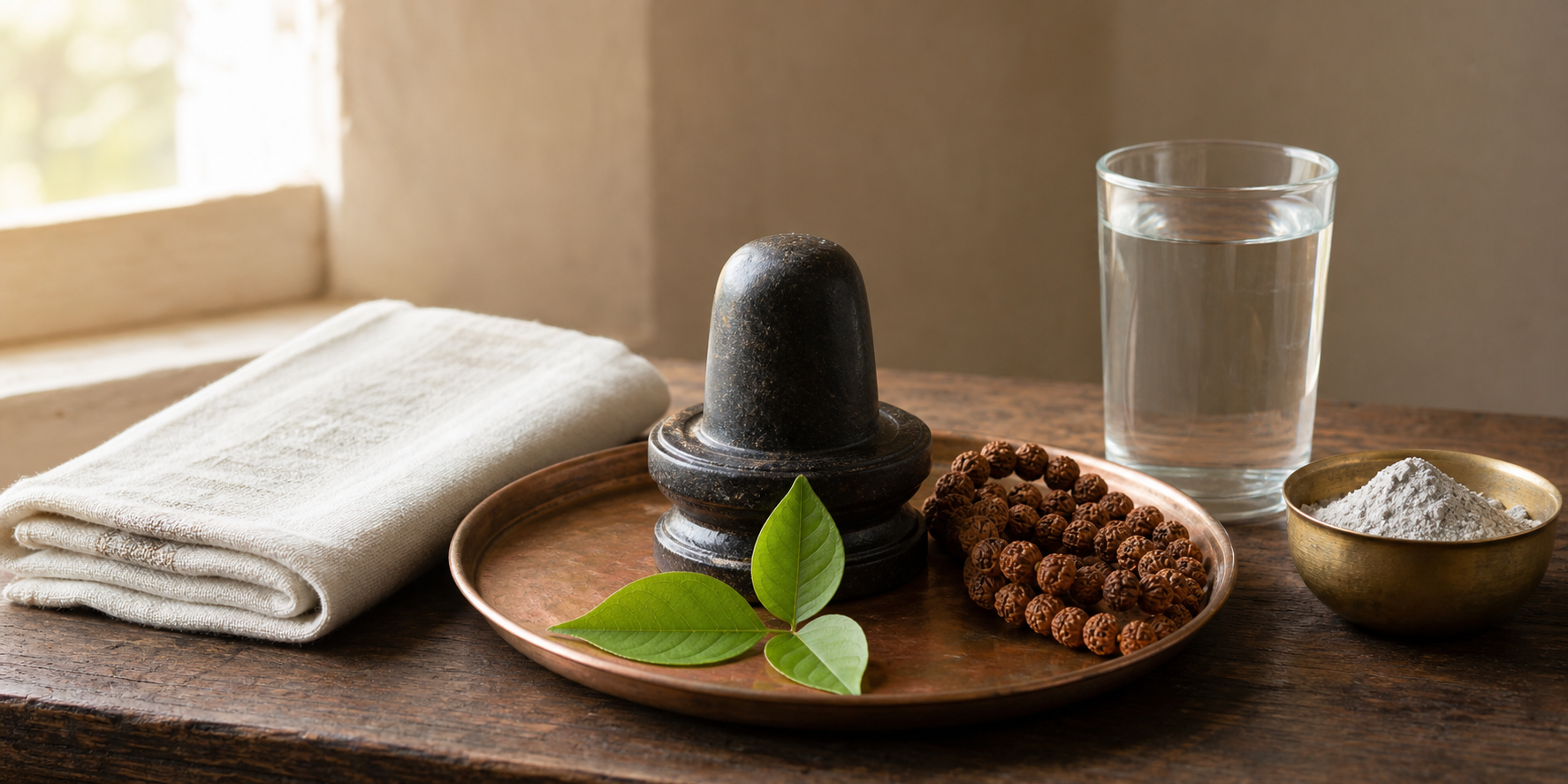
If you have reached for Bilva Patra, Rudraksha, or Vibhuti because you are ill, caring for someone, or struggling to remain steady, the first question is not which symbol is most powerful. Ask what the symbol is calling you to do: remember Shiva, govern the mind, care for the body responsibly, and act with compassion.
A Shaiva healing practice can hold devotion and medical judgment together. The sacred objects retain their full religious meaning, while prayer supports rather than replaces diagnosis, treatment, rest, and practical care. Here is a disciplined way to work with these symbols without turning them into either magical products or empty decorations.
Let healing mean wholeness, not a guaranteed cure
In ordinary speech, healing and curing are often treated as the same thing. They are not. A cure concerns the resolution of disease. Healing can also include steadier attention, courage during uncertainty, reconciliation with change, adherence to necessary care, and a return to dharmic conduct. A person may need all of these even while an illness remains under treatment.
Jvarabhagnamurti embodies Shiva as the breaker of jvara, understood broadly as unhealthy states affecting body, mind, and spirit. That breadth should deepen responsible action, not weaken it. Remembrance, prayer, balanced habits, and seva can accompany modern healthcare; they do not establish that a ritual object cures a medical condition.
Two opposite errors obscure this distinction. The first asks a sacred symbol to do the work of a clinician, medicine, or psychological treatment. The second reduces worship to a decorative wellness exercise. A more faithful path recognizes that the symbol is sacred and then lets that sacred relationship govern conduct. If prayer leaves you more truthful about symptoms, more willing to accept help, more consistent with treatment, and more compassionate toward others, it is already shaping the conditions in which healing is sought.
When illness is involved, keep the order clear: obtain appropriate care, follow the agreed plan, and use sadhana to support clarity and perseverance. If symptoms are severe, rapidly worsening, or otherwise alarming, seek professional or emergency help promptly. Do not delay care in order to complete a ritual.
Give Bilva, Rudraksha, and Vibhuti one clear role each
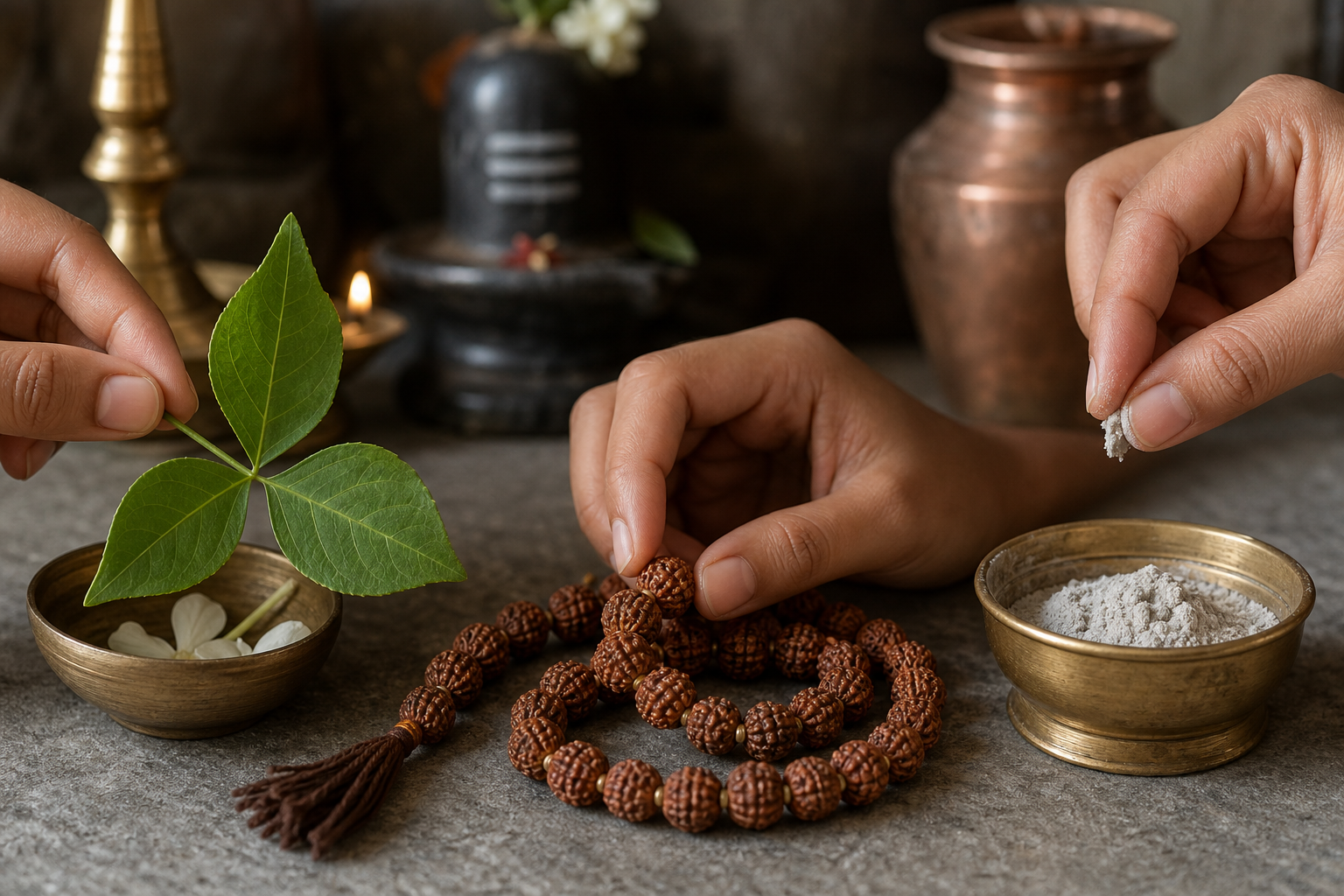
Each emblem trains a different capacity. Bilva directs you toward reverence and simplicity. Rudraksha steadies repeated remembrance. Vibhuti confronts attachment and impermanence. You do not need to make one object carry every hope you have about health.
| Shaiva emblem | What to notice | What to do | Important boundary |
|---|---|---|---|
| Bilva Patra | The three leaflets traditionally evoke the trishula, the three gunas, and movement from gross toward subtler awareness. | Offer a fresh, whole leaf on the Shivlinga with an intention of humility and purification. | Gather sustainably. Do not over-pluck, damage the tree, or assume ritual use makes an unverified preparation medically suitable. |
| Rudraksha | The bead, remembered as a tear of Rudra, gives the fingers a physical anchor during japa. | Move through your mala with a Shiva mantra already established in your practice, keeping attention with each repetition. | Do not let claims about rare mukhis replace regular sadhana. Source beads responsibly and handle them respectfully. |
| Vibhuti | Sacred ash recalls change, mortality, and the eventual reduction of possessions and identities. | Receive properly prepared Vibhuti as prasada. Apply the tripundra if that belongs to your practice, then carry its ethical reminder into the day. | Do not treat random ash as sacred Vibhuti or use it as a medical remedy. Stop applying it if it irritates your skin. |
Bilva Patra: The trifoliate leaf comes from Aegle marmelos. Its wholeness matters ritually because the offering expresses care rather than mere acquisition. Inspect the leaf before offering it. Select an intact one, take only what is needed, and avoid stripping a branch. If your household observes Shiva worship on Mondays, a modest family offering can establish a dependable rhythm without turning devotion into display. Offering Bilva joins worship to ecological restraint: reverence for Shiva should be visible in how you treat the living tree.
Bilva also has a place in Ayurvedic traditions, but that fact is not a prescription. Species, plant part, preparation, dose, medical history, and interactions all matter when a plant is used therapeutically. Do not eat a ritual offering or begin a Bilva remedy merely because the leaf is auspicious. Seek appropriately qualified guidance if you are considering medicinal use.
Rudraksha: Beads from Elaeocarpus ganitrus are associated with distinct mukhis, or faces, and different contemplative aims. For most daily practice, however, the first decision is simpler: will the mala help you return to japa consistently? If you already possess a suitable Rudraksha mala, begin with it rather than postponing practice while searching for a supposedly exceptional bead. Authenticity and ethical harvesting matter, but rarity is not a substitute for attention, truthfulness, or compassion.
Vibhuti: Sacred ash is traditionally connected with sanctified preparation, including ash associated with homa or prescribed materials. It is received as prasada, not selected casually from any fire. The three horizontal lines of the tripundra make impermanence visible on the body. Before applying them, ask what must be reduced today: vanity, resentment, fear-driven control, or neglect of duty. The ash becomes useful when the answer changes your conduct.
Build a Shaiva practice that survives difficult days
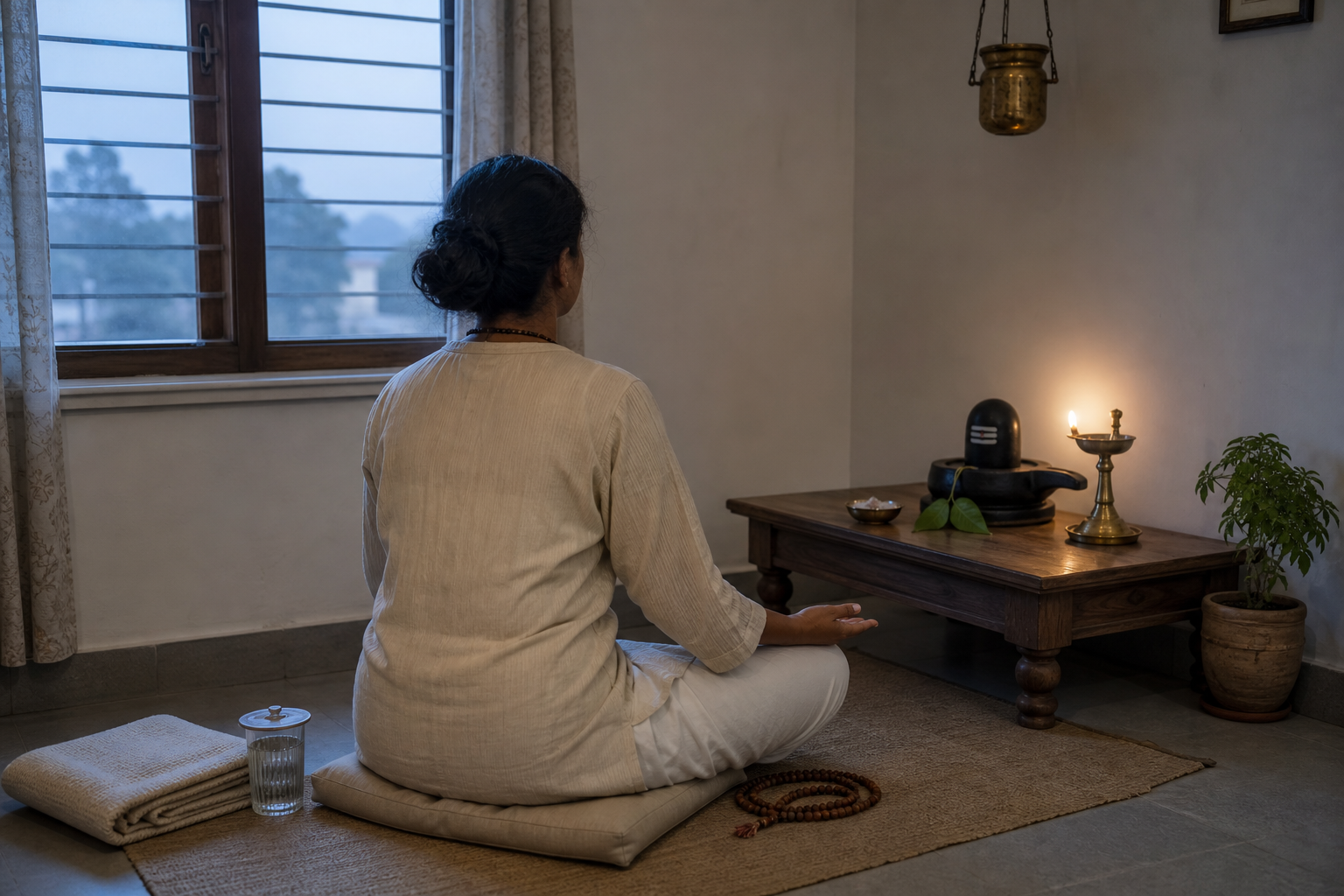
An elaborate observance that disappears when you are tired will not steady you during illness or stress. Build a small sequence that can be completed attentively. On stronger days, you may expand it according to your sampradaya, family custom, or guidance from a guru. On weaker days, preserve the core.
- Prepare the place. Use a clean, quiet space before a Shivlinga or the sacred focus already used in your household. Place the Bilva leaf, Rudraksha mala, and properly obtained Vibhuti within reach so that the practice does not become a search for objects.
- Name the intention. Use one direct sentence, such as: “May this worship steady me to meet illness with clarity, discipline, and compassion.” An intention is not a bargain for a particular outcome. It is a commitment about how you will meet the situation.
- Offer Bilva with restraint. Look at the three leaflets, remember the trishula or the three gunas, and place the leaf gently on the Shivlinga. Let the act mark a movement from agitation toward attention.
- Use Rudraksha for undistracted japa. Recite a familiar Shiva mantra and move one bead with each repetition. Decide the extent of the practice before beginning so that discomfort, fatigue, or anxiety does not turn it into a test of endurance. If you are too weak to handle the mala, quiet remembrance is enough.
- Receive Vibhuti as an ethical reminder. Apply the tripundra if appropriate in your tradition. With the three lines, notice attachment, conduct, and service: what are you clinging to, what needs correction, and who needs your care?
- End with the next responsible action. Take the prescribed medicine, eat or rest as advised, make the needed appointment, check on the person you are caring for, or complete one neglected duty. This step prevents the practice from ending at the altar.
Regularity matters more than emotional intensity. Rudraksha can cue attention, Vibhuti can cue humility, and Bilva can cue reverence, but you still have to respond to the cue. This is abhyasa in practical form: returning without waiting for a dramatic mood.
If you practice as a family, keep the observance calm and comprehensible. Let a child place a Bilva leaf without burdening the act with frightening claims about illness. Let an elder participate at the level their strength permits. A shared ritual should give the household a rhythm of remembrance, not make a sick person responsible for producing everyone else’s desired outcome.
During illness, make devotion strengthen good judgment
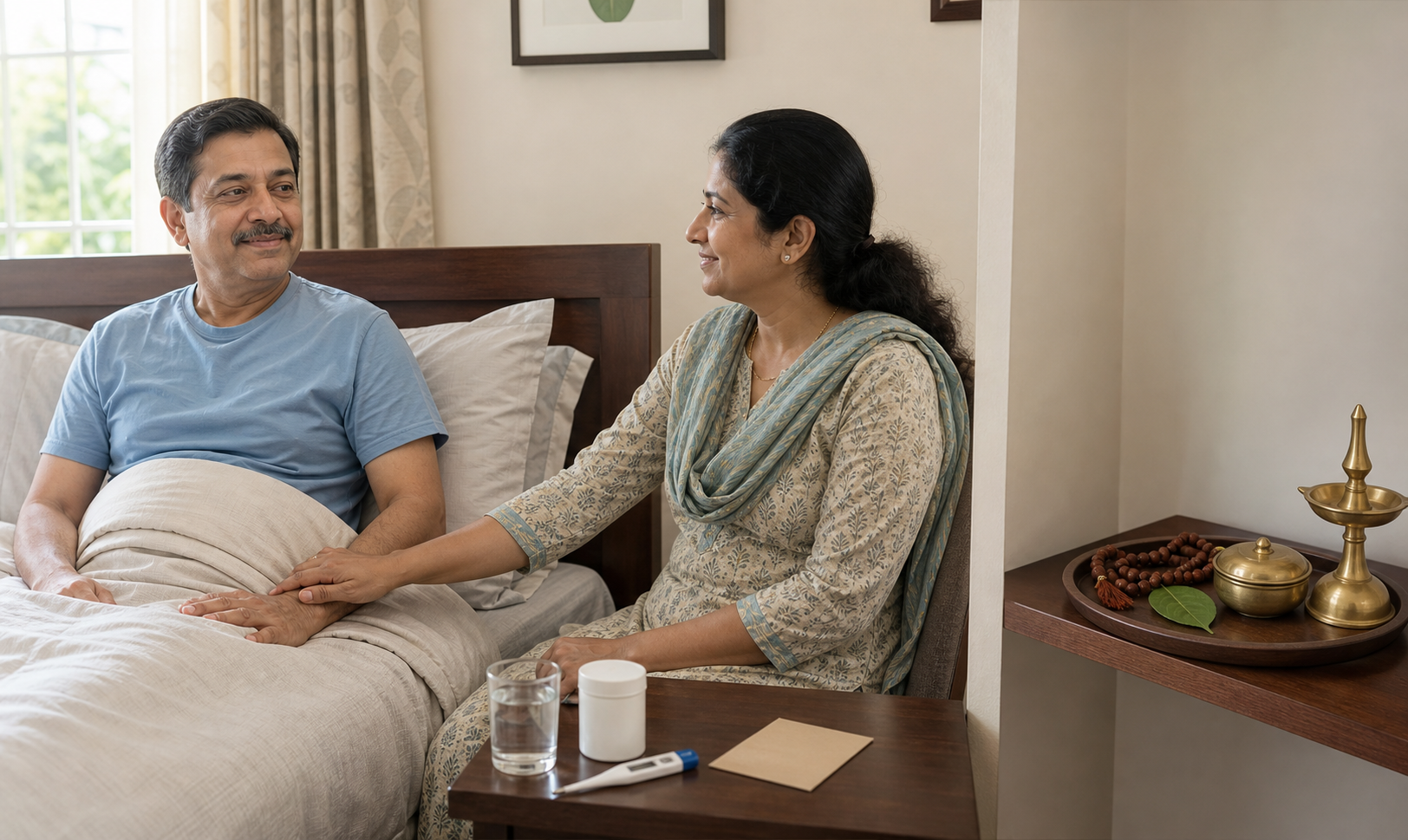
Illness can narrow attention until every decision feels like a referendum on hope. That is precisely when the boundaries of spiritual practice need to be explicit. Do not stop prescribed treatment, cancel an assessment, or ignore worsening symptoms because a puja has been performed. Do not ingest Vibhuti, Bilva, Rudraksha preparations, or any other ritual material as a treatment unless an appropriately qualified professional has assessed the specific use for you.
Devotees may experience greater calm, courage, and willingness to maintain healthy routines through steady remembrance. Those are meaningful forms of support, but they are not proof that a disease has resolved. Prayer is most responsibly integrated with nourishing food, measured rest, mindful practice, and informed healthcare. Let clinical evaluation answer medical questions; let sadhana shape the quality with which you meet the answers.
When you are supporting another person, seva may be the most important Shaiva healing practice available. Help them follow the care plan they accepted. Make room for rest. Offer food that fits their professional guidance. Assist with transport or appointments. Listen without forcing either optimism or religious performance. Respect their consent before applying Vibhuti, arranging a ritual, or speaking about the spiritual meaning of their illness.
Use these questions whenever faith and treatment begin to feel confused:
- What medical or psychological care does this situation require?
- Is my devotional practice helping me follow that care, or tempting me to avoid it?
- What does ahimsa require of my choices right now?
- Which part of the ritual is genuinely sustaining, and which part has become exhausting or compulsive?
- What concrete act of seva would reduce suffering for the person in front of me?
This discernment is not a concession to doubt. It is dharmic responsibility. Jvarabhagnamurti points toward the ending of dis-ease in its widest sense; responsible care, compassion, and truthfulness belong within that aspiration.
Key takeaways
- Use Bilva Patra to practice reverence, simplicity, and responsible care for nature.
- Use Rudraksha to make japa steady; do not confuse an unusual mukhi with depth of practice.
- Use Vibhuti and the tripundra to remember impermanence and correct conduct.
- Understand Jvarabhagnamurti as a focus for wholeness, courage, and compassionate action, not as a guaranteed medical cure.
- Keep treatment and devotional practice together. Seek prompt professional help when symptoms are severe, worsening, or alarming.
- Complete worship with one concrete act: follow the care plan, rest, fulfil a duty, or serve someone who is suffering.
At your next worship, choose one emblem and one responsibility. Offer the Bilva leaf, complete your japa, or receive Vibhuti; then do the practical thing the symbol has placed before you. That union of remembrance and right action is where a Shaiva healing practice becomes part of life.
References
- DharmaRenaissance Blog — Bilva Patra, Rudraksha, and Vibhuti: Timeless Shaiva Symbols that Heal, Protect, and Inspire
- DharmaRenaissance Blog — Jvarabhagnamurti: Lord Shiva’s Healing Power to End Illness and Restore Well-Being
