
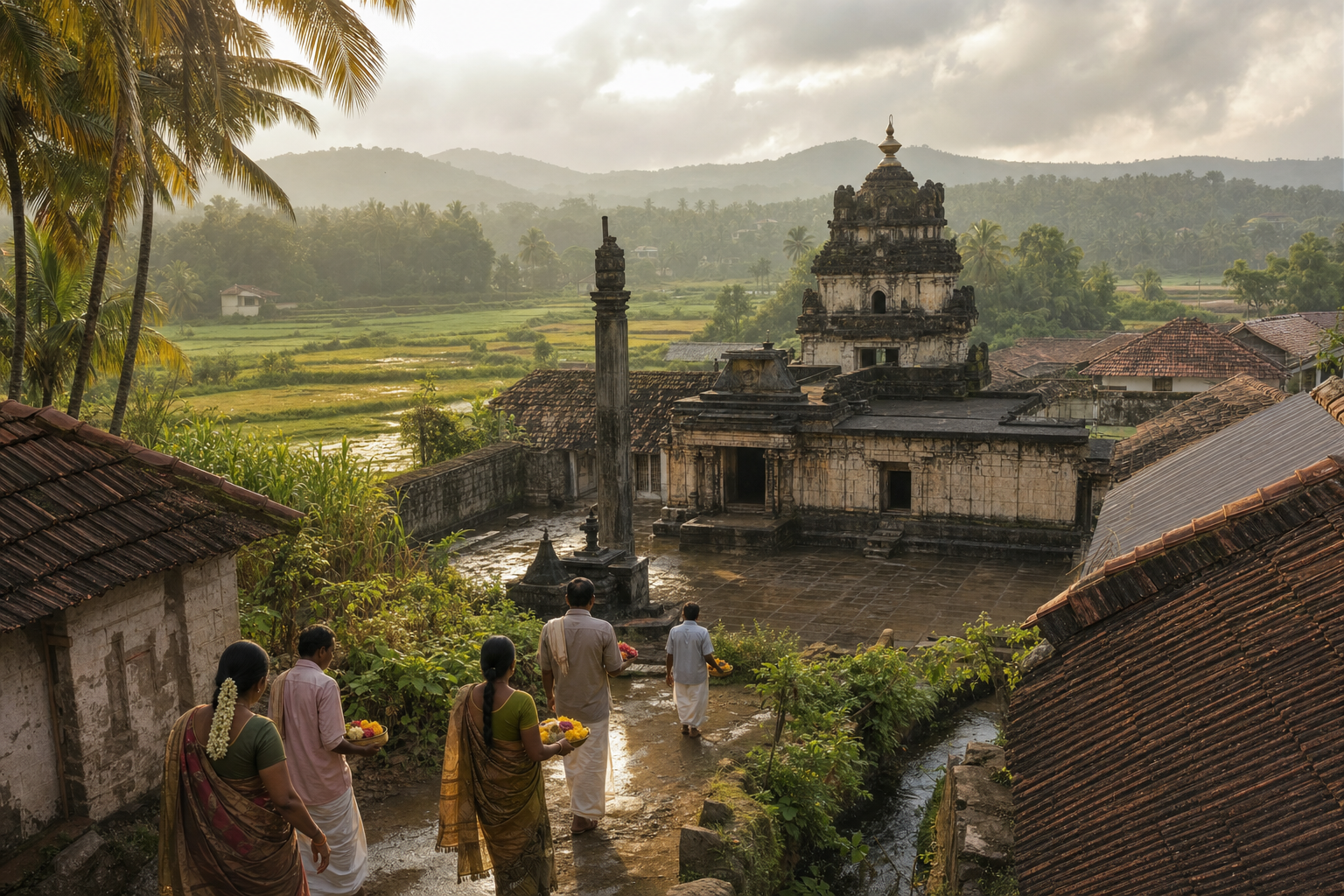
If you are deciding whether Ummatturu deserves a detour on a Karnataka temple journey, the short answer is yes—but only if you arrive looking for more than Sri Krishnadevaraya’s footprint. The village’s deeper significance lies in the relationship among stone temples, kula-devata worship, hereditary ritual rights, shared seva, fertile land, and festivals that still organize collective life.
You will miss that relationship if you visit one sanctum, take a few photographs, and leave. Use Sri Bhujangeshwara Temple as your anchor, but read the wider village as a sacred landscape. The practical aim is not to cover everything. It is to recognize what kind of heritage you are standing within—and to behave in a way that helps it remain alive.
Begin with a sacred landscape, not a single monument
Ummatturu is in Chamarajanagar district, approximately 28 kilometres from Chamarajanagar taluk, 53 kilometres from Mysuru, and 14 kilometres from Yelanduru on the Nanjangudu–Kollegala road. Those distances make Ummatturu possible as part of a broader southern Karnataka heritage journey, but they do not tell you how much time the site deserves. That depends on whether you want architecture, political history, worship, or a festival experience.
The first correction to make in your mental map is simple: Ummatturu is not one temple. The village and its surroundings contain numerous temples of different sizes, with some dating at least to the tenth century CE. Four points will help you orient yourself:
- Sri Bhujangeshwara Temple is the principal anchor for understanding the village’s worship, Vijayanagara patronage, Shivaratri observances, and kula-devata traditions.
- Ranganatha Temple belongs to the same political-sacred history. Inscriptions at Ummatturu record land grants made to the Bhujangeshwara and Ranganatha temples by Vijayanagara rulers and regional chieftains.
- Urukateshwari Temple reveals the village’s living social organization through monthly worship, family deity relationships, offerings, and the Halarive seva.
- Gourishwara Temple at nearby Yelanduru provides an architectural counterpart. Its mukhamandapa is locally called the bale-devalaya because each corner carries an interlinked stone chain carved from a single block; the rings can move even in a gentle breeze.
This is why a useful visit begins with relationships, not a checklist. Bhujangeshwara gives you the ritual and royal centre. Ranganatha strengthens the inscriptional picture. Urukateshwari shows how sacred obligations extend through families and communities. Yelanduru lets you see the technical refinement of the region’s stone craft.
Do not judge Ummatturu only by whether every structure has the visual completeness of a major protected monument. A weathered Nandi, an old wall, an active offering, a hereditary duty, and an inscription can preserve different parts of the same history. The site becomes legible when you allow ritual continuity to count as heritage alongside architecture.
Keep inscriptional history and local tradition distinct
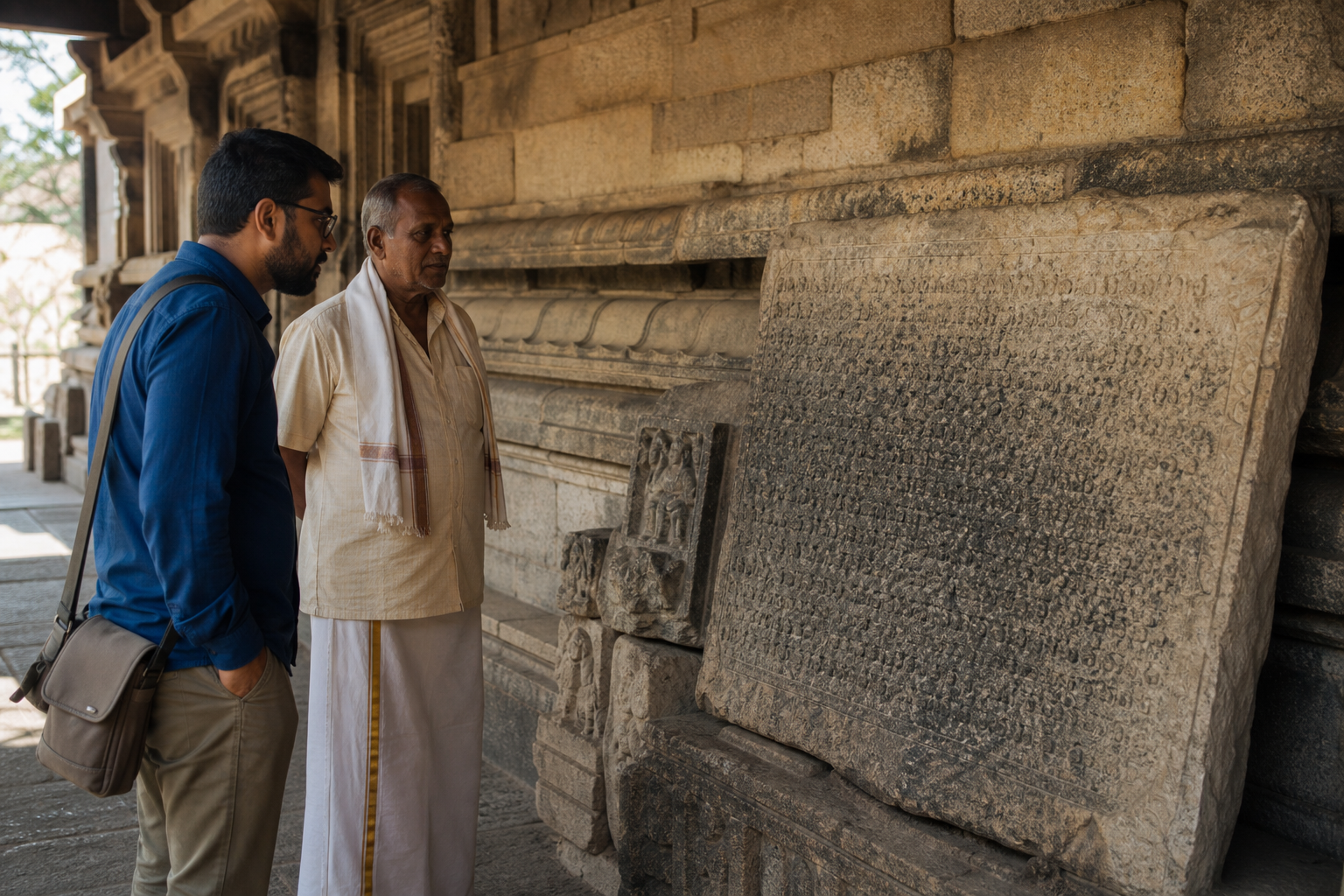
Ummatturu’s setting helps explain why a substantial temple culture developed here. One local etymology interprets Umma as gold and Ummatturu as a place that carries gold—a metaphor for unusually productive soil. Residents identify five varieties of soil capable of producing abundant crops with little water. The nearby Kondikallu Basavana Betta hillock supplied rock used in temples, houses, and roads, while local memory also preserves the durability of the clay foundations beneath prominent streets.
Treat the name’s interpretation as local cultural memory rather than settled linguistic proof. Its importance lies in what it communicates: the village understood its prosperity through land, water, stone, cultivation, and sacred institutions together. The temple was not an isolated object placed into an empty landscape. It stood within the material economy that made worship, construction, festivals, markets, and patronage possible.
The political history also has layers. Hanumappa Odeya is remembered as the local hero who established Ummatturu’s first Samsthana. The principality later attracted Ganga and Vijayanagara attention, and its domains are described as extending as far as Karmade near Coimbatore and, for a time, into Kerala. Gangarasa pursued autonomy strongly enough to issue his own coinage. Sri Krishnadevaraya then reasserted imperial control and incorporated the territory into the Vijayanagara realm early in his reign.
Two kinds of historical memory meet at this point, and you should not flatten them into one. Ummatturu’s inscriptions provide material testimony that Vijayanagara monarchs and regional chiefs endowed the Bhujangeshwara and Ranganatha temples with land. Local tradition goes further: Krishnadevaraya is believed to have sought the blessings of both deities before beginning a 16-year digvijaya-yatra associated with fifty-two victories.
The distinction does not make one layer meaningful and the other disposable. It tells you how to speak accurately. Say that the grants are recorded in inscriptions. Say that the blessing and campaign narrative belongs to tradition. Presenting both as the same kind of evidence weakens the history; preserving the distinction lets political record, sacred memory, and community identity each do their proper work.
If you document an inscription, record the exact temple, wall, pillar, slab, or other surface where it appears. Ask before photographing inside a worship area. A detached image without its location, orientation, or local name loses much of its value and can encourage confident but unsupported readings later.
Choose your visit by Ummatturu’s ritual calendar
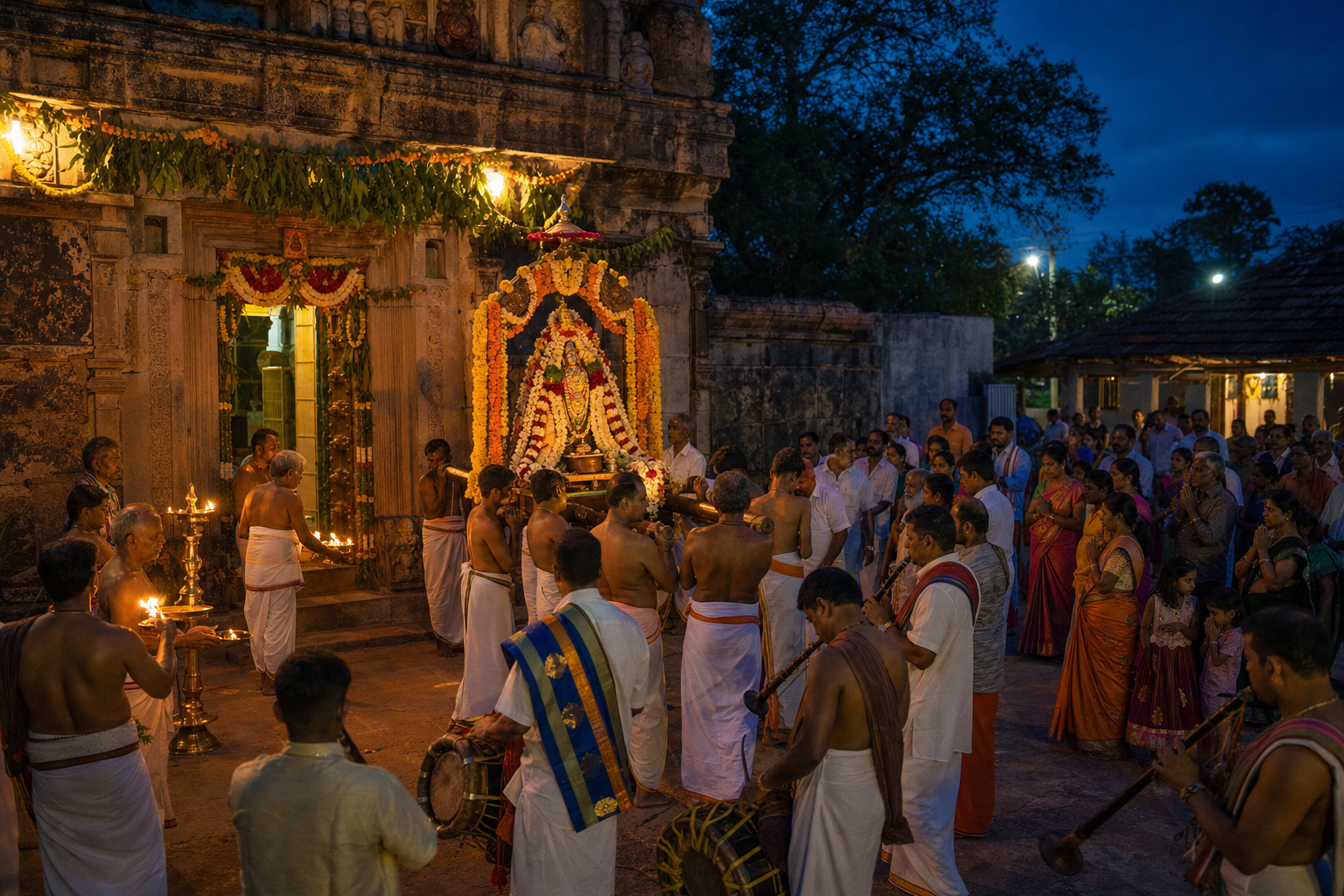
The best time to visit depends on what you want to understand. A festival date may reveal collective service and processional traditions, while a regular observance may give you a clearer view of how worship fits into family life. Use the calendar below as an interpretive guide, not as a guaranteed event schedule.
| Observance | Timing | What happens | What you should do |
|---|---|---|---|
| Bandi-katto-utsava | Sankranti in January | Nine circular wooden bandis carry nine village deities. Veerabhadra Swami leads and Sri Bhujangeshwara completes the sequence. | Verify locally whether the procession will take place before building your journey around it. |
| Shivaratri | Shivaratri night | Devotees maintain jagarana, conduct puja through the four jamas of the night, and sing bhajans. | Plan for a night of worship rather than assuming there will be a large cultural programme. |
| Yugadi | Yugadi, with panchanga-shravana in the evening | Special pujas culminate in the reading of the Panchanga by Jaina pandits who hold a hereditary right recorded in a royal hakku-patra. | Listen for the institutional history carried by the ritual, not only the calendar predictions. |
| Modala-mangalavara | The first Tuesday of each month | Devotees from surrounding areas, including Tamil Nadu, gather for worship connected with Urukateshwari Devi and the village’s kula-devata relationships. | This is the most regular opportunity named in the tradition, but confirm current arrangements and follow local guidance on offerings. |
The Sankranti procession is the most visually dramatic observance. Each of its nine bandis carries one of Ummatturu’s nine deities, accompanied by singing, dancing, and instruments. For many families, participation is inherited service to a kula-devata rather than a public performance staged for visitors. Recent social tensions and administrative difficulties have interrupted the bandi procession, so an old description or previous year’s schedule is not enough to confirm that it will run.
Shivaratri offers a different experience. The stable centre is the night-long jagarana and worship during the four jamas. Larger cultural programming once associated with the festival has been reduced by limited resources, but the core rites continue. If you attend, order your expectations around puja and bhajan, not around the scale of an external programme.
Yugadi is especially important if your question concerns relations among Dharmic communities. The hereditary right of Jaina pandits to conduct the evening panchanga-shravana is not merely a modern gesture of cordiality. It is preserved through a royal hakku-patra and enacted through recurring temple practice. The right matters because it turns mutual regard into an institution with memory, continuity, and responsibility.
For a more regular window into worship, consider Modala-mangalavara. Devotees offer madilakki: rice, jaggery, fruit, flowers, turmeric, kumkum, and dakshina bundled in a blouse piece or saree for Urukateshwari Devi. Families between Ummatturu and Karmade near Coimbatore may revere Urukateshwari together with one of the village’s male deities as Jodi-kula-devatas; for many, Bhujangeshwara is the family deity. If you wish to make an offering, ask what is appropriate rather than assembling a bundle solely from a written description.
Notice how shared seva keeps the heritage alive
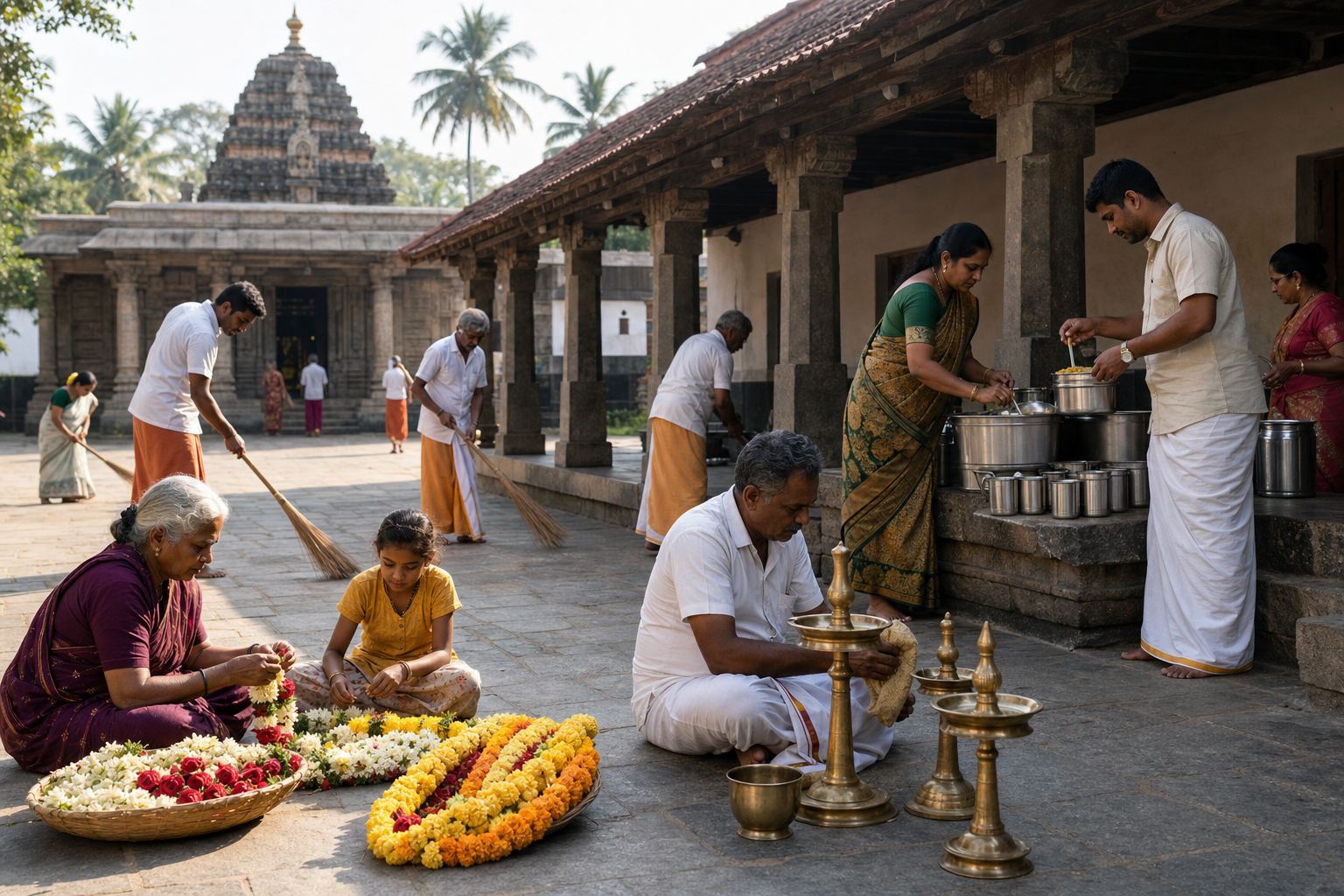
Ummatturu’s heritage becomes clearest when you watch who does the work. During the Halarive offering at Urukateshwari Temple, sacred responsibility is distributed across communities:
- Kumbaras prepare and carry an unbaked pot containing milk and fruit, topped by a rice-flour lamp.
- Folk artists from the Uppara community accompany the procession with song and dance.
- Lingayats bring tree trunks and assemble the ratha at the site.
- A local community historically entrusted with the duty performs the ere seva, showering the goddess with flowers and auspicious materials.
- Other participants clean, decorate, distribute prasada, supply puja necessities, and meet associated expenses.
These services are described as being given without charging even a paisa. The point is not that money has no place in conservation or temple administration. It is that Ummatturu’s ritual order depends upon inherited knowledge, reciprocal obligations, skilled labour, and voluntary participation that cannot be replaced simply by funding a stone repair.
This division of seva should not be reduced to colourful folklore. The unbaked vessel, the lamp, the music, the construction of the ratha, the flower offering, and the distribution of prasada form one ritual sequence. Remove the people who know how to perform any part, and the surviving structure becomes less culturally complete even if its masonry remains sound.
Nor should Dharmic cooperation be romanticized as the absence of disagreement. The interruption of the bandi procession shows that social friction and administration can affect continuity. Ummatturu’s more durable lesson is that unity has historically been enacted through specific rights and duties: Jaina pandits read the Panchanga, different communities perform defined forms of seva, and families return to their kula-devatas. Cooperation survives through practice, not sentiment alone.
If you want to help, begin by protecting that local agency:
- Ask which worship or seva is underway before entering, photographing, or moving close to ritual materials.
- Use the proper name of the observance and learn who carries each responsibility. Do not label every procession as a generic village festival.
- If you wish to donate, ask temple or village custodians what is presently needed. Ritual supplies, cleaning, prasada, documentation, and structural work are different needs.
- Do not promise to revive a procession or resolve a local dispute. Questions of representation, safety, administration, and inherited rights must be handled by the communities involved.
- If you create photographs, notes, or recordings with permission, preserve names, dates, locations, and roles. A documented tradition is more useful when the community can also access what was recorded.
The same rule applies to heritage advocacy. Begin with what is still functioning. Support the people who maintain it. Treat damaged architecture, ritual continuity, inscriptional documentation, and community relationships as connected needs rather than competing projects.
Key takeaways for your Ummatturu visit
- Visit Ummatturu as a network of temples, family deities, festivals, land, craft, and inherited service—not as one Vijayanagara monument.
- Use Bhujangeshwara as the central anchor, while including Ranganatha, Urukateshwari, and the Gourishwara bale-devalaya at Yelanduru in your mental map.
- Keep evidence types clear: inscriptions attest temple grants, while Krishnadevaraya’s blessings and fifty-two victories belong to local tradition.
- Confirm festival arrangements locally. The nine-bandi Sankranti procession has faced interruptions, and older schedules may not reflect current conditions.
- Judge conservation by more than stone. Hereditary rights, ritual knowledge, kula-devata relationships, voluntary labour, and shared seva are also parts of the heritage.
For your first journey, decide whether you want a history-led visit or a ritual-led one, then verify the current arrangements before you travel. Arrive with enough time to ask what is happening, learn the names of the deities and observances, and let the village’s living order—not only its association with an emperor—shape what you carry home.
References
