
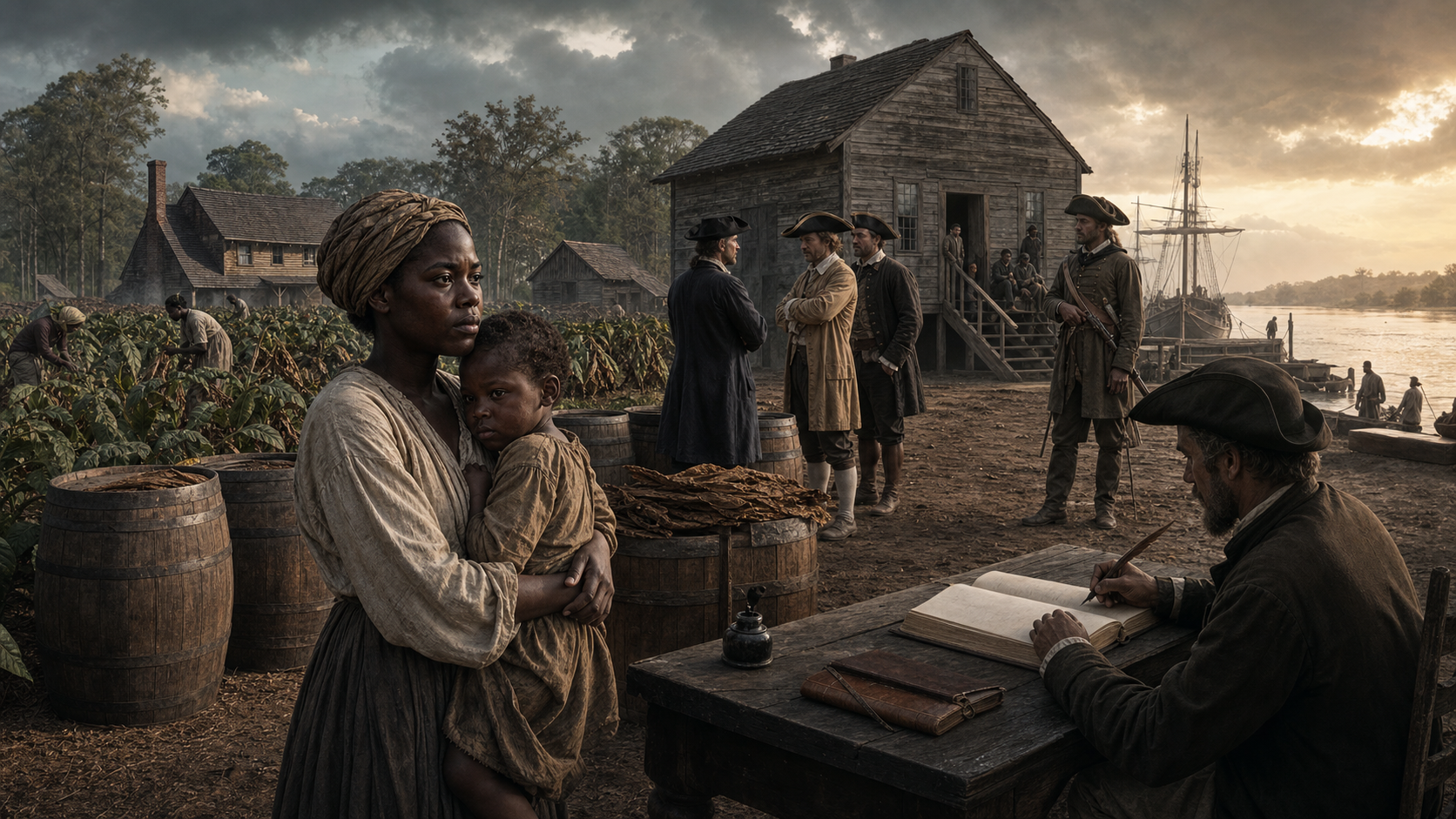
If you have been told that Virginia’s racial order simply appeared with the colony’s first African laborers, the chronology should make you pause. The decisive question is not merely when Africans reached Virginia. It is when bondage became lifelong, inheritable, racially bounded, and powerful enough to organize the colony’s economy, politics, courts, and families.
You can follow that transformation through four pressure points: an expanding plantation economy, a changing labor supply, a law governing the status of children, and elite fear of cooperation among poor Europeans and Africans. Read in that order, Virginia’s slave society looks neither accidental nor inevitable. It looks constructed.
Key takeaways
- Early Virginia contained slavery and other forms of coerced labor, but ancestry did not yet determine every African person’s legal future.
- Anthony Johnson’s rise from an Angolan laborer called Antonio to a free landholder with a 250-acre farm reveals possibilities that later racial law would close.
- Falling mortality, population growth, declining European indentured migration, and increasing African imports made permanent captive labor more attractive to planters.
- Virginia’s 1662 inheritance law made a child’s status follow the mother, allowing slavery to reproduce through birth as well as importation.
- Bacon’s Rebellion did not create racial slavery by itself, but it exposed the danger that servants and enslaved people could mobilize together. The ruling class answered by sharpening legal distinctions between them.
Early Virginia did not yet have a complete racial order
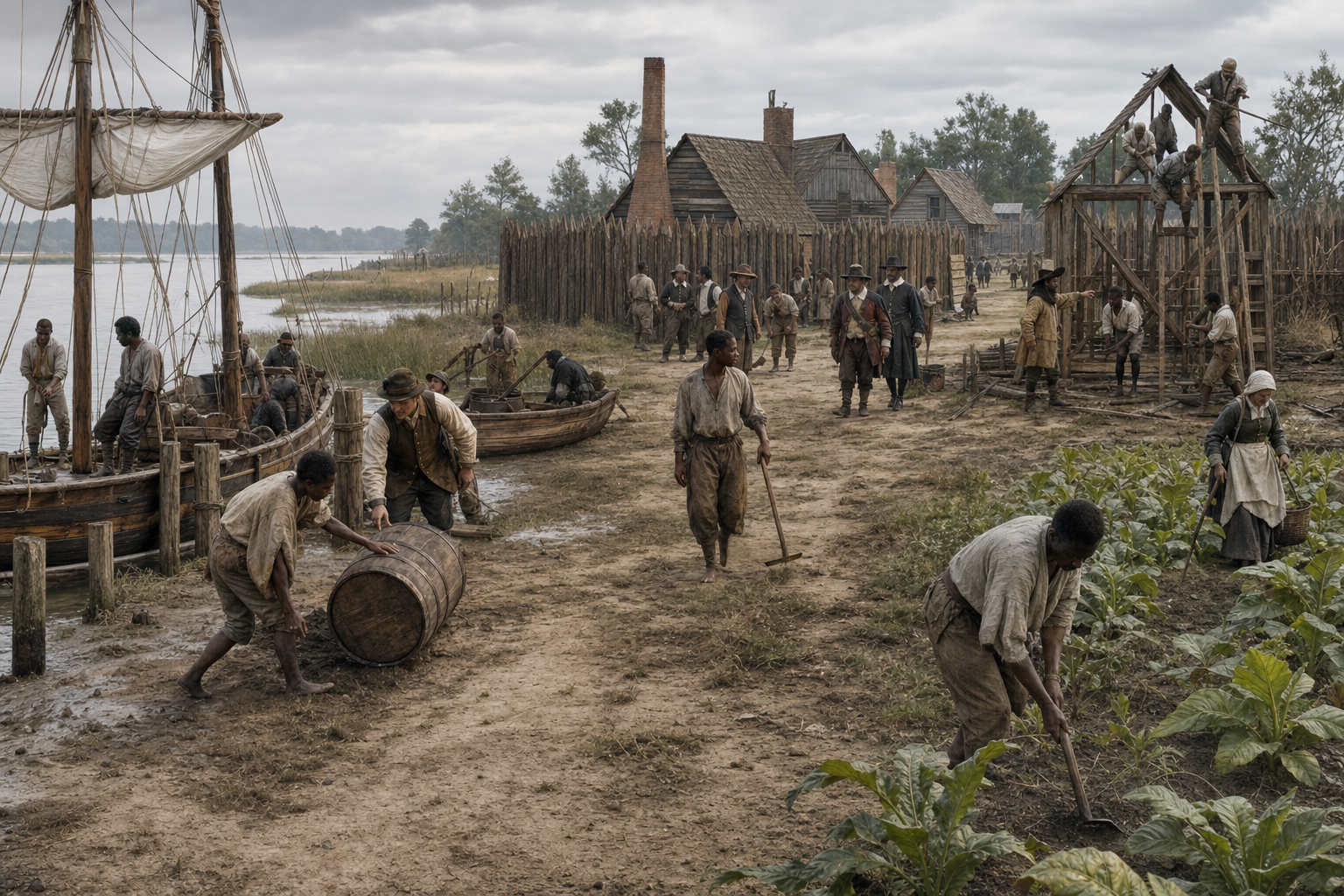
Begin with a distinction that changes the whole story. A society with slaves permits people to be held in bondage. A slave society makes bondage foundational: labor, wealth, political authority, family status, policing, and social rank are all arranged around it. Virginia moved from the first condition toward the second over several generations.
The colony began under a Virginia Company charter issued in 1606. Jamestown then endured hunger, disease, and the catastrophe remembered as the Starving Time. Survival did not produce an egalitarian community. It produced an expanding plantation economy with an immense appetite for controlled labor. Yet the legal boundary between a temporary servant and a permanently enslaved person remained less comprehensive than it would become.
European indentured servants generally exchanged a fixed period of labor for passage and the possibility of freedom afterward. Africans could be subjected to harsher treatment and lifelong bondage, but African ancestry did not yet function as a single, automatic legal verdict in every case. Free Black residents could own land, form families, bring claims before courts, and sometimes marry across racial lines. Africans were also more balanced by age and gender than the overwhelmingly young and male European servant population.
Do not mistake this relative fluidity for racial equality. Capture, sale, forced migration, coercion, and exploitation were already present. The narrower point is more important: lawmakers had not yet joined ancestry, lifetime bondage, inheritance, and civic exclusion into one nearly inescapable system. That joining had to be accomplished through identifiable choices.
The life of Anthony Johnson lets you test that distinction against a real person. Originally known as Antonio, he was an Angolan captured by a rival African group, moved through regional trading networks, sold to an Arab merchant, and eventually taken to Virginia. He worked as an indentured laborer rather than remaining legally bound for life. After completing his term, he became free, acquired land with his wife Mary, adopted the name Anthony Johnson, and by the 1640s operated a 250-acre farm with servants.
Johnson’s success does not prove that early Virginia was just. Nor should one exceptional life be used to minimize the suffering of people already held permanently. His life establishes something more precise: an African man could pass from coerced labor into recognized freedom, property ownership, family life, and the employment of servants. That possibility becomes historically revealing because later laws worked to deny it to people of African descent.
When you encounter a claim that racial slavery had been complete and unchanging from Virginia’s beginning, use biography as a check. Ask whether an African person could complete a labor term, acquire land, use a court, establish a legally recognized family, or hold others as servants. If the answer changes across decades, then the institution itself was changing.
The 1660s joined labor demand to hereditary status
By the 1660s, several conditions were moving in the same direction. Mortality declined. The white settler population grew. Fewer European indentured servants arrived. Planters increasingly drew labor from an expanding Atlantic trade in captive Africans, while direct imports from Africa rose markedly after the middle of the century.
Political power was also narrowing. Landholders consolidated authority, voting was restricted to people with property, and elections could be suspended for long periods. That matters because a labor system does not become dominant through private prejudice alone. The people who benefit from it need the power to define status, distribute rights, enforce discipline, and prevent those rules from being overturned.
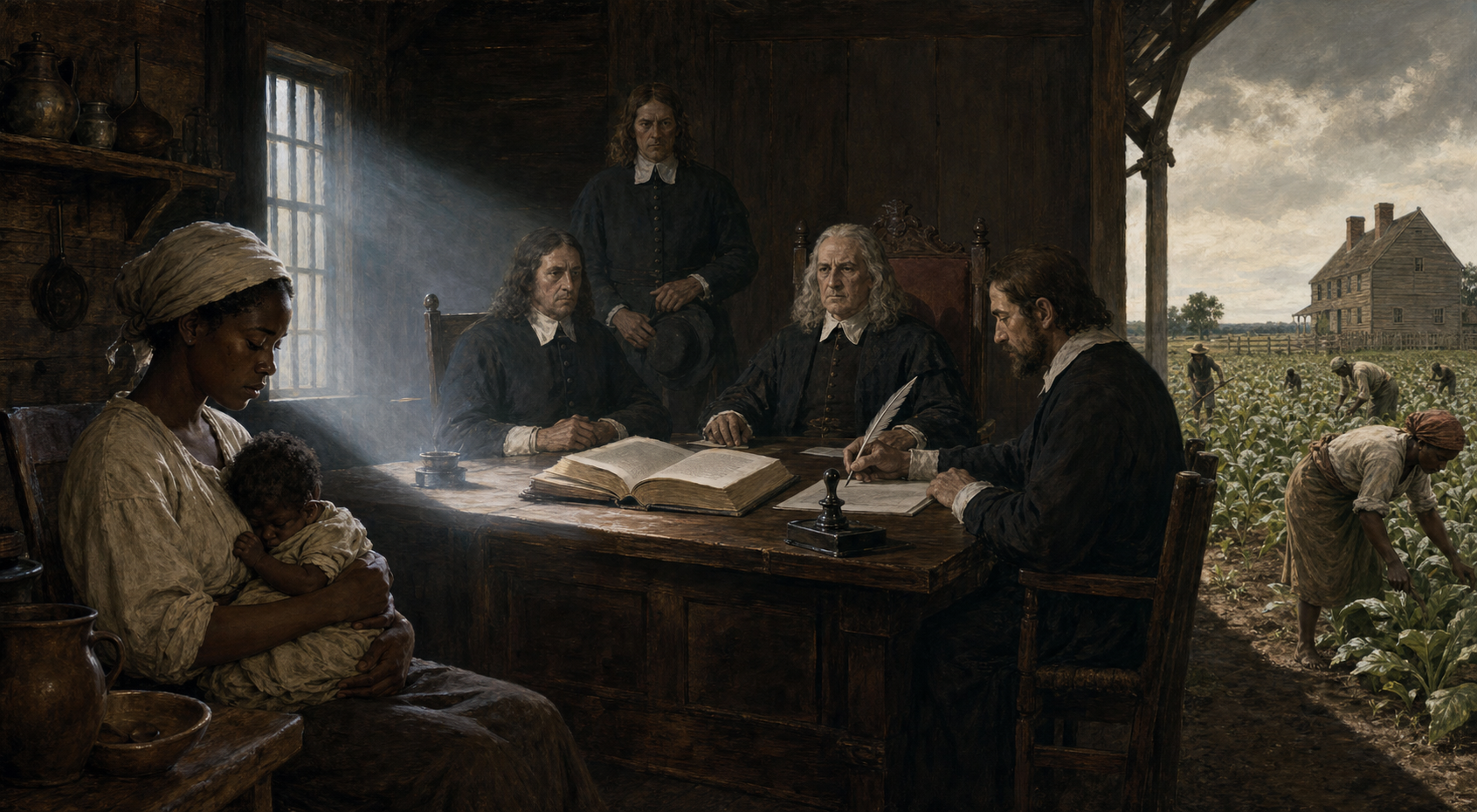
The pivotal legal move came in 1662. Virginia adopted the rule commonly expressed as partus sequitur ventrem: a child’s legal condition would follow that of the mother. A child born to an enslaved woman would therefore be enslaved regardless of the father’s identity.
This rule did far more than settle an administrative question. It placed the reproductive lives of enslaved women inside the property system. Bondage could now expand through birth as well as forced Atlantic migration. A free father could not confer freedom on the child, and a man’s paternity could not interrupt the enslaver’s claim. The condition of the mother supplied the colony with a simple, enforceable mechanism for making slavery hereditary.
Here is the point to notice: the law did not merely describe an existing racial hierarchy. It helped manufacture one. It converted a person’s birth into a transferable social fate and ensured that the institution could continue from one generation to the next. Once the children of enslaved women could be claimed for life, the system no longer depended only on new arrivals.
This is why an account focused only on attitudes remains incomplete. Prejudice can rationalize domination, but a slave society requires machinery. Inheritance rules determine who can be owned. Courts recognize the claims. Political restrictions protect the lawmakers. Coercive authority enforces the result. The machinery turns a hostile idea into a durable institution.
When you read any history of institutionalized inequality, look for the rule governing children. Ask whether a status ends with one person’s death or passes automatically to the next generation. Hereditary status is the point at which an injustice can reproduce itself without being renegotiated in every individual case.
Bacon’s Rebellion made cross-status solidarity an elite threat
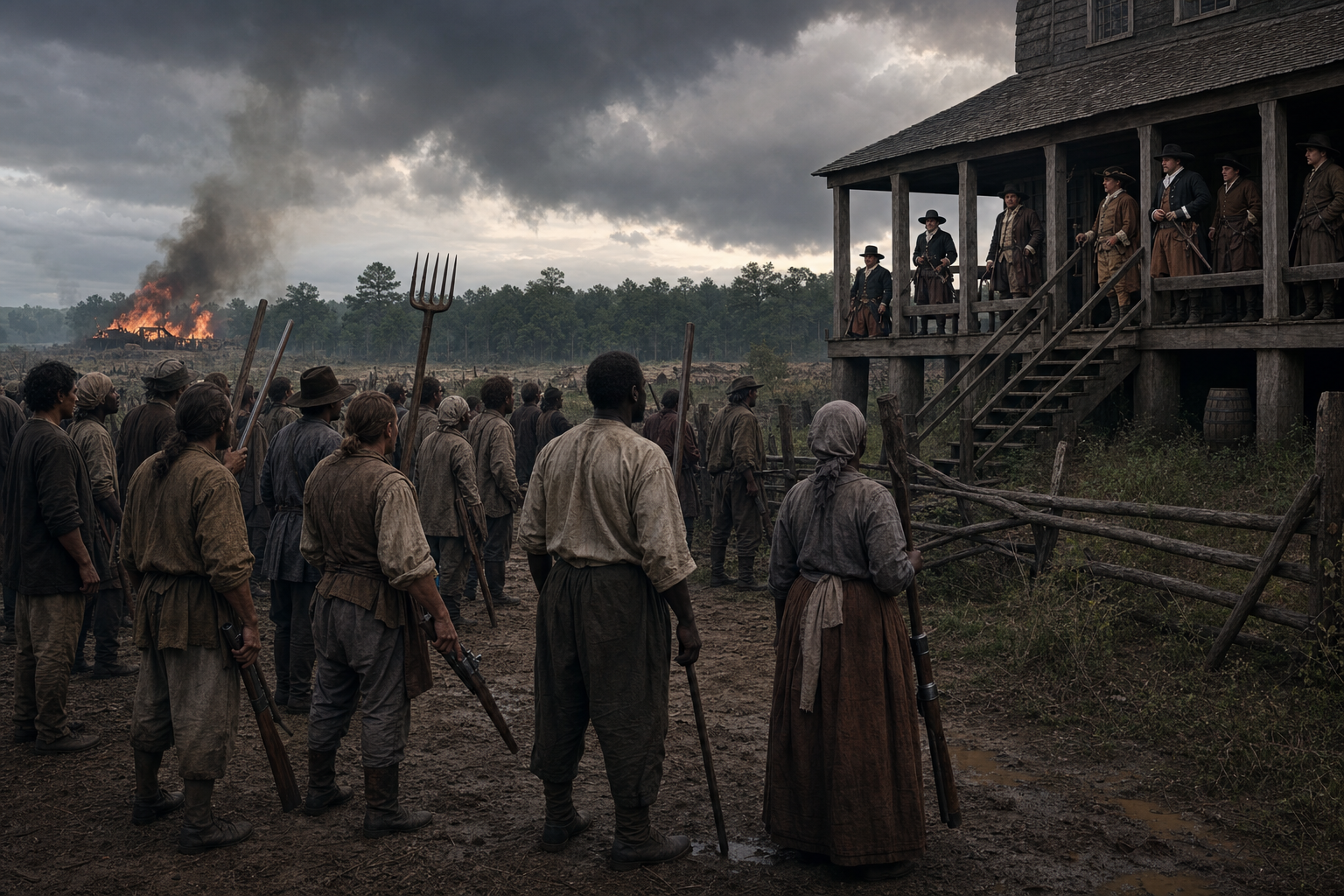
Hereditary slavery solved a labor problem for planters, but the ruling class faced a political problem as well. Poor Europeans, indentured servants, free Africans, and enslaved people did not yet inhabit completely sealed social worlds. They could flee together, resist together, and recognize common enemies. Bacon’s Rebellion in 1676 showed how dangerous that possibility could become.
Nathaniel Bacon sought authority to conduct violent campaigns against Native peoples. After colonial authorities branded him a rebel, he assembled an armed following that included servants and enslaved people. His forces seized Jamestown and burned it. The uprising collapsed after Bacon died and armed vessels restored the established order.
This was not a modern movement for racial equality, and it should not be romanticized as one. Bacon’s aims included violence against Native communities, while the participants did not share a single emancipatory program. Its importance lies elsewhere: people occupying different positions in the labor hierarchy had demonstrated that they could join an armed challenge to colonial authority.
The careful causal claim is that Bacon’s Rebellion accelerated a process already underway. Virginia had adopted hereditary slavery fourteen years earlier. Labor and demographic changes had also begun before the revolt. The uprising therefore did not invent racial slavery. It gave the planter elite a fresh reason to make the boundaries among poor workers harder to cross.
Afterward, lawmakers drew sharper distinctions between white servants identified as Christian and people of African descent. Free Black residents lost important civil rights, including freedom in marriage. Masters received broad latitude to discipline enslaved people. A population that had once shared some legal spaces was increasingly separated by rights, ancestry, and presumed status.
Virginia’s rulers did not have to invent every element locally. Barbados had already demonstrated how a stark racial binary could govern plantation labor. Virginia adapted that logic to its own conditions. By the early eighteenth century, a comprehensive lattice of slave codes connected ancestry, inherited status, civic disability, plantation discipline, and elite political power. The colony had crossed the line from possessing slaves to being organized as a slave society.
When someone reduces this transition to greed alone or racism alone, ask what kept exploited people apart. The answer in Virginia includes law: unequal civil standing weakened the basis for common action. Race became not only an ideology used to justify exploitation but also a governing boundary that divided people whose labor conditions had once overlapped.
A Dharmic reading must examine institutions, not only intentions

For a Dharmic reader, it is tempting to condemn the cruelty, invoke ahimsa, and stop there. That response is morally sound but historically incomplete. The deeper warning is that adharma can be made routine. It can be written into inheritance, protected by political exclusion, administered by courts, and normalized through categories that later generations mistake for natural facts.
Hindu, Buddhist, Jain, and Sikh traditions do not define every moral concept identically. Yet each gives you resources for testing power against human dignity, restraint against harm, compassion toward the vulnerable, and responsibility for the order a community sustains. Virginia’s transformation shows why personal virtue cannot compensate for institutions designed to produce injury. A personally restrained master still participated in a legal system that claimed human beings and their unborn descendants as property.
Do not turn this history into a loose analogy with every other hierarchy, including debates about caste in Bharat. Analogies can illuminate only when the mechanisms remain visible. Virginia’s system was built through Atlantic trafficking, plantation labor, maternal inheritance of bondage, racial civil restrictions, and coercive slave codes. Erasing those features in favor of a universal slogan makes the history less useful, not more.
A sharper Dharmic test asks three questions. What harm does an institution produce even when individual participants claim good intentions? Which rules allow that harm to outlive its original decision-makers? Which social divisions prevent the people bearing the harm from acting together? Those questions move dharma from private sentiment into public responsibility.
Virginia also cautions you against treating injustice as inevitable merely because it later became pervasive. Anthony Johnson’s life discloses paths that once remained open. The 1662 statute shows when one of those paths was deliberately narrowed. Bacon’s Rebellion shows why elites feared cooperation across status lines. The later slave codes show how separate decisions accumulated until the structure appeared permanent.
The next time you meet the claim that a hierarchy was simply an ancient custom, ask for its construction history. Find the law that made status inheritable, the economic change that rewarded permanence, the political crisis that hardened group boundaries, and the authority that enforced them. Naming those choices is the first step toward refusing the old excuse that no one could have chosen differently.
References
