

If you are deciding whether demographic change should alter your politics, refuse the two easiest answers: that nothing is changing, or that catastrophe is inevitable. Neither position helps you distinguish a measurable risk from a frightening headline.
A serious Hindu civilizational response begins with three separations: a current count is not a projection, a national trend is not a district-level condition, and cultural confidence is not collective suspicion. Make those distinctions and you can move from anxiety to a practical agenda built around accurate data, stronger Dharmic institutions, capable families, lawful enforcement, and equal citizenship.
Before you fear a demographic turning point, audit the claim

The phrase demographic turning point can mean at least three different things. It might describe a community’s rising headcount, a change in its share of the total population, or a projected date when two populations approach parity. Those are different claims. A population can continue growing while its growth rate falls, and it can grow faster than another population without coming close to becoming a majority.
The most important limitation is temporal. India’s latest complete religion-wise Census baseline remains 2011. Until a later religion-wise enumeration is available, any claim about the country’s present religious composition is an estimate or projection, not a fresh national count. Ask for that label before accepting the conclusion.
| Community | Share of India in Census 2011 | Approximate decadal growth, 2001-2011 |
|---|---|---|
| Hindus | 79.8% | 16.8% |
| Muslims | 14.2% | 24.6% |
| Christians | 2.3% | 15.5% |
| Sikhs | 1.7% | 8.4% |
| Buddhists | 0.7% | 6.1% |
| Jains | 0.4% | 5.4% |
The table contains two kinds of percentages. The middle column is each community’s share of India’s population at one point in time. The final column is the percentage change in that community’s own headcount across a decade. A 24.6% decadal growth rate does not mean a 24.6-percentage-point increase in national population share.
Growth rates with different denominators also cannot simply be added. If someone claims that one religion’s percentage growth exceeded the combined percentage growth of several others, ask what was combined. A valid comparison of absolute increases requires headcounts. A valid comparison of pace can compare each group’s rate separately. Adding unrelated percentages produces a dramatic sentence, not a meaningful demographic measure.
Fertility adds another layer. NFHS-5, conducted in 2019-21, placed India’s total fertility rate at about 2.0. Hindu fertility was below replacement, while Muslim fertility remained modestly above it; crucially, the gap had narrowed sharply over the preceding two decades. This does not erase the difference. It changes the responsible interpretation from an ever-widening divergence to an ongoing transition whose pace varies by region and socioeconomic conditions.
Falling fertility does not stop population growth immediately. A community with a younger age structure can produce more births because more people are entering childbearing ages. This population momentum explains why a growth-rate difference may persist after family sizes begin converging. It also explains why projecting a short-term difference unchanged across many decades is unsafe.
When you encounter a demographic claim, run this five-question audit:
- Is it describing headcount, population share, fertility, or a growth rate?
- What are the starting and ending years, and is the figure a count, survey estimate, or modeled projection?
- Does it apply to India, a state, a district, or one neighborhood?
- Which mechanism is proposed: fertility, age structure, internal migration, cross-border migration, or religious switching?
- Does the conclusion remain true after the denominator and geographic scale are stated plainly?
If any of those answers is missing, you do not yet have enough information to make a political judgement.
National stability and local pressure can both be real
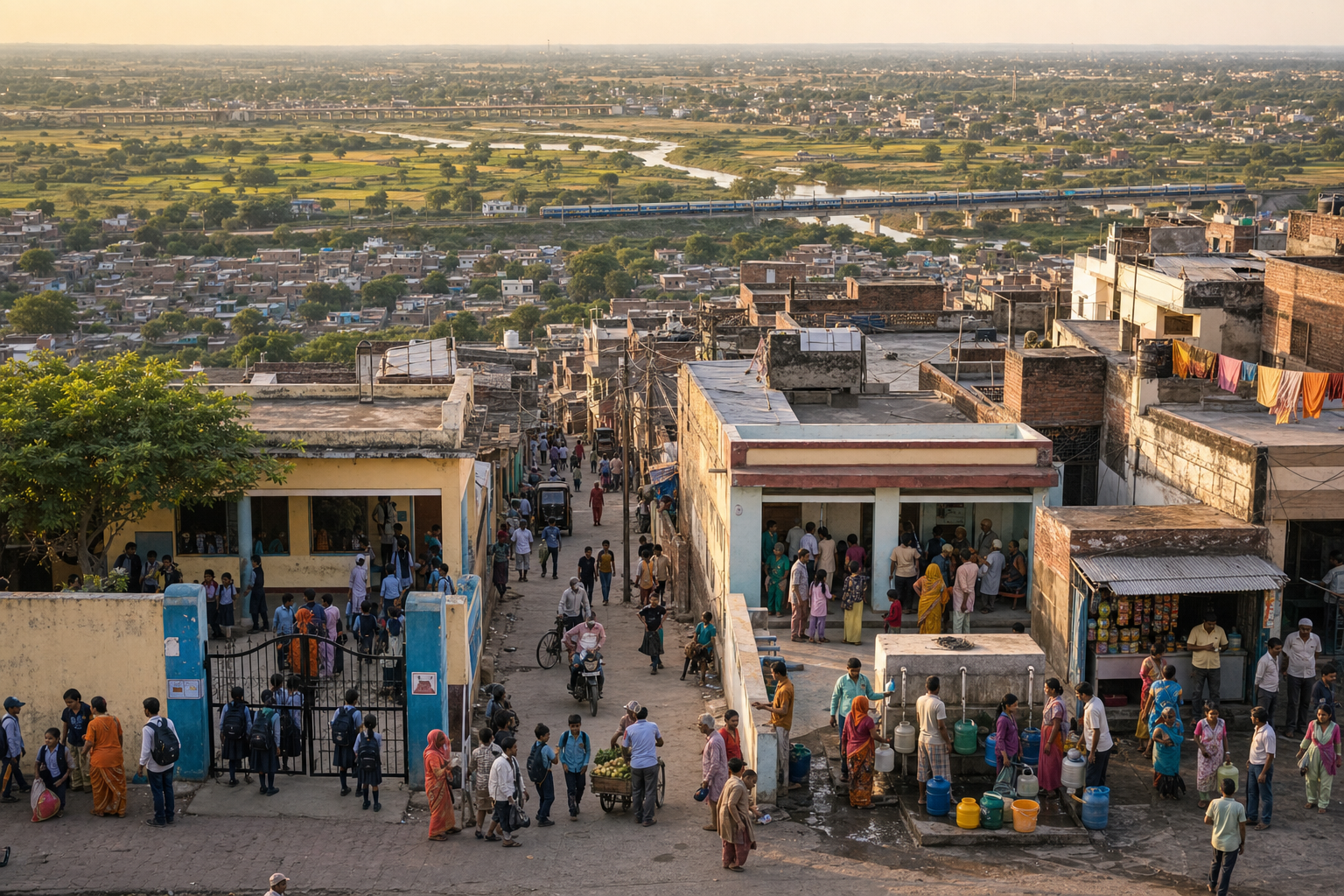
National averages can conceal concentrated change. Kerala and Tamil Nadu have low fertility across communities after long investment in schooling, health, and women’s capabilities. Bihar and Uttar Pradesh have higher fertility across communities, with differences shaped by female education, child survival, urbanization, and rural conditions. Religion matters to identity and family life, but it is not an adequate substitute for these variables.
This gives you a better way to interpret uneven change. A fertility difference found in one state should not be projected mechanically onto another. Nor should a national average be used to dismiss a district facing rapid population growth, crowded schools, housing pressure, or a strained labor market. The correct unit of analysis is the smallest geography for which reliable data and the relevant administrative decision both exist.
Migration requires the same discipline. Internal migration for work, education, marriage, and family life accounts for most movement within India and can transform a receiving area’s service needs. Irregular cross-border migration may still create acute pressure in particular border districts. A national claim about religious replacement cannot be inferred from a local migration dispute, but a national average does not make that local dispute imaginary.
Religious switching appears to have little net effect on India’s overall religious composition, with reported movements across faiths roughly balancing at the population level. That finding answers a national demographic question. It does not establish that every individual conversion is voluntary, nor does an allegation in one locality establish a population-scale strategy. These are separate evidentiary questions and should stay separate.
If your concern is local, build a local diagnosis before choosing a slogan:
- Identify the visible pressure: school places, housing, employment, welfare delivery, policing, or cultural continuity.
- Obtain state- or district-level figures with a date and denominator. Do not use an undated image or a national projection as a local count.
- Separate natural increase from internal migration and disputed cross-border movement. Each mechanism calls for a different administrative response.
- Check whether public capacity grew with population. A service shortage may reflect weak planning even when demographic change contributed to demand.
- For conversion or documentation allegations, distinguish verified individual cases from estimates of community-wide prevalence.
This approach leaves room for vigilance without turning every Muslim or Christian neighbor into an explanation for administrative failure. It also prevents legitimate local concerns from being waved away with a reassuring national average.
Build civilizational capacity instead of demographic theatre
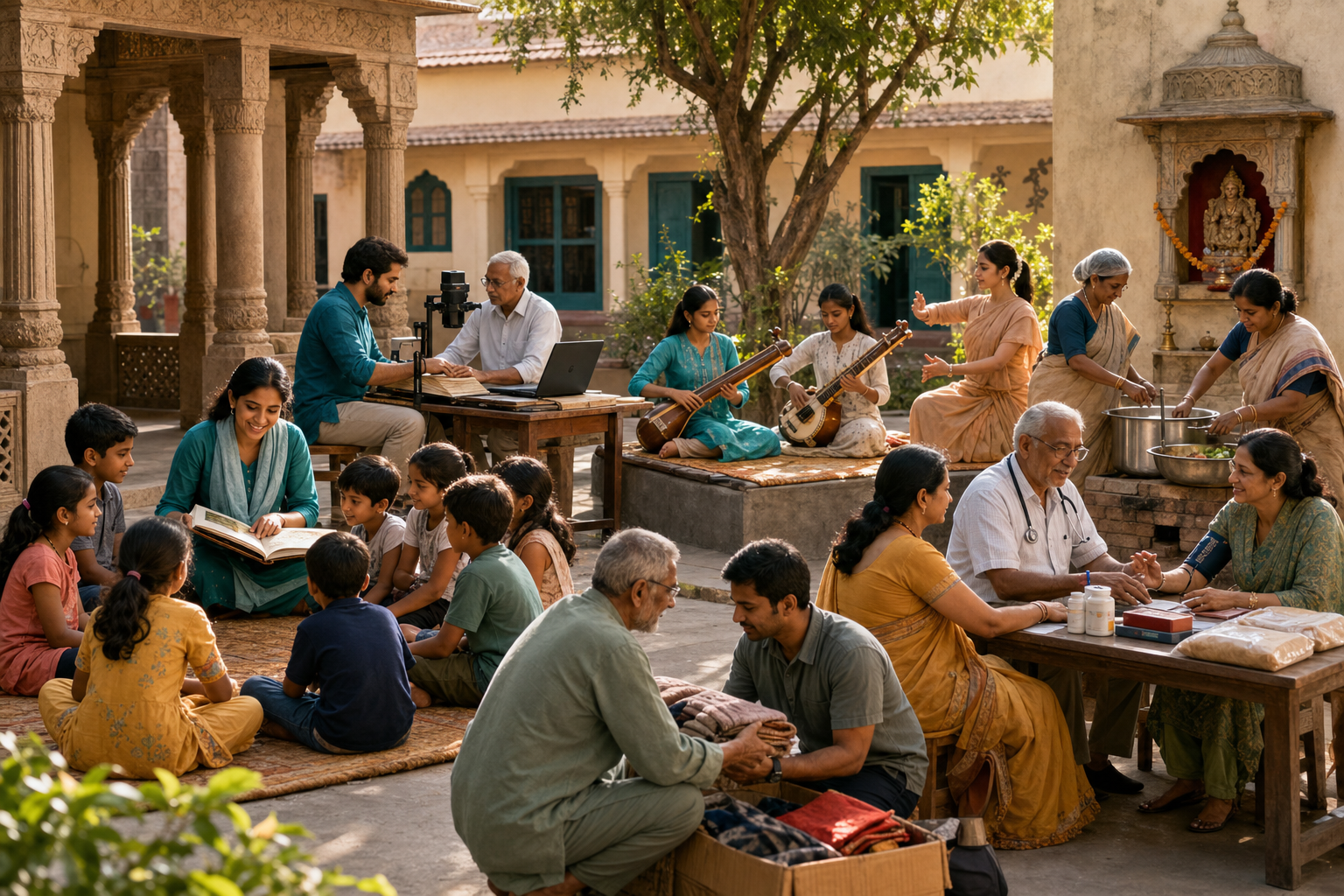
A Hindu civilizational politics worthy of the name cannot reduce survival to a contest over birth rates. Numbers matter, but a numerical majority can still lose historical knowledge, institutional independence, sacred geography, linguistic memory, and the habit of transmitting its traditions. Civilizational continuity depends on what families and institutions teach, preserve, fund, and practice.
That changes the political agenda. The question is not only how many Hindus, Buddhists, Jains, or Sikhs there will be. It is whether a child can learn the family’s tradition accurately, whether a temple or vihara can serve its community responsibly, whether young adults can form stable households, and whether Dharmic institutions have the competence to preserve archives, care for elders, teach languages, and respond to public controversies with evidence.
Five forms of capacity deserve priority:
- Data capacity: demand a timely Census, reliable vital statistics, and district-level publication of demographic and service indicators. Insist that public claims identify their year, geography, denominator, and method.
- Family capability: support girls’ secondary education, maternal and child health, skills, housing, and dignified employment. These investments improve family security and are also associated with fertility convergence across communities.
- Cultural transmission: make temples, mathas, gurudwaras, Jain upashrayas, Buddhist viharas, community schools, and family observances places of serious learning rather than occasional symbolism. Teach texts, histories, languages, ethics, and practices at an age-appropriate level.
- Dharmic solidarity: cooperate across Hindu, Buddhist, Jain, and Sikh institutions where interests align, without erasing theological differences. Heritage protection, educational access, relief work, archival preservation, and defense of religious freedom are practical fields for common action.
- Local governance: connect demographic discussion to school capacity, primary health care, sanitation, safe public space, affordable housing, and transparent welfare delivery. When services keep pace with population, perceived zero-sum competition loses some of its force.
Family policy requires particular care. Treating women as instruments in a demographic contest violates dignity and produces bad analysis. A Dharmic family agenda can support marriage, parenting, maternal health, child welfare, and intergenerational care without coercing fertility or measuring a woman’s civic worth by the number of children she bears.
You can make this concrete in one district. Choose one measurable pressure and one civilizational institution. For example, compare school-age population with school capacity, or assess whether local Dharmic institutions provide regular youth education. Publish the dataset, date, denominator, and unanswered questions. Then ask an elected representative or institution for one bounded remedy. That is slower than circulating an alarming projection, but it creates knowledge and capacity that remain useful after the argument fades.
Draw bright lines around equal citizenship and lawful enforcement

Hindu civilizational politics faces a defining choice: whether identity will discipline power or merely seek it. A Dharmic polity can place satya, ahimsa, seva, duty, plural worship, and civilizational memory at the center of public life. It becomes indefensible when collective blame replaces individual evidence or when equal protection depends on a citizen’s religion.
The Constitution supplies important guardrails. Articles 14 and 15 establish equality and non-discrimination, while Articles 25-28 protect religious freedom within constitutional limits. Article 25 protects the freedom to profess, practice, and propagate religion, subject to public order, morality, and health. In Rev. Stainislaus v. State of Madhya Pradesh in 1977, the Supreme Court held that propagation does not create a right to convert another person through force or fraud. These principles permit both religious freedom and lawful intervention against coercion; neither requires denying the other.
A coherent position therefore has four parts:
- Protect every person’s freedom to retain, change, explain, or peacefully practice a faith.
- Investigate credible allegations of coercion, fraud, intimidation, or unlawful inducement through evidence and due process.
- Apply border, citizenship, and identity rules transparently, humanely, and consistently rather than through religious profiling or improvised punishment.
- Reject vigilante action, harassment, and collective retaliation. They endanger innocent people, compromise evidence, weaken legitimate cases, and damage public trust.
If a real allegation reaches you, preserve original messages or documents, record dates and events accurately, and take the matter to competent authorities or qualified legal counsel. Do not publish an accused person’s identity or organize a confrontation on the strength of an unverified claim. The reputational and physical harm may be irreversible, and public agitation can make a lawful investigation harder.
The same standard should govern migration disputes. Accurate identification under law, humane border management, bilateral cooperation, and due process are compatible with civilizational self-protection. Rumor-based identification is not. An administration that cannot explain its evidence, legal authority, and review process will not sustain trust even when the underlying concern is legitimate.
A civilizational understanding of Hindu Rashtra can therefore be articulated as a values-centered public order rather than a theocracy: confident about Bharat’s Dharmic inheritance, protective of its institutions, and equally bound to safeguard the dignity and legal rights of minorities. Civilizational identity and constitutional order need not be treated as opposites. Their compatibility is tested in administration, especially when officials deal with unpopular people, disputed claims, and emotionally charged incidents.
Key takeaways for reading and acting on demographic change
- India’s last complete religion-wise Census baseline is 2011. Treat later national religious shares as estimates or projections unless a new enumeration is identified.
- A faster growth rate is not the same as an approaching majority, and percentage growth rates with different denominators cannot be added meaningfully.
- The Hindu-Muslim fertility gap persists but has narrowed substantially; age structure can sustain different growth rates even as family sizes converge.
- National trends and local pressures can move differently. Use state- and district-level evidence for local decisions.
- Minimal net religious switching nationally does not disprove individual coercion, just as an individual allegation does not prove a national demographic strategy.
- A durable pro-Hindu response invests in data, families, education, cultural transmission, Dharmic cooperation, competent governance, and fair enforcement.
- Equal citizenship is not civilizational surrender, and civilizational confidence is not permission for collective suspicion.
Your next move can be modest and exact. Take the last demographic claim that influenced you and apply the five-question audit: metric, dates, geographic scale, mechanism, and denominator. Then convert the answer into one local demand, such as better district data, adequate school capacity, girls’ secondary completion, transparent identity procedures, or sustained education through a Dharmic institution.
Politics that can name the metric, protect the innocent, enforce the law, and build the institution is more civilizationally serious than politics that only repeats a fear. That is how demographic awareness becomes disciplined Hindu public action.
References
- DharmaRenaissance Blog — Data-Driven Look at Pew’s Projections: Rapid Muslim Growth and India’s Demographic Turning Point
- DharmaRenaissance Blog — Samastipur Hindu Rashtra-Jagruti: Urgent Call for Dharmic Unity amid Demographic Change
