

If an examination centre allows one candidate to retain religious clothing but tells you to remove a mangalsutra, kara, tilak, janeu, turban, or mala, the inconsistency is not cured by demanding that everyone surrender something sacred. The better question is whether the centre has applied the same security purpose, the same evidence-based test, and the same safeguards to every candidate.
That question reaches beyond examination halls. Schools, government offices, employers, publishers, and businesses all encounter religious symbols, but not always in the same role. You can judge their decisions more clearly once you separate a person’s expression of faith from an institution’s own speech and conduct.
Neutrality is a rule of conduct, not a ban on visible faith
An institution does not become neutral merely by making every religious symbol disappear. Visual uniformity can conceal unequal treatment: a rule may burden the religious practices of one community heavily while barely affecting another. Neutrality is better measured by the reason for the rule, the way it is enforced, and the remedy available when officials get it wrong.
Three roles must be kept distinct. A citizen may wear or carry a symbol as a matter of identity, conscience, family practice, or devotion. A public institution may regulate conduct to perform a legitimate function such as verifying identity or preventing cheating. The institution may also speak in its own voice through advertisements, notices, ceremonies, displays, and publications. Each role calls for a different test.
A candidate’s turban, mangalsutra, hijab, kara, tilak, janeu, burqa, or Jain mala does not ordinarily become an endorsement by the examination board simply because the candidate is allowed to retain it. Accommodation protects the person; it does not adopt the person’s theology. Conversely, religious imagery selected by an institution for its own campaign is institutional speech. The institution is responsible for the context it creates.
India’s constitutional framework places equality before the law, dignity and privacy, and freedom of conscience and religion in the same field. Religious freedom is not absolute, and legitimate requirements connected with public order, morality, health, or institutional integrity may justify restrictions. But a genuine objective does not make every restriction reasonable. The method still has to be proportionate to the risk.
Equal treatment therefore does not always mean an identical physical procedure. A visible tilak presents no concealment issue. A metal object may warrant a detector check. Layered clothing may require a limited private inspection. A face covering may have to be adjusted briefly so an authorised female official can compare the candidate with the identification photograph. Different procedures can be neutral when they answer different physical risks under one published standard.
| Situation | Neutral presumption | Proportionate response |
|---|---|---|
| A candidate wears a visible religious symbol | Permit it | Intervene only if a specific security or safety concern arises |
| A garment temporarily prevents identity matching | Preserve the garment and the candidate’s dignity | Verify identity briefly in private with same-gender personnel |
| An item may conceal a prohibited object or activate screening equipment | Examine the physical risk, not the candidate’s religion | Use targeted screening and restore the permitted item promptly |
| An institution places sacred imagery in its own communication | Treat the choice as institutional speech | Review context, cultural accuracy, likely consequences, and available consent |
This distinction also answers a common objection. Fairness does not require granting a religious object immunity from every rule. Nor does security give an official unlimited discretion to order its removal. The symbol may be screened without being disparaged, and the candidate may be verified without being publicly exposed.
Use five questions before restricting any symbol

Whether you are writing a policy, enforcing one, or challenging a decision, apply the following questions in order. Starting with the name of a religion encourages selective rules. Starting with the institution’s actual task produces a standard that can be used across traditions.
- What legitimate function is at stake? Name it precisely: matching a face to an admit card, detecting an electronic device, preventing access to concealed notes, meeting a genuine safety requirement, or protecting the integrity of official communication. General discomfort with visible religion is not an operational objective.
- What feature of the particular item interferes with that function? Consider whether it covers the face, contains metal, has pockets or layers capable of concealment, creates a physical hazard, or does none of these things. The assessment should follow the item’s relevant properties rather than assumptions about the community associated with it.
- Can the concern be resolved without complete or permanent removal? Identity comparison, a handheld detector, a same-gender pat-down, a brief private visual check, or secure storage of a genuinely prohibited object may accomplish the task with less intrusion. Choose the narrowest measure that actually works.
- Would the same reasoning be applied across traditions? Substitute burqa, dastar, kara, mangalsutra, janeu, mala, and another comparable personal article in the written rule. If the outcome changes even though the security facts do not, the policy needs revision.
- Was the rule published, explained, and made reviewable? A candidate should be able to know the requirements before arriving, request a privacy accommodation, reach a responsible supervisor, and obtain a record of an adverse decision. An unwritten rule invented at the gate is difficult to apply consistently or challenge fairly.
The least-intrusive option is not automatically the weakest option. A private inspection can be thorough. A metal detector can identify a relevant risk more accurately than a blanket jewellery ban. A documented identity check can protect the examination better than a hurried argument in public. Precision serves both security and dignity.
Symmetry is equally important. A Hindu candidate’s legitimate complaint about being ordered to remove a mangalsutra is not answered by humiliating a Muslim candidate in a burqa. The proper demand is a written, risk-based rule that protects both. Reciprocal dignity is a stronger standard than reciprocal deprivation.
A reported contrast between permission for burqas in Maharashtra board examinations and requests that some CTET candidates remove mangalsutras shows why centre-level improvisation is so damaging. Even a defensible policy loses credibility when candidates learn its meaning only after reaching the security line.
Exam neutrality succeeds or fails before the gate opens
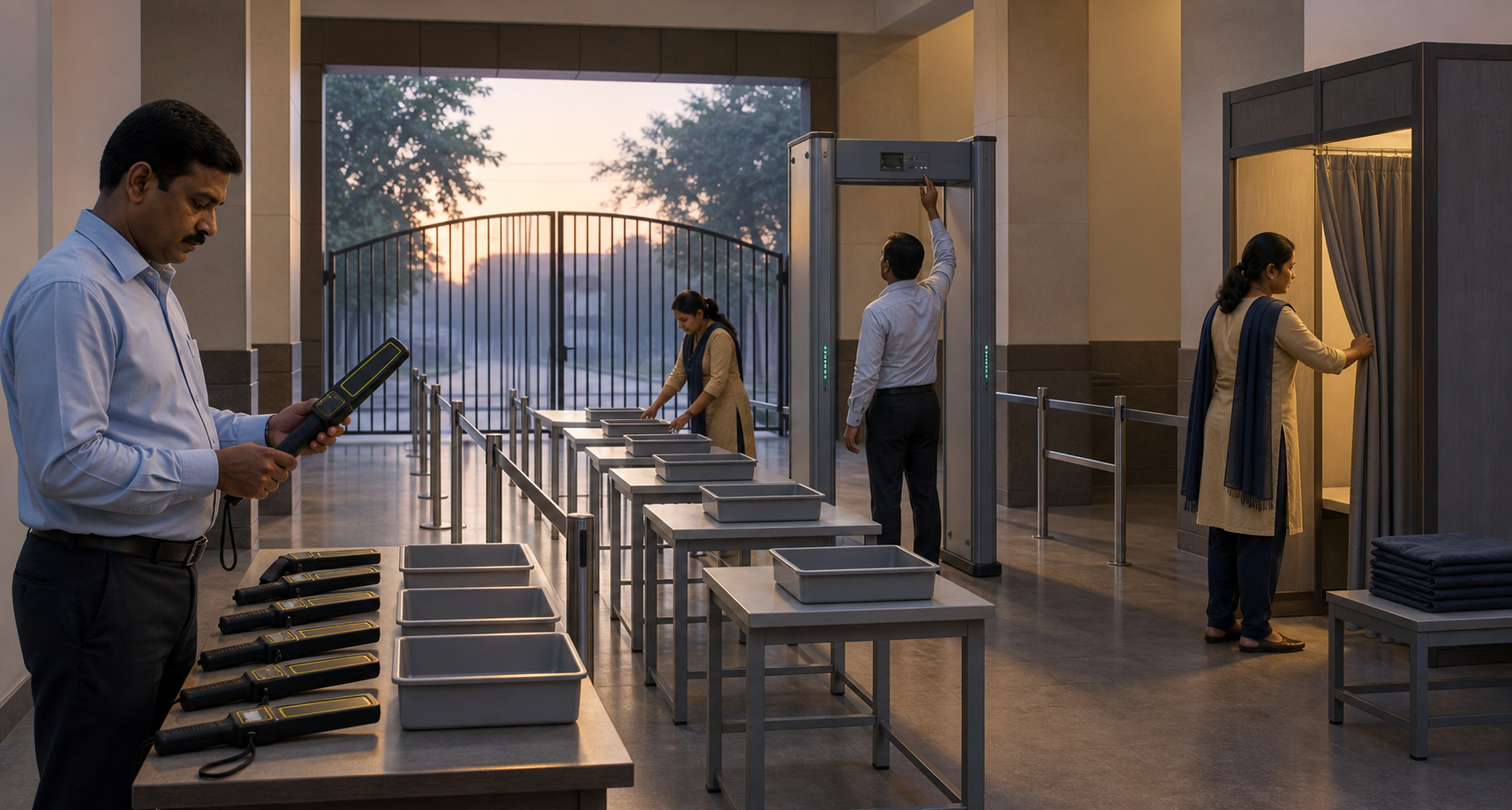
Most examination disputes cannot be resolved well in the final minutes before a paper begins. The student is anxious, the queue is moving, and staff may fear that any departure from their routine will create a security lapse. The solution is to convert broad principles into a sequence that leaves little room for personal preference.
A board or testing body should publish one dress-and-security notice for all candidates. It should identify prohibited articles, state that religious garments and symbols are generally permitted, explain that additional screening may occur when an item presents a relevant risk, and promise private same-gender screening when exposure or bodily contact is required. Multilingual notices, candidate FAQs, and a reachable helpline reduce disputes before examination day.
Each centre then needs the means to honour that promise. A policy offering private screening is hollow if there is no screened area or authorised female employee available. Before candidates arrive, the superintendent should assign personnel, identify a private space, test available screening equipment, establish secure storage for prohibited belongings, and designate an official who can decide escalated cases without delaying the entire queue.
The operational sequence can remain short:
- Match the candidate and admit card using the ordinary identity procedure.
- Identify the specific security concern, if any, created by an item or garment.
- Offer the least-intrusive effective check, in private and with same-gender personnel where appropriate.
- Return every permitted article immediately; place genuinely prohibited belongings in documented secure storage if the rules allow storage.
- Record only an unusual or disputed outcome and allow the candidate to proceed without public discussion of the person’s faith.
- Refer an unresolved disagreement to the centre superintendent or designated grievance officer at once.
An optional accommodation request or self-declaration may help a centre plan staffing, but it should not become a religious test. The form should ask what practical arrangement is needed, such as private female screening, rather than requiring a candidate to prove the theological importance of a familiar symbol. The institution’s task is to manage the examination risk, not to adjudicate doctrine at the gate.
Data restraint matters as well. Identity verification does not normally justify casual photography, circulation of a candidate’s image, or collection of unrelated personal details. Limiting records to what verification and escalation require is especially important when minors and young adults are involved.
If you are the candidate or parent, do three things before the examination. Save the published dress and security notice. Ask in writing about any symbol or garment that may require special screening. Carry only the articles permitted under the notice. A written answer will not guarantee flawless treatment, but it gives centre staff something authoritative to follow.
If a problem arises at the gate, ask which written rule is being applied and what concrete security concern the official is addressing. Request private same-gender screening if removal or exposure is proposed. If the first official cannot decide, ask calmly for the superintendent. Do not turn the security queue into a physical confrontation or leave without learning whether the centre has recorded a refusal; either action can make the academic consequence harder to remedy.
After the examination, submit a factual grievance through the same-day or earliest available channel. Include the examination, centre, approximate time, item involved, words of the applicable notice, official approached, screening alternative requested, and outcome. Avoid speculation about motives unless you have evidence. A precise account is easier to investigate and compare with incidents at other centres.
Where exclusion threatens an admission, qualification, or employment opportunity, act promptly. Administrative complaint periods and legal remedies may be time-sensitive. Preserve the notice, admit card, correspondence, and grievance acknowledgement, and obtain advice from a qualified Indian lawyer on the applicable examination rules rather than treating a general constitutional principle as an automatic answer to an individual case.
When the institution uses sacred imagery, neutrality changes direction

A private advertiser does not occupy the same constitutional position as a state examination board. Yet a company, publisher, or platform still speaks institutionally when it selects Lord Shiva, Shri Ganesh, the Buddha, a Jain Tirthankara, the Sikh Khanda, scripture, liturgical language, or ritual objects for public communication. It cannot shift responsibility to the audience by calling every objection a misunderstanding.
Permitting a devotee to wear a symbol protects personal expression. Choosing a sacred figure to sell a product is an editorial and commercial decision made by the institution. Neutrality here requires restraint, knowledge, and consistent respect across communities rather than a security accommodation.
A useful review has three parts:
- Context: Is the symbol being used to explain a tradition, mark an observance, or communicate something relevant, or has it been placed in a setting that converts devotion into a joke, prop, or attention device?
- Consent: Has someone with genuine knowledge of the tradition reviewed the concept, language, imagery, and timing before release? An internal approval from people unfamiliar with the symbol is not a cultural review.
- Consequence: How will the communication reach devotees, including people who never chose to encounter it? Festival timing, newspaper placement, family viewing, geographic reach, and the possibility of decontextualised digital circulation all affect the likely harm.
These checks do not prohibit criticism, scholarship, news reporting, or serious artistic engagement with religion. A classroom may analyse an image, a museum may place it in historical context, and a newspaper may report a controversy. The warning sign is not mere visibility. It is the use of sacred meaning without enough relevance, accuracy, or care to justify the chosen treatment.
The practical cost of neglect is visible when an institution has to withdraw material after publication. In Chhattisgarh, an advertisement involving Lord Shiva and Shri Ganesh before Mahashivratri was withdrawn after organised representation, followed by an unconditional written apology. The durable lesson is not simply to apologise faster. It is to place cultural review before media booking and distribution, when correction is still inexpensive and complete.
A responsible faith-sensitive workflow should include a calendar of major observances, a named cultural-review owner, reviewers familiar with the traditions depicted, proof-stage checks by publishers, and an escalation route that joins creative, legal, media, and leadership teams. The review should cover print, digital, influencer, outdoor, and regional-language versions; approving one master image is insufficient if later adaptations alter its meaning.
If offensive material has already appeared, the institution should withdraw it across every controlled channel, notify distribution partners, audit related assets, acknowledge the harm without blaming the audience, and explain the process change that will prevent repetition. An apology repairs little when the same creative remains in scheduled posts, dealer materials, newspaper inventory, or regional adaptations.
Communities also have choices. A documented representation identifying the image, placement, timing, harm, and requested remedy gives the responsible institution something concrete to act upon. Ask first for withdrawal, correction, and accountable review. Preserve copies and correspondence. Organised advocacy is most credible when it protects sacred dignity while avoiding threats, collective blame, or retaliation against uninvolved people.
Key takeaways for judging a neutral policy
- Personal religious expression and institutional endorsement are different. Allowing a candidate to retain a symbol does not make it the institution’s symbol.
- A restriction needs a defined operational purpose and a connection to the physical item or conduct, not a presumption about the candidate’s community.
- Comparable risks should receive comparable treatment across a mangalsutra, kara, dastar, burqa, hijab, tilak, janeu, mala, and other religious articles.
- Private, same-gender, targeted screening can protect examination integrity without demanding public exposure or routine surrender of sacred articles.
- Rules must exist before the encounter: publish them, train staff, provide the promised facilities, identify an escalation officer, and document disputed outcomes.
- When an institution itself uses sacred imagery, review context, informed consent, and likely consequences before release rather than relying on crisis management afterward.
If you are facing a rule now, ask for its text, purpose, screening alternative, and appeal route. Those four requests quickly reveal whether you are dealing with a genuine neutral standard or an improvised demand.
If you write institutional policy, draft it with operational verbs: verify, screen, store, return, document, and review. Mention particular garments or symbols only as examples beneath a religion-neutral rule. That gives staff a procedure they can follow and gives every citizen, including Hindus, Buddhists, Jains, Sikhs, Muslims, Christians, and others, a standard they can hold the institution to.
References
- DharmaRenaissance Blog — Maharashtra Allows Burqa in Class 10-12 Exams: Ensuring Fair, Secure, and Inclusive Access
- DharmaRenaissance Blog — Safeguarding Sacred Symbols: HJS Spurs Withdrawal of Offensive Shiva-Ganesh Ad, Full Apology
