
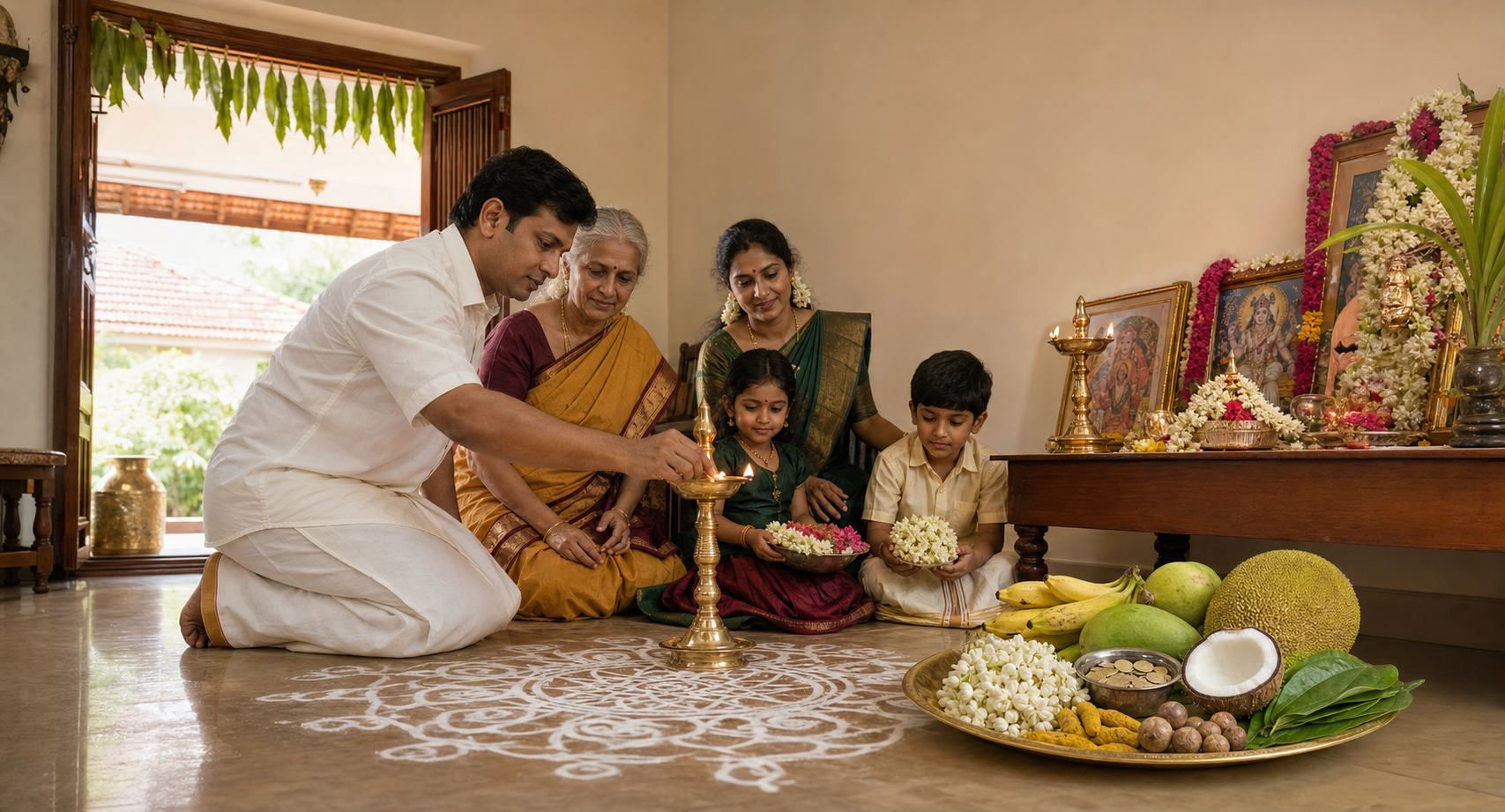
If you are arranging Puthandu for your family, the first question is practical: which date should go on the calendar? In Tamil Nadu, Puthandu 2026 falls on Tuesday, 14 April. If you live outside India, confirm the local date and temple schedule before fixing your pūjā or gathering.
The rest need not become complicated. Once you understand what Chithirai 1 marks, you can shape the day around a few coherent acts: welcome the year auspiciously, worship, receive the elders’ blessings, share a balanced festive meal, give in charity, and begin Parabhava with one intention you can actually keep.
Confirm the date before choosing an auspicious hour
For households in Tamil Nadu, the answer is settled: Chithirai 1 falls on 14 April 2026. Puthandu is also called Varusha Pirappu, Chithirai Pirappu and Chithirai Vishu. These names refer to the beginning of the Tamil solar year, not to several separate festivals requiring different dates.
The date comes from Mesha Sankramana, the instant at which Sūrya moves from Meena Rāśi, sidereal Pisces, into Mesha Rāśi, sidereal Aries. This is why Puthandu remains close to 13 or 14 April on the Gregorian calendar rather than moving through the seasons like a lunar observance.
If you are in the Tamil diaspora, do not copy an India-based clock time into your programme. The astronomical transition is one event, but its local clock reading, civil date and relationship to sunrise change with time zone and location. A community in another part of the world may therefore assign Varusha Pirappu to 13 or 14 April locally. Use a Tamil panchangam calculated for your location, or follow the date published by a nearby temple that has made that calculation.
This distinction matters most when relatives are observing from several countries. You do not have to force every household to light its lamp at the same clock reading. Agree on the locally correct Chithirai 1 for ritual observance, then choose a separate family call that everyone can attend. That preserves both calendrical integrity and family participation.
You may also see slightly different ingress times in different almanacs. Traditional Vākya calculations and modern Drik computations do not always produce the same minute, and the selected ayanāṃśa can affect fine timing. Such differences do not change Tamil Nadu’s observance date in 2026. They matter only if you are selecting a narrow Puṇya Kāla, Mahā Puṇya Kāla or muhūrta.
For an ordinary home New Year pūjā, follow the locally designated sunrise day and do not turn a minute-level discrepancy into anxiety. For an inauguration, business opening, saṃskāra or another event for which you want a precise muhūrta, obtain a local panchangam and ask a qualified priest or astrologer to consider the weekday, nakshatra, lagna and, where relevant, the person’s horoscope. A generic internet time is not a substitute for a location-specific calculation.
Know what changes when Chithirai 1 begins

The Tamil calendar is solar in this context. It follows the sidereal zodiac, which keeps the rāśis aligned with a stellar reference frame. The tropical zodiac familiar from Western seasonal astrology ties its starting point to the vernal equinox. Because precession creates an offset between those two frames, a tropical Aries date cannot be used to determine Puthandu.
You do not need to master the astronomy to observe the festival correctly, but the distinction protects you from a common mistake: Puthandu is not simply a cultural date attached arbitrarily to 14 April. It is the civil observance of a defined solar transition, interpreted through the Tamil calendrical tradition and its sunrise rule.
The transition also advances the traditional sixty-year samvatsara cycle. The year beginning with Mesha Sankramana in 2026 is named Parabhava. You will hear this name in temple saṅkalpas, almanac readings and discussions of the year ahead.
Treat Parabhava as the name of a calendrical year, not as a verdict on your future. Panchangams may present annual palangal concerning society, weather, agriculture or other themes. Many families use these forecasts as prompts for reflection and prudent conduct rather than as deterministic commands. The Dharmic response to a new cycle is still moral agency: clearer duties, steadier practice, generosity and responsible action.
A useful family exercise is to choose one Parabhava saṅkalpa that can survive beyond festival day. Make it observable. “We will practise dāna” is too broad; “we will set aside a portion for charity each month” tells the household what to do. “We will preserve Tamil culture” is admirable but vague; “we will speak Tamil during one weekly family meal and teach the children one prayer used at home” creates a practice.
Build the home observance around a clear morning sequence
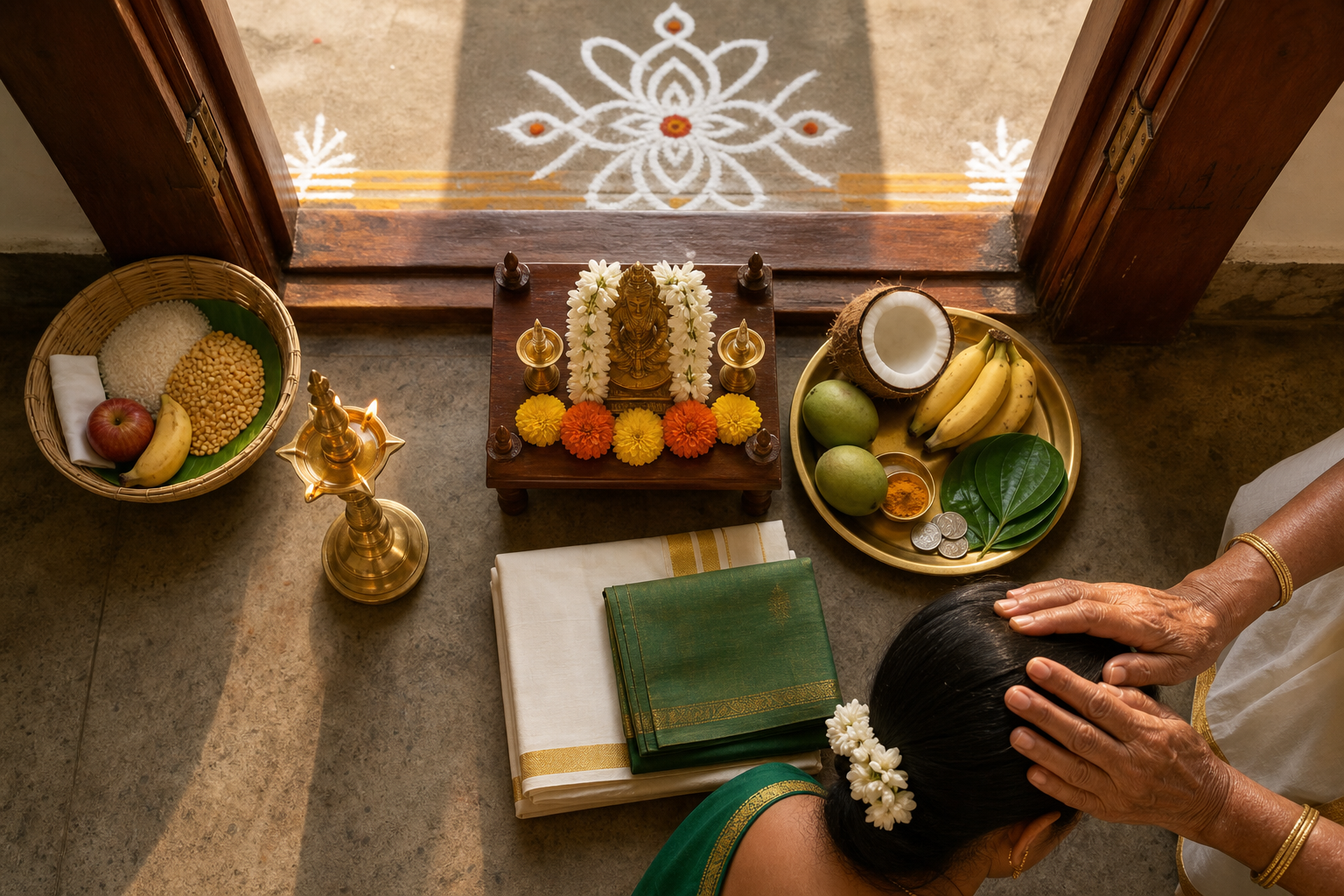
Puthandu customs differ among families, regions and sampradāyas. Preserve your inherited household practice where you have one. If you are rebuilding the observance after a generation away from it, use a simple sequence rather than assembling every custom you encounter online.
Prepare the previous evening
- Clean the entrance and family shrine so the morning is not consumed by chores.
- Set out natural kolam powder and plan the threshold design.
- Gather lamps, flowers, fruit, betel leaves and nuts, coins or another auspicious metal, and a clean mirror if your family observes the morning kani custom.
- Prepare your pūjā materials and place new or freshly cleaned clothes where they are easy to reach.
- Check the temple programme, especially if you want to attend abhishekam, archana or the panchanga pāṭhanam.
- Decide what you will give as dāna. Setting it aside in advance makes charity part of the vrata of the day rather than an afterthought.
The auspicious arrangement sometimes called kani is meant to make the first deliberate sight of the year one of light, beauty, nourishment and sufficiency. A mirror, lit lamps, fruit, flowers, betel leaves and nuts, coins and other symbols of prosperity are customary choices. It does not have to become an expensive display. Cleanliness, attention and reverence matter more than the number of objects.
If kani is not part of your family tradition, you do not need to present it as compulsory. Draw the kolam, light the lamp and begin at the shrine according to your sampradāya. Puthandu remains complete when its centre is worship and dharmic renewal rather than decoration.
Move from first sight to worship and blessings
- Begin after waking with the auspicious sight arranged by the household, if that is your custom.
- Freshen the threshold, draw the kolam and light the lamps at the shrine.
- Offer flowers, fruit and a simple sattvic naivedya to the deities worshipped by your family.
- Recite the prayers or nāmas familiar to your household. A short, attentive pūjā is better than an elaborate sequence performed without understanding.
- State the new year-name, Parabhava, when your inherited saṅkalpa or priest-led worship calls for it.
- Bow to elders and receive their blessings before the day scatters into meals, messages and travel.
- Listen to a local panchangam reading at home or at the temple, then complete the dāna you set aside.
New clothes can mark the freshness of the beginning, but they are not a test of devotion. Clean, respectful clothing is enough. The same principle applies to food and décor: do not turn a festival of renewal into financial strain or comparison between households.
Let the meal teach the day’s central lesson
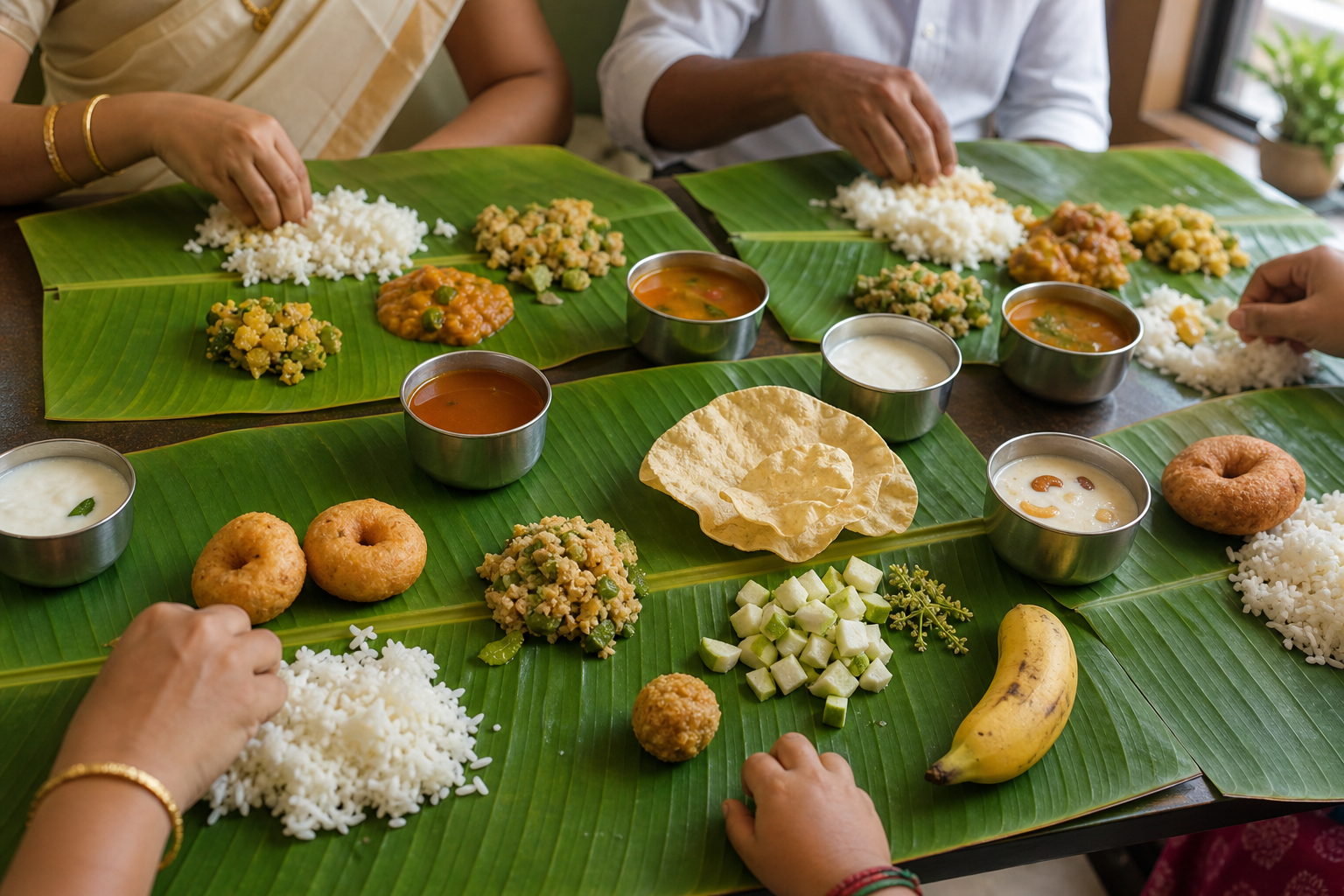
Maanga pachadi gives Puthandu its most memorable edible teaching. Its combination of raw mango, neem flowers, jaggery, tamarind and spice holds contrasting tastes in one preparation. The year ahead will also contain experiences we would choose and experiences we would not. Dharma does not ask us to pretend that every taste is sweet; it asks us to meet the whole with balance.
Serve the pachadi as part of a sattvic festive meal rather than treating it as a decorative spoonful no one understands. Tell children why the tastes are combined. That two-minute explanation carries more cultural memory than an elaborate menu served without context.
Chithirai begins during Tamil Nadu’s hot-weather period, so hospitality should also respond to the season. Neer mor, nannari sherbet or water infused with vetiver can accompany the meal. If guests include people with dietary restrictions, adapt the menu openly while preserving its symbolic centre. Tradition is strengthened when people can participate without avoidable discomfort.
You can extend the day’s ethics through the materials you choose. Natural kolam powder, reusable serving ware, seasonal produce and minimal disposable decoration connect celebration with stewardship. Planting a native sapling can be meaningful when someone has accepted responsibility for its continuing care; planting it only for the photograph misses the point.
Use temple and community observances to deepen the day
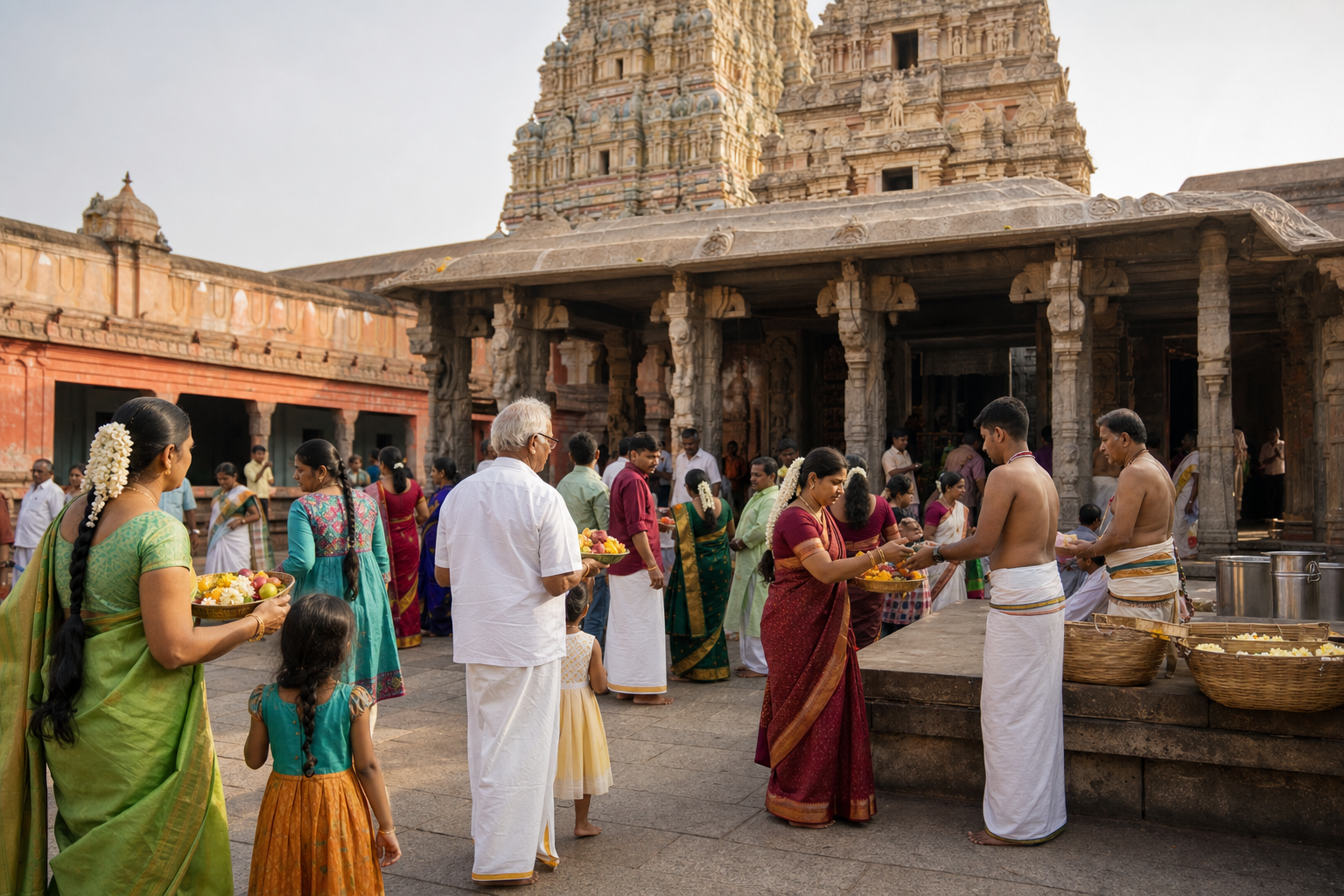
At Tamil Śaiva, Vaiṣṇava and Śākta temples, Puthandu commonly brings special abhishekam, archana and a formal reading of the new panchangam. The reading places the household celebration inside a larger sacred and social calendar. If you can attend only one part of the temple programme, the panchanga pāṭhanam is especially useful because it explains how the community will name and navigate Parabhava.
Check the temple notice before travelling. “Puthandu programme” may include several events at different hours, while the sankranti merit period may be narrower than the main public worship. Families with children or elders can choose the accessible public service without assuming they have failed by missing a minute-specific rite.
In Madurai, Chithirai also opens the renowned Chithirai Thiruvizha associated with the Meenakshi Amman–Sundareswarar temple complex. Its processions bring theology, artistry and civic participation together on a scale far beyond the domestic shrine. A local temple abroad may express the same community principle through a smaller procession, cultural programme, shared meal or almanac reading.
The solar passage behind Puthandu belongs to a wider civilizational rhythm. Related seasonal observances include Vishu in Kerala, Pohela Boishakh in Bengal, Pana Sankranti in Odisha and Bohag Bihu in Assam. Vaisakhi is cherished in Sikh communities around the same period. Theravāda Buddhist cultures mark new-year celebrations such as Songkran in Thailand, Thingyan in Myanmar, Pi Mai in Laos and Choul Chnam Thmey in Cambodia.
Notice the unity without erasing the distinctions. These festivals do not share one interchangeable ritual system, language or theology. What they reveal is a broad Dharmic and Asian habit of aligning communal renewal with cosmic and seasonal time. Jain communities, for example, traditionally mark their New Year in Kārtik around Deepavali, while sharing the ethical emphasis on self-renewal and ahiṃsā.
This wider frame gives diaspora families a practical way to teach Puthandu. Begin with the Tamil name, calendar and household customs. Then show children how neighbouring cultures greet the same season in their own forms. Cultural confidence grows through accurate relationship, not through flattening every celebration into a generic “Indian New Year.”
Your Puthandu 2026 plan at a glance
Key takeaways
- Date in Tamil Nadu: Observe Puthandu on Tuesday, 14 April 2026.
- Date outside India: Confirm Chithirai 1 through a locally calculated Tamil panchangam or your regional temple; the local civil date may be 13 or 14 April.
- Calendrical event: Puthandu follows Mesha Sankramana, when Sūrya enters sidereal Mesha Rāśi.
- Year-name: The new samvatsara is Parabhava, part of the traditional sixty-year cycle.
- Home essentials: Prepare the shrine, draw a kolam, light lamps, make offerings, seek elders’ blessings and complete an act of dāna.
- Festive food: Use maanga pachadi to explain how a dharmic life holds contrasting experiences without losing balance.
- Precise timing: Use local panchangam data for Puṇya Kāla or a new venture; seek personalised counsel when horoscope factors are meant to be considered.
Put three entries on your calendar now: the locally confirmed Chithirai 1, the temple service you intend to attend, and the act of dāna your household will complete. Then choose one modest Parabhava saṅkalpa with a clear rhythm. That is enough to turn a date change into a lived beginning.
References
