
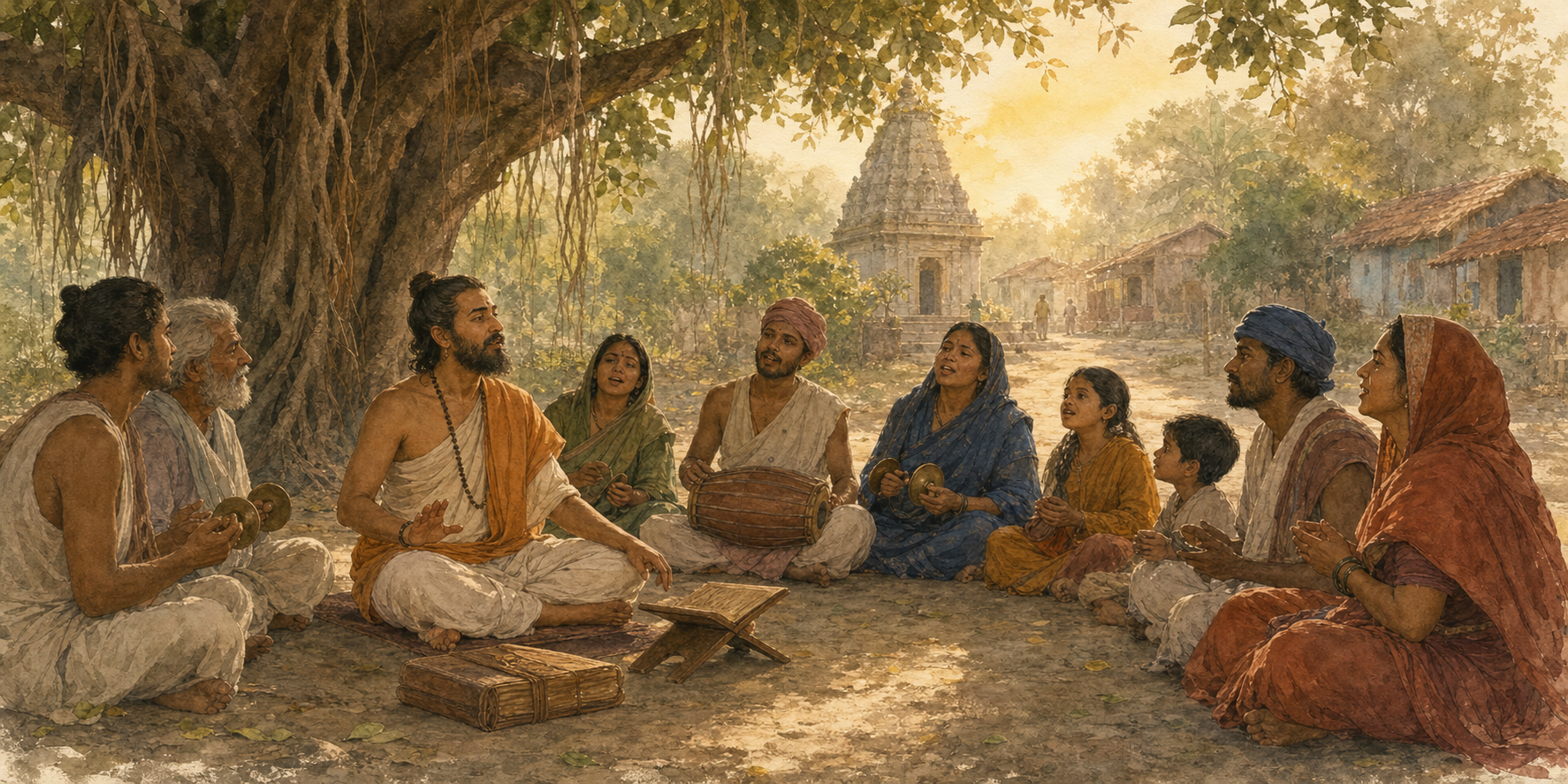
You may know a bhajan well enough to sing its refrain, yet still wonder what it asks you to believe, practise, or change. A translation gives you the words. It does not automatically give you the theology, discipline, performance setting, or lineage carried by those words.
You do not have to choose between warm devotion and serious study. Bhakti saints repeatedly joined the two: they absorbed śāstra, clarified it through reflection, embodied it in conduct, and gave it a form that other people could remember. If you want to receive that inheritance responsibly, learn to follow the whole chain from teaching to song, and from song back into life.
Key takeaways
- Scholarship gives bhakti a theological grammar; devotion turns that grammar into a lived relationship with the Divine.
- A devotional composition carries more than verbal meaning. Melody, repetition, narrative, ethical discipline, guru-paramparā, and communal performance all help transmit it.
- Read every song on two tracks: ask what it teaches, and separately ask what can be established about its author, date, text, and performance history.
- Sacred memory and critical history need not be enemies. Respect begins by describing each form of knowledge accurately.
- The best way to preserve a bhakti composition is to unite careful study, faithful singing, ethical application, and a record of who taught it to you.
Why learned saints made song a vehicle of knowledge
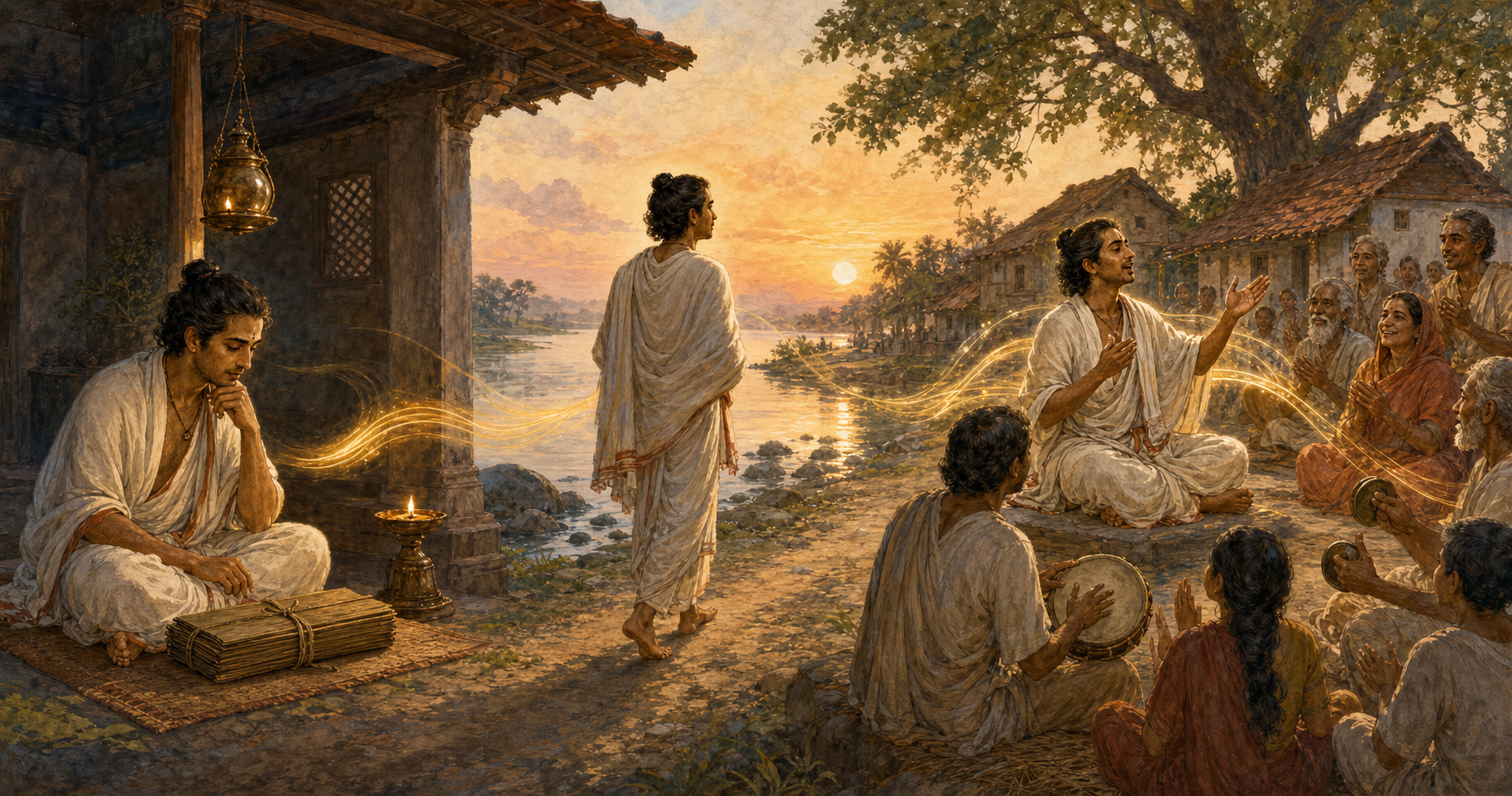
Scholarship in a bhakti setting is not the accumulation of information for its own sake. It disciplines interpretation. A teacher trained in śruti, Vedānta, logic, grammar, poetics, or music can distinguish a pleasing religious sentiment from a coherent teaching about the self, the Divine, liberation, duty, grace, and practice.
Traditional memory presents Madhava Dasar as a student of the four Vedas, Vedānta, and Vaiśeṣika. The combination matters. Vedānta directs inquiry toward Brahman, Ātman, and mokṣa, while Vaiśeṣika trains the mind to make exact distinctions among such categories as substance, quality, motion, generality, particularity, and inherence. Devotional feeling therefore enters a mind already trained to ask what is real, what belongs to what, and what kind of claim is being made.
Madhava Dasar is also remembered through the Janaka ideal: a person can remain engaged in household and civic obligations while cultivating inward freedom. That corrects a common misreading of saintly life. Spiritual seriousness is not measured only by visible withdrawal. You can test your understanding amid work, family duties, speech, money, disagreement, and service. Satya, dayā, dama, and dāna – truthfulness, compassion, restraint, and generosity – are not decorations around realization. They reveal whether knowledge has entered conduct.
Narottama Dasa Thakura shows another form of the same union. Born around 1534 and active into the early seventeenth century, he studied grammar, poetics, music, and Gaudiya theology. In Vrindavan, his training under Jiva Goswami grounded him in acintya-bhedābheda, the teaching of inconceivable unity and difference, and in a disciplined theology of devotional rasa. The songs were not a retreat from that education. They were one of its most effective public forms.
Prarthana and Prema-bhakti-candrikā organize teachings on guru, the divine name, humility, repentance, remembrance, regulated practice, and longing for Krishna. A singer may experience these compositions emotionally, but the emotion has direction. It trains particular relationships, habits, and understandings. The lyric becomes a compact sādhana manual because doctrine, poetic voice, and repeated performance reinforce one another.
Sri Hanuman Das represents a more uncertain textual case. He is remembered as a Sanskrit poet devoted to Rama and Hanuman, and hymns, eulogies, and devotional verses circulate under his name. Those attributions are difficult to verify through comprehensive manuscript catalogues or modern critical editions. You can still study the Rama-Hanuman devotional ideal associated with him, especially dāsya-bhakti, nāma-japa, courage, and sevā. You should simply avoid claiming more textual certainty than the evidence permits.
When you meet a bhakti composition, ask three questions before treating it as a detachable inspirational verse:
- Tattva: What does it claim about the Divine, the self, the guru, the world, bondage, or liberation?
- Bhāva: What disposition does its voice cultivate – service, surrender, repentance, intimacy, wonder, courage, tranquility, or longing?
- Sādhana: What does it train the devotee to do – remember a name, restrain the ego, serve, contemplate, recite, sing, or fulfil an obligation as an offering?
If you cannot yet answer one of these, do not fill the gap with a convenient interpretation. Mark the question and take it to a teacher, commentary, or study circle. That pause is part of faithful transmission.
How devotion survives the journey from śāstra to community
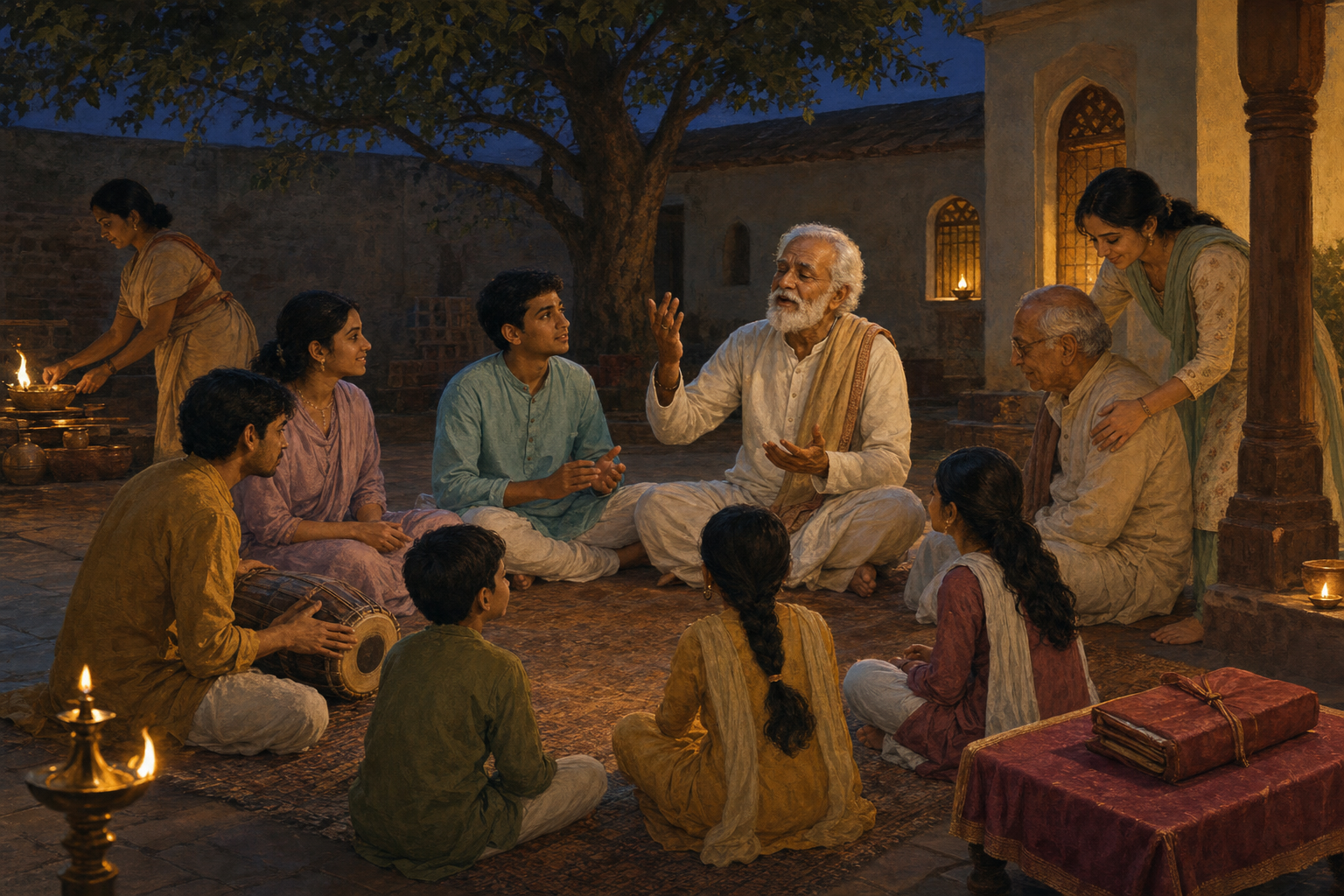
A teaching becomes durable when each part of its transmission does a distinct job. Remove too many parts, and the result may remain attractive while losing its intellectual or practical centre.
| Layer | What it carries | What you should notice |
|---|---|---|
| Śāstra | The authoritative vocabulary, claims, and limits of a tradition | Which primary teachings govern the composition’s meaning |
| Reflection and commentary | Distinctions, reasoning, and answers to misunderstanding | How technical terms relate rather than merely how they translate |
| Kathā | A human situation in which a teaching becomes imaginable | Who acts, chooses, fails, serves, remembers, or receives grace |
| Song and sacred name | Sound, rhythm, affect, and memorability | Which words repeat, where the response falls, and what mood the melody cultivates |
| Ethics and sevā | Visible evidence that devotion is changing conduct | Whether truthfulness, compassion, humility, restraint, and service follow the singing |
| Paramparā and gathering | Correction, recurrence, shared memory, and continuity | Who teaches the text and melody, when it is sung, and how variants are handled |
The movement from kathā to tattva and from tattva to sādhana is especially important. A story first gives you a person, conflict, or relationship to remember. Reflection then draws out the governing principle. Practice makes that principle operative. Without reflection, you may imitate a surface action without understanding it. Without practice, you may admire the principle without allowing it to govern anything.
Music strengthens this chain because it binds meaning to breath, rhythm, bodily participation, and collective recall. Narottama’s saṅkīrtana culture used congregational call-and-response, mṛdaṅga and kartāla accompaniment, and rāga choices suited to occasion and devotional mood. The doctrine did not disappear when it became singable. Its musical form helped communities rehearse it together.
Transmission also requires organization. Narottama joined Srinivasa Acharya and Shyamananda Pandit in carrying the Goswamis’ writings from Vrindavan toward eastern India. Gaudiya memory preserves the disruption of that manuscript journey, but also the wider teaching networks that followed it. The Kheturi Mahotsava is remembered for coordinating kirtana forms, devotional etiquette, festival observance, and previously dispersed communities. Books, trained teachers, pilgrimage, performance conventions, and a recurring calendar worked as one system.
The memory of Sri Hanuman Das belongs to a less textually secure but still instructive ecology. Ayodhya, Kashi, temples, households, villages, pilgrims, and reciters formed channels through which Rama-Hanuman devotion could circulate even when manuscripts were scarce. A saintly name could remain active within a network of recitation, temple worship, and local lineage without leaving the kind of documentary trail a modern historian would prefer.
This helps you notice the difference between storage and transmission. An audio file stores a performance. A scanned manuscript stores an image of a text. Living transmission adds pronunciation, interpretation, correction, occasion, discipline, and responsibility. Preservation is complete only when someone knows how to receive what has been stored and hand it onward without silently remaking it.
Read on two tracks: devotional meaning and historical evidence
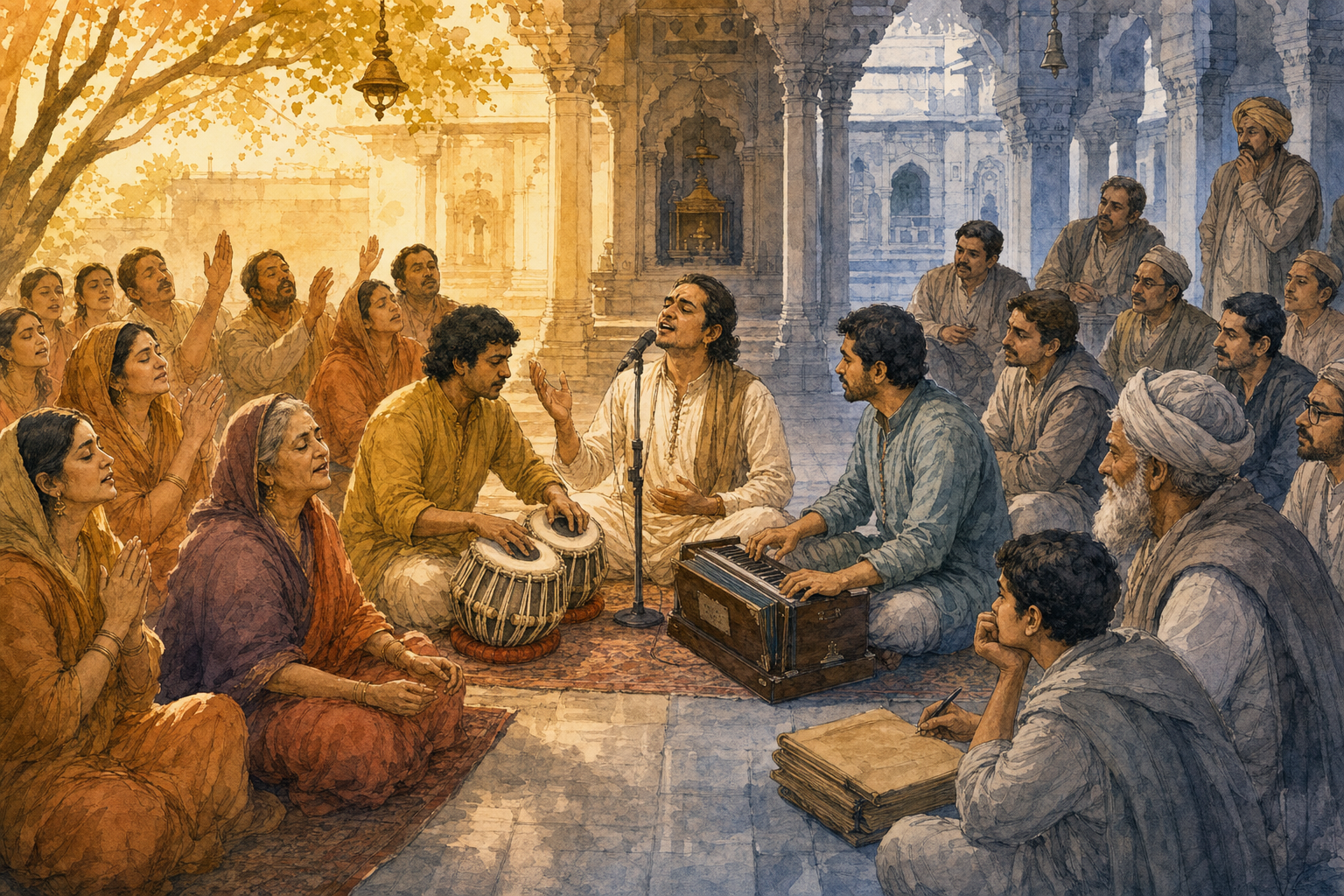
Sympathy without scrutiny can turn uncertain claims into false certainty. Scrutiny without sympathy can reduce a living sacred inheritance to a dispute over dates. A better method keeps devotional interpretation and historical judgment distinct, then lets each illuminate the questions it can actually answer.
Track one: recover what the song is doing
- Name the speaking position. Is the voice praising, confessing, petitioning, instructing, remembering, surrendering, or resolving to serve? Do not assume every devotional utterance is a doctrinal definition.
- Mark the technical words. Terms such as nāma, guru, sevā, śaraṇāgati, prema, bhakti, Brahman, and mokṣa belong to systems of meaning. Translate them, but keep the original terms visible so that a smooth English equivalent does not erase their range.
- Trace the inner movement. Notice whether the composition moves from forgetfulness to remembrance, pride to humility, fear to refuge, separation to longing, or hearing to service. That movement often reveals how the song is meant to train the singer.
- Recover the performance setting. Ask whether the composition serves private japa, congregational kirtana, temple recitation, pilgrimage, a festival, or narrative exposition. A refrain designed for communal response does different pedagogical work from a verse intended for solitary contemplation.
- Identify the ethical consequence. Write down the conduct the song should produce. If surrender is the theme, does it reduce entitlement? If divine service is praised, where does service enter your obligations? If the holy name is central, what pattern of remembrance will continue after the music stops?
Return to the sung form after analysis. A lyric is not merely a proposition wearing ornamental language. Meter, repetition, sound, rāga, tāla, and the relation between lead singer and congregation can shape attention and devotional rasa. Explanation should help you hear more, not leave the song behind.
Track two: state the evidence at its actual strength
Use clear labels in your notes, teaching, and publishing:
- Historically anchored: a claim supported by datable manuscripts, colophons, inscriptions, securely identified people, critical editions, or a traceable institutional setting.
- Traditionally attributed: a name, work, event, or teaching consistently carried by a lineage, though the available evidence does not settle every historical detail.
- Presently uncertain: a claim for which attribution, chronology, textual identity, or provenance remains unresolved.
Narottama Dasa Thakura can be situated around 1534 to the early seventeenth century, and named works, teachers, associates, places, and institutions give his transmission a comparatively firm historical frame. Hagiographic accounts of vocational calling or divine grace should still be identified as sacred biography rather than converted into ordinary documentary claims.
Madhava Dasar’s remembered learning, morality, songs, and Janaka-like household spirituality can guide devotional interpretation, while dates and individual attributions vary in oral memory. The responsible wording is not evasive: say that the tradition remembers him in this way, then explain why that memory matters.
Sri Hanuman Das requires greater chronological caution. A first-century CE date belongs to regional lore rather than established epigraphic or philological history. Hanuman’s iconographic and epigraphic prominence becomes more visible during the Gupta and post-Gupta centuries, roughly the fourth through seventh centuries CE, which makes the earlier attribution unusually difficult to sustain. This does not prove that every associated devotional memory is spiritually empty. It means you should not use devotional importance as a substitute for chronological evidence.
Keep a compact record beside any composition you teach:
- Attribution: the name used by the lineage and any variant names.
- Textual basis: manuscript, edition, oral transcription, temple booklet, or recording.
- Confidence: historically anchored, traditionally attributed, or presently uncertain.
- Teaching: the central tattva, bhāva, and sādhana you can justify from the words.
- Performance lineage: who taught the melody, pronunciation, rhythm, and occasion of use.
- Variants: wording or melodic differences that should remain visible instead of being silently harmonized.
Oral testimony is especially valuable for showing what a community received, how it performs the material, and which meanings it associates with the practice. It does not automatically establish the date at which every word originated. Once you stop asking one kind of evidence to answer every kind of question, faith and history can meet without either being misrepresented.
Run a study circle that joins text, voice, and conduct

You can apply this method in a home, temple group, or informal satsanga without turning every gathering into an academic seminar. The aim is disciplined participation: enough preparation to protect meaning, enough singing to inhabit it, and enough ethical reflection to keep devotion from becoming a performance detached from life.
- Select responsibly. Begin with a composition already carried by a recognizable paramparā or community. Record the attributed author, language, text used, and level of historical confidence.
- Hear it before dissecting it. Let participants listen to or sing the complete composition. Notice the refrain, pace, emotional tone, and congregational response before offering an interpretation.
- Place the words in view. Provide the original script when possible, a transliteration for readers who need it, and a clear translation. Flag uncertain readings and variants instead of quietly choosing whichever wording makes the explanation easier.
- Extract tattva, bhāva, and sādhana. State the doctrinal claim, the devotional disposition, and the requested practice separately. This prevents an intense mood from being mistaken for the whole teaching.
- Connect the song to its narrative and lineage. Explain the divine relationship, kathā, teacher, festival, or theological school needed to understand the composition. Keep established history distinct from hagiographic memory.
- End with a lived obligation. Ask each participant to name a concrete act of truthfulness, compassion, restraint, generosity, remembrance, or service that follows from the teaching. The act should fit the person’s actual duties rather than imitate the external life of a renunciant.
- Preserve the handoff. Keep the text, translation, performance lineage, variants, explanatory notes, and recording together. Future singers need to know not only what was sung but how your community understood and received it.
The Janaka model is useful here. Madhava Dasar’s remembered synthesis of jñāna, disciplined action, and bhakti directs the householder toward integration. Your employment, care for relatives, civic obligations, and ordinary speech become places where devotional knowledge is verified. A song about surrender that leaves your conduct untouched has not yet completed its journey.
In a gathering that includes several Dharmic traditions, name resonances precisely and leave genuine differences intact. Hindu nāma-saṅkīrtana can be discussed alongside Sikh kirtan, nām-simran, and sevā; Buddhist contemplative discipline and compassion; and Jain ahiṃsā and rigorous self-mastery. These practices meet around remembrance, compassion, discipline, truthfulness, and service, but they do not thereby become identical accounts of the Divine, the self, karma, or liberation. Say that one practice resonates with another, not that they are secretly the same.
Before your next recitation, choose a song your family or community already sings and prepare its transmission record: attribution, textual basis, central teaching, devotional mood, practical discipline, and performance lineage. Bring that record into the gathering, sing the composition in its proper setting, and let its teaching govern one real obligation afterward. That is how inherited devotion becomes a faithful handoff rather than a fading memory.
References
- DharmaRenaissance Blog – Madhava Dasar: Timeless Vedantic Scholar and Bhakti Luminary Bridging Knowledge and Devotion
- DharmaRenaissance Blog – Sri Hanuman Das: Enigmatic Early Bhakti Poet of Uttar Pradesh and Rama-Hanuman Devotion
- DharmaRenaissance Blog – Narottama Dasa Thakura: Architect of Gaudiya Bhakti, Kirtan Pioneer, and Kheturi Revival
