
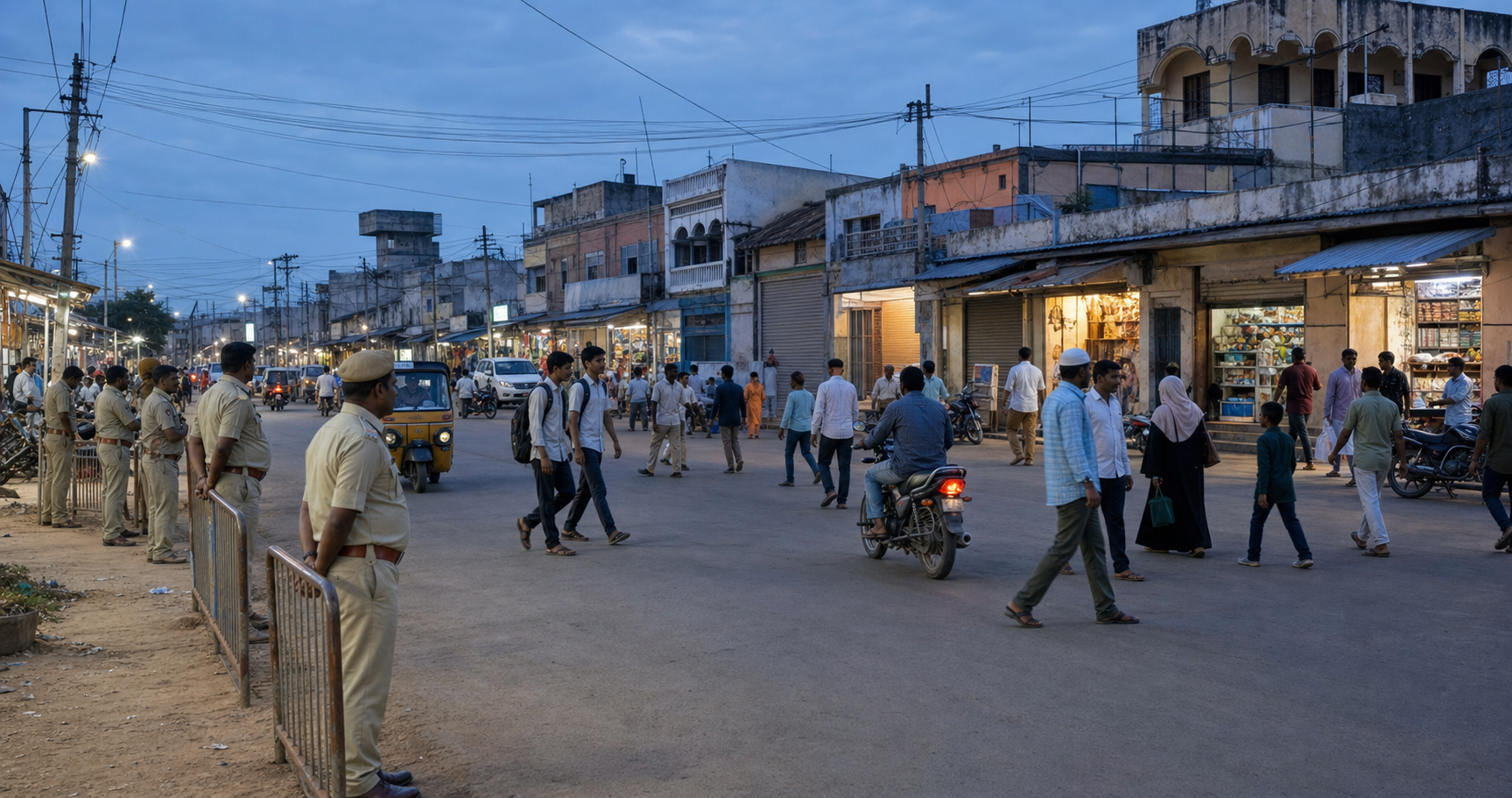
If you live, trade, study, travel, or worship in the Kamareddy-Nizamabad belt, the immediate question after a communal clash is practical: what will stop a second confrontation without turning temporary police power into arbitrary control?
On 22 February 2026, Telangana Police detained former BJP MLA T. Raja Singh while he was travelling toward Banswada following reports of a clash. The sound way to assess that intervention is neither to approve it automatically nor to reject it because of the leader involved. Ask whether it addressed a specific and immediate danger, used no more restraint than necessary, treated all potential mobilisers equally, and remained open to review.
The immediate task is preventing a second event, not obscuring the first
A local clash and its next wave are often different public-order problems. The first may involve identifiable participants at a particular place. The next can grow through an unverified video, a rumour about an injured person or place of worship, an unexpected roadside gathering, a prominent political visit, or a counter-mobilisation organised in response.
This is why stopping a high-profile visitor before entry into a sensitive area can be a legitimate circuit breaker. The visitor’s stated intention is not the only relevant factor. A convoy, supporters waiting along the route, hostile counter-groups, and live social-media updates can create a focal point around which a crowd forms. Police do not have to wait for the crowd to become violent before managing that risk.
But a preventive stop is not a finding of guilt. It cannot replace investigation of the original violence, protection for threatened residents, preservation of evidence, or prosecution of actual offenders. Quiet streets achieved by postponing those duties would be administrative silence, not justice.
You should therefore look for three tracks operating at once: investigation of what already happened, containment of an immediate risk, and restoration of ordinary movement and civic life as soon as conditions permit. If officials discuss only restrictions while saying nothing about victims, evidence, suspects, or the conditions for lifting controls, the response is incomplete.
Key takeaways
- Judge a preventive detention by the immediacy of the risk, the narrowness of the restriction, equal treatment, recorded reasons, and prompt review.
- Do not confuse a temporary preventive stop with proof of criminal culpability.
- Police should combine restrictions with investigation, route guidance, protection of vulnerable locations, and frequent verified updates.
- Residents help most by refusing unverified forwards, avoiding sensitive junctions, reporting specific threats, and checking vulnerable neighbours.
- A Dharmic response rejects collective blame without accepting impunity for verified violence.
A fair test for detention, prohibitory orders, and dispersal
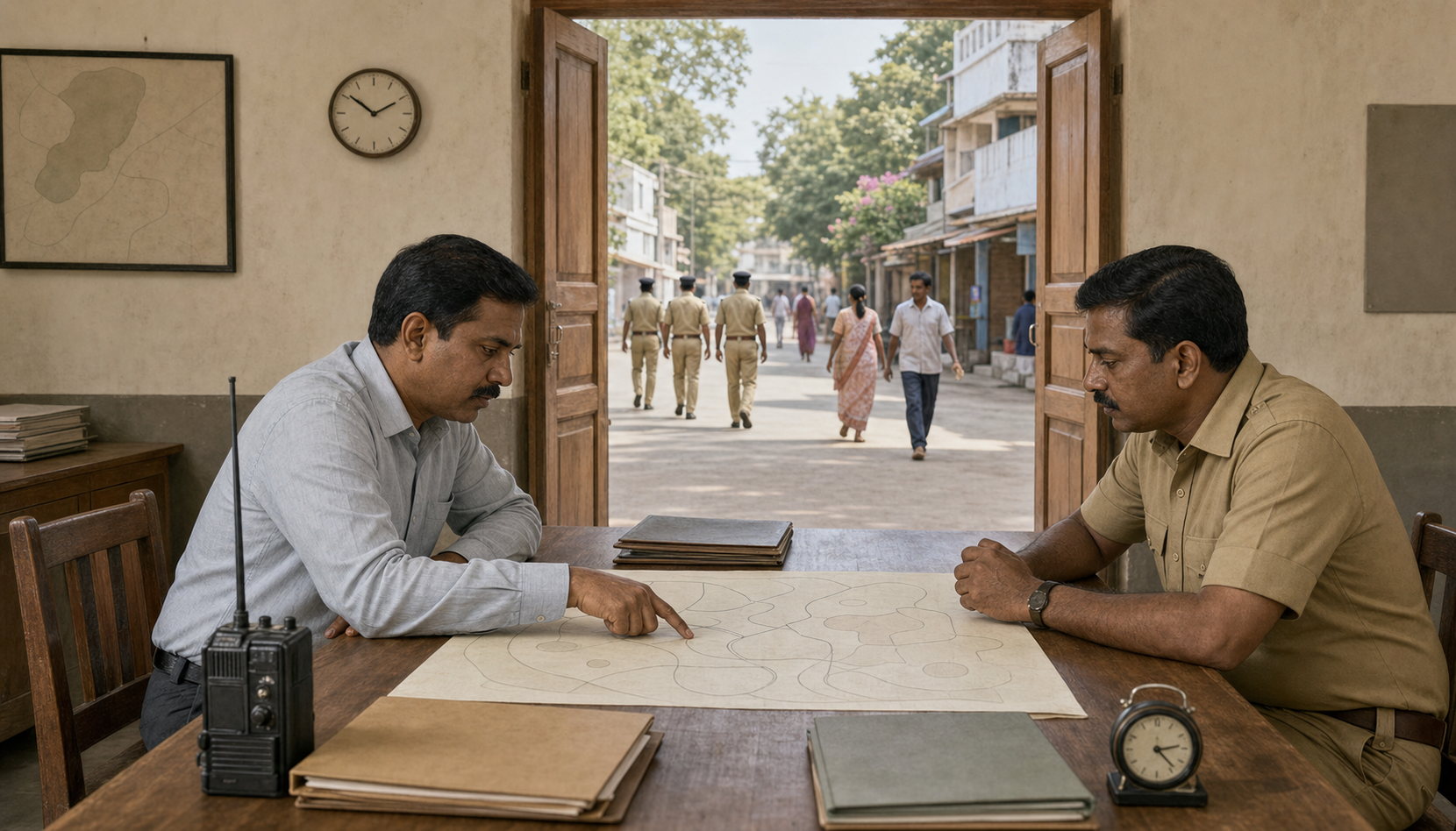
Preventive policing covers measures of very different severity. A short, event-specific arrest intended to avert an imminent breach of peace is not the same as detention under a specialised preventive-detention statute. A local order limiting assembly is not the same as an indefinite ban on political activity. Dispersing a dangerous crowd is not permission to punish peaceful bystanders.
The familiar CrPC provisions associated with this preventive ladder help explain the distinctions: Section 149 concerned the police duty to prevent cognisable offences; Section 151 addressed arrest to prevent such an offence in an imminent situation; Section 144 supported urgent prohibitory orders; and Section 129 dealt with dispersal of an unlawful assembly. These labels do not by themselves prove that a particular action was lawful or proportionate. Anyone challenging a current order should obtain the operative written order and advice on the law then in force rather than relying on a section number copied into a message or television graphic.
For a citizen, journalist, community representative, or political worker, the useful questions are concrete:
- What was the immediate risk? Officials should be able to connect the restriction to a place, anticipated gathering, route, threat, or other current condition. Reputation and political disagreement alone are not enough.
- How narrow was the measure? Stopping entry into a flashpoint is easier to justify than preventing unrelated activity across a much wider area. A restriction should not extend beyond the risk that prompted it.
- Were less coercive options considered? A route change, postponed visit, limited delegation, remote statement, negotiated timing window, or controlled meeting may sometimes address the danger.
- Was the rule applied evenly? If one side’s mobilisation is blocked while a hostile counter-gathering is tolerated, confidence in the operation will collapse. Neutrality has to be visible on the ground.
- Can the decision be reviewed? The order, reasons, responsible authority, geographical scope, and route for legal challenge should be identifiable. Emergency power must remain accountable power.
- What ends the restriction? Residents need to know whether reopening depends on dispersal of crowds, completion of a security assessment, restoration of transport, or another observable condition.
A pro-Hindu outlook does not require an automatic defence of every state restriction, and it does not require an automatic defence of every leader who is restricted. It requires something harder and more durable: equal protection for Hindus, equal restraint on those capable of escalating violence, a real investigation, and reasons that can survive scrutiny after the emergency passes.
If you believe an order is unlawful, do not try to settle that question physically at a barricade. Defiance at the flashpoint can expose you and others to injury, detention, or prosecution while making the underlying legal issue harder to isolate. Record the order or notice where this can be done safely, note the issuing authority and location, preserve relevant communications, and seek qualified legal assistance.
Containment works only when the administration reduces uncertainty
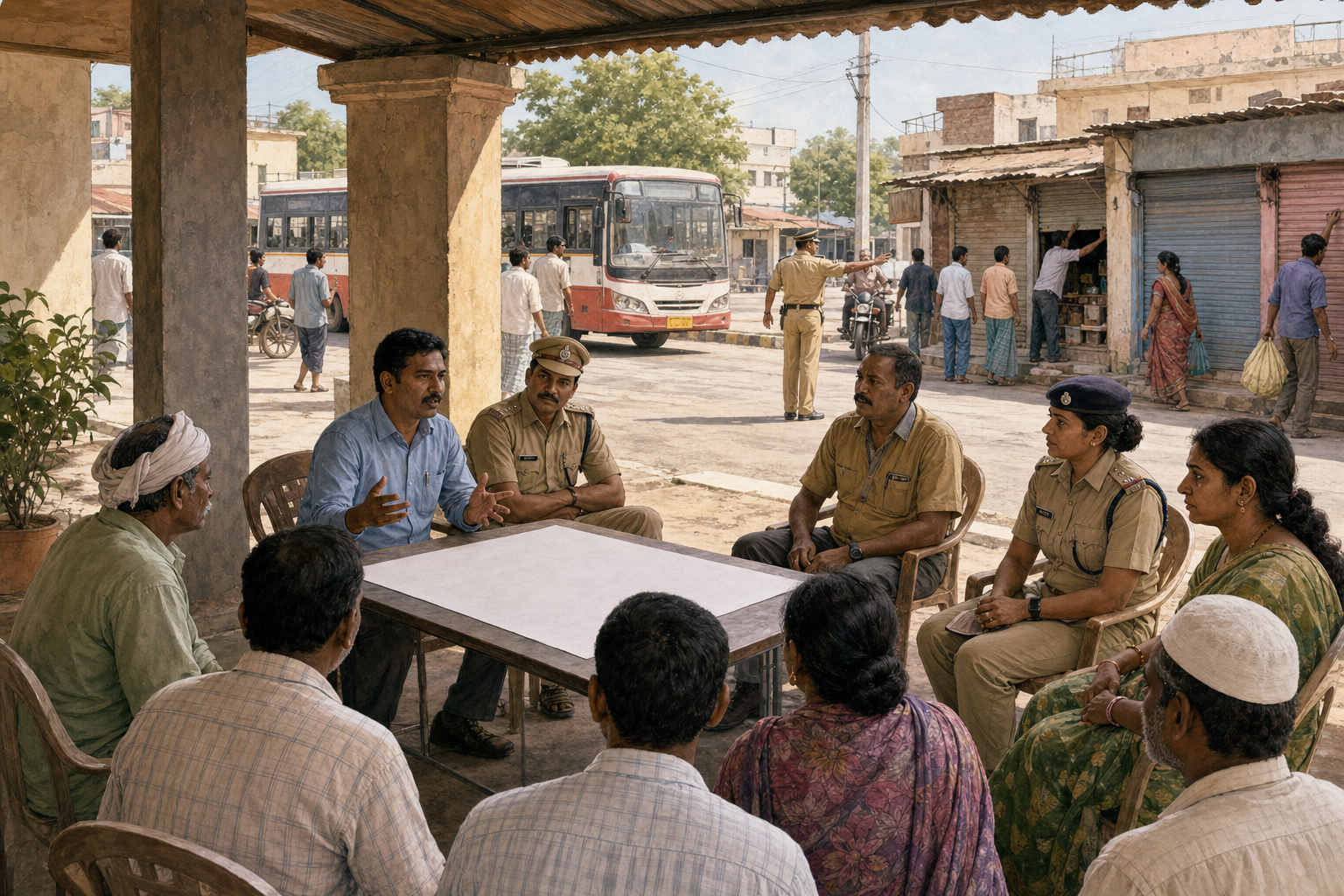
A barricade can separate two crowds, but it cannot answer the questions moving through homes and messaging groups. Is a road open? Is the market closed? Is a temple accessible? Is a circulating video from Banswada, or is it old footage from elsewhere? Has a procession been rerouted? Families make decisions from those answers. If official communication arrives late or without usable detail, rumour fills the gap.
An effective district response therefore has several visible parts:
- Separate likely points of contact. Buffer zones, foot patrols, mobile patrols, traffic diversions, and controlled access should concentrate on sensitive junctions and routes rather than inconveniencing an entire population without distinction.
- Keep movement predictable. Residents need clear information about diversions, blocked approaches, permitted access, and changes affecting markets, transport, examinations, work, or worship. A lawful restriction is easier to follow when people can see a safe alternative.
- Use local liaison before the crowd forms. Peace Committees should include religious institutions, traders, youth representatives, women’s groups, and neighbourhood bodies. Their job is not ceremonial endorsement. They should identify rumours, frightened localities, disputed routes, and people capable of calling off an unsafe gathering.
- Issue behaviour-specific appeals. Telling everyone to maintain peace is too vague. Useful guidance identifies the junction to avoid, the route under restriction, the official channel to follow, the conduct prohibited, and the contact for clarification.
- Correct misinformation where it is spreading. A correction posted only on a government website may never reach the messaging group carrying the rumour. Verified district notices should be relayed through trusted local broadcasters, traders, religious committees, and neighbourhood contacts.
- Use force as a last step in a graded response. Clear warnings, negotiation, voluntary withdrawal, and targeted detention of identifiable instigators should come before broader force where circumstances permit. Any use of force should be recorded, supervised, and followed by prompt medical help for anyone injured.
- Preserve an operational record. Written orders, video of dispersal, body-worn camera material where available, arrest records, and logs of warnings support later review. Documentation protects residents against abuse and officers against false allegations.
Broad telecom restrictions should remain exceptional. Cutting communication can slow inflammatory circulation, but it can also obstruct emergency calls, verified corrections, work, and contact with vulnerable relatives. It is not a substitute for precise public communication and should require a demonstrable public-safety need, lawful approval, limited scope, and continuing review.
The administration should also speak about the original offence. Preventive policing loses legitimacy when the public sees great energy devoted to stopping visitors but little visible effort devoted to identifying assailants, protecting witnesses, or securing damaged property. Operational details may sometimes need to remain confidential, but the existence and direction of the investigation should not be a mystery.
What you can do without becoming part of the mobilisation
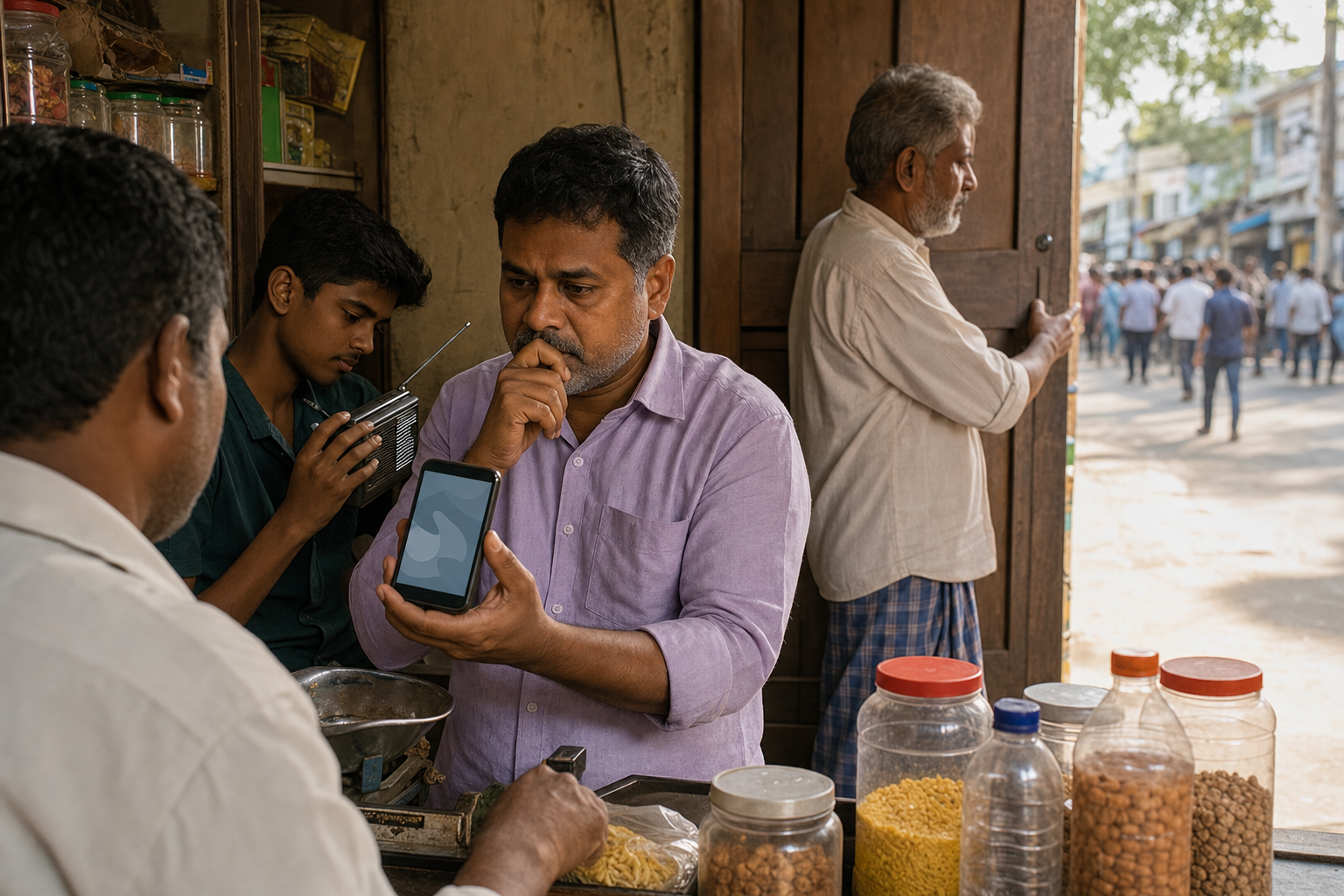
Most residents will never need to negotiate with a police commander or address a public meeting. Your decisions still matter because crowds are assembled from individual movements and rumours are amplified by individual forwards.
Before forwarding a claim or leaving home
- Check whether the district administration or police have issued a verified update. Look at the timestamp and the exact locality, not just the headline or caption.
- Do not forward a video merely because it supports what you already suspect. If its date and place are unverified, say nothing publicly and send it privately to the appropriate reporting channel if it appears relevant.
- Do not add a religious identity, motive, casualty claim, or name that has not been verified. One unsupported label can turn a local criminal allegation into collective accusation.
- Avoid travelling to a sensitive junction to see what is happening. Spectators obstruct movement, enlarge the apparent crowd, and can become trapped between opposing groups.
- Follow a lawful prohibitory or traffic order. If its scope is unclear, ask the named authority or a qualified lawyer rather than accepting an interpretation circulating in a political group.
- Keep emergency contacts accessible and agree on a safe family communication plan. Check on elders, children, people with disabilities, and anyone who depends on medication or daily assistance.
If you directly witness violence or damage
Move to safety before recording anything. When it is safe, note the location, sequence, visible conduct, direction of movement, and what you personally observed. Separate observation from inference. Preserve original files rather than editing them into a dramatic clip, and provide material through a legitimate police or legal channel. Publishing identifiable victims or witnesses can expose them to harassment and contaminate public understanding before facts are established.
Report a specific threat, weapon, fire, assault, blocked escape route, or attack on a place of worship immediately. Do not attempt to confront or detain suspected offenders yourself. Private enforcement can produce mistaken identification, retaliation, injury, and fresh criminal exposure.
If you lead a temple, trader, youth, or neighbourhood group
- Designate a named liaison and a backup who can receive police instructions, verify them, and relay the same wording to members. Competing messages from several office-bearers create confusion.
- Correct a false claim in the same group where it appeared. A quiet correction elsewhere does not interrupt the original forwarding chain.
- Tell members what conduct is expected: do not assemble, do not approach the restricted route, do not answer provocation, and use the specified reporting contact.
- Coordinate access to worship rather than calling supporters to gather in defence of a rumoured threat. Ask police for protection when a threat is specific; do not manufacture a crowd around the site.
- Maintain a private list of vulnerable households that may need food, medicine, transport information, or welfare checks if markets or roads are disrupted.
- If closures create genuine hardship, organise relief such as a shared kitchen only after confirming a safe location and lawful access. Assistance should not become a cover for mobilisation.
- Do not turn volunteers into patrols or an informal intelligence force. Their useful role is to route verified information, reduce panic, and identify needs for lawful authorities.
Political leaders have a parallel duty. They can condemn verified wrongdoing, demand protection and investigation, and challenge an order through lawful channels without travelling into a volatile zone. A public commitment to postpone a visit, avoid provocative language, or accept a negotiated route can reduce street-level danger without surrendering the underlying political position.
Dharmic restraint must lead to accountable peace

Ahimsa is sometimes misread as passivity. In a communal crisis, it demands disciplined action against the conditions that permit further harm. Karuna directs attention to the frightened family, injured stranger, stranded worker, and isolated elder. Aparigraha asks leaders to loosen their grip on prestige and the urge to dominate the moment. Sarbat da bhala widens concern beyond one’s own supporters without erasing the duty to name wrongdoing accurately.
For Hindus, restraint does not mean silence about violence against Hindus, damage to temples, intimidation, or unequal enforcement when any of these is supported by evidence. It means refusing to weaken a valid grievance through exaggeration, indiscriminate accusation, or an unlawful crowd. Precision protects both truth and the community presenting it.
A credible Dharmic response makes three refusals. It refuses collective guilt, because an offender’s religious identity does not transfer culpability to neighbours who committed no offence. It refuses false equivalence, because reconciliation does not require pretending that every verified act has an identical counterpart. And it refuses impunity, because peace without investigation leaves victims unprotected and future instigators encouraged.
Joint appeals can be useful when they contain commitments people can observe: no retaliatory gathering, no unverified posts, respect for agreed procession routes and sound limits, protection of all places of worship, and immediate reporting of threats. A photograph of leaders standing together has little value if their organisations continue circulating incompatible instructions afterward.
Once the streets are calm
The end of visible tension should begin an accountability phase, not close the file. Subject to lawful limits, the district should preserve and review the timeline of orders, detentions, warnings, deployments, injuries, and damage. Allegations concerning the original clash, later incitement, excessive force, discriminatory enforcement, and attacks on property should follow evidence rather than political convenience.
Peace Committees should then turn broad goodwill into local rules. Map sensitive approaches and transport choke points. Agree on liaison contacts, procession routes, timing windows, sound limits, entry and exit flows, and procedures for correcting a rumour. Include traders, women, young people, resident groups, and religious institutions so that the committee can see costs that senior officials may miss.
The review should also account for the quieter damage caused by disorder and prolonged restrictions: lost daily wages, interrupted trade, blocked transport, delayed examinations, and difficulty reaching essential services. These consequences are why early, narrow, and well-communicated intervention is preferable to waiting until a broad curfew becomes necessary.
Successful preventive policing is not merely an absence of noise. It is the absence of further injury and destruction, followed by restored rights, a credible investigation, documented decisions, and lawful consequences for those responsible. That is the standard Banswada’s residents should apply regardless of which party, leader, or community is under scrutiny.
If you are in the affected belt, make your next steps deliberately ordinary: save the verified district information channel, confirm a safe route, identify your community liaison, decline unverified forwards, and check a vulnerable neighbour. Then keep asking the harder civic questions about evidence, equal enforcement, written reasons, and restoration of normal life. Restraint can stop the next crowd; accountability is what prevents the next crisis.
References
