
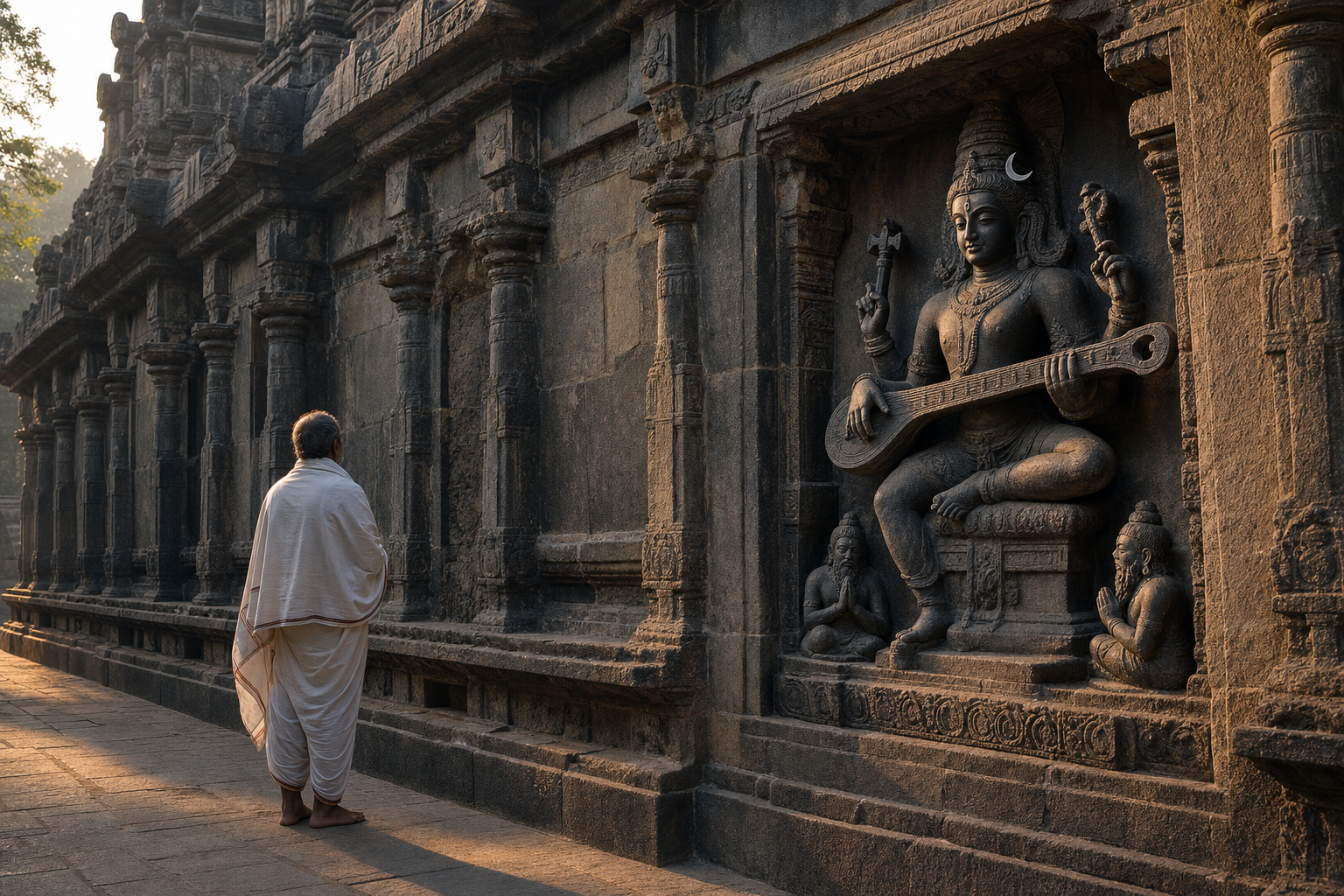
You are walking around a Shiva temple’s sanctum when a quiet figure stops you: matted locks, a stringed instrument, perhaps a few attentive sages, and hands poised over strings that stone cannot sound. Is this Dakshinamurthy, another form of Shiva, or simply a divine musician?
You can usually identify Veenadhara Dakshinamurthy without a label if you read the image in the right order. Begin with its architectural position, confirm the Shaiva signs, examine the veena, and only then use posture and style to ask when and where it may have been made. That sequence protects you from the two most common errors: treating every veena-bearing deity as this form of Shiva, and assigning a date from posture alone.
Begin with the niche, not the instrument
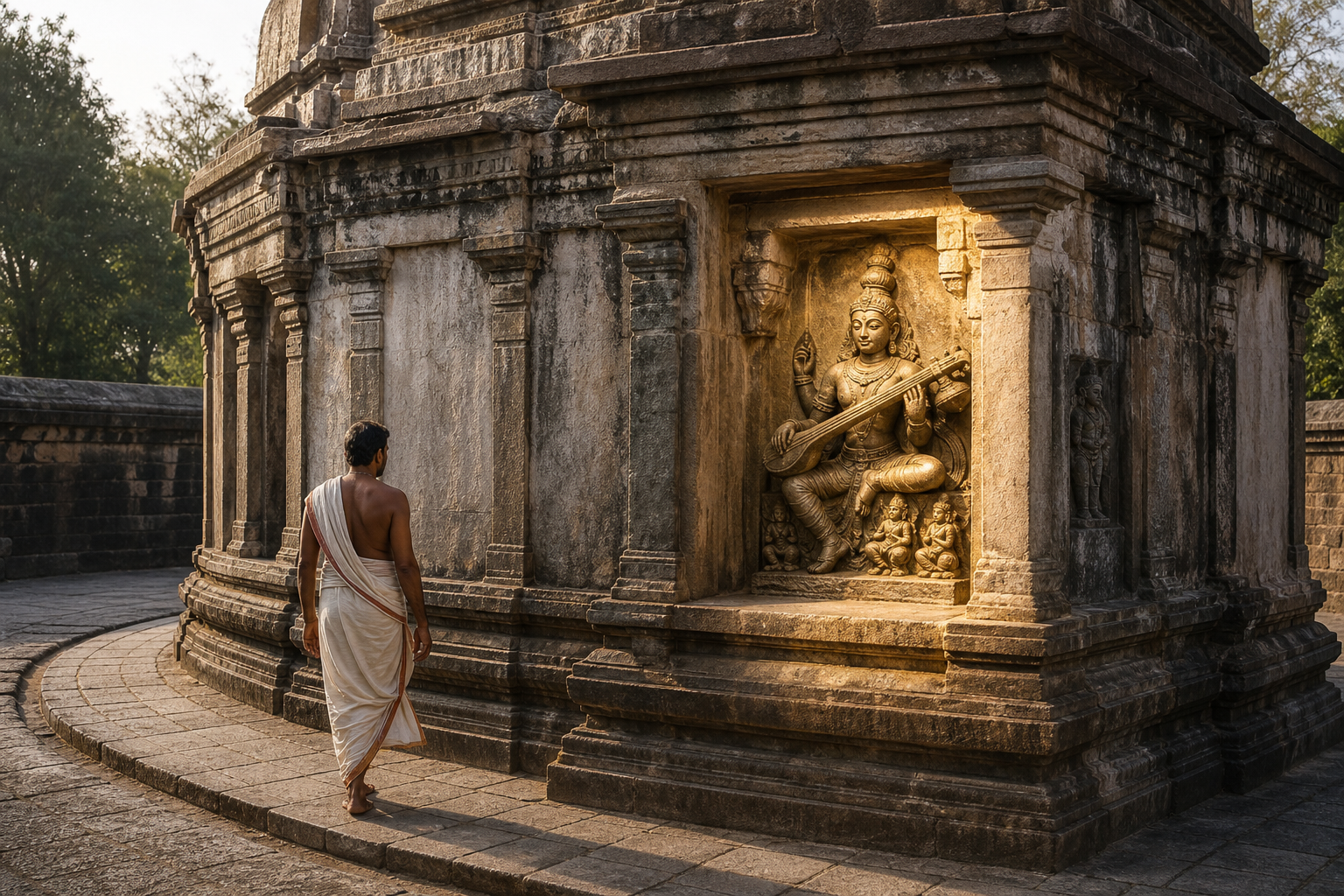
Veenadhara Dakshinamurthy belongs to the larger Dakshinamurthy tradition of Shiva as guru. His usual architectural address is the south-facing niche on the sanctum’s outer wall, traditionally called the dakshina koshta. The position is meaningful rather than incidental: dakshina identifies the southern direction embedded in the name Dakshinamurthy.
Use this field sequence when the temple provides no readable identification:
- Locate the main sanctum. Walk around its exterior and establish which wall faces south. A figure in that wall’s niche begins with a strong Dakshinamurthy context.
- Confirm that the figure is Shaiva. Look for matted locks arranged as a jata-makuta, a crescent, a serpentine sacred thread, or a tiger-skin garment. Preservation may leave only some of these signs.
- Find the governing object. In this form, the veena organizes the pose. It is not a small accessory at the edge of the composition; the hands and torso are arranged in relation to it.
- Read the posture. A seated musician points toward the āsana form. A standing musician, often held in a gentle rhythmic bend, points toward the sthānaka form.
- Use the surrounding figures as confirmation. Sages or ganas may attend the guru. A banyan canopy is especially at home in the seated composition, but neither a particular attendant nor a surviving canopy is required in every example.
No single clue should bear the whole identification. A veena can appear elsewhere in sacred art, and a south-wall location by itself does not describe the figure’s particular form. Confidence comes from the cluster: south niche, Shiva’s visual identity, the veena, and the bearing of a teacher.
If damage has removed the instrument or head, do not force a precise name from the remaining pose. Record the location, arm positions, attendants, and surviving attributes separately. A careful probable identification is more useful than a confident label that conceals what the stone can no longer show.
Seated and standing forms create different kinds of presence
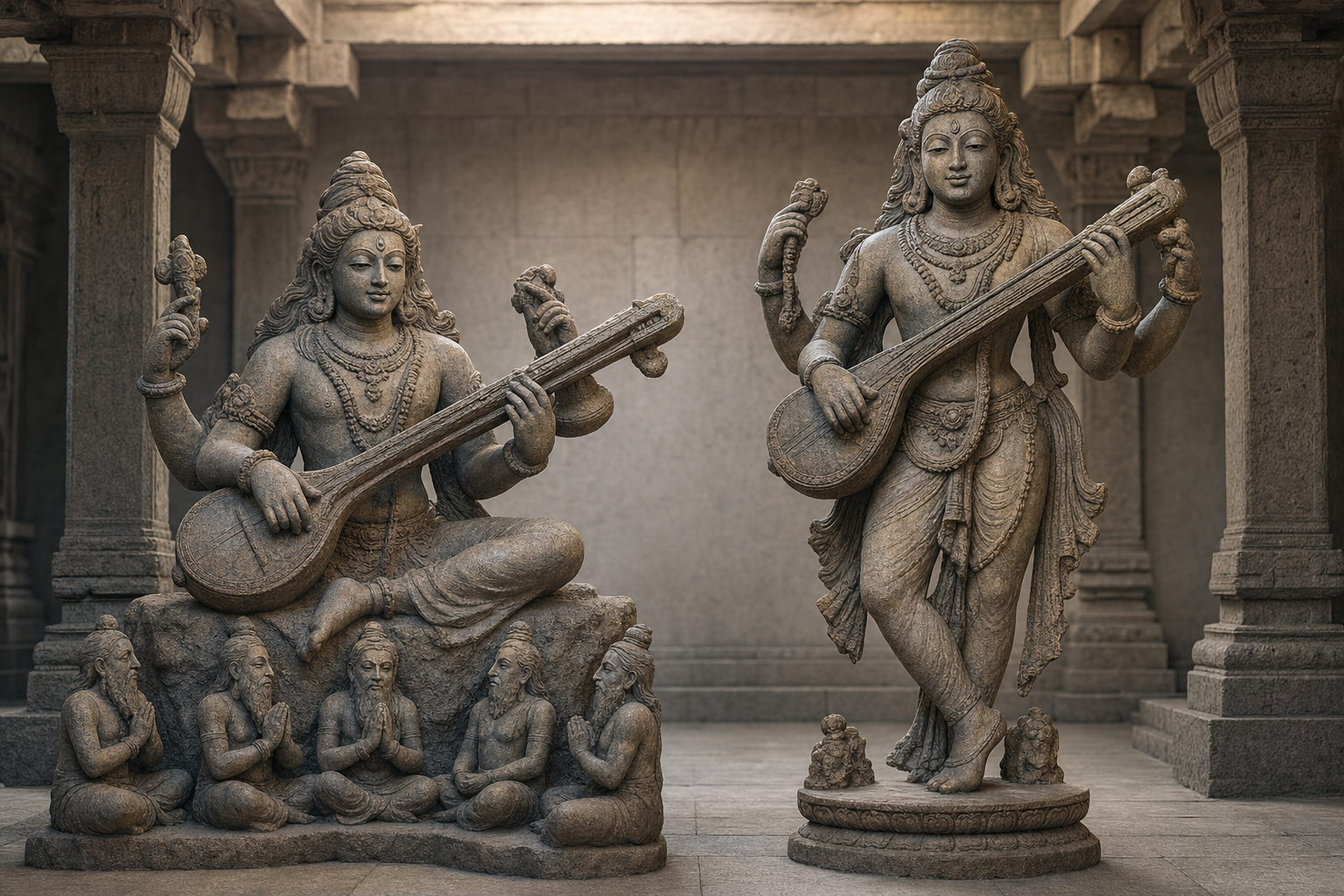
The two principal forms do more than place the same deity in different positions. Each changes how you experience Shiva’s teaching. The seated image gathers attention inward; the standing image lets musical rhythm travel through the body.
| Feature | Seated, or āsana, form | Standing, or sthānaka, form |
|---|---|---|
| Body | Composed in a meditative seat, usually with a tranquil, lowered gaze | Often shaped by a subtle tribhanga, giving the figure rhythmic poise |
| Veena | Usually rests across the lap | May be cradled, slung, or supported for an imagined performance |
| Setting | May include a banyan canopy and attentive sages or ganas | Movement in stance and drapery can carry more of the composition’s energy |
| Dominant impression | Contemplation, absorption, and intimate instruction | Musical action, grace, and the bodily animation of sound |
| Historical association | Especially refined in Chola work of the 10th-12th centuries CE | Often associated with early Pallava experimentation of the 7th-8th centuries CE |
These historical associations are useful, but they are not automatic dates. Early Pallava ateliers are linked particularly with the standing musician, while Chola sculptors brought the seated teacher to a highly controlled meditative maturity. Yet workshop lineages continued and localized these patterns across Tamil Nadu and into parts of Karnataka and Kerala. A later sculptor could inherit an earlier compositional preference.
Style should therefore support, not replace, the iconographic reading. Slender limbs, restrained ornament, animated drapery, and an impression of movement can point toward a Pallava idiom. Greater bodily volume, clearer anatomical modelling, rich detail, and the composed gravity of the seated guru can point toward Chola refinement. Date cautiously unless the temple’s wider sculptural programme, inscriptions, or established provenance supplies firmer evidence.
The most revealing distinction is experiential. In the seated form, the veena crosses a body already at rest, so music seems to emerge from contemplation. In the standing form, the body itself becomes part of the rhythm. The first asks you to listen into stillness; the second makes stillness visible within movement.
Read the attributes in a hierarchy
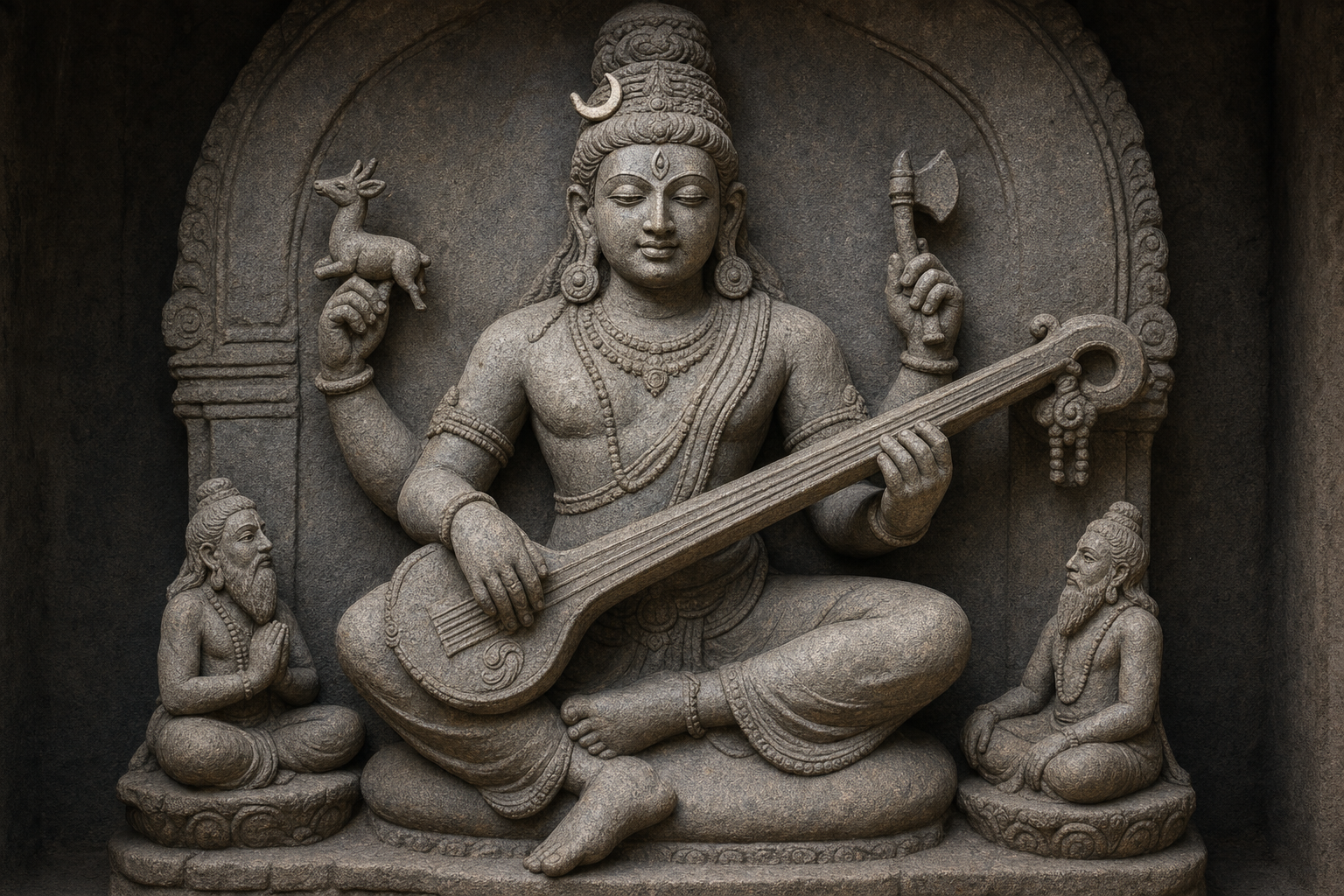
Temple iconography permits meaningful variation. Veenadhara Dakshinamurthy may have two arms or four. The veena may change shape, and attendants may differ with period, region, available space, or the choices of a workshop. You will identify the image more reliably if you separate its essential sign from its supporting signs.
- The essential sign is the musical guru. Shiva’s relationship to the veena defines the form. In a two-armed image, both hands can be wholly occupied with the instrument.
- The Shaiva signs establish identity. Matted locks, crescent, serpent-thread, and tiger skin tell you that the musician is Shiva rather than merely any sacred figure holding a stringed instrument.
- Upper hands extend the teaching. In a four-armed image, an akshamala may evoke time, a pustaka scripture, and a small flame inner illumination. Their presence enriches the form; their absence does not disqualify it.
- The setting establishes the relationship. Sages show the deity as teacher before receptive pupils. Ganas can place the musician at the centre of a celestial ensemble. The banyan carries the familiar atmosphere of Dakshinamurthy’s instruction.
This hierarchy resolves several apparent inconsistencies. Four arms do not make the image more authentic than two. A book does not turn it into a different form when the veena remains central. Ganas need not appear merely because the name Gana Dakshinamurthy is used, and sages need not be present in every carving for the guru-character to remain legible.
The alternative epithet Gana Dakshinamurthy brings forward Shiva’s role as the inspirer and ordering presence among the ganas. It is a complementary emphasis, not a reason to detach the figure from Veenadhara Dakshinamurthy’s musical teaching. In both names, sound is ordered by awareness rather than released as noise.
Do not make the precise silhouette of the veena a rigid test. Regional workshops could develop different instrument forms while preserving the decisive relationship between teacher, hands, strings, and attentive company. The icon’s grammar is stable even when its sculptural vocabulary changes.
Move from visual recognition to the teaching of sound
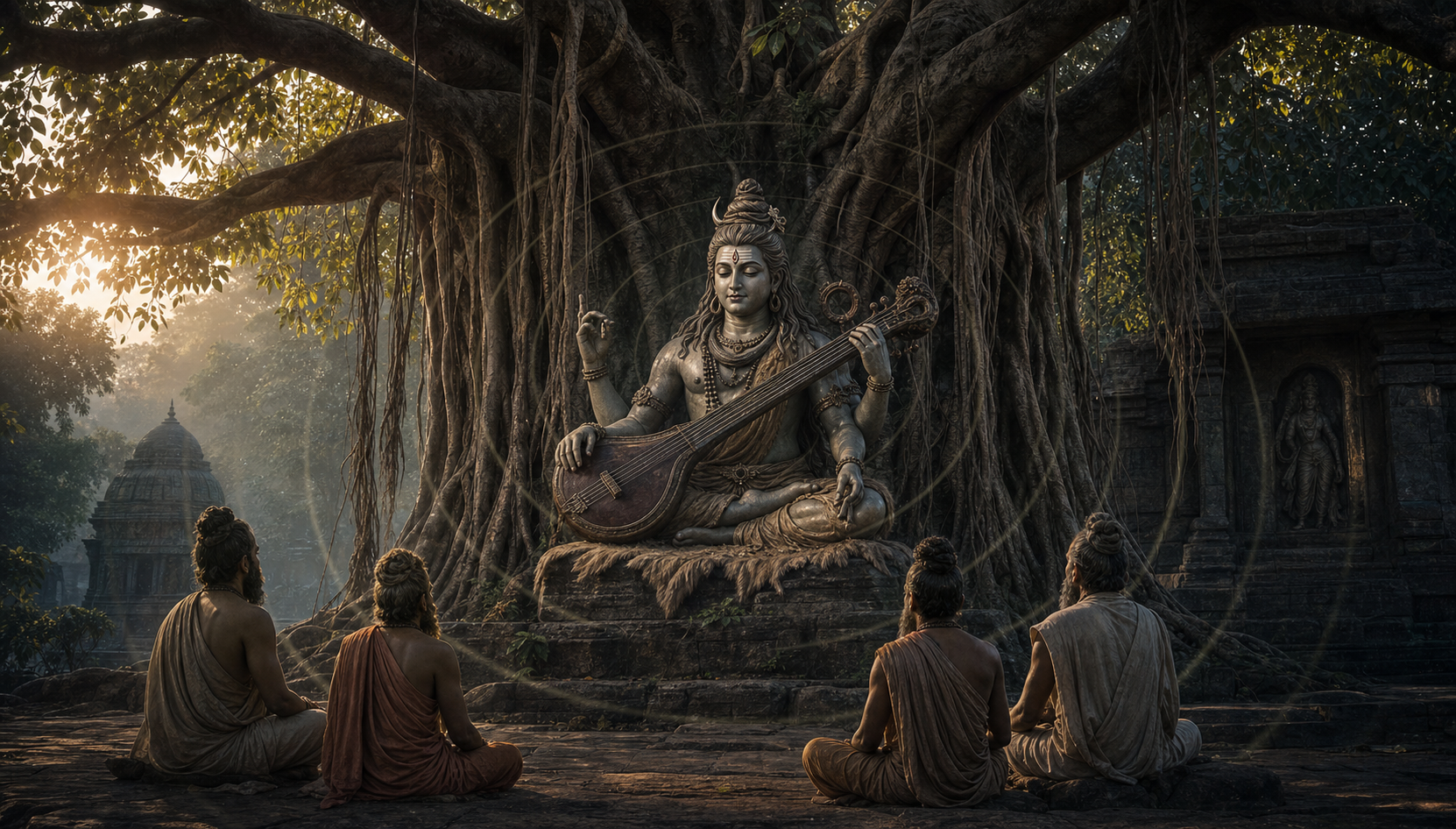
What the veena adds to Dakshinamurthy
Dakshinamurthy is the guru in whom knowledge, stillness, and revelation meet. The Veenadhara form does not abandon the famous teaching through silence; it lets you see how sound can arise from that silence without breaking it. Shiva’s instruction becomes audible in principle as nāda, sacred vibration disciplined into meaning.
The instrument can be read as a model of ordered life. Its resonating body has been understood in relation to the cosmic source of sound, its neck to the course of prana, and its strings to senses brought into harmony. These correspondences should not become a mechanical code imposed on every carving. Their practical force lies in the relationship they share: resonance requires structure, tuning, attention, and rightly held tension.
That is why the veena is not decoration. A string produces no meaningful note merely because it exists. If it is slack, it cannot answer; if its tension is misjudged, its sound fails. The musician must listen while acting. As a spiritual image, Veenadhara Dakshinamurthy gives form to the same discipline: senses are not simply rejected, but tuned; breath is not ignored, but steadied; knowledge is not merely stored, but made living through attentive practice.
The contrast with a book is especially instructive. A pustaka represents doctrine in articulated form. The veena brings hearing, memory, repetition, bodily skill, and attunement to the foreground. This is not an argument against scripture. It is a reminder that a teaching has not completed its work when you can repeat its words; it must alter the rhythm of attention.
Nataraja and Veenadhara Dakshinamurthy make complementary Shaiva statements. Nataraja reveals cosmic order through dance and rhythm. The musician-guru reveals its melodic dimension. One makes the universe appear choreographed; the other asks whether you are tuned well enough to hear its order.
This insight also helps you recognise a real kinship among Dharmic paths without flattening their distinct teachings. Hindu kirtan and instrumental devotion, Buddhist and Jain recitation, and Sikh shabad kirtan all give cultivated sound a serious religious role. Shared reliance on listening, recitation, and song does not mean identical theology. It shows that Dharmic practice repeatedly treats sound as a means of training memory, attention, ethical disposition, and contemplative awareness.
How to use the encounter as a visitor or practitioner
Once you have identified the figure, resist the urge to reduce it to a photograph and a dynasty label. First record what is actually present: temple and niche, facing direction, seated or standing posture, number of arms, position of the veena, objects in the upper hands, Shaiva markers, canopy, attendants, and the stylistic features you can describe without guessing. Keep observation separate from interpretation in your notes. That distinction will make your photographs and later reading far more useful.
Then look at the relationship between stillness and action. Are the fingers poised to play while the face remains undisturbed? Does a standing curve animate the instrument, or does the lap stabilize it? Are the attendants looking toward Shiva, and does their scale make the guru appear remote or intimate? These questions let the composition teach you how it wants to be seen.
If you are a music student, carry four questions from the niche into your next practice session: Is the breath steady? Are you listening before producing sound? Is tension calibrated rather than merely increased? Can attention remain composed while the hands work? The figure’s relevance to artistic discipline lies precisely in this union of breath, listening, controlled tension, and inner steadiness.
If you teach, the icon offers an equally exact standard. Technique and character do not mature on separate tracks. The guru’s poise models a rigor that is firm without becoming agitated, while the instrument shows that the learner must participate through repeated, attentive adjustment. Teaching is neither the delivery of information nor indulgent encouragement; it is the patient cultivation of a student’s capacity to hear and correct.
For devotional practice, Thursday, or Guru-vāra, is commonly associated with worship of the guru, and devotees approach this form seeking clarity, artistic mastery, and stability in practice. The sculpture itself keeps those aspirations grounded. Shiva holds an instrument whose beauty depends on discipline, so the prayer for mastery also carries a demand: become teachable, listen closely, and return to the work.
Key takeaways
- Start at the sanctum’s south exterior niche; architectural position is your first strong clue.
- Confirm Shiva through matted locks, crescent, serpent-thread, tiger skin, or other surviving Shaiva markers before relying on the veena.
- A seated figure with the instrument across the lap emphasizes contemplative teaching; a standing figure with a rhythmic bend emphasizes musical action.
- Standing forms are often associated with early Pallava work of the 7th-8th centuries CE, while seated forms received notable Chola refinement in the 10th-12th centuries CE. Treat these as tendencies, not self-sufficient dates.
- Two or four arms, different attendants, and varying veena forms are legitimate variations. The constant is Shiva as guru making disciplined sound the vehicle of wisdom.
- After identifying the image, apply its teaching: steady the breath, listen before acting, calibrate tension, and preserve composure within skilled movement.
On your next temple visit, go deliberately to the southern wall and read the sculpture before reading its label. When you notice how location, posture, hands, instrument, and attendants work together, the silent veena stops being an object in stone. It becomes a precise invitation to make listening part of knowledge.
References
