
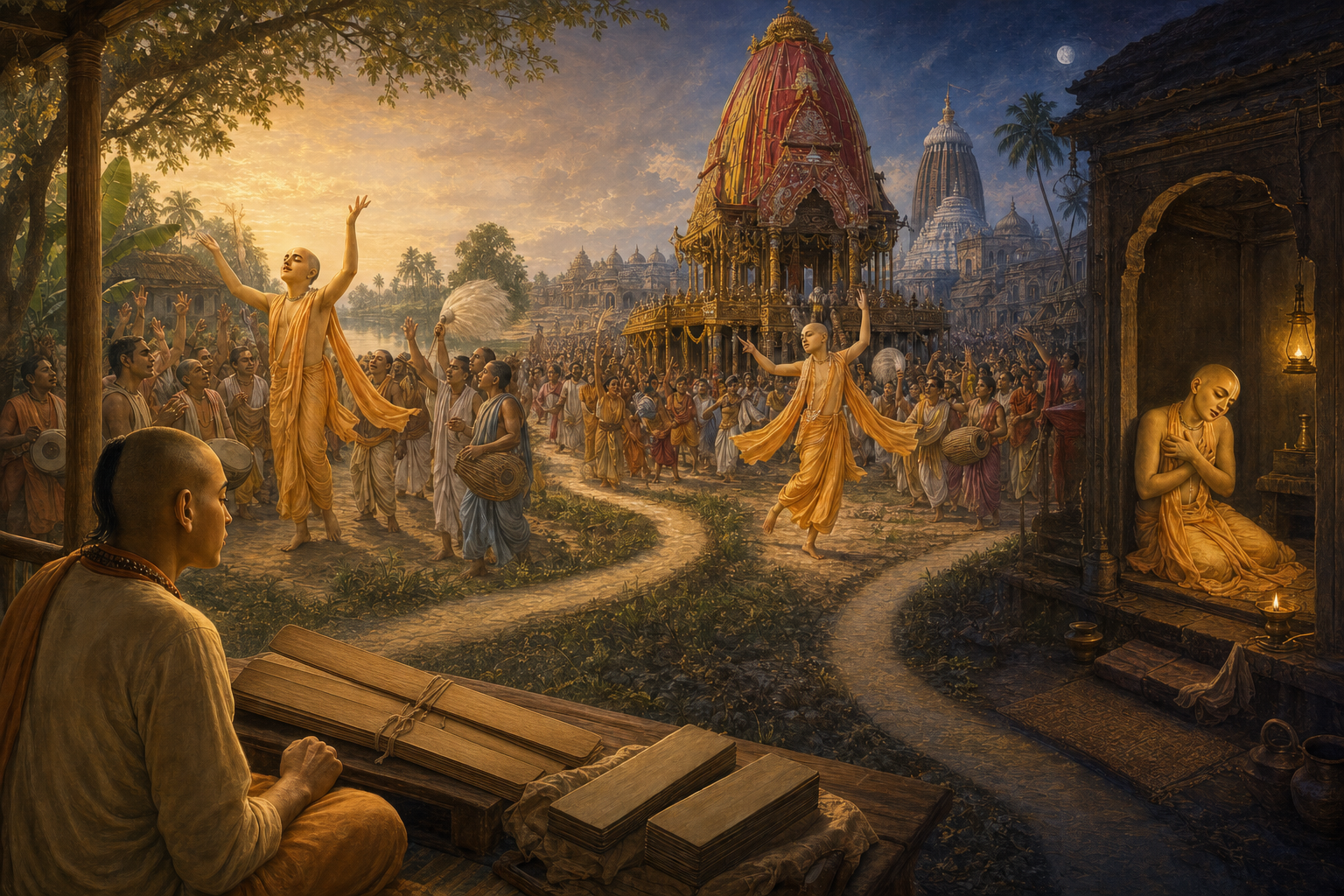
You reach the Second Chapter of Madhya-lila expecting the middle of Sri Chaitanya Mahaprabhu’s life. Instead, you are shown glimpses of the intense inner states associated with his final twelve years in Jagannatha Puri. If you read only for chronology, the placement can look like a detour or an unnecessary repetition.
Read it as an interpretive key instead. By allowing Antya-lila to appear before the narrative fully arrives there, the Caitanya-caritamrta tells you how to approach everything between the opening and the culmination. The early glimpse prepares you to recognize a progressive deepening of devotion, especially the love of Krishna experienced through separation.
The three lilas are movements of meaning, not sealed compartments
Adi-lila, Madhya-lila, and Antya-lila provide a chronological structure, but chronology is not their only function. They also move through origins, expansion, and culmination. The divisions tell you what kind of spiritual development to notice, not merely where one period ends and another begins.
| Movement | Primary function | Question to carry while reading |
|---|---|---|
| Adi-lila | Establishes origins, identity, and mission | What makes the later unfolding possible? |
| Madhya-lila | Expands the mission through teaching, movement, relationships, pilgrimage, and public devotion | How does divine love enter the shared world? |
| Antya-lila | Brings Chaitanya’s inner absorption to its culmination | What does love become when separation from Krishna fills consciousness? |
The appearance of later material in Madhya-lila is therefore not a fourth movement or a break in the design. It works as sangraha, an anticipatory synopsis that discloses the destination before you have travelled the whole route. Classical Indian literary and aesthetic practice often places the heart of a work within view early so that later events are received with the right expectancy.
When you encounter Antya-lila scenes within Madhya-lila’s Second Chapter, write one instruction in the margin: forecast, not interruption. Do not ask only, “When did this happen?” Add two more questions: “Why am I being shown this now?” and “What does this glimpse teach me to notice in the chapters ahead?”
That small change keeps you from treating the middle section as a collection of episodes. A meeting, a procession, a darshana, a kirtana, and a period of inward absorption can then be read as stages within one developing devotional logic. When you eventually reach Antya-lila, return to your first notes. The difference between what you understood before the journey and after it is part of the intended education.
Vipralambha is the emotional key, not merely a mood label
The culminating horizon is Gaura’s embodiment of Radha-bhava, the devotional disposition of Radha’s love for Krishna. In Antya-lila, this love is saturated with vipralambha, or love in separation. Separation here does not mean that devotion has failed because the beloved feels absent. Within Gaudiya theology, longing itself intensifies remembrance, attention, and the devotee’s entire orientation toward Krishna.
This is why spectacular bodily or emotional descriptions should not become the centre of your reading. Their meaning rests in a relationship: who loves, who is loved, what awakens remembrance, and how love becomes visible. Rasa vocabulary can discipline your attention:
- Alambana: the persons around whom love is organised. Its two poles are visaya, the object of love, and asraya, the one in whose heart that love resides.
- Uddipana: a stimulus that awakens or intensifies remembrance of the beloved, such as a setting, sound, sight, or devotional occasion.
- Anubhava: the observable expressions through which an inward devotional state becomes outwardly perceptible.
- Sattvika-vikara: involuntary transformations associated with overwhelming spiritual emotion.
Use these terms as reading instruments, not as labels to scatter over every dramatic line. In a selected passage, circle the persons or objects around whom love coheres. Underline the stimulus. Box the outward expression. Mark an involuntary transformation only when the description actually presents one. This prevents you from confusing your interpretation with what is on the page.
The order also matters. Start with relationship and stimulus before looking at manifestation. If you begin with the most astonishing expression, you may reduce devotion to spectacle. If you begin with the beloved, the lover, and the occasion of remembrance, the expression becomes intelligible as part of a coherent rasa rather than an isolated marvel.
You should also expect incomplete understanding. The tradition recognises adhikara, the reader’s developed capacity to receive a teaching responsibly. Capacity grows through repeated sravana, hearing; kirtana, chanting; and smarana, remembrance. Difficulty is not a reason to force a quick conclusion. It is a reason to return with steadier attention.
Ratha-yatra and the Gambhira express one love at two scales
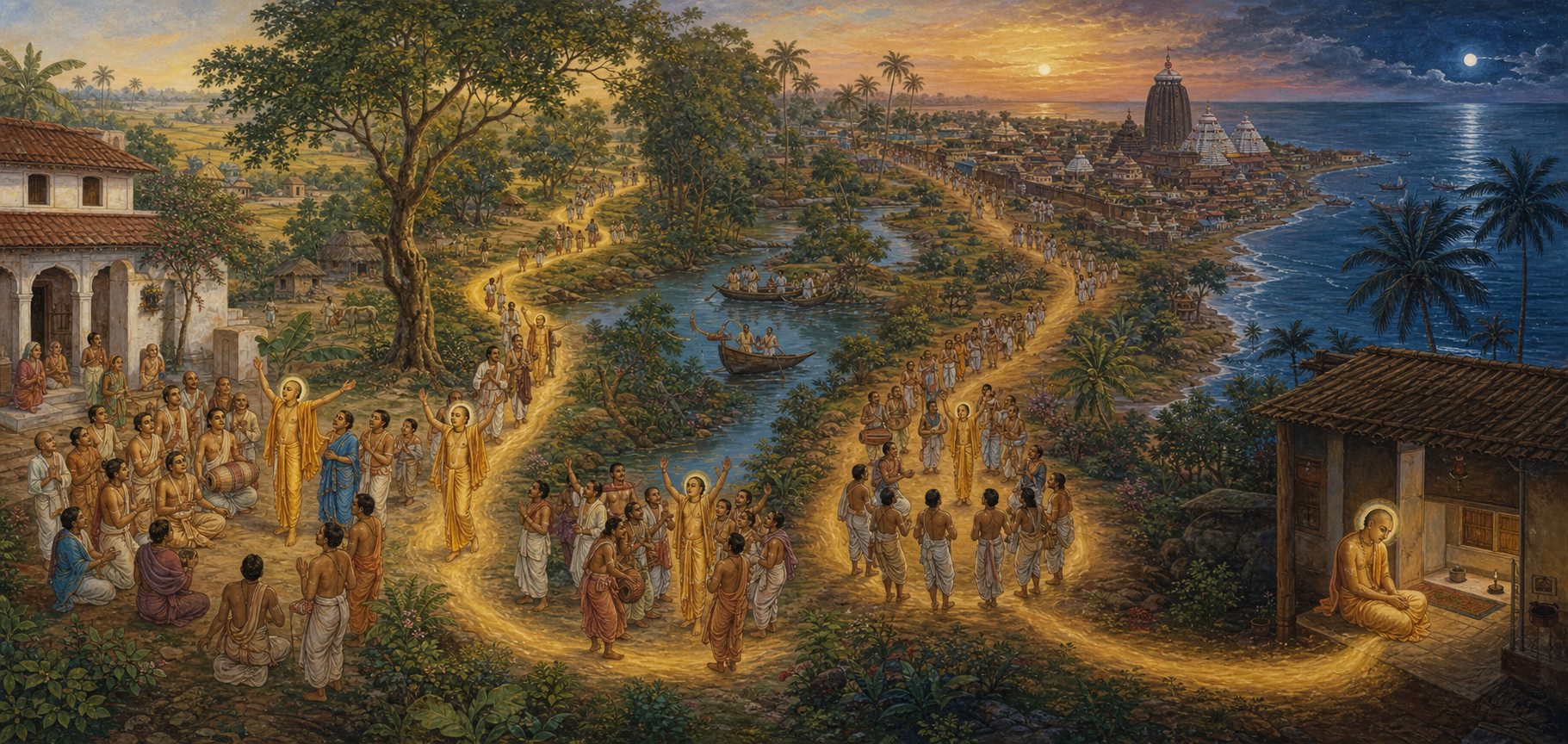
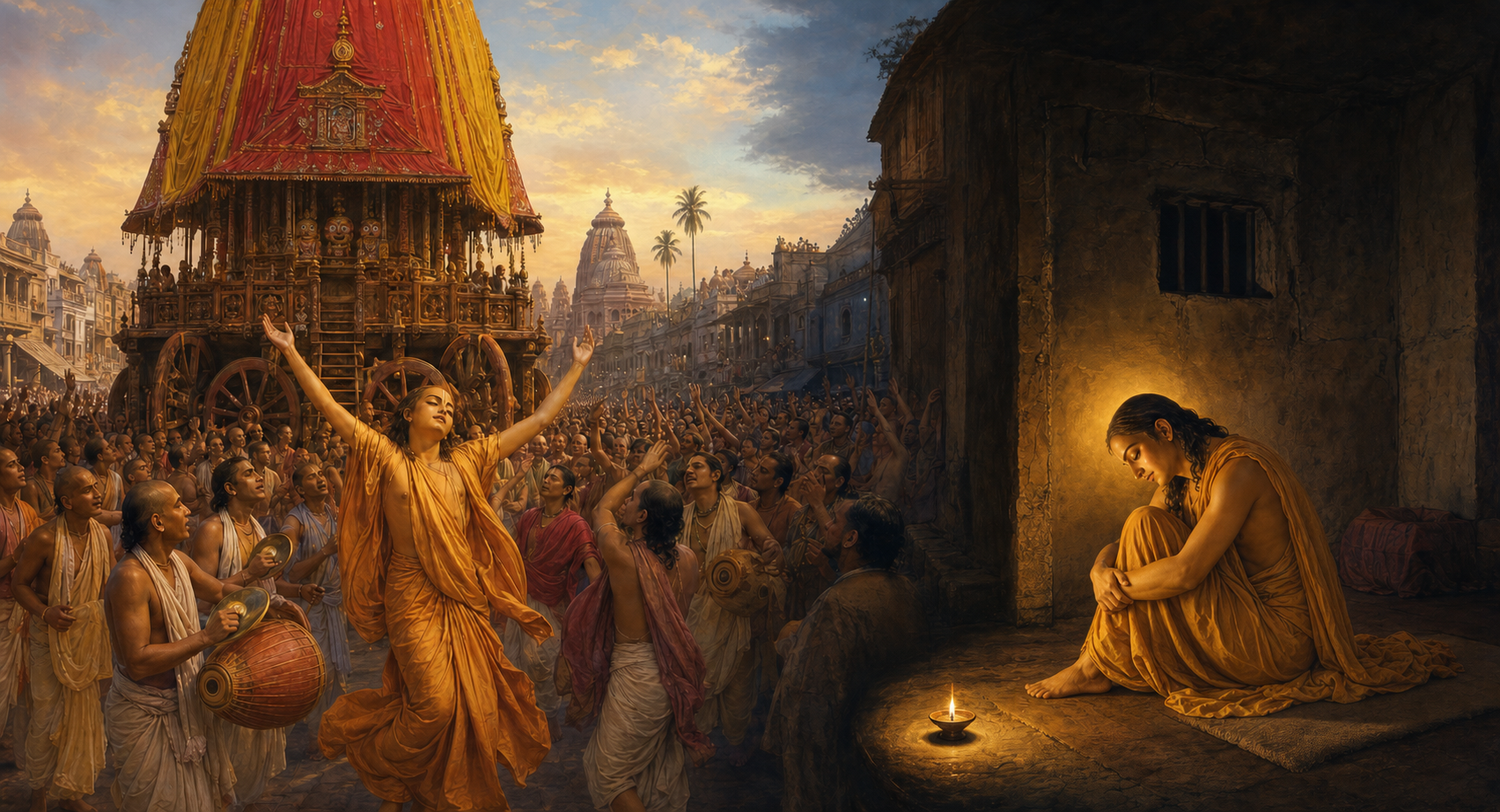
The final twelve years in Jagannatha Puri bring public and private devotion into a particularly close relationship. Ratha-yatra places devotion in procession, song, movement, and collective participation. The nights of the Gambhira disclose an intimate inward absorption, especially in the company of Svarupa Damodara and Ramananda Raya. These settings should not be divided into an outward religion for the crowd and an inward religion for an elite.
The same devotional current runs through both. During Ratha-yatra, a whole community participates in the public movement surrounding Lord Jagannatha. In the Gambhira, that current becomes concentrated through secluded remembrance and intense separation. Public celebration gives love a shared form; inward absorption reveals its depth. Each protects the other from distortion.
Public kirtana without inward assimilation can become an event you consume and leave behind. Private feeling without community, scripture, or mature companionship can become self-confirming. The presence of Svarupa Damodara and Ramananda Raya is therefore not decorative. Their companionship shows ecstatic devotion held within relationship, refined understanding, and accountability.
You can apply this structure without pretending to reproduce Chaitanya’s states. After congregational kirtana, preserve a quiet period for japa, remembrance, or reflective reading instead of treating the emotional high point as the conclusion. Then ask what service should follow. If private reflection produces a dramatic theological claim, test it through guru, sadhu, and sastra rather than granting intensity the status of authority.
This balance also helps a reader approaching Chaitanya from another Dharmic path. Buddhist mindfulness and compassion, Jain nonviolence and non-possessiveness, and Sikh remembrance of the Divine Name and seva offer genuine points of ethical resonance. They should not, however, be collapsed into Radha-bhava or treated as interchangeable doctrines. Let shared commitments sharpen mutual respect while allowing each tradition’s inner grammar to remain distinct.
A six-step reading practice from plot to participation
You do not need to master rasa theory before reading Madhya-lila and Antya-lila. You do need a method that slows down premature conclusions. Use the following sequence with one manageable passage at a time.
- Orient yourself to the destination. Begin with the Second Chapter of Madhya-lila as a map of what will culminate later. On the first pass, identify what the preview makes important: separation, remembrance, Jagannatha Puri, devotional expression, and trusted companionship.
- Locate the scene. Record the place, the companions present, and whether the action is public, private, or moving between the two. These details are part of the theology, not background decoration.
- Trace the rasa sequence. Identify the alambana and uddipana before interpreting anubhava or sattvika-vikara. Ask what relationship gives an expression its meaning and what has stimulated remembrance.
- Connect the scales. When you read a public occasion such as Ratha-yatra, ask how its devotional current continues inwardly. When you read a Gambhira episode, ask what public mission and communal practices have prepared its context.
- Assimilate one point through practice. Hear the passage, chant, and retain one theological or ethical insight during remembrance. Choose a proportionate response such as more attentive nama, more careful speech, or concrete seva. The aim is formation, not imitation of extraordinary manifestations.
- Verify and return. Bring difficult interpretations to guru, sadhu, and sastra. Commentarial streams such as Amrta-pravaha-bhasya and Anubhasya can help protect theological clarity. After reading the corresponding development in Antya-lila, return to the Madhya-lila preview and note what has become clearer.
A simple notebook makes this method easier. Give each passage five lines: setting, relationship, stimulus, expression, and implication for practice. Leave the implication line blank if the passage has not yet become clear. An honest blank is more useful than a forced moral.
Over repeated readings, look for continuity rather than novelty. The central question is not how many unusual states you can catalogue. It is how consistently the narrative draws attention toward Krishna, how separation intensifies remembrance, and how public devotion and inward absorption sustain one another.
What a responsible reading refuses
Refuse the chronology-only reading. Sequence matters, but the early disclosure of the culmination is purposeful. Treating every anticipation as a misplaced episode causes you to miss how expectancy shapes the middle journey.
Refuse devotional spectacle. Bodily transformations are not a checklist for measuring yourself or other devotees. Their place within Antya-lila depends on Radha-bhava, vipralambha, remembrance of Krishna, and the singular theological identity of Chaitanya Mahaprabhu. Imitating an expression cannot produce the relationship from which it arises.
Refuse intensity as self-authentication. Powerful feeling does not remove the need for scriptural grounding or mature companionship. Svarupa Damodara and Ramananda Raya matter precisely because the Gambhira is not portrayed as spirituality without witnesses, discernment, or relationship.
Refuse the split between festival and sadhana. Ratha-yatra and the Gambhira reveal a single devotional rhythm at different scales. Let public kirtana lead into personal remembrance, and let personal remembrance return you to ethical conduct, community, and seva.
Refuse hurried mastery. The admission that this literary interweaving is difficult for an ordinary reader is itself guidance. Progress comes through repeated, reverential engagement. A passage that exceeds your present understanding can still teach you how to listen.
Key takeaways
- Madhya-lila’s glimpse of Antya-lila is an interpretive forecast that prepares you for the culmination.
- Vipralambha should be read through relationship, remembrance, and Radha-bhava, not reduced to ordinary sadness or dramatic emotion.
- Identify alambana and uddipana before interpreting outward or involuntary manifestations.
- Ratha-yatra and the Gambhira unite congregational devotion with inward absorption.
- Extraordinary devotional states remain accountable to guru, sadhu, sastra, and trustworthy companionship.
- Reading matures through hearing, chanting, remembering, service, and return visits to difficult passages.
On your next reading, begin with one Antya-lila glimpse in Madhya-lila’s Second Chapter. Mark one relationship, one stimulus, and one expression. Carry that pattern forward until it reappears in the final years, then bring what you have understood into nama and seva. That is how the summit can illuminate the path without tempting you to skip the path.

References
