

If you searched for the eight forms of Lord Ayyappa, you probably want more than eight Sanskrit names. You want to understand why Ayyappa appears as a still yogi in one kṣetra, a guardian in another, a child elsewhere, and a householder accompanied by consorts at Achankovil.
The clearest way to understand these forms is to treat them as eight approaches to dharma. Each one addresses a different human need, but all point back to the same divine teacher: self-mastery must become service, strength must answer to compassion, and grace must deepen responsibility.
Resolve the counting question before learning the names

Aṣṭa means eight. Śāstā comes from the Sanskrit root śās, associated with teaching, guiding, and governing. The name therefore presents the deity not merely as a giver of desired results, but as one who instructs the devotee in dharma.
Lord Ayyappa is also revered as Hariharaputra, the son of Śiva and Viṣṇu in the form of Mohini, and as Dharma Śāstā. This parentage itself expresses integration: apparently opposed principles such as asceticism and household duty, firmness and tenderness, or discipline and grace can be brought into a higher harmony.
There is an important caution. Lineages and local temple traditions do not always enumerate the forms of Śāstā identically. Names, iconographic details, and associations can shift between Kerala, Tamil Nadu, and individual kṣetras. A local sthala-purāṇa or established temple tradition should therefore take precedence over a generalized list.
The practical eightfold map used here consists of Yoga, Gṛhastha or Kalyāṇa, Vīra, Bāla, Jñāna, Bhūtanātha, Arogya, and Saṁtāna-prada Śāstā. Dharma Śāstā is not a ninth form in this arrangement. It is the unifying center: the complete presence in whom the functions of all eight meet.
Key takeaways
- The eight forms are complementary expressions of one Lord, not eight competing deities.
- Each form brings a particular duty into focus: discipline, household responsibility, protection, renewal, wisdom, harmonization, healing, or care for the future.
- Local temple tradition determines how a particular image and name should be understood.
- Choose a form by asking which quality your present situation requires, not merely which blessing you want.
- Devotion becomes complete when mantra, darśan, and prayer produce a concrete change in conduct.
The eight forms at a glance

| Form | Primary emphasis | Recognizable context or cue | Turn to this form when you need to cultivate |
|---|---|---|---|
| Yoga Śāstā | Self-mastery and inward steadiness | Yogic posture, yogapaṭṭa, meditative mudrā; especially associated with Sabarimala | Restraint, clarity, regular practice, and command of the senses |
| Gṛhastha or Kalyāṇa Śāstā | Sacred household and social duty | Accompanied by Pūrṇa and Puṣkalā, as at Achankovil | Family harmony, ethical livelihood, hospitality, and responsible stewardship |
| Vīra Śāstā | Righteous protection | Dynamic or guardian imagery; affinities with Tamil Ayyanar traditions | Courage, vigilance, fair judgment, and protection of the vulnerable |
| Bāla Śāstā | Purity and new beginnings | The divine child; associated in regional tradition with Kulathupuzha | Trust, curiosity, renewal, and responsible care for children |
| Jñāna Śāstā | Wisdom joined to practice | Rosary or palm-leaf manuscript | Discernment, study, contemplation, and integrity of character |
| Bhūtanātha Śāstā | Harmonizing disordered forces | Lordship over beings and attendant powers | Integration, ecological responsibility, and the redirection of turbulent energy |
| Arogya or Parihāra Śāstā | Healing and restored balance | Prayers concerning illness, fear, and hazards; healing associations at Achankovil | Patient care, moderation, courage, and practical support during illness |
| Saṁtāna-prada Śāstā | Continuity and care for the future | Family prayers concerning children and the continuation of dharmic life | Nurturing, intergenerational responsibility, and transmission of values |
What each form asks you to practise
1. Yoga Śāstā: bring the senses under wise direction
The celebrated Ayyappa image at Sabarimala is the clearest expression of Yoga Śāstā. The Lord sits in yogāsana, often understood as padmāsana, with a yogapaṭṭa securing the legs. The collected gaze, restrained ornamentation, tiger-skin seat, and cinmudrā or jñānamudrā communicate alert stillness. The bell association of Maṇikaṇṭha likewise suggests awareness that does not lapse into carelessness.
For the Sabarimala pilgrim, the traditional 41-day vrata gives this form practical force. Truthfulness, restraint, a vegetarian diet, regular repetition of Swamiye Saranam Ayyappa, and service prepare the person, not just the travel bag, for darśan. The vrata matters because pilgrimage begins with the reordering of daily life.
If your mind is scattered, do not answer Yoga Śāstā with a vague wish for peace. Identify the habit that repeatedly breaks your inner order. Set a consistent period for japa, remove one avoidable indulgence, and keep one promise even when convenience pulls the other way. The measure of the practice is whether you become less impulsive and more dependable.
2. Gṛhastha or Kalyāṇa Śāstā: make responsibility sacred
At Achankovil, Śāstā appears with the consorts Pūrṇa and Puṣkalā, and some representations also include the child attendant Satyaka. This family ensemble corrects the assumption that spiritual seriousness always requires withdrawal. Livelihood, kinship, hospitality, and social responsibility can themselves become fields of sādhana.
Turn toward this form when the problem is not a lack of spiritual ideas but a neglected relationship or duty. Name the responsibility precisely: a promise you have postponed, an unfair division of work, a family member who has not been heard, or hospitality that has hardened into inconvenience. Then repair one part of it. Kalyāṇa Śāstā asks you to seek harmony without hiding injustice and to pursue prosperity without allowing possession to become the household’s governing deity.
3. Vīra Śāstā: protect without becoming ruled by anger
Vīra Śāstā is the vigilant guardian of boundaries, fields, villages, and vulnerable people. This aspect has close affinities with Ayyanar traditions in Tamil Nadu, where guardian imagery may include dynamic postures, mounted retinues, and attendant gaṇas. Its central virtue is not aggression but disciplined protective strength.
This distinction matters whenever you feel morally outraged. Anger can reveal that a boundary has been violated, but it cannot be allowed to decide what justice requires. Before acting, separate the person who needs protection, the conduct that must stop, and the restraint you must maintain. Vīra Śāstā calls you to speak clearly, intervene proportionately, give facts a fair hearing, and refuse both cowardice and cruelty.
4. Bāla Śāstā: recover purity without becoming naive
Regional tradition associates Kulathupuzha with Bāla Śāstā, the child form of the Lord. Here childhood signifies purity, wonder, trust, and the possibility of beginning again. It does not mean ignorance of danger. Dharmic innocence is an uncluttered heart, not an unguarded mind.
This form is especially meaningful during rites of passage, prayers for a child’s well-being, and moments when repeated disappointment has made you cynical. If a child is in your care, let the prayer alter your conduct: protect curiosity from humiliation, model the truthfulness you expect, and make discipline intelligible rather than arbitrary. If you are beginning something new, carry forward the wisdom earned from the past but leave behind the habit of assuming that every new effort must repeat an old failure.
5. Jñāna Śāstā: turn learning into character
Jñāna Śāstā expresses the teaching function already contained in the name Śāstā. A rosary and palm-leaf manuscript can appear as iconographic signs of contemplative learning. One points toward sustained practice; the other toward transmitted knowledge. Neither is complete by itself.
Approach this form when you are collecting teachings faster than you are embodying them. Choose one principle from your current study and give it a visible test in conduct. If you are contemplating ahiṁsā, examine the harm carried by your speech. If you are studying self-restraint, observe what happens when your preferences are denied. If you are studying seva, serve where no recognition is likely. Wisdom has ripened when another person can encounter its effects in your patience, honesty, and judgment.
This union of discipline, compassion, and lived understanding also gives Śāstā worship an ethical resonance with Buddhist cultivation, Jain ahiṁsā, and Sikh seva. Recognizing those shared concerns need not erase the theological and ritual distinctions among the Dharmic traditions.
6. Bhūtanātha Śāstā: redirect disorder instead of feeding it
As Bhūtanātha, Ayyappa is Lord of beings and the harmonizer of forces that have fallen out of right relationship. The point is not the destruction of everything unfamiliar or unruly. It is the restoration of order, so that energies which once caused disturbance can be directed toward a worthy purpose.
Use this form as a mirror when anger, fear, restlessness, or group conflict has begun to govern the room. Ask what useful capacity is trapped inside the disturbance. Anger may contain courage; restlessness may contain unused energy; fear may contain attentiveness. Give that capacity a disciplined form through service, repair, protection, or sustained work. The same principle extends to the natural world: reverence for a sacred landscape is hollow if your conduct leaves pollution, waste, or avoidable damage behind.
7. Arogya Śāstā: join prayer to responsible care
Devotees approach Arogya or Parihāra Śāstā during illness, anxiety, and exposure to environmental hazards. Achankovil carries a strong local memory of prayers concerning snakebite and of ritual care that consoles people facing fear. The larger spiritual meaning is the restoration of balance among body, breath, mind, conduct, and community.
Prayer can steady a frightened mind and mobilize family or community support, but it is not a substitute for medical treatment. If someone may have suffered a snakebite or another acute illness, seek emergency medical care immediately; do not wait for a rite, a traditional remedy, or a change in symptoms. Nor should devotion be presented as a guarantee of cure.
A responsible offering to Arogya Śāstā includes the care that recovery actually requires: following appropriate professional advice, moderating habits that undermine health, accepting help, and supporting the people who carry the daily burden of care. Healing prayer becomes ethically serious when it makes you more truthful about the condition and more cooperative with sound care.
8. Saṁtāna-prada Śāstā: prepare to transmit what you value
Saṁtāna-prada Śāstā receives the hopes and anxieties of people praying for children, family well-being, and continuity. Yet saṁtāna should not be reduced to biological succession alone. The deeper concern is what will continue through the next generation: habits, values, memory, compassion, and willingness to serve.
Prayer for a child is not a promise of conception and should not replace appropriate medical evaluation when fertility is a concern. It can, however, become a demanding preparation for parenthood. Ask which qualities you hope a child will inherit, then examine whether your household currently demonstrates them. If you seek truthful, disciplined, compassionate children, begin by making truth, discipline, and compassion more visible in the life they would enter.
This form also speaks to teachers, elders, and community members who may not be parents. You participate in continuity whenever you preserve knowledge, mentor a younger person, maintain a sacred place, or pass on a practice without turning it into an empty performance.
Let temple iconography guide your understanding
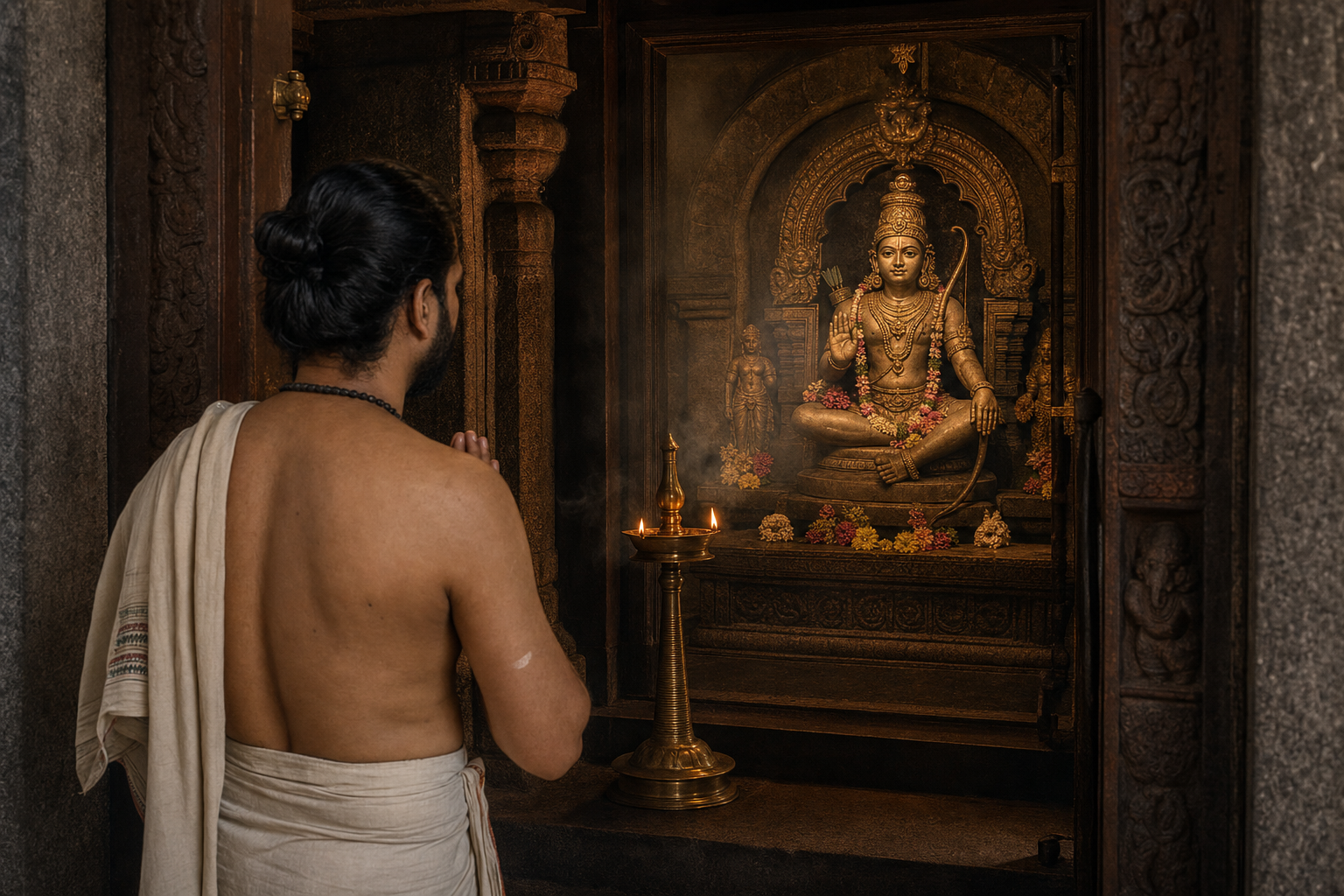
The distinctions among the forms become easier to grasp when you pay attention to posture, companions, attributes, and local ritual setting. A Śāstā image may be two-armed or four-armed according to regional conventions. Abhaya communicates assurance; varada expresses benevolence. A yogapaṭṭa and inwardly settled gaze emphasize self-mastery, while a family ensemble sacralizes worldly duty and dynamic guardian imagery emphasizes protection.
- Sabarimala: Look first for Yoga Śāstā and the discipline surrounding the image. The 41-day vrata, Irumudi, Pamba, Pathinettampadi or eighteen steps, annadāna, and climactic darśan form a single pedagogy of restraint, equality in discipline, service, and surrender. Aravana Payasam marks the sweetness that follows fulfilled restraint.
- Achankovil: The presence of Pūrṇa and Puṣkalā draws attention to Kalyāṇa Śāstā and the sanctity of household life. Local healing and snakebite associations also bring the Arogya dimension into view.
- Kulathupuzha: The Bāla form places purity, childhood, trust, and new beginnings at the center of contemplation.
- Aryankavu: This is one of the major Śāstā kṣetras named alongside Sabarimala, Achankovil, and Kulathupuzha. Let its own established tradition explain the form encountered there instead of imposing a generalized label.
- Tamil village shrines: Śāstā and Ayyanar traditions often emphasize guardianship, the protection of land and community, and reciprocal responsibility between people and place.
When you visit a temple, begin with observation. Notice whether the Lord is seated in yogic stillness or presented dynamically, whether consorts or attendants are present, and whether the hands communicate knowledge, assurance, generosity, or protection. Then ask how the temple itself names the form. Iconography opens the question; living tradition answers it.
Choose the form that corrects your present imbalance

You do not need to address all eight forms at once. A simple discipline can turn the map into practice:
- Name the duty, not only the desire. Replace “I want this problem to disappear” with a precise question such as “What quality must I develop to meet this situation dharmically?”
- Identify the primary imbalance. Scattered senses point toward Yoga Śāstā; neglected family duty toward Kalyāṇa Śāstā; threatened boundaries toward Vīra Śāstā; cynicism toward Bāla Śāstā; confusion toward Jñāna Śāstā; inner or communal disorder toward Bhūtanātha Śāstā; illness and responsible care toward Arogya Śāstā; intergenerational responsibility toward Saṁtāna-prada Śāstā.
- Join remembrance to one observable action. Repeat Swamiye Saranam Ayyappa, contemplate the relevant form, and choose a conduct change that another person could recognize: keep the vrata, repair the duty, protect fairly, teach patiently, study honestly, redirect disorder, support care, or transmit a value.
- Examine the result. Ask whether the practice has made you more disciplined, compassionate, truthful, courageous, and useful. If it has only increased pride, anxiety, hostility, or demands upon others, the form has not yet been understood correctly.
Some situations naturally involve more than one form. During a family illness, Arogya Śāstā directs attention to treatment and balance, while Gṛhastha Śāstā brings the household’s duties of care into focus. In a public dispute, Vīra Śāstā supplies courage and Jñāna Śāstā demands discernment. Choose the quality that must lead, then let the others support it.
Before your next prayer or temple visit, name one duty that is presently yours and choose the form of Ayyappa that most directly illuminates it. Carry one instruction from darśan back into ordinary life. That is where surrender becomes dharma.
References
