
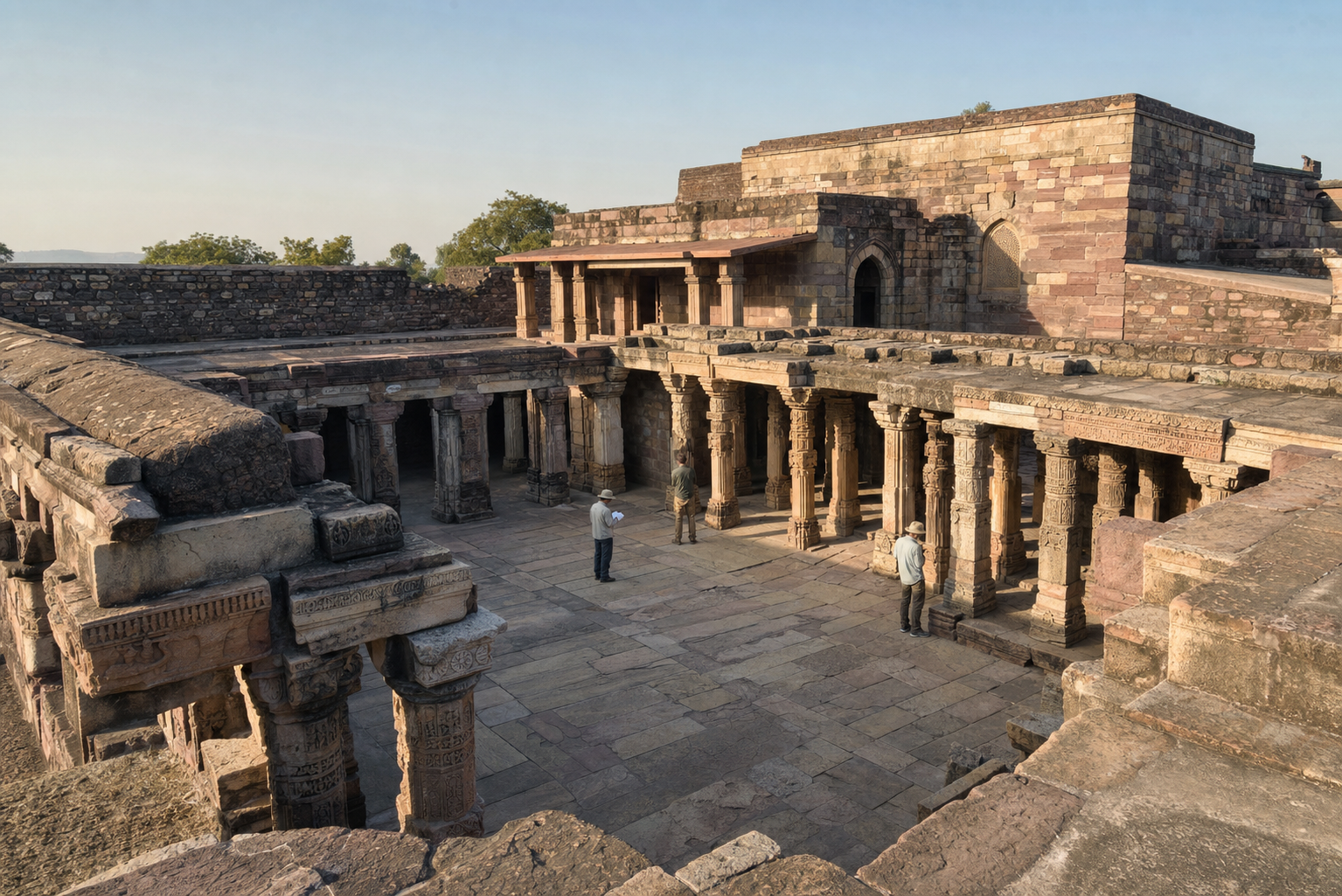
If you came to Bhojshala-Kamal Maula looking for a one-word archaeological verdict, begin with a distinction that much of the public argument misses. The visible fabric provides strong support for the conclusion that temple-era architectural material was extensively reused in the present complex. That conclusion matters. It does not, by itself, reconstruct the complete earlier building, identify every fragment’s original position, establish the precise circumstances of reuse, or decide present legal rights.
That boundary is not a concession. It is how a serious case for Hindu heritage becomes harder to dismiss. Once you separate what the stones demonstrate from what still requires proof, you can recognize the temple material plainly, reject rhetorical evasions, and avoid asking a carved pillar to carry claims that only stratigraphy, inscriptions, plans, and legal reasoning can establish.
Ask which layer you are looking at, not what label wins
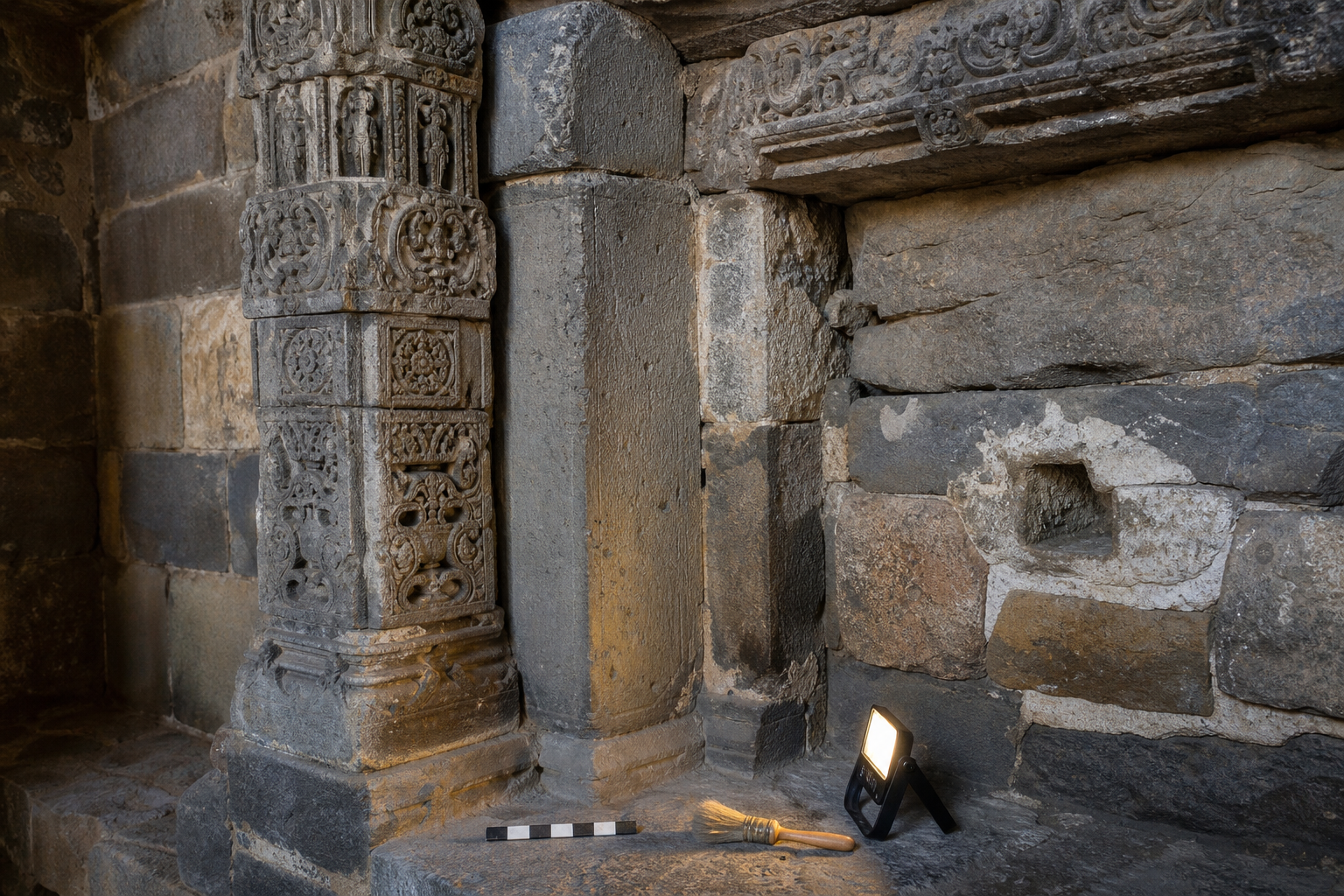
Bhojshala-Kamal Maula is a protected, composite monument. Hindu tradition remembers Bhojshala as a seat of learning associated with Vagdevi, or Saraswati, and with the cultural memory of Raja Bhoja. Islamic sacred memory identifies the complex with the Sufi figure Kamal Maula and congregational prayer. These traditions are part of the site’s social history, but archaeology asks a more tightly framed question: which physical elements belong to which construction phase?
The word spolia means architectural material taken from an earlier building and incorporated into a later one. It describes the material’s secondary use. It does not automatically explain whether the earlier building was ruined, dismantled, appropriated, damaged during political change, or simply treated as a convenient source of dressed stone. Those possibilities have different historical meanings and require evidence beyond the mere presence of reused material.
A useful way to test any claim about Bhojshala is to place it on an inference ladder:
- Identify the object. Is it a temple-form pillar, bracket, moulding, lintel, inscription panel, figurative fragment, or something less diagnostic?
- Establish its placement. Is the element in its original structural position, or has it been inverted, trimmed, rotated, mismatched, or inserted as fill?
- Determine the construction phase. Do masonry bonds, plinth courses, column alignments, mortar horizons, and floor relationships connect it to an earlier structure or a later rebuilding campaign?
- Reconstruct the earlier institution. Can an original plan, securely situated inscription, iconographic program, or foundation sequence identify the building’s function and dedication?
- Assess the legal consequence. What does the physical history mean under heritage law, court orders, access arrangements, and claims concerning worship? Archaeology informs this question but does not decide it on its own.
Confusion begins when someone jumps directly from the first step to the fifth. The strongest defensible baseline is already significant: the current monument contains a substantial body of earlier temple-craft material, much of it in secondary architectural use. More specific conclusions must be earned element by element.
Read the diagnostic combination, not one dramatic photograph
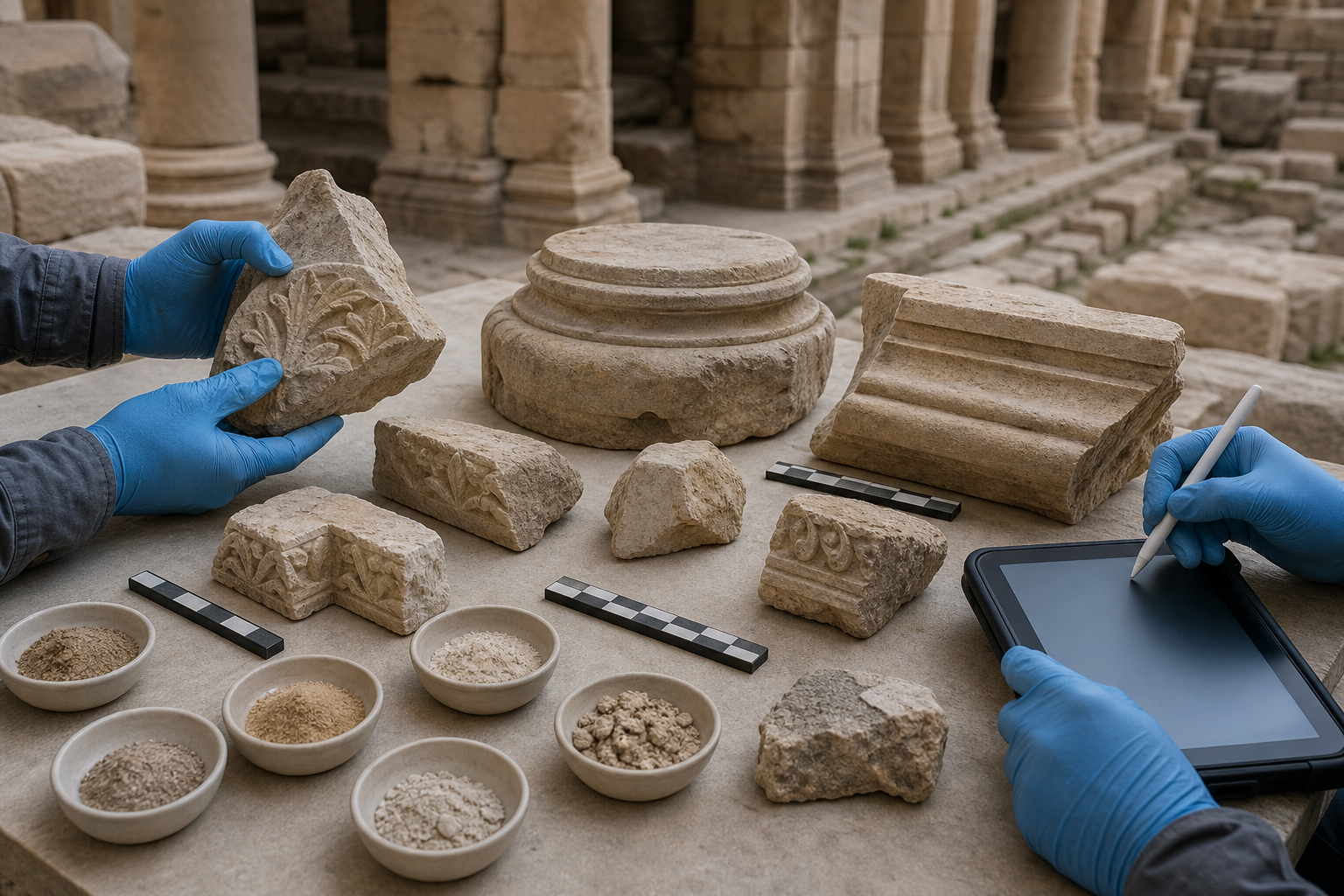
No single lotus, column, or line of script should carry the entire argument. The case becomes stronger when several independent indicators converge: temple-form profiles, Nagari writing, secondary dressing, incompatible column parts, altered orientation, and discontinuities in the surrounding masonry.
| Observation | What it can support | What it cannot establish alone |
|---|---|---|
| Carved pillars, bracketed capitals, floral or lotus medallions, temple mouldings, lintel portions, and door-jamb fragments | The presence of material belonging to an earlier temple-craft tradition | The exact plan, dedication, or location of the building from which every element came |
| Truncated figures, re-cut surfaces, inverted carvings, rotated panels, or pieces used as infill | Deliberate adaptation and secondary use rather than an element remaining in its first position | The complete circumstances, date, agent, or motive behind the reuse |
| Mismatched bases and capitals, breaks in plinth courses, changed masonry bonds, or distinct mortar horizons | Multiple building or repair campaigns and a relative sequence between them | An exact calendar date unless independent dating evidence is available |
| Nagari-script fragments and regionally recognizable architectural profiles | A palaeographic or stylistic date range and a connection with an earlier cultural setting | The date of the wall in which a reused fragment was later placed |
| A mihrab orientation and an open congregational prayer arrangement | An Islamic architectural and devotional phase within the standing complex | The absence of an earlier sacred phase or the origin of all material used in that phase |
| A subsurface contrast detected by ground-penetrating radar, if one is recorded | The possible presence of a buried wall, void, floor, trench, or other change in material | Whether the feature is a temple, what deity it served, or even whether it is masonry without controlled verification |
The date of a carving and the date of its secondary placement are two different dates. A Nagari panel may help date the panel’s inscription, while the mortar around it belongs to a later campaign. A temple-style capital sitting on an incompatible shaft may reveal reuse more clearly than either component considered separately. This is why a mapped assemblage is more informative than a gallery of close-up images detached from their locations.
Tool marks and profiles add another layer of comparison. Fine-grained sandstone, chisel-and-punch finishing, bracket shapes, stepped plinth components, and kapota-like cornice forms can place a fragment within a regional craft tradition. Their diagnostic value comes from repetition and structural context, not from a single visual resemblance.
Comparable medieval complexes, including Quwwat-ul-Islam in Delhi and Adhai Din ka Jhonpra in Ajmer, show why craft and function must also be distinguished. Builders could retain local corbelled ceilings, beam-and-bracket systems, familiar stone-working techniques, guild labor, and available components while creating a building with a different devotional use. Continuity of workmanship is not necessarily continuity of institutional purpose.
How a survey turns fragments into a defensible chronology
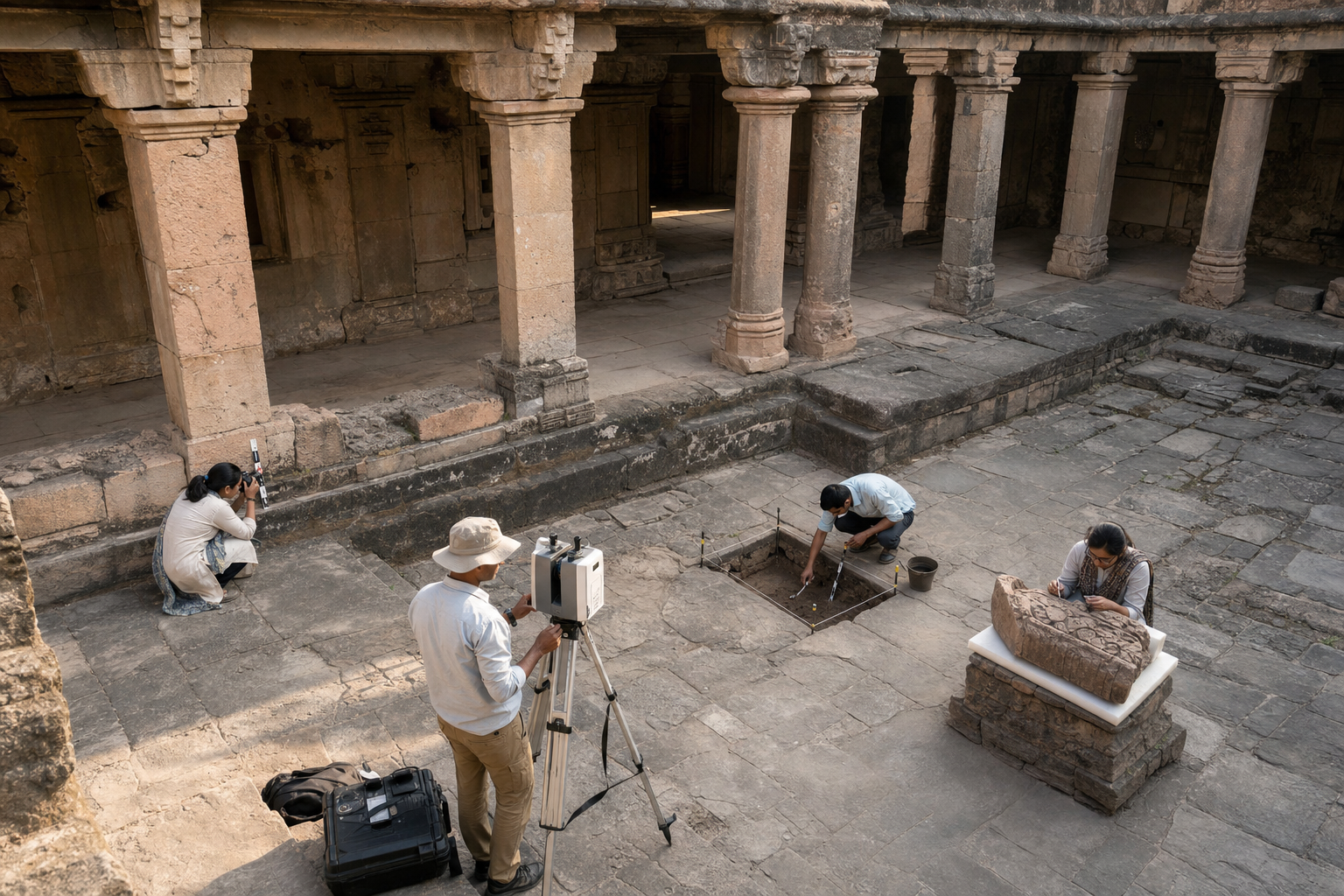
Archaeology depends on provenience: the exact place, orientation, level, and physical relationship in which an object or feature was recorded. A beautiful fragment with no mapped context may establish that the fragment exists, but it is far less useful for reconstructing the building sequence.
A defensible investigation of a composite monument proceeds in a controlled order:
- Create a fixed recording grid. Give each visible fragment, pier, wall face, floor break, and architectural bay a stable identifier.
- Record before interpreting. Photograph elements with scales, measure their orientation, and use photogrammetry or a three-dimensional point cloud to preserve spatial relationships.
- Classify the fabric. Record stone type, moulding profile, carving style, tooling, joints, weathering, and signs of re-cutting.
- Test for secondary use. Look for inverted faces, severed projections, patched sockets, incomplete iconography, incompatible dimensions, and load-bearing arrangements that do not match the element’s original design.
- Map construction breaks. Follow masonry bonds, plinth discontinuities, column alignments, mortar changes, floor levels, and blocked openings across the building rather than treating each fragment in isolation.
- Compare secure records. Check present observations against archival photographs, measured plans, inscription records, and earlier condition documentation.
- Investigate below ground only under permission and control. Ground-penetrating radar can identify contrasts worth testing; a limited micro-stratigraphic sondage can then examine actual layers while minimizing damage to protected fabric.
Measurements, photogrammetric records, three-dimensional models, masonry analysis, and carefully limited subsurface methods allow later specialists to check how a conclusion was reached. That audit trail matters especially at a contested monument, where a caption or selected photograph can circulate much faster than the underlying field record.
Ground-penetrating radar deserves particular restraint. It responds to physical contrasts below the surface; it does not display a labeled image of a buried temple. A contrast may represent masonry, a trench, a void, disturbed soil, a utility, or a natural change. Its location and geometry can guide a test, but controlled stratigraphy is needed to identify the feature and its relationship to surrounding deposits.
Inscriptions require similar discipline. Palaeography uses letter forms, ligatures, and spelling conventions to produce a date range, not an automatic single-year date. A fragment naming a deity, patron, or royal title may be important, but its interpretive reach depends on whether it remains in original context. A reused inscription can identify an earlier cultural world without proving that the later wall served the same function.
Where the evidence is strong, and where claims still outrun it
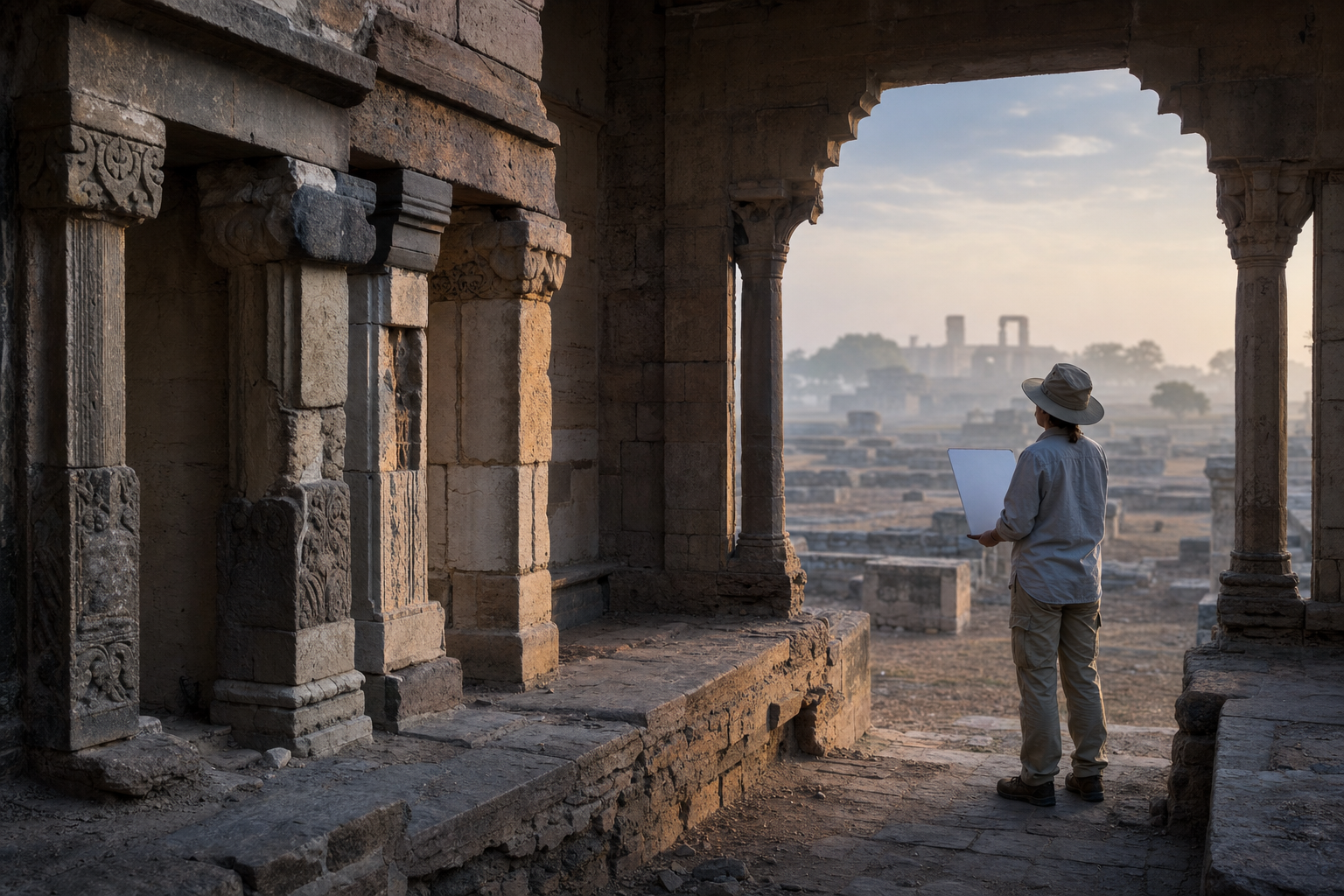
The earlier temple-craft layer is materially serious
The convergence of carved pillars, brackets, mouldings, Nagari fragments, temple-type lintel and jamb portions, figurative remnants, and signs of secondary placement makes the temple-era material difficult to dismiss as generic decoration. Calling every such element merely ornamental avoids the technical question of why components designed within an earlier architectural system appear altered, mismatched, or inverted in a later one.
The opposite overstatement should also be avoided. Reused components do not automatically reveal how many earlier buildings supplied them, whether all came from precisely the same footprint, or what the complete earlier ground plan looked like. Those questions require mapped provenience, foundation relationships, and stratigraphic continuity.
The Bhoja and Vagdevi association needs the right kind of proof
Malwa flourished under the Paramara dynasty, and the early eleventh-century reign of Bhoja carries a strong literary memory of learning and architectural patronage. That setting makes the Bhojshala tradition historically intelligible. Local remembrance of a Saraswati-centered institution is itself important cultural evidence, but cultural memory and excavated proof are not interchangeable categories.
A securely situated inscription naming the institution or deity, a recoverable architectural plan consistent with the proposed function, or an undisturbed foundation sequence would carry more identifying weight than a displaced inscription or isolated iconographic fragment. If someone declares the complete historical identification settled, ask which evidence joins the traditional name to a secure archaeological context.
Reuse does not narrate its own cause
The physical act of reuse may be observable while its cause remains a historical inference. Material can become available through dismantling, damage, political and devotional transition, structural collapse, or changing patronage. Truncation, face removal, and inversion may show purposeful alteration more clearly than simple reuse does, but even those marks do not, without further context, identify the responsible agent or provide a complete event narrative.
This is not a reason to soften uncomfortable evidence into a vague story of aesthetic blending. Spolia can record appropriation as well as craft continuity. The disciplined position is to describe every alteration exactly, establish its sequence, and then test competing historical explanations against inscriptions, architecture, stratigraphy, and securely dated events. Shared heritage should mean responsibility for the whole record, not permission to blur it.
Archaeological history and legal entitlement are separate questions
Proceedings concerning the site have been before the Madhya Pradesh High Court, so technical claims should not be converted into predictions about a judicial outcome. The Archaeological Survey of India’s responsibilities under the Ancient Monuments and Archaeological Sites and Remains framework concern protection, documentation, conservation, and presentation. A court determines how admissible evidence interacts with applicable law and existing orders.
The site’s living practices add another category that should not be confused with construction history. Tuesday darshan and Vasant Panchami observances for Hindu devotees, together with Friday prayer and the Sufi association of Kamal Maula, have figured in the social and administrative life of the complex. An access schedule manages living claims; it is not archaeological proof for or against an earlier phase.
Key takeaways for a responsible public position
- State the strongest conclusion plainly: the standing complex contains extensive temple-era architectural material in secondary use.
- Ask for context, not just images: every significant fragment should have an identifier, mapped location, orientation, measurements, photographs, and a record of its relationship to surrounding masonry.
- Keep the two dates separate: the date of a carved or inscribed stone is not automatically the date of the wall into which it was reused.
- Treat subsurface claims as a sequence: a radar contrast is a lead, controlled verification identifies the feature, and stratigraphy establishes its relative phase.
- Respect memory without replacing method: Hindu remembrance of Bhojshala and Muslim devotion associated with Kamal Maula belong in an honest interpretation, but neither substitutes for physical analysis of the building.
- Protect the evidence while litigation continues: no visitor or campaign should move, scrape, clean, make a rubbing from, excavate around, or otherwise alter a fragment. Destroyed context cannot be reconstructed later.
You can turn those principles into concrete public demands. Survey drawings, element catalogues, three-dimensional scans, conservation reports, and explanations of uncertainty should be released when legal and security constraints permit. Selective photographs encourage competing narratives; a mapped dataset lets specialists examine distribution, phasing, and structural relationships.
Conservation cannot wait for every historical or legal question to be resolved. Drainage defects, salt efflorescence, vegetation, cracked masonry, unstable brackets, and vulnerable flooring are physical problems with physical consequences. Repairs should use compatible materials, including appropriately matched lime mortars, and follow the minimal, evidence-preserving, reversible approach associated with the Venice, Burra, and Nara conservation principles.
Interpretation should be just as exact. On-site panels can distinguish earlier temple-craft components, later congregational architecture, subsequent repairs, and modern administrative history without flattening them into one timeless structure. Hindi, English, and Urdu presentation would make the evidence accessible to more visitors. Predictable access arrangements, trained docents, and non-intrusive crowd management can reduce friction while protecting fragile surfaces.
A dharmic response has a clear ethical discipline here. Satya requires us to calibrate every sentence to the strength of the evidence. Ahimsa governs how claims are pursued and how living communities are treated. Jnana demands open records, patient examination, and the willingness to correct an interpretation when better context appears. None of these values requires silence about temple spolia; they require us to describe it accurately and preserve it.
When the next sensational claim about Bhojshala appears, ask four questions before repeating it: What exactly was found? Was it in its original position? Which method established its date and phase? Where can the mapped record be examined? Press for answers, support immediate conservation, and let each conclusion remain no broader than its evidence. That is how you defend the temple heritage in the stones while keeping the material record intact for the generations that will judge it after us.
References
