
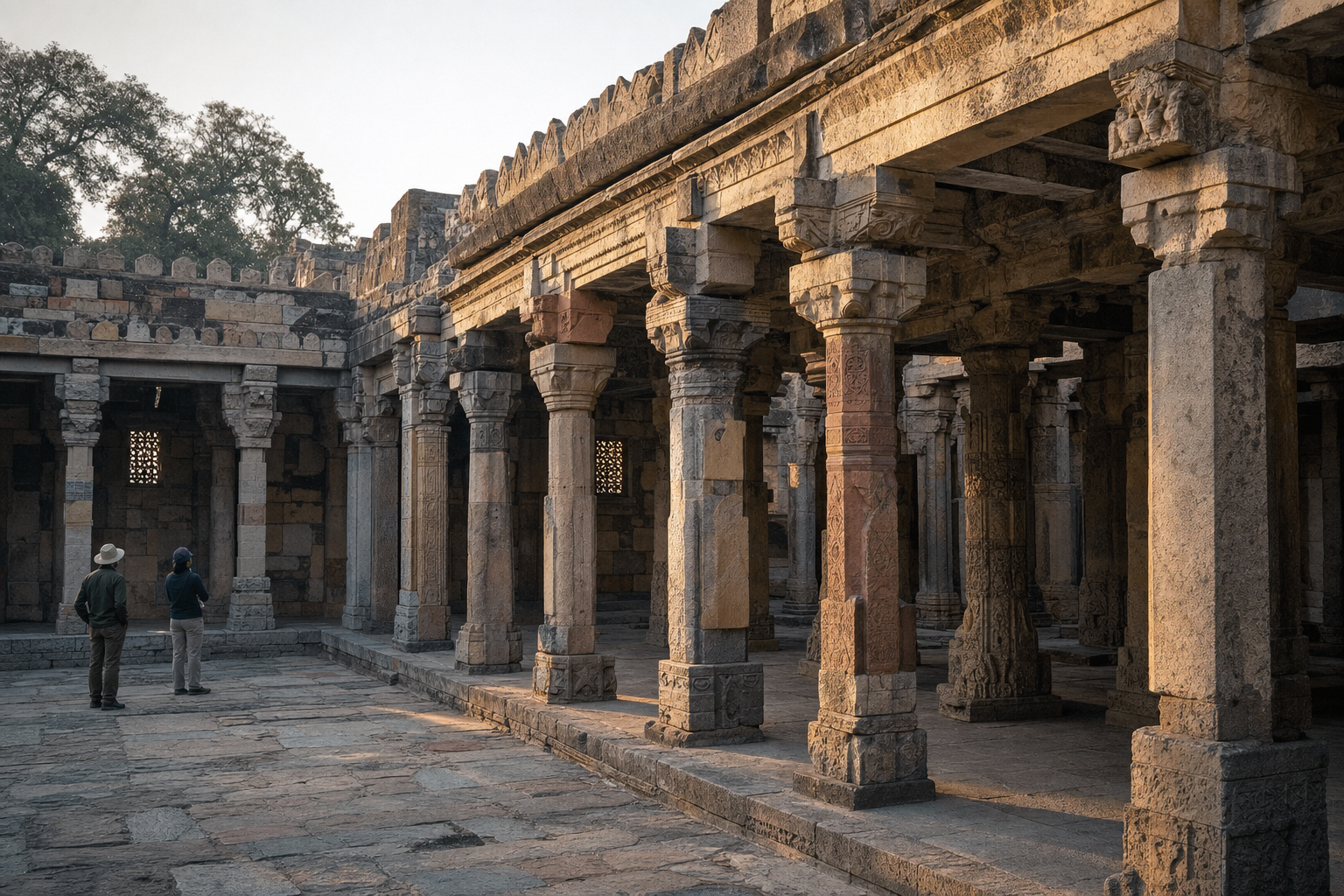
If you arrived here after hearing either that Dhar Bhojshala has been conclusively explained or that reused temple stones prove nothing, you have been offered a false choice. The archaeology supports a substantial conclusion, but it also has boundaries. You can recognize the Hindu sacred material in the complex without turning every inference into a certainty.
The central fact is clear: the Archaeological Survey of India submitted a scientific assessment to the Indore Bench of the Madhya Pradesh High Court concluding that the structure known as Kamal Maula Masjid, within the Bhojshala precinct, incorporates architectural, sculptural and inscribed material from earlier temples. To understand the importance of that conclusion, you need to know how archaeologists identify spolia, what reused stone can establish, and where responsible interpretation must stop.
Key takeaways
- Temple spolia are architectural or sculptural elements made for an earlier temple and incorporated into a later structure.
- The strongest identification does not depend on one lotus, inscription or broken image. It comes from several kinds of evidence agreeing with one another.
- Rotated, inverted, trimmed or structurally misplaced temple members are especially important because their position reveals secondary use.
- Reused temple material establishes an earlier sacred architectural phase and a later rebuilding phase. By itself, it does not settle the exact circumstances in which every stone changed hands.
- A trustworthy account separates the date of carving, the date of reuse and the history of community use.
- The right public response is to demand a complete, accessible archaeological record while protecting the fabric of the site.
What the archaeological conclusion establishes
Dhar is closely associated in regional memory with the learned court of the Paramara ruler Raja Bhoja in the 11th century CE and with the worship of Saraswati, locally remembered as Waghdevi. Memory matters, particularly at a living sacred place, but archaeology asks a narrower question: what sequence of activity is recorded in the physical fabric?
Spolia are pieces of an earlier building reused in a later one. A pillar made for a temple but installed as a support in a later mosque is spolia. So is a carved frieze cut down for use as masonry. The term describes reuse; it does not, on its own, name the motive behind that reuse.
At Bhojshala, the conclusion rests on a combination of temple-type mouldings, iconographic fragments and inscriptions associated with earlier religious endowments. That combination matters. A simple floral design may occur in more than one architectural tradition. A diagnostic temple profile, a deity fragment and an early Nagari inscription found in secondary positions form a much stronger chain of evidence.
You can think of the interpretation as a ladder. Each step must be supported before moving to the next:
- Document the object: its dimensions, material, carving, damage and present location.
- Identify its original architectural function: pillar, capital, base, frieze, image panel or another member.
- Compare its form, script and workmanship with dated examples from Paramara-era Malwa.
- Determine whether it remains in its original position or was installed secondarily.
- Reconstruct the most defensible sequence of construction and reuse.
- Only then consider the wider historical explanation.
The first four steps can often be tested directly against the stone. The final step may require stratigraphy, inscriptions, securely dated comparisons and other historical evidence. Certainty therefore narrows as an argument moves from identifying a reused temple member to describing the precise event that placed it there.
This distinction protects the significance of the evidence. The presence of earlier temple components is not made trivial merely because the exact history of every component remains incomplete. Nor does the identification of those components automatically establish the number, complete plan or precise dedication of every earlier building. Claims at either extreme ask the stones to say more or less than they actually do.
How you can recognize temple spolia
Start with position, not decoration
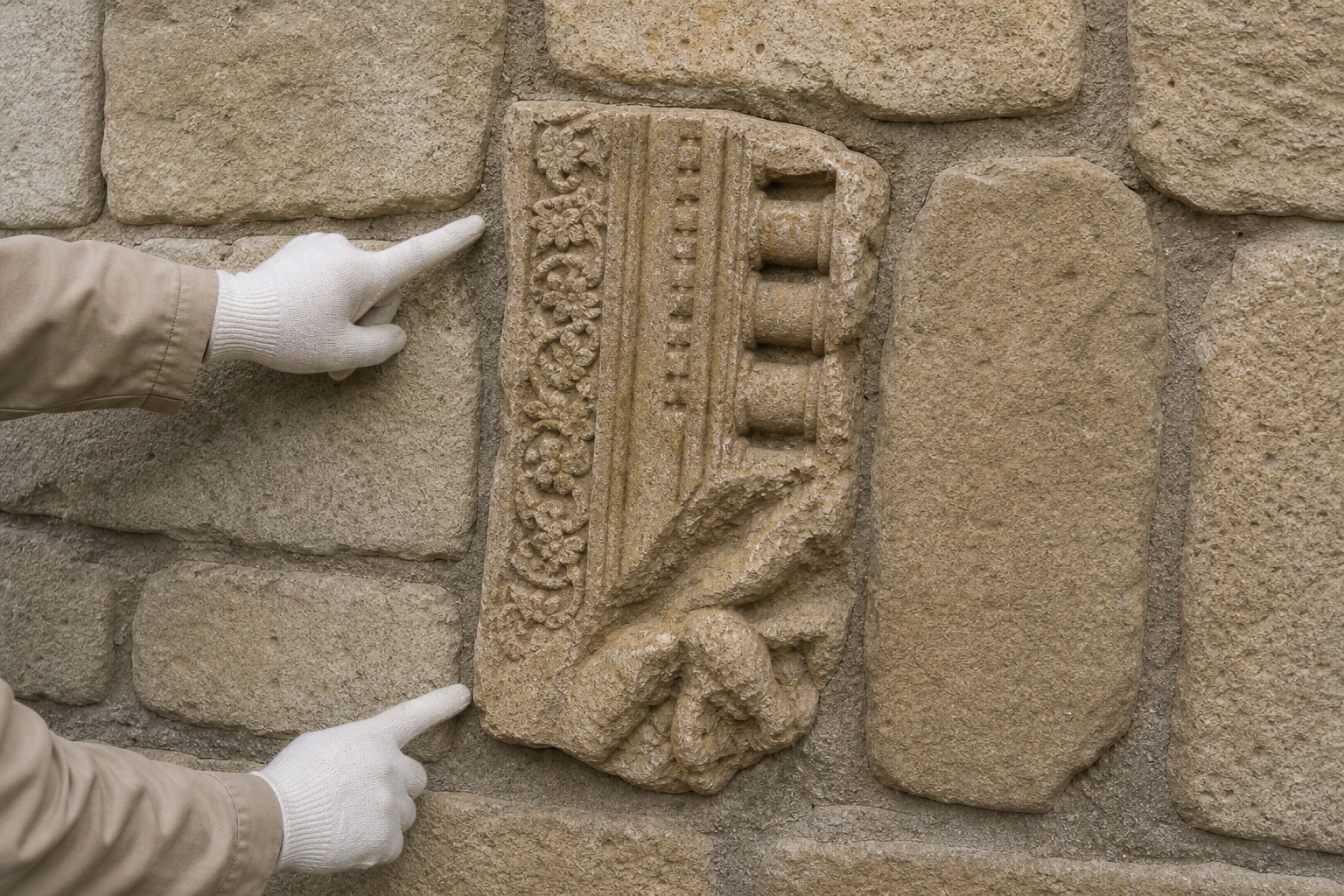
A reused member often sits in a position for which it was not designed. It may be upside down, turned sideways, partly buried, shortened, split or concealed behind later masonry. A moulding meant to run horizontally may appear vertically in a wall. A carved face may point inward, where no original designer intended it to be seen. A fragmentary sculpture may function as a filler or chock rather than as an image.
These mismatches are more informative than ornament alone. They connect the form of the stone to a building sequence: first it was carved for one purpose, then removed or displaced, and finally adapted to another.
Look for a coherent architectural vocabulary
Temple architecture in the Malwa-Paramara sphere of the 10th to 12th centuries employed recognizable combinations of profiles and motifs. These include kapota and chhajja forms, kumbha and kalasha motifs on bases, lotus-bearing or bracketed capitals, and carved bands associated with a temple’s jangha or wall zone. Remnants resembling an amalaka also belong to a specifically temple-oriented architectural vocabulary.
Do not identify a temple from one familiar-looking motif. Ask whether the member’s shape, scale and joinery make sense in a temple system. Then ask whether several comparable pieces repeat that system. Repetition reduces the chance that you are looking at an isolated decorative resemblance.
Read damaged sculpture by attributes and context
Even an incomplete relief can retain useful evidence. Floral scrolls, vyalas, kirtimukhas and portions of deity panels belong to established programs of temple decoration. Archaeologists examine surviving attributes, posture, framing, carving technique and the relationship between the image and its architectural border. A broken figure should not be named more precisely than its surviving attributes permit, but damage does not erase every trace of its original function.
The present use of a fragment is also revealing. An image panel deliberately designed for viewing but later hidden in a wall has plainly lost its first architectural role. That functional displacement is part of the archaeological evidence, not a minor detail.
Use inscriptions as dated human testimony
Inscriptions can name donors, deities, places of pilgrimage or religious gifts. Their language, formulae, spelling and letter forms can also help establish a date. Sanskrit or Prakrit wording in Nagari scripts belongs to a different epigraphic setting from later Persian-Arabic writing. When both occur in the same complex, they need not cancel one another. They may record different phases in the life of the site.
A dependable epigraphic claim should provide a sharp image or facsimile, a transcription of the visible characters, a transliteration, a translation and an explanation of the proposed date. If you see only a translation circulating online, you cannot check whether a damaged letter, missing line or uncertain reading has been presented too confidently.
Material analysis can strengthen the sequence further. Stone type, quarry characteristics, tool marks, broken joints and differences in weathering may show whether members belong together or came from separate campaigns. High-resolution photography, measured drawings, photogrammetry and laser scanning preserve details that casual photographs miss. No single technique supplies the whole history; their agreement is what makes an interpretation robust.
Keep three different chronologies separate
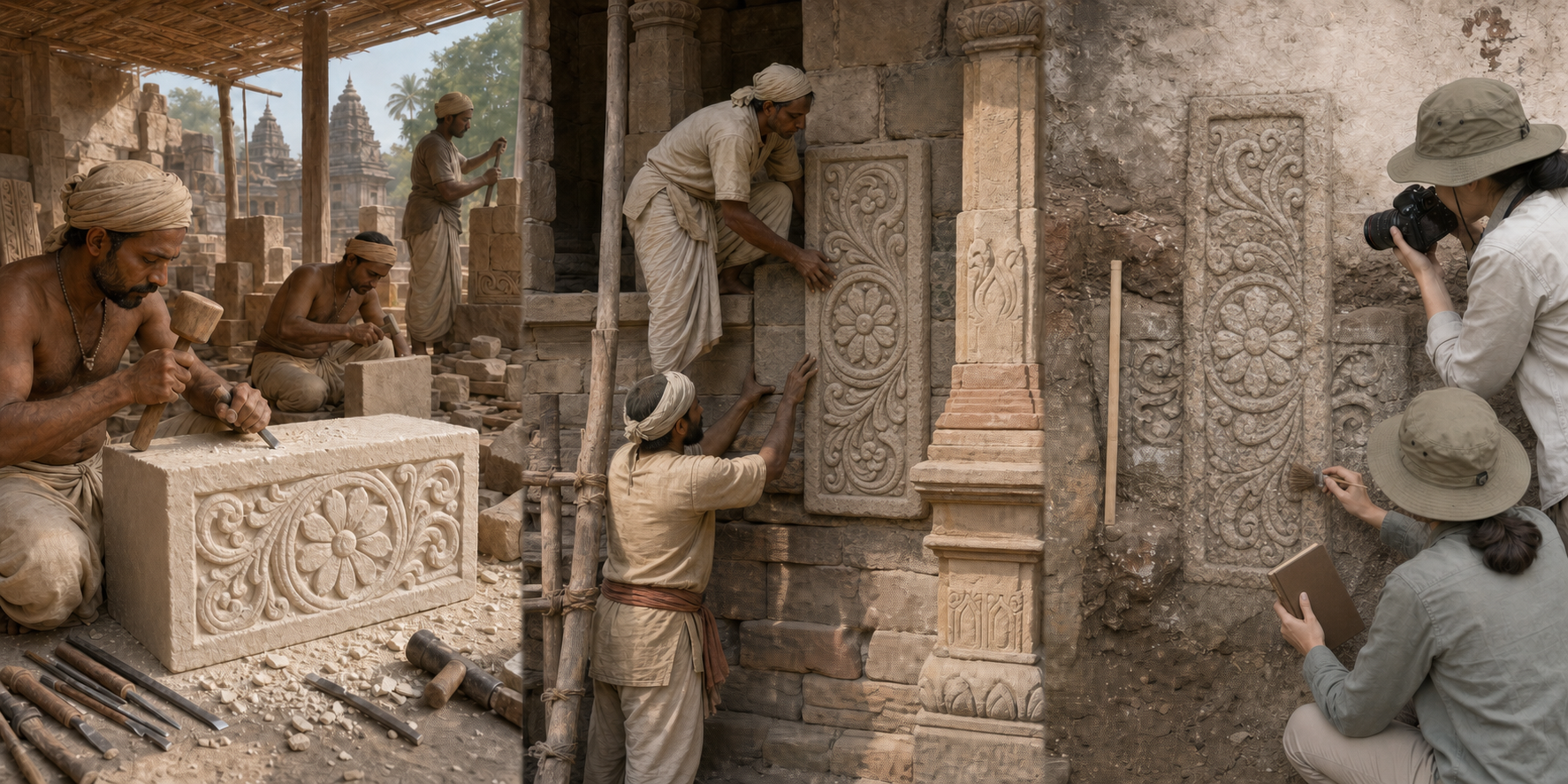
Much of the public confusion around Bhojshala comes from treating every date as if it described the same event. It does not. A reused member carries at least three possible histories.
| Chronology | The question it answers | Evidence that can answer it |
|---|---|---|
| Original construction | When and for what kind of building was the stone first carved? | Architectural type, sculptural style, script, dedicatory language, stone and tool marks |
| Reuse | When was the member removed, altered or installed in the later structure? | Secondary orientation, cut surfaces, masonry bonds, stratigraphy, associated inscriptions and construction joints |
| Community use | How have people worshipped, taught, remembered and negotiated access at the place over time? | Administrative records, documented practices, community memory and social history |
A stone can therefore belong to an earlier Paramara sacred structure, be incorporated into a building campaign associated with a later political period, and acquire further meanings through subsequent worship and public use. None of those facts erases the others.
This framework also tells you what kind of evidence to request. If someone makes a claim about the original temple, ask for architectural and epigraphic evidence. If the claim concerns the moment of reuse, ask for masonry relationships and stratigraphy. If it concerns a modern access practice, archaeological typology alone cannot answer it; you need administrative and social records.
Judicial supervision has a specific role here. The court can require evidence, transparent procedures and lawful administration. Archaeology can establish material sequences. Neither task is identical to deciding the truth of a community’s faith, and neither should be replaced by political slogans.
Context should clarify the evidence, not neutralize it
Architectural reuse occurred in many regions and periods. Builders reused stone because it was available, durable, valuable or already shaped; reuse could also operate within the political and religious economy of a new building campaign. Comparable mixed-material monuments elsewhere in India show why spolia are a recognized archaeological category.
But a general comparison cannot determine the motive at Dhar. Saying that reuse happened elsewhere does not explain who moved a particular Bhojshala member, when it was moved or under what circumstances. Context gives archaeologists questions and comparisons. It does not relieve them of proving the local sequence.
Two shortcuts should therefore be rejected. The first says that because spolia are common, the temple material at Bhojshala has no special historical meaning. That does not follow: common processes still produce specific and consequential local histories. The second says that the presence of temple fragments, by itself, resolves every disputed question about destruction, continuity, access or present legal status. That also outruns the available evidence.
A pro-Dharmic reading does not require weak standards. It should insist that the Hindu architectural and epigraphic record be named plainly, documented fully and neither hidden nor euphemized. It should also refuse unsupported embellishment, because one demonstrably careless claim can be used to cast doubt on a much stronger body of evidence.
The values associated with vidya, ahimsa, karuna and seva offer a practical discipline for this work. Vidya demands accuracy. Ahimsa rules out damage and intimidation. Karuna recognizes that living communities attach profound meaning to the same place. Seva turns concern for heritage into conservation, teaching and responsible public access.
What you should demand from the public record
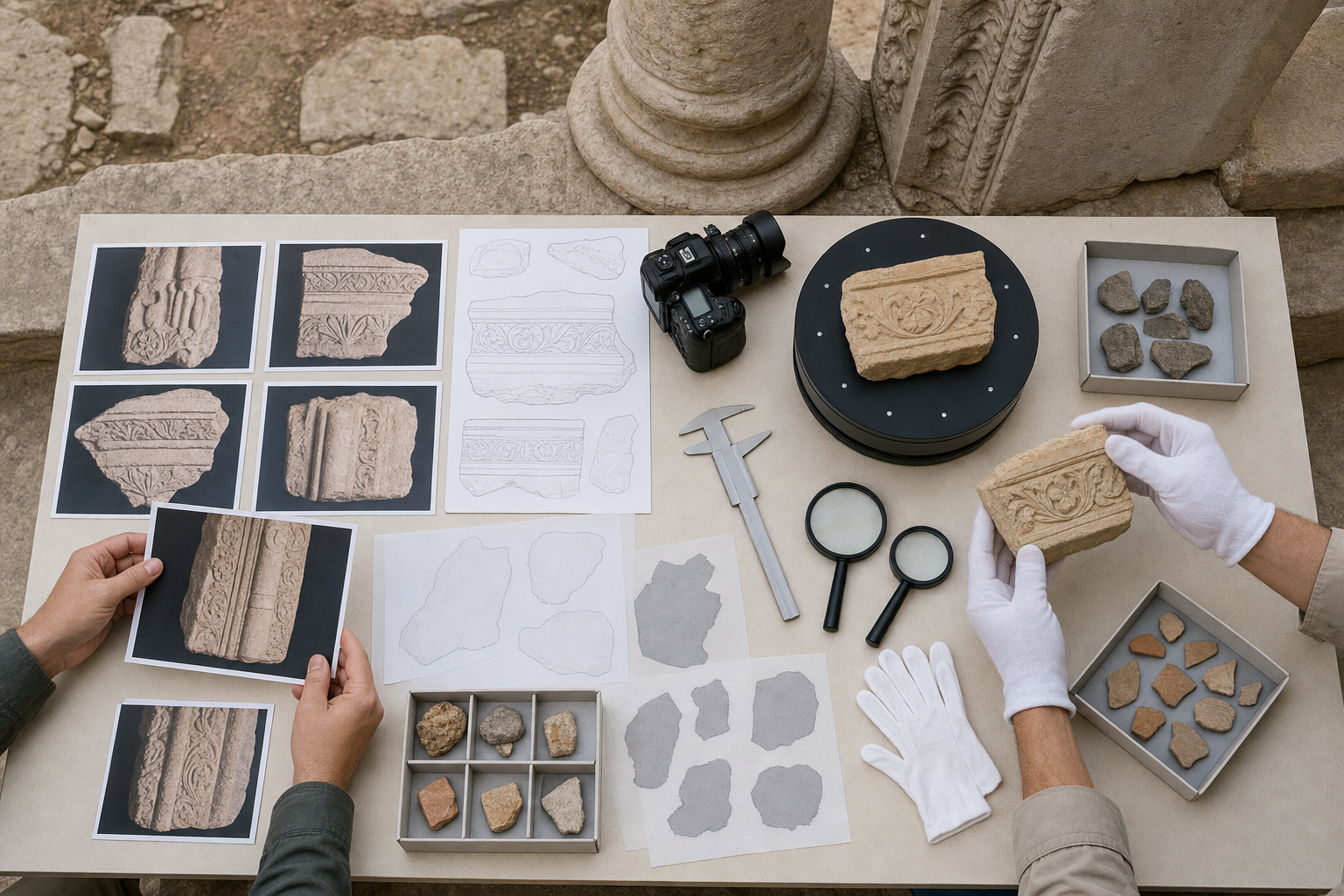
The most productive next step is not another louder claim. It is an object-level record that allows specialists and ordinary visitors to see how each conclusion was reached. For every significant member, a useful public catalogue should include:
- A unique inventory number and precise recorded location.
- Scaled photographs of every accessible face, including broken and concealed edges where documentation is possible.
- Dimensions, stone type, condition and visible tool marks.
- The member’s present orientation and the orientation proposed for its original use.
- A measured drawing showing mouldings, joints, cut surfaces and later alterations.
- The reason for identifying it as a pillar, base, capital, frieze, image panel or another architectural type.
- Comparative examples used for stylistic or chronological attribution.
- For inscriptions, a facsimile, transcription, transliteration, translation and notation of uncertain characters.
- For reconstructions, a clear distinction between directly observed features and inferred missing portions.
A digital 3D model can make orientation and tool marks easier to inspect. A GIS map of recorded find-spots can reveal whether related pieces cluster in particular parts of the complex. An on-site gallery can place drawings, inscription facsimiles and regional comparisons beside plain-language explanations. Periodic demonstrations of documentation methods would let the public see how measurements become historical conclusions.
Interpretation should also disclose uncertainty. Labels such as observed, probable, possible and unverified are more informative than a single sweeping narrative. If a deity cannot be identified because the decisive attribute is missing, say so. If a member is certainly temple-derived but its original building cannot yet be reconstructed, state both conclusions together.
When you encounter a new claim about Bhojshala, use five questions before sharing it:
- Which specific stone, inscription, layer or architectural relationship is being discussed?
- Is it in its original position or demonstrably reused?
- Which diagnostic feature supports the identification?
- How was the date assigned, and are the comparisons visible?
- Does the conclusion stay within what that evidence can establish?
Do not touch, scrape, chalk, wet or otherwise attempt to test carvings and inscriptions yourself. Such interventions can destroy surface evidence and harm a protected monument. Documentation and any physical examination belong with authorized archaeologists and conservators.
Dhar Bhojshala deserves more than a choice between denial and overstatement. The next time a claim reaches you, pause at the object: Which stone? In what position? Bearing which script or moulding? Dated by what comparison? Support the interpretation that answers those questions most completely, and support public documentation that lets others test it. That is how cultural memory becomes durable historical knowledge rather than a passing argument.
References
