
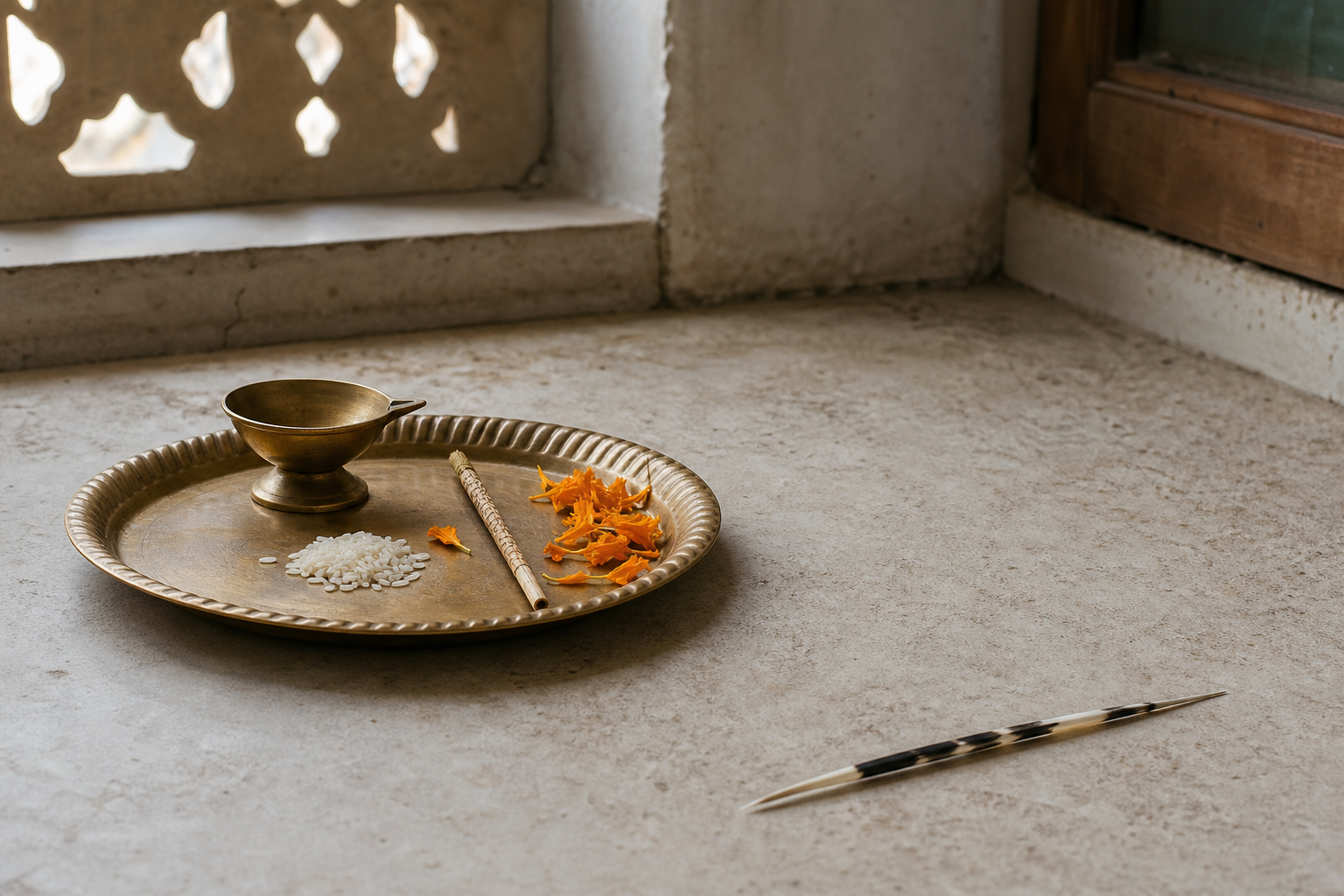
You may have found a porcupine quill among an elder’s puja objects, heard that one belongs in a samskara, or been asked to obtain one for a ceremony. Before you treat it as a sacred requirement, the central distinction is this: porcupine quills have a plausible place in some regional and domestic customs, but they are not established as a universal or indispensable Hindu ritual implement.
You can respect an inherited practice without exaggerating its authority. You can also retain its ritual meaning without buying, collecting, or touching wildlife material. The right approach is to identify the precise custom, separate evidence from interpretation, and reproduce the intended action through an ethical substitute when any doubt remains.
The first distinction is custom versus command
Samskaras sanctify thresholds in a person’s life. Their textual framework is found largely in the Grihya Sutras and Dharmashastra literature, while their performance also reflects lineage, region, household memory, and the instructions of particular ritual specialists. This combination produces real diversity. An object can belong to a valid local custom without being required of every Hindu.
Explicit instructions involving porcupine quills are scarce in the mainstream domestic-ritual corpus. That scarcity does not prove that no community ever used them. It does limit what anyone can responsibly claim. The careful formulation is, “This implement is remembered in a particular household or regional practice,” not, “Hindu scripture requires this implement.”
When someone describes a quill as traditional, separate three possible claims:
- Family custom: an identifiable household used or preserved it in connection with a named rite.
- Regional or community practice: several practitioners associate it with the same action, even if mainstream manuals are silent.
- Scriptural prescription: a named text, recension, commentary, or ritual manual actually specifies it.
These claims are not interchangeable. An inherited quill proves that an object was kept; by itself, it does not reveal when it entered the household, what it did, or whether its use was religious, decorative, medicinal, or protective. Likewise, a priest’s recollection may preserve valuable local knowledge without establishing a pan-Hindu rule.
If a quill is presented as mandatory, ask for the name of the rite, the action it performs, the textual or lineage basis, and the accepted substitute. This is not disrespect. It prevents a small custom from being inflated into doctrine and gives the ritual specialist an opportunity to explain the tradition at its proper scale.
The meaning lies in protection, precision, and restraint
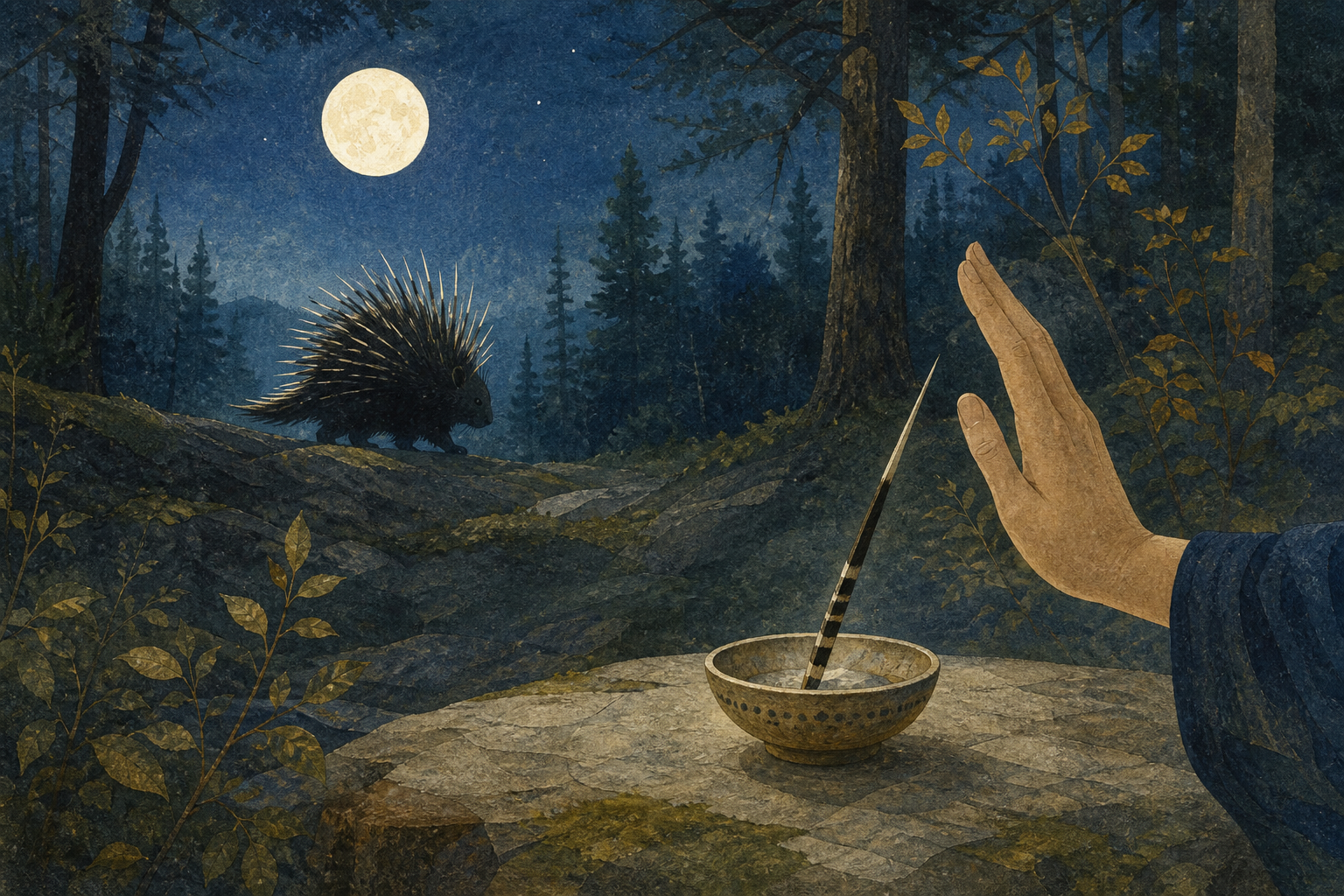
Hindu ritual objects often communicate through their physical qualities. Darbha purifies and marks sacred space; ghee nourishes the fire; metal suggests endurance. A porcupine quill can be read in the same way, but the reading should remain an interpretation rather than being presented as a forgotten universal doctrine.
Three meanings fit the object’s form especially well:
- Protection without aggression: the quill is defensive. Its symbolic force lies in guarding a boundary rather than seeking conflict. In ritual language, that can express firm protection governed by restraint.
- Discernment: a fine point evokes viveka, the ability to distinguish carefully. That is appropriate at a samskara, where a small rite marks a consequential change in duty, identity, or stage of life.
- Boundary-making: a quill can indicate a point, trace a narrow line, or mark the edge of a small design. It therefore lends itself to the symbolism of raksha: establishing a wholesome limit around a person, intention, or sacred space.
The strongest unifying idea is gentle exactness. A samskara seeks a deep change through mantra, intention, touch, and disciplined sequence, not through spectacle or force. The quill’s combination of lightness and sharp definition makes it an apt image for guidance that leaves an impression without domination.
Regional and oral recollections associate quills with functions such as pointing to a syllable during instruction, tracing a miniature sacred design on rice flour, making a very small ritual mark, or serving as a protective token. These are plausible, context-bound uses. They should not be converted into claims that every quill had the same purpose or that every samskara once required one.
The Indian crested porcupine naturally sheds quills, which are modified hairs made of keratin. Natural shedding explains how a household might once have obtained one without killing the animal. It does not prove that a particular specimen was naturally shed, ethically acquired, or legally possessed.
Test an inherited account before repeating it as history

Oral memory is most useful when it is recorded precisely. “Our ancestors used porcupine quills” is too broad to preserve much knowledge. A short interview with the elder, priest, or custodian can turn that claim into something future family members and researchers can evaluate.
- Name the rite. Ask whether the quill was associated with birth, naming, initiation, marriage, protection of a child, domestic worship, or another occasion. Do not assign it to a major samskara merely because it was stored with puja objects.
- Record the action. Was it used to point, trace, apply, sprinkle, touch, display, or store? The action often carries more meaning than the material.
- Identify the practitioner. Note who performed the action and which family, lineage, locality, or community taught it.
- Ask whether it was required. An elder may remember it as convenient, auspicious, optional, or essential. Preserve that distinction in the elder’s own terms.
- Ask what replaced it. A remembered substitution can reveal the original function. If a wooden pointer replaced the quill, instruction may have mattered more than animal material. If darbha replaced it, purification or protective touch may have been central.
- Seek corroboration at the right level. Look for a regional ritual manual, commentary, temple record, family notebook, or a second independent recollection from the same community. Silence in mainstream texts should also be noted.
- Label inference as inference. “The family used it to draw a line” is testimony. “The line represented cosmic protection” may be a later interpretation unless the practitioner actually supplied that explanation.
Photograph inscriptions, containers, labels, and the object’s position if doing so is lawful and safe. Record names, places, relationships, and the approximate period remembered by the speaker, but do not manufacture a date when no one knows it. Good cultural preservation keeps uncertainty visible.
This method protects both sides of the tradition. It prevents genuine local knowledge from being dismissed merely because it is not universal, and it prevents a striking object from attracting a grand history that the evidence cannot bear.
A real quill is usually the wrong choice for a rite today
Ahimsa changes the practical decision. A naturally shed quill may avoid direct injury to an animal, but “naturally shed” is not a reliable label when provenance cannot be verified. Demand for quills can also encourage collection and trade whose methods are opaque. A sacred intention does not make an uncertain supply chain harmless.
Legality is a separate question. Porcupines are protected wildlife in India, and collection or possession of animal parts is regulated. Rules and their application can change, so naturally shed material should never be assumed lawful merely because no animal was visibly harmed. Before possessing, transporting, gifting, buying, displaying, or using a quill, obtain current guidance from the relevant wildlife authority. A vendor’s assurance and a family’s long possession are not legal clearance.
If a quill is already in a family collection, do not sell it, move it across jurisdictions, or incorporate it into a ceremony while its status is unresolved. Ask the competent authority how an inherited specimen should be documented or handled. Do not destroy or secretly discard it in an attempt to solve the problem, because that may erase cultural information and could create another legal issue.
Physical safety also matters. A pointed quill can puncture skin. It should not be used to apply a tilaka or touch a participant, especially an infant or anyone unable to remain still. Ritual sanctity does not remove an ordinary injury risk.
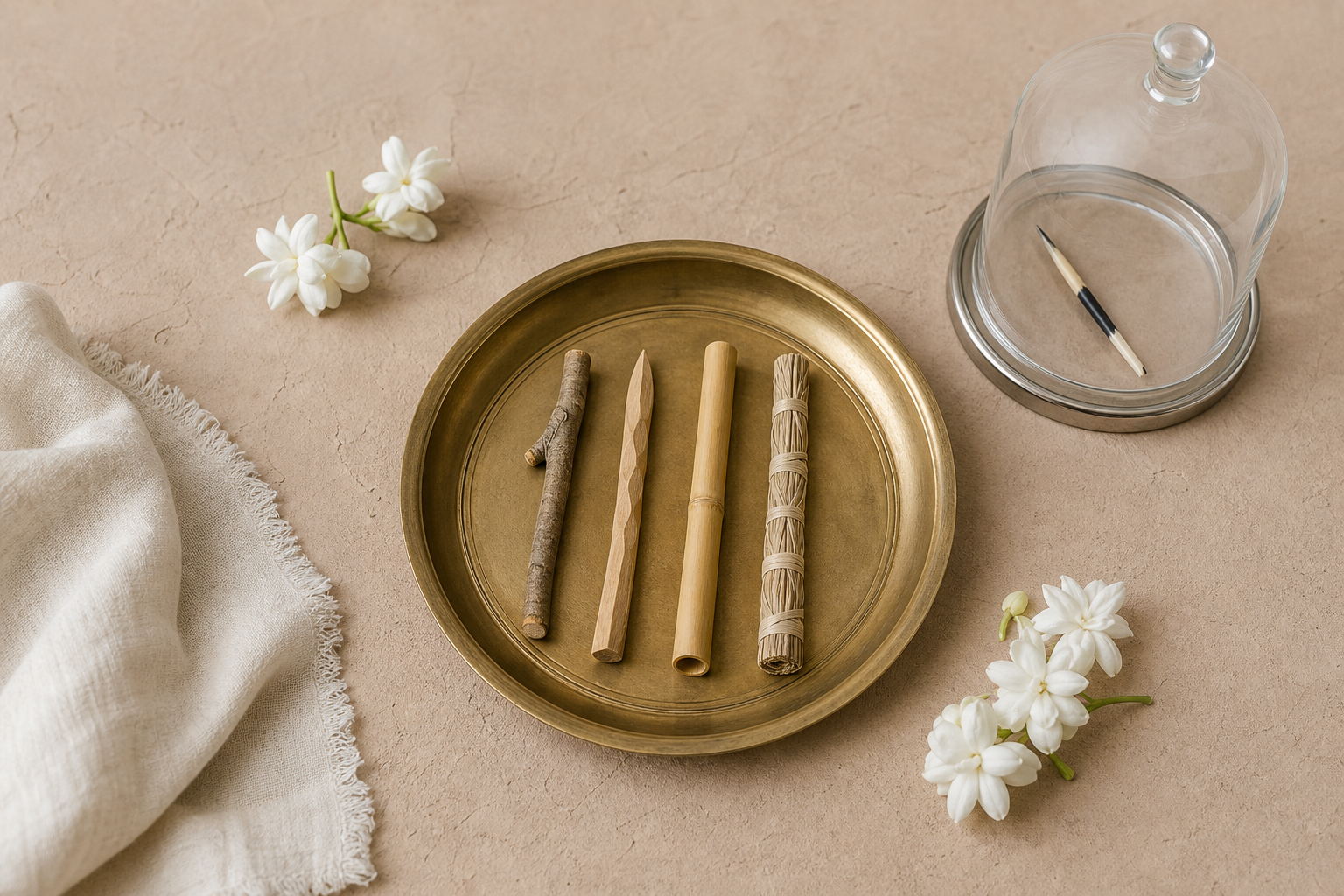
A simple decision rule avoids most problems: if provenance, legality, or safe use is uncertain, replace the material while retaining the action and intention. The best substitute depends on what the quill was meant to do:
- For pointing to a syllable or indicating a ritual step: use a slim wooden pointer with a smooth, blunt end.
- For tracing a yantra or line in rice flour: use a rounded copper stylus, a carved wooden implement, or a firm piece of darbha.
- For a small tilaka or other skin contact: use a clean, blunt applicator dedicated to the rite, not a quill.
- For sprinkling or protective touch: use a darbha bundle where that agrees with the family’s ritual instructions.
- For symbolic protection: preserve the quill’s meaning through a traced boundary, protective mantra, or non-animal representation rather than through wildlife material.
This is not a dilution of dharma. Ritual authenticity does not always require material identity. If the inherited purpose was precise marking, a precise substitute keeps that purpose. If it was protection, a lawful and non-harming implement expresses protection more coherently than an object of doubtful origin.
The inter-Dharmic ethical setting reinforces that choice. Ahimsa has an especially prominent place in Hindu, Buddhist, and Jain thought, while Sikh practice strongly emphasizes compassionate and truthful conduct. Their doctrines and ritual forms are not identical, but none gives us a sound basis for invoking sanctity through avoidable harm or dishonest acquisition. Satya includes being truthful about what we know, what we merely remember, and what we cannot establish.
Key takeaways
- Porcupine-quill use belongs, at most, to optional regional, household, or circumstantial practice; it is not established as a universal requirement of Hindu samskaras.
- The quill can symbolize restrained protection, discernment, careful boundary-making, and transformation through gentle, exact action.
- A family claim becomes useful history only when you record the named rite, exact action, practitioner, locality, lineage of transmission, and whether the object was optional.
- Natural shedding may address direct harm, but it does not prove a specimen’s origin or settle the legal question.
- Do not acquire or use a real quill when provenance, wildlife law, or physical safety is unclear.
- Choose a substitute by function: wood for pointing, rounded copper or wood for tracing, darbha for appropriate ritual touch, and a blunt dedicated applicator for marks on skin.
If you are planning a rite, ask what the implement must accomplish and choose the lawful, non-harming tool that accomplishes it. If you already hold an inherited quill, preserve the associated oral history, leave the object’s legal status to the proper wildlife authority, and resist turning a small family memory into a universal claim. That approach honors heritage, evidence, and ahimsa at the same time.
References
