
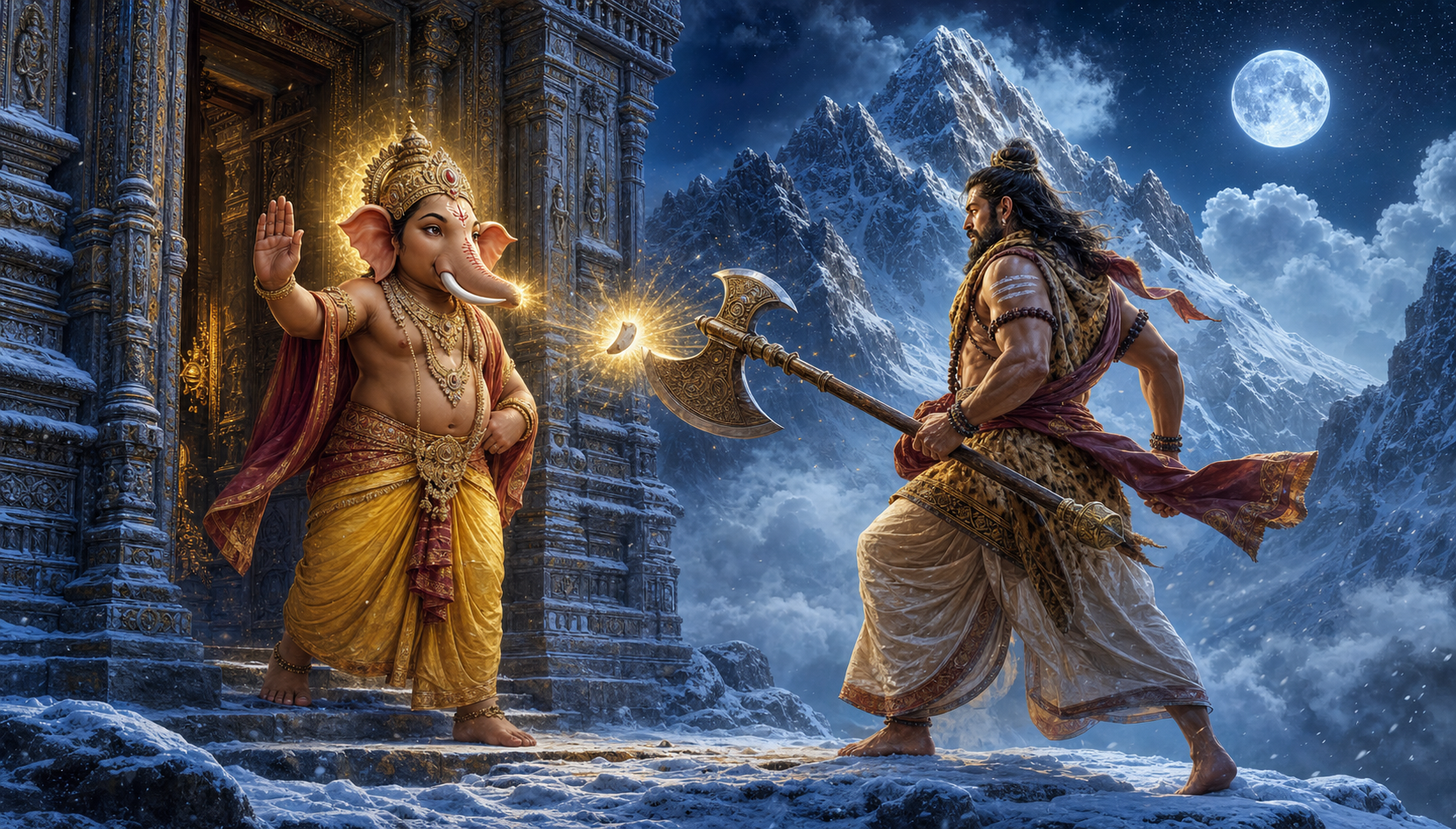
If you have looked at Ganesha’s single tusk and wondered whether Parashurama broke the other one, the short answer is yes – in one important traditional telling. But the encounter is more than an explanation of an unusual feature. It asks what happens when the force needed to confront adharma is carried into a place governed by restraint.
The order of events matters. Parashurama reaches Kailasa intending to honour Bhagavan Shiva, yet he arrives with the momentum of a warrior who has just completed a terrible campaign. Ganesha stands between that momentum and the sacred presence within. Their clash turns the broken tusk into a lesson about anger, boundaries, obedience and strength.
How Parashurama broke Ganesha’s tusk
After avenging his father’s death and punishing erring Kshatriyas, Parashurama went to Kailasa to pay homage to Shiva. There he encountered Shiva’s attendants and Ganesha, who guarded access to his father. Ganesha would not allow Parashurama to proceed immediately, while Parashurama would not accept being stopped.
The disagreement became a fight. In the familiar form of the Kailasa encounter between Parashurama and Ganesha, Parashurama used his axe. Ganesha recognised the weapon’s connection with Shiva and did not treat it as an ordinary weapon to be dishonoured. He received its force, and one of his tusks was broken.
This is the narrative behind the name Ekadanta in this telling. Eka means one, while danta means tooth or tusk: Ekadanta is the One-Tusked Lord.
You should retain one qualification when repeating the story. Hindu traditions preserve more than one explanation for Ganesha’s broken tusk. This encounter should therefore be introduced as one traditional account, not declared to be the only permissible account. Multiple kathas can illuminate different qualities of the same devata without requiring every narrative detail to be forced into one literal chronology.
The sequence of events is the moral key
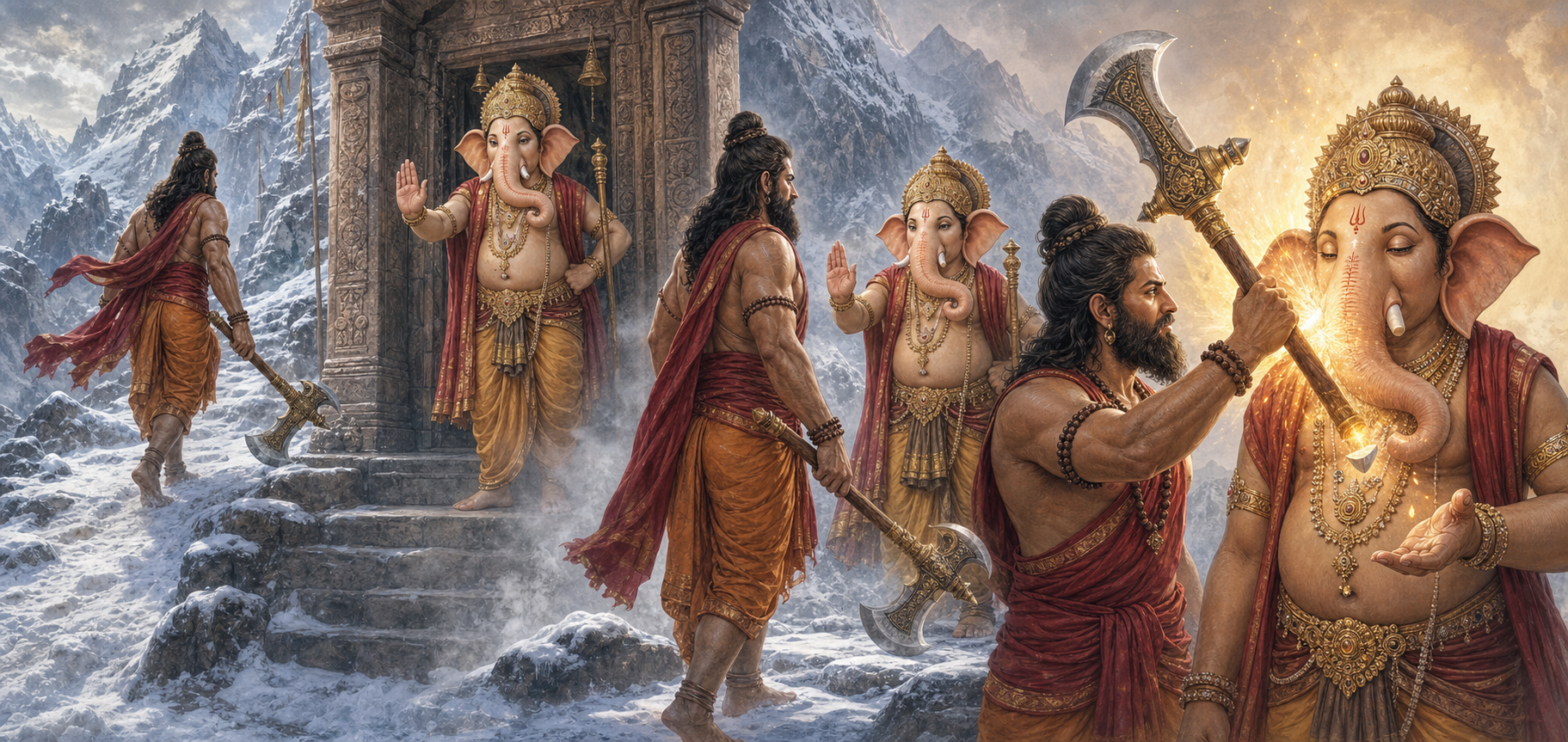
Parashurama does not go to Kailasa as an enemy of Shiva. He goes as a devotee wishing to offer respect. That makes the confrontation more instructive, not less. A worthy destination and a sincere intention do not automatically purify the state of mind in which you approach them.
Parashurama’s earlier violence had a stated object: vengeance for his father’s death and punishment of Kshatriyas who had departed from dharma. At Kailasa, however, he meets neither his father’s killers nor a hostile army. He meets a guardian performing his duty. The outer situation has changed, but the force of confrontation has not yet subsided.
That distinction gives you a practical way to read the episode. Anger may arise in response to a genuine wrong, yet remain active after its proper task has ended. Once carried into the next encounter, it can mistake delay for disrespect, a boundary for hostility, and resistance for adharma.
When you finish a serious dispute, do not assume that changing rooms has changed your inner condition. Before the next conversation, ask three exact questions: Has the original duty ended? Did the person now before me commit the wrong? Am I defending dharma, or defending the expectation that no one may stop me? Those questions preserve resolve without allowing resolve to harden into ahankara.
What Ganesha’s resistance asks you to notice
Not every obstacle is an enemy
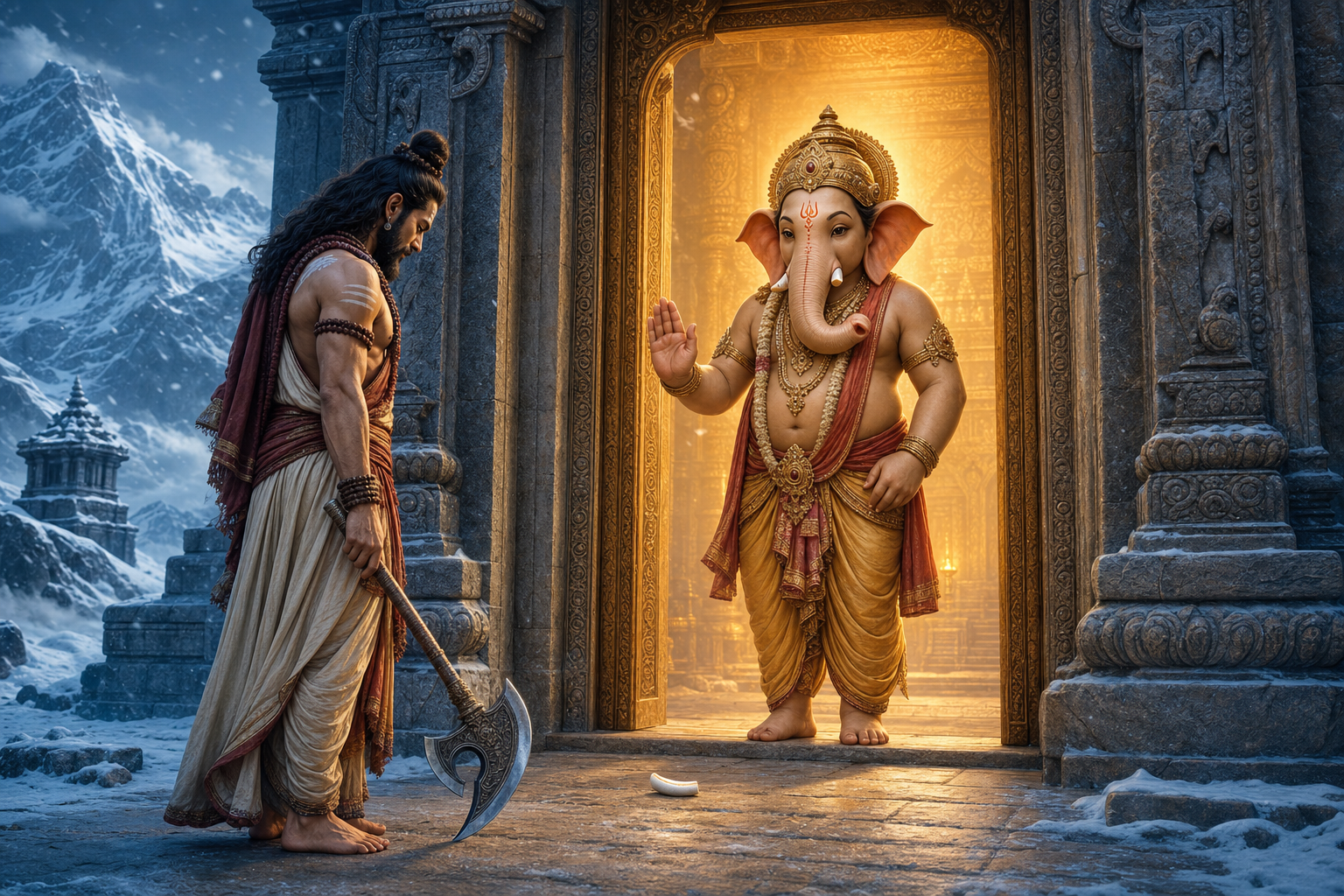
Ganesha is widely approached as the remover of obstacles, but this story places him in the role of a boundary keeper. There is no contradiction. A wise guardian removes what blocks rightful action and places a check before action that has lost its measure.
When a boundary frustrates you, examine its function before judging it. Is it protecting rest, duty, sequence, consent or sacred order? Or is it merely serving someone’s vanity? You may still challenge an unjust barrier, but first identify which kind of barrier you are facing. Parashurama’s error in the episode is not strength itself; it is treating Ganesha’s guardianship as though it were another battlefield.
Restraint is not helplessness
Ganesha’s reception of the axe should not be reduced to weakness. The weapon’s association with Shiva changes the meaning of the moment. Ganesha’s response can be read as disciplined regard for his father even amid conflict. He bears a cost without surrendering the duty that brought him into the confrontation.
This gives you a sharper definition of restraint. Restraint is not the inability to resist. It is the ability to decide that a value must not be discarded merely because the encounter has become painful. In your own conflicts, identify the principle you refuse to violate – truth, respect for a parent, protection of someone entrusted to you, or fidelity to a legitimate duty – before deciding what victory would mean.
A broken form need not be a diminished form
The lost tusk does not make Ganesha incomplete in worship. It becomes the feature by which he is named and recognised. Ekadanta does not hide the mark of conflict; the name incorporates it into the divine form.
That is why it is too shallow to tell the episode as a scoreboard on which one deity wins and another loses. The visible wound becomes an enduring sign of identity, resolve and sacred memory. When you see Ekadanta, notice that Hindu iconography does not always equate perfection with untouched symmetry.
How to retell the katha without flattening it
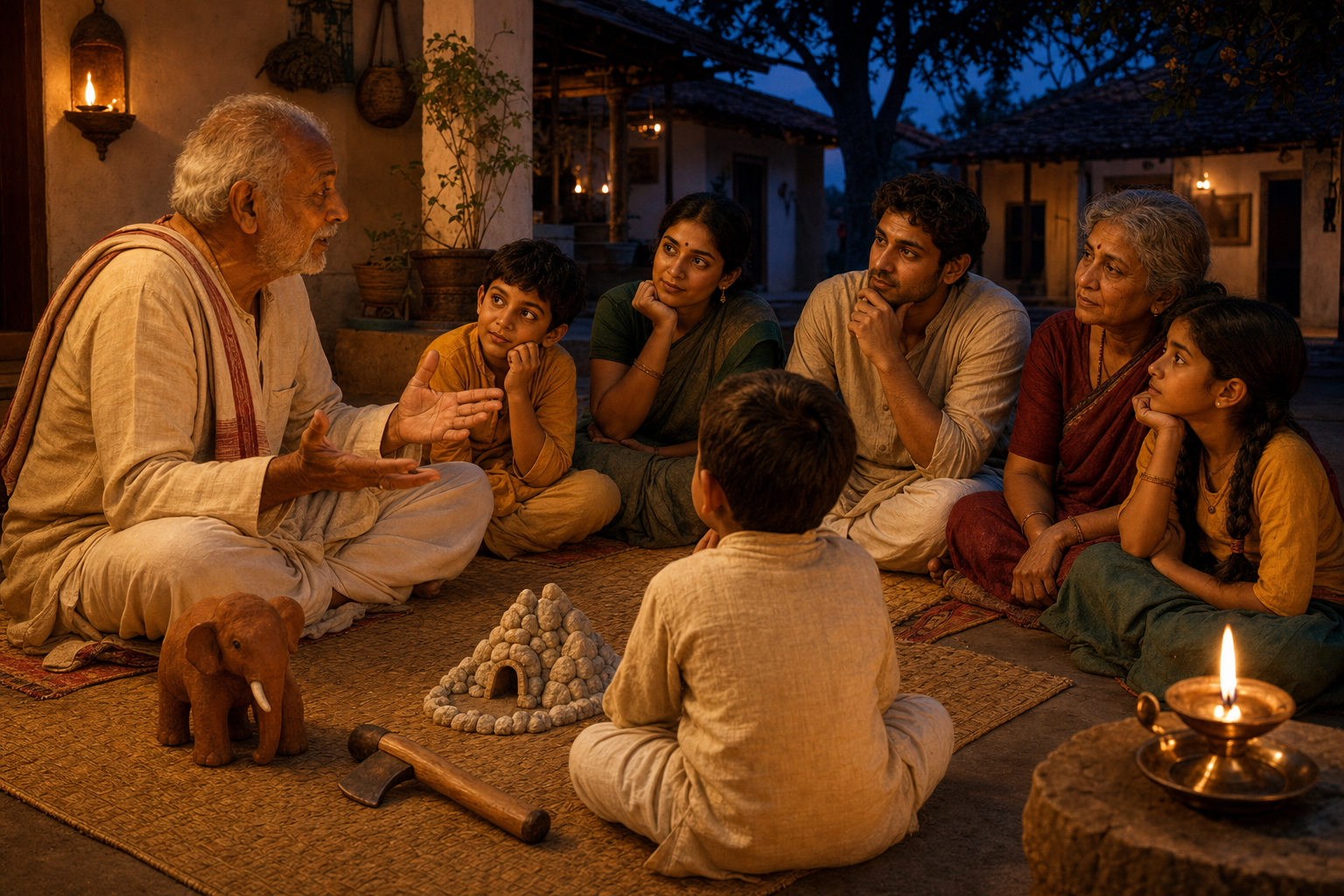
This story is often told briefly, especially to children or during Ganesha worship. Brevity is useful, but careless shortening can turn a dharmic conflict into a simple tale of two angry figures. Preserve the following distinctions:
- Identify it as one traditional telling. Say, “In one account of the broken tusk,” rather than claiming that every tradition gives the same explanation.
- Begin with Parashurama’s previous campaign. His arrival after avenging his father explains why the transition from battle to worship is morally significant.
- Keep his devotional intention. He goes to Kailasa to honour Shiva, not to attack him. The tension lies between sincere devotion and an undisciplined manner of approach.
- Keep Ganesha’s duty. He is not an arbitrary obstruction. He guards access to Shiva and does not abandon his responsibility merely because the visitor is formidable.
- Retain the axe’s relationship to Shiva. Without that hinge, Ganesha’s reception of the blow may look like defeat rather than a deliberate refusal to dishonour what is connected with his father.
- Separate narration from interpretation. First say what happens. Then introduce symbolism with phrases such as “This can be read as” or “The episode invites us to notice.” Do not present your preferred moral reading as the only fixed meaning.
- Do not turn either figure into a villain. Dharmic narratives can show conflict, excess and correction among revered beings without collapsing into a simple contest between absolute good and absolute evil.
If you are teaching the story, ask the listener where the decisive error occurs. Is it in possessing great force, approaching Kailasa, refusing a delay, misreading a guardian, or failing to calm the mind after a justified struggle? The question leads beyond plot recall and into ethical discernment.
Questions readers commonly ask about Ekadanta
Did Parashurama really break Ganesha’s tusk?
In this traditional account, yes. Their confrontation at Kailasa culminates in Parashurama’s axe breaking one of Ganesha’s tusks. It is one explanation for the form and name Ekadanta, not the only katha preserved about the tusk.
Why did Ganesha receive the blow?
The familiar telling connects Parashurama’s axe with Shiva. Ganesha’s response is therefore understood through his regard for his father, not simply through an inability to defend himself. This detail turns the moment from a crude defeat into an act marked by restraint.
Does the story condemn Parashurama?
It is more useful to read it as correction than condemnation. Parashurama’s devotion and earlier purpose remain part of the narrative, but they do not excuse every later action. Reverence for a figure does not require you to erase the episode’s warning about force that has exceeded its proper setting.
What is the central lesson for a devotee?
Power requires a boundary, and righteous action requires an inner transition when its task is complete. Ganesha’s tusk also shows that a visible loss can be carried into sacred identity without becoming spiritual diminishment.
The next time you stand before an image of Ekadanta, do not hurry past the asymmetry. Use it as a three-part check: What battle am I still carrying? What rightful boundary have I mistaken for an insult? What can I yield without abandoning dharma? That is how the katha moves from something you know into something you practise.
References
