

You are reading a translation of a Hindu text and a serpent suddenly speaks, rules a realm, guards treasure, bears the worlds, or intervenes in a royal conflict. Calling that being merely a “snake” may be grammatically convenient, but it can erase the part of the passage that matters most.
The useful distinction is contextual: uraga usually describes a serpent as a kind of creature, while Nāga usually identifies a member of a named, semi-divine order. Once you know what clues to look for, you can read scripture, temple art, and ritual practice without confusing an animal with a cosmic personality.
Key takeaways
- Uraga is usually descriptive. Traditionally understood as “one that moves on the belly,” it belongs with Sanskrit serpent words such as sarpa, ahi, bhujaṅga, and phaṇi.
- Nāga is usually an identity. Nāgas have names, families, rulers, realms, alliances, rivalries, and sacred responsibilities.
- English “snake” is not enough. Check whether the being is acting like an animal, a poetic image, a person, a ruler, or a cosmic power.
- Reverence should guide conduct. Honouring Nāgas is compatible with protecting living snakes, sacred groves, water systems, and other habitats; it is not a reason to handle or force-feed a snake.
Read the context, not just the word “snake”
The quickest working rule is that uraga generally tells you what a being physically is, while Nāga tells you who the being is. An uraga crawls or coils. A Nāga may do those things too, but the Nāga also belongs to a lineage, inhabits a recognised realm, exercises agency, and may hold an office within the cosmic order.
This is a reading rule, not a mechanical search-and-replace instruction. Sanskrit serpent vocabulary is flexible, especially in poetry. A writer may select a word for metre, sound, imagery, or emphasis. You therefore need to test the whole scene before deciding whether “snake,” “serpent,” “Nāga,” or “serpent being” best preserves the meaning.
| Question to ask | Uraga is more likely | Nāga is more likely |
|---|---|---|
| What work is the word doing? | Describing shape, movement, danger, or a natural serpent | Identifying a class, community, ruler, or sacred personality |
| What kind of being appears? | An animal or a serpent used in poetic comparison | A semi-divine being with intelligence, status, and relationships |
| What does the being do? | Crawls, coils, bites, or appears in a description | Speaks, negotiates, rules, protects, opposes, marries, or performs a cosmic function |
| How is the being represented? | Usually as a naturalistic serpent | Often with a human torso, serpent body, multiple hoods, attendants, or royal signs |
The surrounding vocabulary can settle an ambiguous case. Words such as nāga-rāja, “Nāga king”; nāga-kula, “Nāga lineage”; and nāga-loka, “Nāga realm,” announce a social and theological identity. A personal name such as Śeṣa, Vāsuki, Takṣaka, or Karkoṭaka is an even stronger signal. Uraga does not ordinarily supply that kind of court, genealogy, or office.
The historical pattern also helps. Early Vedic language more prominently uses ahi and sarpa, including ahi in the name Ahi Vṛtra. The full social and cosmological profile of the Nāgas becomes especially visible in the epics and Purāṇas. Uraga remains available as a poetic or general term for a serpent. This does not create a rigid boundary between historical periods; it tells you where each term does its most characteristic work.
If you are taking notes, teaching, or translating, preserve “Nāga” whenever kingship, lineage, worship, or supernatural agency is relevant. Use “snake” or “serpent” when the passage is plainly zoological or descriptive. If the evidence is incomplete, “serpent being” is more honest than prematurely reducing a personified figure to an animal.
When the serpent is a person, the moral stakes change
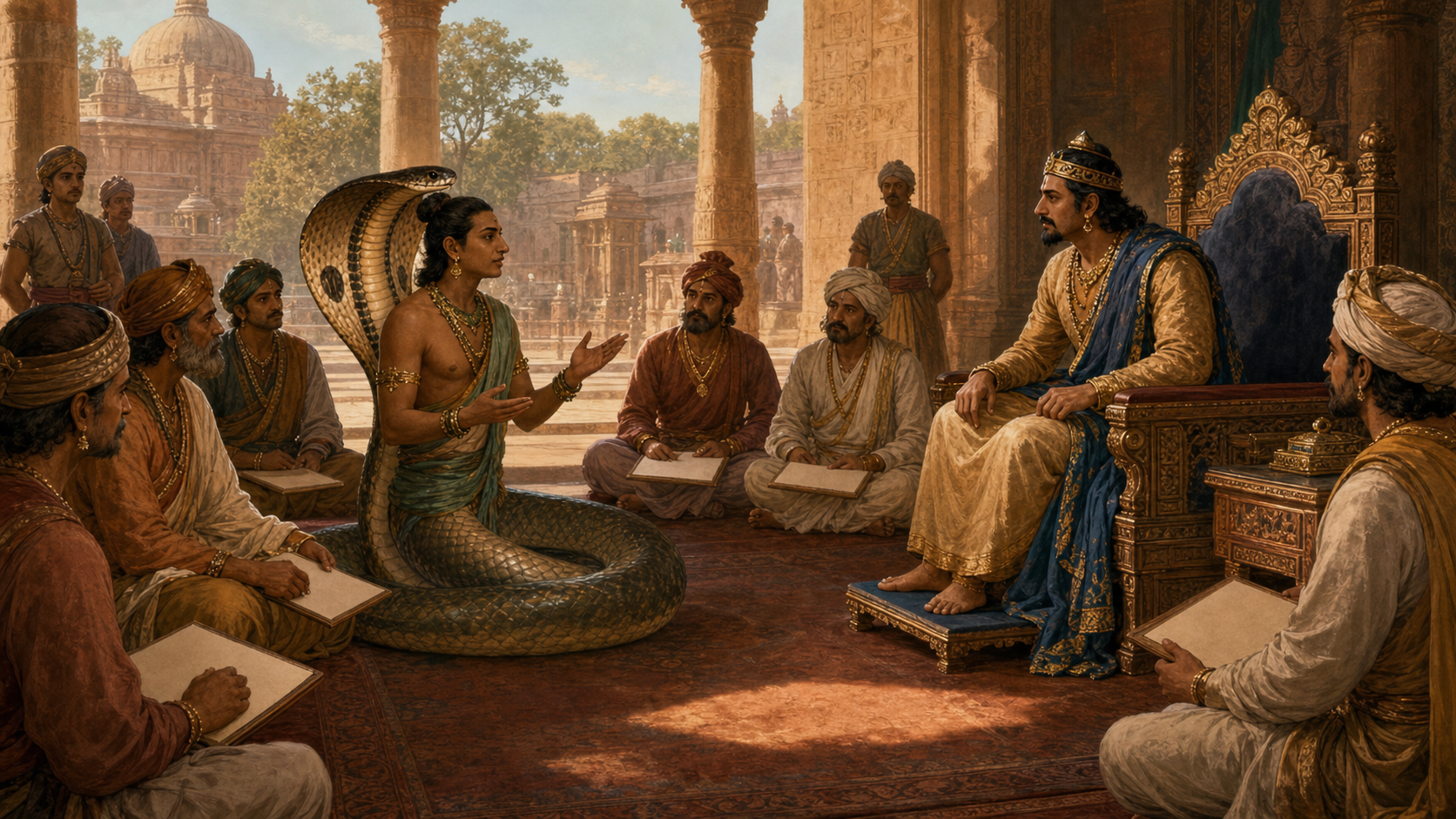
The Mahābhārata treats Nāgas as moral agents
The Mahābhārata does not use Nāgas merely to make its landscape mysterious. They participate in kinship, conflict, retaliation, diplomacy, and restraint. That difference is decisive when you read the sarpa-satra of King Janamejaya. Translating the episode only as a “snake sacrifice” can make it sound like an unusually large animal-control rite. The narrative instead concerns a royal campaign directed against a community of Nāgas amid the enmity involving Takṣaka.
Āstīka’s intervention gives the episode its dharmic turn. He interrupts a widening cycle of vengeance and prevents retaliatory destruction from becoming total. You do not need to make every Nāga innocent or every human wicked to see the lesson. The narrative asks whether inherited injury authorises indiscriminate punishment, and it answers through restraint, mediation, and the recovery of right relationship.
The burning of the Khāṇḍava forest likewise places serpent beings within a contested world of habitat, power, and political consequence. Read these episodes with the same moral attention you would give conflicts involving human peoples. Nāgas can protect or threaten, honour obligations or pursue enmity. Their capacity for mixed motives is part of their personhood, not a reason to collapse them into either demons or decorative nature spirits.
The Purāṇas give Nāgas cosmic offices
Purāṇic cosmology makes the distinction still clearer. Nāgas are frequently traced to Kaśyapa and Kadru and are associated with Pātāla, particularly Nāga-loka. Named figures include Śeṣa or Ananta, Vāsuki, Takṣaka, Karkoṭaka, Padma, and Mahāpadma. These are not interchangeable specimens of a species. Their names identify personalities with different roles and narrative histories.
Śeṣa bears the worlds and becomes Viṣṇu’s couch in the Ananta-śayana image. Vāsuki serves as the churning rope during Samudra Manthana. The first image expresses stability, continuity, and infinitude; the second places a Nāga inside a cosmic undertaking where danger and possibility emerge together. Neither scene makes sense as a claim about the ordinary behaviour of reptiles.
This gives you a practical interpretive test: ask whether the serpent’s body is its whole meaning or the visible form through which a larger agency acts. With an uraga, the body and its motion are usually central. With a Nāga, the serpentine form carries sovereignty, potency, protection, danger, fertility, water, or cosmic balance.
Let iconography and worship confirm the reading

A multi-hooded figure with an anthropomorphic torso is rarely just a realistic snake. The hoods operate almost like a canopy or crown, while human features communicate consciousness and relational presence. Nāgas and Nāgī-kanyās appear as regal guardians of thresholds, waters, treasures, and sacred places. Uraga has no comparable, fixed iconographic programme; a purely naturalistic serpent may simply be a serpent, although its exact identity still depends on context.
When you stand before a serpent image in a temple or sacred grove, look for four visual signals: multiple hoods, a human-serpent form, royal or devotional attendants, and placement near water, a threshold, a tree, or a protected sacred space. One sign alone may not decide the matter. Several together strongly favour a Nāga identity.
Regional practice adds another layer. Nāga Panchami, Kerala’s sarpa-kāvu, Karnataka’s Nāgabānas, and the worship of Manasā in eastern India connect Nāga reverence with fertility, rainfall, water, agrarian life, and protection. These practices are not directed toward an abstract dictionary synonym. They address sacred powers understood through local forms, inherited obligations, and particular places.
The ecological implication is concrete. A serpent grove that preserves trees, anthills, soil, and water can become a small refuge for many forms of life. The religious boundary around the place limits casual clearing and disturbance. In that setting, devotion protects habitat not through a modern slogan but through disciplined restraint.
Apply the same restraint to living snakes. Keep milk offerings symbolic and associated with the shrine or image according to local custom; do not capture, handle, or force-feed a live snake. If one enters a home or gathering place, keep people and animals at a safe distance and contact a trained local wildlife rescuer. Reverence is shown by protecting both the snake and the community, not by manufacturing a close encounter.
Serpent symbolism can then be contemplated without confusing symbol and animal. The shedding of skin can suggest renewal. Coiled power can evoke kuṇḍalinī-śakti. Ananta can direct the mind toward continuity beyond ordinary measurement. Venom can signify a destructive potency that must be contained or transformed. These associations illuminate practice when they arise from the particular image or narrative; they should not be imposed on every passing reference to an uraga.
See the shared Dharmic symbol without erasing differences
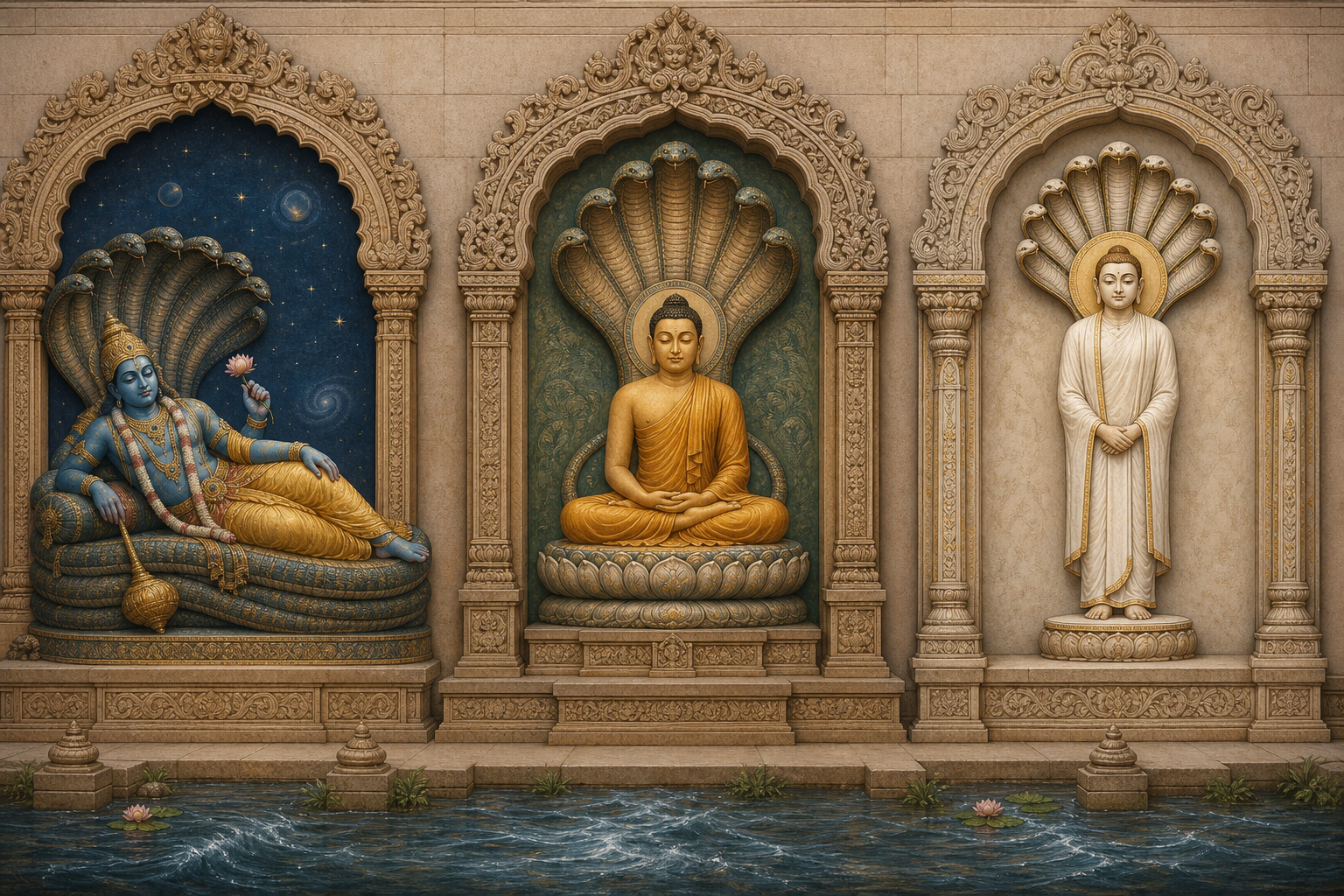
The protective serpent canopy travels across Dharmic traditions because it communicates shelter, vigilance, fearlessness, and nature’s recognition of spiritual power. In Buddhism, the Nāga king Mucalinda shelters the Buddha. In Jain iconography, Dharanendra spreads his hoods above Pārśvanātha during an ordeal. Sikh lore remembers a cobra shading the young Guru Nānak as he slept in a field. Hindu traditions place Śeṣa, Vāsuki, and other Nāgas within their own cosmic, devotional, and ethical settings.
You can recognise a shared Dharmic vocabulary of serpent guardianship without claiming that every tradition teaches the same theology. The visual pattern is continuous; its doctrinal work changes with the person being sheltered, the community preserving the account, and the spiritual truth the scene is meant to honour.
The same visual language moved beyond Bharat. Nāga balustrades on Khmer causeways and serpent guardians at Lao and Thai temples show how an Indic symbol could enter new artistic and religious landscapes while remaining recognisable. What travelled was not merely the image of a snake. It was a grammar of sacred protection, royal presence, water, fertility, and access to consecrated space.
One distinction must remain firm: scriptural Nāgas are not the contemporary Naga peoples of Northeast India. A shared English spelling does not establish a common historical identity. The latter are human societies with their own cultures and histories; they should not be turned into an extension of Sanskrit cosmology.
The next time a translation gives you only “snake,” pause before moving on. Check the name, lineage, speech, role, realm, and visual form. Keep Nāga when the identity carries the meaning; use serpent when the language is descriptive. That small act of attention preserves both the precision of Sanskrit and the moral depth of the Dharmic world you are reading.
References
